« February 2005 | Main | April 2005 »
March 31, 2005
Jets victory predicted for Hudson Yards vote today
Here's this morning's local coverage on today's MTA board vote that is expected to go the Jets' way.
 The NY Times, Opinion, Hold That West Side Decision
The NY Times, M.T.A. Expected to Approve Jets' $720 Million Plan for Stadium
NY Daily News, Mike Lupica, Story of West Side:
They bilked this city
NY Daily News, Cablevision 'Hail Mary'
NY Daily News, Pro-stadium union boss guilty of mob link
NY Post, JETS LAND STADIUM DEAL
NY Newsday, Jets expected to win bid
NY Newsday, AP, Stadium supporters rally
If the Metropolitan Transportation Authority awards the 13-acre property known as the Hudson Railyards to the Jets today, one of the most shameful political processes in the history of this city will have played out, at least for now, to its logical conclusion. -- Mike Lupica
NoLandGrab: Lupica understands that the MTA's Atlantic Railyards deal with Ratner will likely be more "shameful" than today's charade.
Posted by lumi at 6:39 AM
March 30, 2005
For M.T.A., the Search for Savings Has a Price
The NY Times:
The Metropolitan Transportation Authority is spending money to save money. Buried amid hundreds of documents distributed yesterday during a series of meetings was an unusual contract: a three-month, $832,283 award to a consulting firm to help the authority become more efficient.
In other words, to help it spend less money
Posted by lumi at 11:54 PM
Developers are lusting after us
Emdo Speak Out, 3/27/05: A new feature on Eminent Domain Watch where readers can submit their stories and opinions about eminent domain abuse.
Kathy Scruggs, Boyton Beach, FL:
...every day, all over the US, the government is allowing lands and private property to be taken, not for some true "public purpose," but to raise more tax dollars, so that wages and benefits of those who work with or for the various government agencies can grow and assure them of future health care and retirement benefits that few of us in private enterprise can ever hope for. Meanwhile our seniors and minorities are thrown away like so much debris because our homes are "undervalued". Where do these people go? Our city commissioner recently suggested building 'affordable' housing on an old city dump for goodness sake!
Posted by lumi at 7:34 AM
Dems Dis Mayor Giff, Applaud PA Siegel
Brooklyn Downtown Star
Central Brooklyn Independent Democrats invited Gifford Miller and Normal Siegel to woo members for the club's endorsementn during their March 17 meeting.
But when [Miller] was questioned about his feelings toward the Brooklyn arena proposal, he said he "can't make a final decision" until he gets the details, which he claimed are not available yet, although several audience members wearing "Develop Don't Destroy Brooklyn" shirts seemed to have plenty.
Posted by lumi at 7:27 AM
After Drop, He Posts a Net Gain
LA Times
Fan favorite Carter, who reached superstar status before stumbling with Toronto, resurrects his career and reputation with New Jersey.
Posted by lumi at 7:09 AM
March 29, 2005
Ratner push polling Brooklynites, focus group testing Manhattanites
Recent news of Ratner using push polls to sway the opinions of Brooklynites who live near the Atlantic Railyards stands in stark contrast to the focus group testing Ratner and Gehry are planning for Manhattanites. Curbed.com got a hold of the email solicitation for workshop participants (commonly known as focus group testers).
Posted by lumi at 9:21 PM
WNYC's Brian Lehrer interview with Councilmember Yassky
WNYC, The Brian Lehrer Show
On March 16 Brian Lehrer interviewed Councilmember David Yassky his New York 51 series.

Lehrer: Your district in Brooklyn is not exactly where the Nets stadium and that whole development would be. Do you think that people in your district have a predominant view on that proposed stadium or the West Side stadium?
Yassky: I think on the Nets arena, most folks in my district would like to see professional basketball come to Brooklyn. They think that would help with the continued resurgence of Brooklyn. They would not like to see, nor would I, 70-story office towers and apartment buildings go along with the arena.
L: That’s really what’s controversial?
Y: That’s the controversial part. On the West Side stadium, I think most folks share my view that that is not a good use of a billion taxpayer dollars. Although, you know, let me be clear about this, I think if we get the Olympics, then we should live up to our bid and we should build the stadium and I hope we do get the Olympics because it would infuse some $3 billion into New York City to refurbish our waterfront that we have just let go to waste. We want to do our very best to get the Olympics to come here. If not, let’s not waste money on a stadium.
NoLandGrab: 70 stories? Yassky is woefully ignorant of the plan that will directly impact his constituents. Earlier in the interview he cited "noise" as the #1 constituent complaint to his office. If the arena is built at that intersection, he can expect more of the same as traffic from Downtown Brooklyn spills into residential streets. It's promising that he doesn't think that the stadium is a good use of a billion taxpayer dollars, because that's what the Ratner proposal's final tab is likely to be.
Posted by lumi at 2:58 PM
Founders had individual real estate rights in mind
 Part 1: Government action created modern-day homeownership frenzy
Inman Real Estate News
The history of individuals' right to own private property has its roots in Locke and our Founding Fathers.
...it remains to be seen whether the Supreme Court will share the founding fathers' conservative views on the preservation individual private-property rights.
Posted by lumi at 8:31 AM
KeySpan Renews 335,000 at 1 Metrotech Center
GlobeSt.com

Anchor tenant KeySpan Corp. has renewed its 335,000-sf lease at One MetroTech Center here for 20 years. No financial information was released, but space in the site is advertised for $29 per sf.
Posted by lumi at 7:27 AM
March 28, 2005
LAWMAKERS WANT MTA TO REJECT RAIL YARD OFFERS
Weiner: It’s Like ‘Peeling an Onion’
The NY Sun
With only four days remaining until the Metropolitan Transportation Authority picks a developer to transform the Hudson rail yards on Manhattan’s West Side, a chorus of elected officials is calling for the agency to put the brakes on making a final decision.
...the New York Post reported that Newmark & Company, a real-estate firm that is acting as a consultant for the MTA on this project, has been urging the MTA to reject the existing bids because it could get $300 million more than what the Jets and Cablevision have offered (See, "'LOW' BLOW TO BIDS," NY Post, March 27, 2005). The dollar-per-square-foot value of the development rights is being vastly undervalued, a source told the paper.
NoLandGrab: Many of the same lawmakers who are calling for a "do over" in the Hudson Yards bidding process have remained silent on the Atlantic Yards deal. Read this article so that these politicians can be held to account for their positions.
Posted by lumi at 11:39 PM
SCARY GEHRY: The Gehry Effect
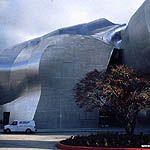
You've all heard of the "Gehry Effect" which is said to be drawing new life into Bilbao with a Frank Gehry designed Guggenheim museum. What of the Gehry effect with Seattle's Experience Music Project?
Well, the project is collapsing in on itself, but the hideous building remains. What to do with your hideous piece of steel once it fails to reach it's potential?
While he said the exterior is inviting, inside EMP is too quiet, too empty and difficult to navigate."I think if you walked in there for the first time, you'd be at a loss as to where to go," said Bream. "I didn't even know where the Hendrix exhibit was, and wouldn't that be their crown jewel?"
If EMP shuts down (which would be sad), what would you like to see happen to the big chunk o’ color that has become part of our city’s landscape?
A complex of nightclubs? The coolest food court ever?
EMP officials make it sound as though the layoffs, budget cuts and shrinking attendance were all part of its plan.
Perhaps we should call it the Skehry effect...
Posted by amy at 10:10 PM
AIRING THIS MORNING: BCAT's Reporter Roundtable
BCAT's Reporter Roundtable hosted Marie Louis (of BUILD), Scott Turner (of Fans for Fair Play and Develop Don't Destroy), and Brooklyn Rail's Brian Carreira for a discussion that will first air this Saturday, March 26th at 9pm. Here is the full schedule:

| Day | Time | Time Warner/ Cablevision |
| Monday | 10:30am | 56/69 |
| Wednesday | 10:30am/6:30pm* | 56/69 |
| Thursday | 12:00pm/8:00pm | 56/69 |
*(also seen on Manhattan Neighborhood Network - TW ch. 34, RCN ch. 109)
Posted by lumi at 9:43 PM
FORUM- The Abuse of Eminent Domain: Enriching the Coffers of Private Developers & Institutions
An analysis of three developments & their impact on neighborhoods: Columbia University's Manhattanville Expansion, the proposed Manhattan Westside Stadium, & Brooklyn Atlantic Yards.
Wednesday, March 30, 6:30 PM
Harlem State Office Building, Room 8A & B
163 West 125th Street @ Adam Clayton Powell Blvd.
Guest Speakers :
* City Councilwoman Letita James
* Bonnie Brower, Executive Director, City Project
* Patti Hagan, Develop Don't Destory Brooklyn
* Cynthia Doty, Coalition to Preserve Community
(others TBA)
Sponsored by the Harlem Tenants Council. For additional information contact the Harlem Tenants Council (Tel: 212-234-5005 or E-mail: harlemtenants@aol.com).
* Photo ID is required for entrance into the Harlem State Office building.
Posted by lumi at 8:36 AM
Lawyer's belief in civil rights leads him to defend detainees
 The Cleveland Plain Dealer: Read about Michael Ratner, hero of the left, champion of constitutional rights, brother of Bruce, and part owner of the NJ Nets.
NoLandGrab: Normally, scrutiny of family members of well-connected developers would be off limits, but not when this family member, a champion of civil rights, doubles as a shrewd businessman whose investment in the NJ Nets has led to a money-losing arena proposal which seeks to use eminent domain, not for public use, but for a private developer's gain. Read previous entry on Michael Ratner.
Posted by lumi at 8:03 AM
States seek to curb governmental abuse of eminent domain
Court watchers feel that the US Supreme Court will not reverse the trend of local governments using eminent domain as a tool for re-development.
Whittier Daily News (CA), Cities' eminent domain rights face test
While interested parties wait for the US Supreme Court to rule in Kelo v. New London, some state legislatures are already moving to protect property owners from governmental abuse of eminent domain.
Las Vegas Sun, New Nevada bill would limit eminent domain proceedings
The Birmingham News, In defense of property rights
Posted by lumi at 7:42 AM
March 27, 2005
Triple Play for New York Teams
How the Nets deal should go according to The NY Times:
A mixed-use development like this could be a shot in the arm for the local economy. The low- and moderate-income housing units would be a big plus, and the developer has agreed to pay fair market value for the railyards at the site. But the city and state are each supposed to contribute $100 million to build streets and sidewalks and prepare the site for development. That's unnecessary: Mr. Ratner should pay his own way. He should also make more of an effort to work with the community.
Posted by at 7:19 PM
Group: Rail yard evaluation has stadium ties
NY Newsday: Conflict of interest still surrounds the MTA bidding process for the Hudson Railyards. Newmark & Co., the NY real estate firm contracted by the MTA to analyse the Hudson Railyard bids, "gave at least $100,000 to NYC2012, the organizing committee seeking the 2012 Summer Games in the city."
Posted by lumi at 8:51 AM
Ridge Hill seeks to win over critics
The Journal News: Forest City Ratner blames the 2003 contentious mayoral race for not reaching out to the community. Local resident association president John Larkin cites Ratner's poor community track record in Brooklyn as reason to be skeptical of FCR's real motives.
"Maybe they're trying to paint a different picture of themselves," Larkin said, reached after the company's meeting with the editorial board. "They're beginning to feel all of the community pressure."
Posted by lumi at 7:14 AM
March 26, 2005
Atlantic Yards poll transcript
Brooklyn Papers:
How to answer when the pollsters come calling...

Pollster: OK. Generally speaking, do you have a very favorable, favorable, unfavorable or very unfavorable impression of Bruce Ratner?Hagan: The most unfavorable impression one can have. The guy lies. He buys off people. He destroys neighborhoods. This is predatory, imperialistic development and it’s basically targeted at communities of color; poor, working-poor communities.
Posted by at 10:25 PM
Pollsters push Ratner arena
Brooklyn Papers:
Ratner "polls the public" and disseminates propaganda.
Patti Hagan, an outspoken opponent of developer Bruce Ratner’s Atlantic Yards plan, said she received a phone call on Sunday at 6:30 pm from a pollster asking about her political inclinations and thoughts on the project and its supporters. This format, according to the book, “The Polling and The Public,” by Herbert Asher, is “a telemarketing technique in which telephone calls are used to canvas potential voters, feeding them false or misleading ‘information’ about a candidate under the pretense of taking a poll to see how this ‘information’ affects voter preferences.
Posted by at 10:21 PM
WNYC's Brian Lehrer interview with Manhattan Borough President C. Virginia Fields
C. Virginia Fields is a staunch opponent of the West Side Stadium. But what does she think about the "Prospect Heights' Stadium?" Fort Greene's tireless advocate, Lucy Koteen, called in to find out.
Brian Lehrer interview with Manhattan Borough Presidnet, C. Virginia Fields (excerpt) Click here listen online to the interview from The Brian Lehrer Show" archives.
C. Virginia Fields: I do not support a stadium on the West Side of Manhattan.
Brian Lehrer: Under any circumstances, even if it is entirely financed with private money?
Fields: I do not support a stadium; I think that it is an entirely inappropriate venue. I think that there are environmental issues, there are infrastructure issues, and that the idea of a stadium, even making it a part of the Javitz center, is totally unacceptable and inappropriate.
*Lehrer: * Let’s take another phone call. I think we’re going from one stadium to another here. Lucy in Brooklyn, you’re on WNYC.
Caller, Lucy from Brooklyn: Hi and thanks for taking my call. It’s great to hear Virginia Field’s voice. I am very interested in hearing her position on many issues.
I’m in Brooklyn where we have been screaming, look at us over here, there are many of the same issues here as in the WS Stadium, except it is worse, because here we are looking at eminent domain being used, there’s been the same lack of transparency, we face the same issues of mega stores vs. mom-and-pop stores, we’re looking at a massive giveaway of MTA land at a site that is solid-gold, it’s a very valuable site. And no one is taking a look at this from Manhattan, and we’ve been trying to reach out to the candidates, asking for their point of views. Take a position, come out and talk to us, we would love to talk with you.
It’s the same thing, the housing that they talk about, some people say, “well there’s going to be housing there, 50% percent affordable housing.” But if you look at the MOU, you see how bogus is that is. The MOU makes very little mention of the housing and it’s certainly nothing like the 50% affordable housing involved.
We’re saying to you, we in Brooklyn, (Mr. Ratner’s chopped liver, for him to just rip down our neighborhood, put up high rises in the middle of a thriving community), we would really like to hear the BP’s position on this.
Lehrer: OK, do you have a position on that stadium proposal?
Fields: We recently received a letter, my campaign recently received a letter, I think probably from the same group, and what I have said about that, I did not take a position on stadium proposal, but a position in terms of the process, which was one of the questions asked.
And given the magnitude of change, and the public dollars that will go into that project, (it appears that there is an amount of public dollars going there) that I support the same process in Brooklyn as I talk about in Manhattan. It should go through the public land use review process. We have a very defined land use review process in this city, and I called for that on the West Side of Manhattan, and the lessons learned there, I think, are relevant to call for the same thing in Brooklyn, because we see how we had gotten into a real bind, here it is now, with only three proposals being submitted for the West Side of Manhattan.
So, while I have not taken a position, stadium, no stadium, in Brooklyn, in the same way, as we are reviewing the entire project and we are doing that. I have said that I do think that one of the questions, which I have been asked, that it should do through the process of our public land use review. In that way, all of these issues that the caller just mentioned, eminent domain, loss of residential development, who would benefit from the housing development, as well as commercial, etc., will give the public a chance and elected officials in the larger community to weigh in.
Lehrer: But, are you saying to Lucy, in effect, after hearing your answer to the WS Stadium question and to her question, that you have more of an open mind on the Prospect Heights’ stadium than you do on the WS Stadium?
Fields: It’s not having more of an open mind. I mean, I’ve been engaged in the WS Stadium now for the last five, six, seven years.
Lehrer: I’m not calling you closed minded. I’m just saying that you’ve come to a conclusion on that. You don’t want a stadium there, publicly- or privately-financed, but you’re not saying that with respect to Prospect Heights.
Fields: What I am saying with respect to Prospect Heights is that we are engaged in looking at the proposal, but have not made a determination on the actual proposal. But the process is one that should be open, it should be transparent, and it should go though the land use review process.
Later in the interview Fields goes on to point out that she is working on Homeland Security issues for NYC as a co-chair of the the Homeland Security Task Force for the National League of Cities. The National League of Cities may be familiar to Brooklynites watching the arena issue as one of the groups who filed an amicus brief in support of the defendant (New London) in the US Supreme case of Kelo v. New London.
Posted by lumi at 11:42 AM
March 25, 2005
The Evolution of "Public Use" in Redevelopment
American Planning Symposium
(posted on Eminent Domain Watch)
Under the Fifth Amendment of the U.S. Constitution, the power of eminent domain is limited to where exercised for a "public use." But what is "public use"? Is it limited to public facilities, like roads and fire stations? Is it any action that benefits the public? Or is it something between? And does it matter whether the condemned property ends up in the hands of another private entity rather than the government?
Read opinions of symposium panelists, including Dana Berliner of the Institue of Justice
Posted by lumi at 7:50 AM
Battle for City Hall Top Job Hits the 'Hood
Columbia Spectator: Democratic mayoral candidates try "to out do each other on bashing [Bloomberg's] stadium plan at the Three Parks Independent Democratic Club.
Posted by lumi at 7:36 AM
When government takes what it doesn' own
Bergen Record, Op-Ed: George Mytrowitz's fight in Newark epitomizes what is wrong with the current state of eminent domain. Pay-to-play is alive and well in New Jersey as long as constitutional protections are cast aside.
Eminent domain is supposed to be employed for a public use - a school, highway or library. But it is hard to see the public use in taking homes and business and replacing them with newer homes and businesses while allowing friends of politicians to make a fortune.
The corrupt nature of these schemes is obvious. In almost every case the developers and architects favored by the government have made sizable donations to the politicians in the redevelopment area. There is never any open competitive bidding for development ideas.
*When government takes what it doesn't own *
Thursday, March 24, 2005
By GEORGE MYTROWITZ
EMINENT DOMAIN - it's a 1,000-year-old concept that poses a contemporary threat to property owners throughout New Jersey. Rooted in English common law, eminent domain is the right of governments to take your house, your business and your livelihood.
President John Adams so feared the government abuse of property rights that he said: "The moment the idea is admitted into society that property is not as sacred as the Laws of God, and there is not a force of law and public justice to protect it, anarchy and tyranny commence. Property must be sacred or liberty cannot exist."
Adams' concerns for private property are ignored by today's petty political tyrants who abuse the power of government to take what it does not own.
In Carteret, an 84-year-old World War II hero, fighting cancer, faces the prospect of being booted out of his house by the mayor's redevelopment scheme.
In Ridgefield, government officials are considering redevelopment schemes that could destroy existing businesses.
In my own case in Newark, the auto body shop owned by my family for 90 years is being targeted for extinction as a part of the city's effort to condemn 14 acres of our neighborhood.
These are but a few of the scores of injustices being committed today in the name of redevelopment in New Jersey.
The politicians argue disingenuously that the taking of homes and businesses is but a small price to pay for the benefits of redevelopment: "more jobs and lower taxes" for the rest of the town's taxpayers. These presumed benefits are never guaranteed and no studies have ever verified if the promises match reality.
Promising more tax revenue is not the same as lowering property taxes - it's just a chance for governments to acquire and spend more money. Similarly, the promise of jobs is usually a distortion. Often high-paying blue collar jobs are wiped out, replaced by low-paying retail or service jobs. Mechanics in my shop earn three times the minimum wage plus benefits. Those wages will not be matched by the Dunkin' Donuts or Gap store that could replace us.
The real beneficiaries of eminent domain are developers and planners who work with compliant politicians to carve out redevelopment districts and then get the government to do what every developer dreams of - force people to sell their property to them. These schemes amount to nothing more than the massive transfer of wealth from one set of private property owners to a private entity that will make millions on the transfer.
Eminent domain is supposed to be employed for a public use - a school, highway or library. But it is hard to see the public use in taking homes and business and replacing them with newer homes and businesses while allowing friends of politicians to make a fortune.
The corrupt nature of these schemes is obvious. In almost every case the developers and architects favored by the government have made sizable donations to the politicians in the redevelopment area. There is never any open competitive bidding for development ideas.
In Newark, we have, as they say, followed the money. And what we discovered was typical. The development for The Mulberry Street area was voted down by the council in 2003. A few months later, after the developers made sizable donations - exceeding $50,000 - to the mayor and council, the project was resurrected and OK'd by the same city council that had turned it down earlier. One of the developers is a former city council aide seen recently dancing up a storm at Mayor Sharpe James' fund raiser. Eminent domain has become an extension of pay-to-play.
Even in cases where the need for redevelopment is substantiated, why is it only the outside developers who benefit from the plans? Why aren't people like me, people who have stayed in the cities year after year - paying taxes, providing jobs - not allowed to share in the prosperity of the city's renaissance?
Politicians are quick to point out that the law provides for just compensation, and relocation assistance for property taken. That's a joke. In many cases heavy industrial business are tough to relocate. Where, for instance does one move a steel fabrication plant or an auto body shop? How many neighborhoods are amenable to such uses?
The larger economic concern for the state is that eminent domain abuse provides a disincentive for investment in the industrial sector and leads to monolithic development patterns - office and retail space and cluster housing in town after town. Why would anyone invest in a new or existing industrial business that could, at the whim of a mayor and council, be targeted for extinction?
State Sen. Paul Sarlo of Wood-Ridge recently held a committee meeting to address concerns about manufacturing jobs in New Jersey. A good place for the senator to start would be addressing the negative impact of eminent domain on industrial jobs.
With a gubernatorial election looming this fall, now would be the time for any would-be state executive to begin addressing the abuses of eminent domain and their impact on people's lives and livelihoods.
Posted by lumi at 7:22 AM
Fighting City Hall
Business Week Online: Ed Hathcock fought city hall, overturned Poletown and now the nation awaits the Supreme Court ruling on Kelo.
Posted by lumi at 7:13 AM
Officials must defend city against Ratner
Journal News, Letter to the Editor:
Forest City Ratner, a money-first, neighbors-be-damned, real-estate empire, has declared war on the residents of Yonkers and surrounding communities. Reasonable, compromise-orientated people would have thought that Ratner logically would scale back its plans when it submitted its Final Environmental Impact Statement proposal. Instead, it expanded the scope of the project with an additional 200 apartments (for senior citizens). How sentimental.
Posted by lumi at 7:09 AM
March 24, 2005
Sent By God? In Ratner's Big Check We Trust
Brooklyn Downtown Star: Ratner supporters heap religious rhetoric during press conference for Ratner's $1 million deposit at Carver Federal Savings Bank.

"As I stand here the life of Martin Luther King comes to mind," said Reverend Herbert Daughtry.
James Caldwell, president of BUILD, another pro-Atlantic Yards group, thanked God and Ratner for the big check, which he said "gives the little people an opportunity." "This is bringing opportunity to our community," Caldwell said. "It is truly great to work with a person who was sent by God."
"We thank Bruce for supporting small businesses in Brooklyn and congratulate him on the tremendous growth his firm has shepherded to an important community corridor," [Carver's CEO and President Debbie] Wright said in a press release.
NoLandGrab: Little people? Sent from God? Geez Caldwell, tell "the little people" what you really think.
Posted by lumi at 8:17 AM
Sharpton supports West Side stadium
Wondering where elected and community leaders stand on Ratner's arena plan? The West Side stadium may not be a useful indicator of those who would oppose the Nets arena, though it is a barometer for those who support it.
Al Sharpton is the latest local leader to line up behind the Mayor in support of the West Side stadium deal. [Thanks to NewYorkGames.org for lining up these articles.]
NY Newsday, Sharpton joins stadium fight
AP (NY Newsday), Sharpton is latest player in West Side stadium fight's unlikely matchups
The NY Times, As Democrats Fight Stadium, Some Blacks Buck the Trend
NY Daily News, Jets' bid Revs up
Posted by lumi at 7:54 AM
Eminently sensible: Another small victory for property rights
Desert Dispatch, Guest Editorial (Orange Country Register):
After arguments were heard in the landmark eminent domain case now under consideration by the U.S. Supreme Court, Kelo v. City of New London (Conn.), we were dismayed by the tone of questioning from most of the court's justices. They expressed little sympathy for the homeowners being driven from their homes to make way for new private development, and seemed unwilling to make distinctions between using eminent domain for public use and for private gain.
Whatever the justices decide this summer, hope remains that abuses can be rolled back and property rights enhanced.
Posted by lumi at 7:46 AM
Ratner Appears to Have Found Winning Formula
Brooklyn Daily Eagle:
Just over a week after practically writing off the Nets’ chances of making a serious run at a playoff spot in the Eastern Conference, I am forced to humbly take back my scathing words of negativity.
by John Torenli
Not unlike his bid to bring the Nets to Brooklyn, Bruce Ratner’s new basketball team keeps finding ways to make believers out of those who doubt them the most. Namely me.
Just over a week after practically writing off the Nets’ chances of making a serious run at a playoff spot in the Eastern Conference, I am forced to humbly take back my scathing words of negativity.
The Nets have reeled off five straight wins since my column all but buried them in the East, and have moved within one game of eighth-place Philadelphia for the final playoff spot in the conference entering tonight’s home meeting with Memphis.
``Since I've been a Net, it's never been about how you start, it's how you finish the marathon,'' said point guard Jason Kidd, who has led the Nets to two NBA Finals and three straight division titles since arriving in New Jersey in 2001.
``Right now we're playing our best basketball, but at the same time we have a lot more to give and also to learn, and we look forward to that challenge.”
Ratner, who has been sighted at courtside with co-owner and Brooklyn rap icon Jay-Z over the past week, never gave up hope that this team would eventually click.
After letting Kenyon Martin go in the offseason and watching Richard Jefferson go down with a season-ending injury, it would have been easy for the Nets to lay down and wait until next year.
But Ratner and general manager Rod Thorn re-loaded by acquiring Vince Carter and when Kidd returned healthy from offseason knee surgery, the Nets knew they had a shot at competing for the playoffs.
Only they didn’t begin truly showing it until this past week.
``It's kind of hard to put it in perspective because at the start of the season we had a totally different team,'' coach Lawrence Frank told the Associated Press.
``We've had this group for a while and we're making strides. We've obviously had some highs and some lows, and I think now what we're in search of is consistency, and we're starting to see that. Our focus is to continue to improve until the season’s over.”
After getting together over $300 million to buy the team last year, Ratner is no doubt hoping his first season as Nets owner doesn’t end until late May or early June. In other words, a deep playoff run would greatly benefit the franchise, which is playing out the string in New Jersey before re-locating to Brooklyn by 2007 or 2008.
The Nets received another boost Tuesday when Jefferson returned to practice for the first time since having surgery on Jan. 20 to repair a ruptured ligament in his left wrist.
Jefferson had his cast removed Monday afternoon, a week ahead of schedule, and was scheduled to begin physical therapy following Tuesday’s practice. He said he felt no pain in his wrist and he spent the majority of the time working on his shooting.
“My wrist has good mobility in it already,” Jefferson said. “I have a long road of rehab in front of me but I’m excited about it. I could do everything except maybe dribble with my left hand.”
No timetable was given on a possible return to the lineup but Jefferson did say if the season was on the line he could be available for the stretch run.
“It could be a possibility but it depends on the scenario,” he said. “I’m not going to say 100% I’ll be back. All I’ll say is I will be capable to playing towards the end of the season.”
The more likely scenario has Jefferson returning for the postseason or the start of the 2005-06 season.
Ratner forecasted himself that the team would get better as the season progressed after giving Thorn the power to acquire Carter from Toronto. Now, he has a real chance of seeing his dynamic trio – Carter, Kidd and Jefferson – on the floor for the first time this year.
Those who chose not to believe in Ratner’s optimism also probably didn’t think an NBA team could play its home games in the heart of Downtown Brooklyn. In a couple of years, the Downtown real estate magnate will be right about that prediction as well.
Posted by lumi at 7:46 AM
Perspective on Expansion
As Pace University looks at it's options to expand their campus in Downtown Manhattan, the Columbia Spectator takes a glimpse at the scuttled deal with Ratner.
Posted by lumi at 7:24 AM
Blacks remain divided over Ratner development
Amsterdam News: Ratner's most recent PR appearance raised eyebrows in the African-American Community, when, to great fanfare, he deposited $1 million in Carver Federal Savings Bank, the nation's largest African and Caribbean American bank and Atlantic Terminal Tenant (See NY1, "Brooklyn Developer Makes Large Deposit In Local Bank"). This is the latest in several moves that has driven a wedge between local African-American leaders, even leading to suspicions that Ratner supporters have been bought off. These allegations that have been denied.
NoLandGrab: The allegations may or may not be true, but all of the leaders who are stumping at community meetings for the CBA just happen to be African Americans (the unions only make occasional appearances). The article mentions that there are eight community groups who are negotiating the CBA with Ratner. Only three have appeared in the press -- what's the big secret?
Blacks remain divided over Ratner development
by TANANGACHI MFUNI
Special to the AmNews
Originally posted 3/23/2005
Amidst a whirl of local controversy, Bruce Ratner, the developer who is lobbying to build a stadium in Brooklyn for the Nets, opened a $1 million account with Carver Federal Savings Bank, the nation’s largest African and Caribbean American bank. In what some hail as community development and others call a racially divisive public relations gimmick, the Forest City Ratner Companies CEO announced the million-dollar account last week at Carver’s new downtown Brooklyn branch in Atlantic Terminal Mall, owned by Ratner.
“It was a nice gesture … but it was a PR move,” said Rev. Clinton Miller, a founding member of the Downtown Brooklyn Leadership Coalition, adding that as Carver’s landlord, “some of that money is going right back to Bruce Ratner.”
The New Jersey Nets owner, who this month signed a non-binding agreement with the city and state to build the arena, 4,500 apartments and retail space over the Atlantic Rail Yards on Atlantic and Flatbush avenues at a cost of $2.5 billion, said in a statement announcing the million-dollar Carver account, “It is important to support local businesses though sizable community reinvestment.” But Ratner’s critics say the developer’s plans would be a disaster for the neighborhood. “Ratner is destroying the mom and pop businesses that are the life-blood of Brooklyn,” said Patti Hagan, co-founder of Prospect Heights Action Coalition, one of several local groups protesting the developer’s plans, maintaining that Ratner will remove nearly 1,000 people from their homes and businesses, and burden traffic, increase pollution and spoil the low-rise landscape of their neighborhood if the stadium is built. What’s more disturbing is that Ratner’s opponents accuse him of buying off local Black leaders and pitting those leaders against the interests of the community. Besides getting former basketball stars like Bernard King and rap mogul Jay Z to promote the stadium, Ratner has garnered the support of a number of community leaders like Rev. Herbert Daughtry, pastor of House of the Lord Church, and James Caldwell, president of Brooklyn United for Innovative Development (BUILD), a pro-Ratner group.
“It’s the most ridiculous thing I have heard,” said Bertha Lewis, executive director of ACORN, a housing advocacy group based in Brooklyn. She scoffs at the notion that she and other Black leaders are being paid off by Ratner. ACORN is among eight local advocacy groups negotiating a Community Benefits Agreement with Ratner. The legally binding agreement forces Ratner to reserve half of the 4,500 apartments for low and moderate income residents. Ten percent of these apartments will be reserved for seniors and residents currently living at the site who will be displaced because of construction.
Other perks of the Community Benefits Agreement, lauded as “historic” by Lewis, Caldwell, and Daughtry, include programs that will train locals for construction and retail jobs at the arena; initiatives that reserve at least 30% of pre- and post-construction contracts to minority- and women-owned businesses; and an agreement to sell discounted game tickets to make the stadium accessible to all in the community.
“[Ratner] should be commended for doing this,” said Lewis, explaining that the company “caught a lot of flack from other developers in the city” because of the concessions made in the agreement. Some like Councilwoman Letitia James (D-Brooklyn) are not impressed by the agreement, expected to be signed by Ratner in the next few weeks. Councilwoman James says Ratner, who developed Brooklyn’s MetroTech Center, made similar promises to benefit the community and local businesses while constructing the 16 acre campus that houses the offices of big corporations like Keyspan, Bear Stearns, Goldman Sachs and J.P. Morgan. “MetroTech turned it’s back on Myrtle Avenue,” said James, who does not trust the Community Benefits Agreement as “Ratner has a history of going back on his word.”
Miller of the Downtown Brooklyn Leadership Coalition, whose group, together with local community boards and elected officials like James, did not participate in negotiating the agreement, questioned whether the contract was made in the best interest of the community. Miller ultimately questions the integrity of some of the community leaders involved in hashing out the contract like Daughtry, who once headed the DBLC but left the group to negotiate with Ratner separately.
“I resigned because I felt they weren’t doing anything,” said Daughtry, who together with BUILD leader Caldwell firmly denies being paid off by Ratner in any way. “It’s not a question of whether Ratner is good or bad. I happen to think that he’s a good man. But even if he’s a bad man the question is: what can we get for the community?” Daughtry said about the agreement, vowing, “If he doesn’t honor this agreement I will do all in my power to make downtown Brooklyn as ungovernable as possible.”
Posted by lumi at 7:01 AM
March 23, 2005
Forest City wins national honor
Crain's Cleveland Business:
Cleveland-based real estate developer Forest City Enterprises Inc. (NYSE: FCEA and FCEB) will receive the National Building Museum’s annual honor award for the company’s investment in America’s cities.
A statement from the Washington, D.C., museum lauded Forest City’s “long history of investment in and revitalization of America’s urban centers, growing dedication to sensitive planning and sustainable development, and vital role in creating affordable housing."
NoLandGrab: Forest City Ratner is an affiliate of FCE, whose business dealings appear on FCE's Quarterly and Annual reports. "...growing dedication to sensitive planning and sustainable development...." Translation: their record in Brooklyn was so pathetic that it could only get better.
Posted by lumi at 4:59 PM
DDDb Press Release: Atlantic Avenue Subway/LIRR Fire
Raises Concerns About Ratner’s Atlantic Yards Project
Safety and Security Comes First, Says Develop Don’t Destroy Brooklyn
BROOKLYN—The latest in a series of Brooklyn subway fires has Brooklyn residents and community groups concerned about the safety and security of the Atlantic Avenue/LIRR transportation hub—particularly if Bruce Ratner’s proposed 17-skyscraper development is built.
“10,000 more riders a day will overwhelm that station, it can’t handle that kind of influx” said Develop Don’t Destroy Brooklyn (DDDb) spokesperson Daniel Goldstein.
Yesterday’s reminder of the vulnerability of the city's second largest transportation hub points to political apathy towards the risks to Brooklyn and the city of placing a sports arena exactly at the site of a 1997 foiled terrorist bomb plot against the city's subways.
Goldstein added, “It is time for those who support this project to address the issue of security and safety. This examination must also include who will pick up the cost of terrorism insurance, for such a large project, once existing federal insurance lapses later this year. It is also time to have a reasoned debate about the other risks that this oversized development brings to our city. Not only is the location of the arena irresponsible, the very design of the associated 17 high-rises must also be considered risky. It is a target that cannot be defended adequately, without causing economically damaging gridlock and havoc at the intersection of Atlantic, Flatbush and 4th Avenue, site of the proposed development. Brooklyn should not become the site of the city's first fortress community.”
Posted by lumi at 12:57 PM
Brooklyn Developer Makes Large Deposit In Local Bank
NY1, from March 16
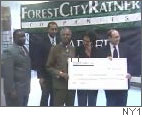
Representatives of Forest City Ratner Companies opened an account Wednesday and deposited $1 million at Carver Federal Savings Bank in the Atlantic Terminal Retail Mall. Carver is the largest bank in the country run by African and Caribbean Americans, according to the owners.
Posted by lumi at 11:16 AM
Eminent Domain and Government Giveaways
The Progress Report
Special Guest Commentary
Wyn Achenbaum
For readers who are interested in the relationship between land use, zoning and eminent domain. Achenbaum argues that frequent reassesment of private property would encourage development of property to a "a higher and better use," and therefore eminent domain would only have to be used when necessary against forces that are "holding up progress," such as in the Ft. Trumbull area of New London, CT.
NoLandGrab: Achenbaum's points would also support the argument that the tax-exempt status for 54% of the land area in New London does not constitute a "better use" of these properties. In this case, the individual homeowners in the Ft. Trumbull area, who are being called upon to sacrifice their homes to ameliorate the effects of poor city planning, are not the ones "holding up progress." If the free market forces really determine the "best use" of private property, then it should be applied across the board. Only then would municipalities be turning to the coercive powers of eminent domain as a last resort.
Posted by lumi at 10:56 AM
Your tax dollars at work
Field of Schemes:
Neil deMause reports on the City Council hearings on legislation requiring City Council approval for use of PILOT (Payment in Lieu of Taxes) for mayoral pet projects.
The PILOT slush fund issue now seems certain to end up in court, at which point maybe the mayor's lawyers will actually show up to explain themselves.
The second half of the day's hearings covered repealing MSG's tax breaks.
 And, if the initial $100 million for Bruce Ratner and $300 million for the Jets isn't enough:
...both Newsday and the Village Voice report that the city plans to provide more than $100 million in tax breaks and loan guarantees for a plan to redevelop the Bronx Terminal Market into a shopping mall and Olympic velodrome. The real-estate tycoon scheduled to receive this taxpayer windfall: Steven Ross, would-be NASCAR developer and former partner of deputy mayor for economic development Dan Doctoroff.
Posted by lumi at 7:23 AM
March 22, 2005
DDDb Press Release:
Free Market for the West Side, Fixed Market for Brooklyn?
DDDB Demands Open Bid for MTA Land
BROOKLYN— Develop Don’t Destroy Brooklyn (DDDB) spokesman, Daniel Goldstein today reaffirmed DDDB’s position that free market forces must be allowed to prevail in Brooklyn, as they have in Manhattan, when it comes to the sale of MTA property.
“Look at the massive difference in benefits that New York City and State will get as a result of an open bidding process at Hudson Yards,” Goldstein stated. “DDDB demands that the MTA yards in Brooklyn be subject to the same open bid process. An independent appraisal and RFP (Request For Proposals) are critical to protecting the public’s rights—including the right to free market benefits that Bloomberg, Doctoroff, Pataki and Ratner are trying to keep from the taxpaying public."
Goldstein’s comment followed last night’s announcement that—after first receiving a $100 million backroom “bid” from the Jets, and then opening the process up—the MTA has now received two other bids for much more money, and a new bid from the Jets that is 700% higher.
“Last night,” Goldstein concluded, “history proved yet again that the free market consistently provides higher benefits to the citizenry and taxpayers than no-bid, single-sourced, taxpayer-financed deals that are cut in a back room between government and industry.”
Posted by lumi at 9:35 PM
Black & White Issue, Or Many Shades of Gray?
Downtown Brooklyn Star: A poor attempt to analyse the fight along racial lines. It more accurately describes how players were dressed than the history of racial division in this fight.
NoLandGarb's Best to Worst Dressed Ranking from March 8:
Letitia James (she always looks fine)
Gib Veconi (nice pants!)
Rev. Daughtry
Brad Lander
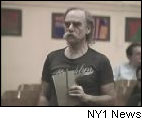
Al Rosner (extra points for cool 'stache, see right)
Marty Markowitz
Random Asian Chick
Marie Louis (Tar-jay fashion victim?)
Dan Goldstein
Patti Hagan (sorry, we don't show favortism for the NoLandGrab Tee.)
NoLandGrab: Seriously, Ratner is successfully exploiting neighborhood tensions along racial lines, while stealthily maneuvering along class lines. He "fairly treats" the wealthiest residents by paying way above market rate for their homes and leaves the rest to deal with the free market forces (EMINENT DOMAIN).
Posted by lumi at 12:01 PM
Hudson Yards, the bids are in
Here's a sample of the today's coverage of the Hudson Yards auction:
The NY Times, Jets and Rivals Increase Bids for Railyards
NY Daily News, MTA's West Side land gets 5 bids, but 2 disqualified
NY Daily News, Gang greenbacks: Jets banking on $720M bid to MTA for W. Side site
NY Newsday, Jets offer $720M for West Side plan
NY Post, GARDEN PLAN SACKED
NY Post, JETS GO FOR THE BOMB
NY Daily News (Juan Gonzales), A tale of two W. Side visions
Posted by lumi at 7:02 AM
New York Skyscraper Stolen, NASA to Blame!
 Severe cost cutting measures in NASA has forced the federal agency to acquire the NYC's Chrylser Building by eminent domain.
George Diller, NASA Spokesman at Kennedy Space Center defends this action., "We determined that the price of construction would be incredibly discounted by removing, shipping and retrofitting the delta-5, solid-fuel engines right onto the structure itself. That's an incredible savings?!"
Assemblyman Brodsky declared that NY State recently passed legislation requiring the government to notify owners when their property is being condemned.
"That may be true" quips Diller, "But, we are the government!, we have bigger boots than you do. We can kick your ass! In the proviso of this law we re-activated our option and ceased hold of the deed in the name of scientific space research and exploration."
Posted by lumi at 6:44 AM
Newark seeks delay on demolition plan
Deleware News Journal:
A reminder that all politics is local, ACORN (Association of Community Organizations for Reform Now) defends low-income housing from the wrecking ball in Newark. Located on a former city landfill, questions of contamination have arisen on the site of the half vacant housing complex.
"I think we're being misled by Jackson," said John Kowalko, an ACORN member and advocate for the Cleveland Heights residents. "Their homes are not unfixable. ... They want to maintain their community."
This is in stark contrast to ACORN's chants of "Tear them down, tear them down...," during Forest City Ratner's presentation last November, when James Stuckey claimed that the Prospect Heights homes and businesses they are seeking to condemn were blighted.
Posted by lumi at 6:26 AM
March 21, 2005
MSG unveils details of W. Side plan
Crain's NY Business:
Cablevision Systems Corp. unveiled a plan for the Hudson Rail Yards that includes the development of nearly 6,000 apartments, a 750-room hotel, commercial space for theater designers and producers, a public elementary school, a library and a five-acre park.
NoLandGrab: Doesn't Cablevision know that the Mayor is concerned that more housing would cause a "glut of housing on the West Side?" School? Library? Does the Mayor support that kind of stuff over stadiums?
Posted by lumi at 4:57 PM
An Agency to Answer a City's Prayers, but Not All Its Questions
The NY Times
By MICHAEL SLACKMAN
Forest City Ratner's Ridge Hill Village proposal in Yonkers is not only getting its fair share of critics fearful of overdevelopment and traffic congestions.
Criticism is raining down on the agency that was created to make the miracle happen: the Ridge Hill Development Corporation, a private, nonprofit group that opponents say appears to have been set up as a haven where friends of current and former politicians can find high-paying jobs and wield huge sums of money.
Here are some particular gems from this article:
"Some state officials said, and a lawyer for Ridge Hill confirmed, that the corporation could have been set up to be accountable to elected officials, and covered by the state's open meetings laws. But Ridge Hill officials said that initially they wanted to keep everything secret to protect their negotiations with the developer, or talks between the developer and the project's potential tenants."
Read: We could've made it transparent, but then it wouldn't have been secret."Tax documents show that in 2003, [former Yonker's Mayor] Spencer's [20-something-year-old] brother-in-law, Chris Spring, had a $100,000-a-year job with the corporation, but a storm of protest followed and by 2004 he was on the developer's [Bruce Ratner] payroll instead.
No worries, they moved the gravy train from the quasi-public sector to the private sector where it belongs.
 NoLandGrab: So many questions have arisen out of the Ridge Hill Development Corporation that a lawsuit is in the works and it is attracting scrutiny from the State Comptroller's Office and Legislature. This may all ultimately have bearing on the Local Development Corporations that Mayor Bloomberg favors for handling big projects in the City like the West Side Stadium and Atlantic Yards.
Oh, and The NY Times once again failed to disclose their existing business relationship with Forest City Ratner.
article
Also, The Journal News,Ridge Hill records to be open in Yonkers
An Agency to Answer a City's Prayers, but Not All Its Questions
By MICHAEL SLACKMAN
For three years, it has been recommended as just the shot in the arm Yonkers needs: a plan to develop 84 acres of state-owned land along the New York State Thruway into a complex of offices, apartments, shops and a hotel that backers say will create thousands of jobs and produce more than $50 million in tax revenue for that beleaguered city.
But now the project is taking shots, not giving them. Criticism is raining down on the agency that was created to make the miracle happen: the Ridge Hill Development Corporation, a private, nonprofit group that opponents say appears to have been set up as a haven where friends of current and former politicians can find high-paying jobs and wield huge sums of money.
Some local officials and community leaders complain that the agency, a local development corporation, would have legal control of the tract and hundreds of millions of dollars in rent that the land will generate, yet is not answerable to voters or elected officials.
The corporation appoints its own board of directors and can keep many of its deliberations and activities secret, and while it is required to pursue economic development activities in Yonkers, it will have near-total say over how it spends the more than $6.5 million in rent it is expected to receive annually over 70 years if the project is completed.
The agency has come under so much pressure that on Friday its board of directors voted to make its records available to the public and to give quarterly reports to the mayor - though it could rescind that decision at any time.
Critics say the situation is a local version of a phenomenon playing out across the state: the creation of more than a hundred similar quasi-governmental agencies that engineer lucrative deals, often without the oversight or accountability required of most government bodies.
Many communities work with such agencies as a way to lure developers through tax or financing advantages, and to provide liability protection. In recent months several of these agencies have come under fire - from the local development corporation that Mayor Michael R. Bloomberg has proposed using to help build a stadium on the West Side of Manhattan, to state authorities like the Canal Corporation, which sold valuable development rights along the Erie Canal for $30,000.
The state comptroller's office has said it plans a review of other, similar types of agencies that conduct economic development activities around the state, called industrial development agencies. (One of them, in fact, set up the Ridge Hill corporation.) And one state lawmaker, Assemblyman Richard L. Brodsky, said he plans to introduce legislation to make these economic development agencies more accountable.
"The Yonkers deal is the poster child for what is wrong" with the agencies, said Mr. Brodsky, a Westchester Democrat who is chairman of the Assembly Committee on Corporations, Authorities and Commissions. "They are being used to systematically avoid scrutiny, legislative and budgetary checks and balances and to evade worker protections, environmental and other social legislation."
The Ridge Hill corporation was created in 2000 by the Yonkers Industrial Development Agency to develop a site that has been the focus of the city's hopes and disappointments since the state granted a 99-year lease to a manufacturer in 1979, hoping to create thousands of jobs. When the jobs did not come, the corporation bought the remainder of the lease and signed a developer, Forest City Ratner, to build the complex, the Ridge Hill Village Center.
By creating the Ridge Hill corporation, the development agency said it sought to protect itself and the city from any liability in case the project fell through. "The board felt that we should be isolated from any litigation that might prevent us from doing our work," said Ed Sheeran, the agency's executive director.
Some state officials said, and a lawyer for Ridge Hill confirmed, that the corporation could have been set up to be accountable to elected officials, and covered by the state's open meetings laws. But Ridge Hill officials said that initially they wanted to keep everything secret to protect their negotiations with the developer, or talks between the developer and the project's potential tenants.
Another major reason for creating the corporation was ensuring the very independence that Ridge Hill's critics find so disturbing, the corporation's lawyer said.
"The business people were allowed to do what was good for the city, and politicians were kept out of the process," said the lawyer, Dennis Lynch. The Yonkers project, he said, stands to be successful because it is being guided by "experienced business people" rather than "politicians who are worried about one thing: the next elections." He said that if politicians were more involved, Ridge Hill would be run by "the usual hacks."
Yet the project's critics say that is exactly what has happened.
Some of the corporation's directors are allies of Mayor Philip A. Amicone and former Mayor John R. Spencer, and sit on the boards of at least two other local development corporations in Yonkers. Tax documents show that in 2003, Mr. Spencer's brother-in-law, Chris Spring, had a $100,000-a-year job with the corporation, but a storm of protest followed and by 2004 he was on the developer's payroll instead.
The corporation's role has created an unusual dynamic in Yonkers, where the Chamber of Commerce has emerged as an unlikely foe. The Chamber's charges of cronyism gained currency when it was disclosed that the corporation had paid a $10,000 bonus to Mr. Sheeran, director of the industrial development agency that created Ridge Hill, for helping to negotiate the purchase of the lease.
"Our concern is, is this a fiefdom being set up down the road for former politicians and their friends to enjoy, or is this really a great thing for the city?" said the Chamber's president, Kevin T. Cacace. "If this is a great thing for the city, they should have no objection to sunset the corporation and let all the money flow to the city." Mr. Lynch, the corporation's lawyer, said it is governed by federal and state laws, and must spend the rent money received on economic development in the city.
But one city councilman, John M. Murtagh, said that while that is true, the company is still not accountable to the public, and can decide for itself what constitutes economic development. When he asked last month for a copy of a lease between Ridge Hill and the developer, he said, the corporation did not comply, saying it assumed he would get to see it at some later point.
"I am a city councilman in Yonkers and a co-chairman of the Real Estate Committee, and it seems fairly outrageous to me they want me to vote on this and not show me the lease," Mr. Murtagh said.
The council, in fact, has obtained most of its information about the project from the developer, an official said. On Friday, the corporation's board approved the resolution that opened its records, though it did not provide details of how that would work.
"This is exactly what we were after," said Mayor Amicone, a key supporter of the project. "To open up the process, to eliminate all the misinformation out there."
The mayor tried to calm public concern last month by announcing that the corporation's board had promised $5 million a year for city schools. A lawyer for Ridge Hill acknowledged in an interview that the promise is not binding.
The project has moved slowly for a variety of reasons, including opposition by community groups that have expressed the fears that often surface over such a large project: concerns over parking, traffic congestion and burdens placed on local schools. The City Council has been weighing whether to change the zoning of the land to allow the complex's mix of housing and businesses.
But the largest obstacle has been misgivings about the role and power of the Ridge Hill corporation - issues that have been explored extensively over the years by The Journal News, a newspaper in Westchester County.
The matter has also raised anew another question that has been shadowing state officials: whether they are getting the best price for state assets. The state has offered to sell the land to Ridge Hill for $8.7 million, but the corporation's contract with Forest City Ratner would generate more than that in rent just in the first two years.
Bart Bush, deputy commissioner for real estate, real property management and development in the state's Office of General Services, said his agency had negotiated a fair price for the land, based on two appraisals. He said it is not the state's role to act as a developer, or to assume the accompanying financial liabilities. Besides, the sale is intended not as a short-term moneymaker, but as a long-term investment that will yield economic benefits for Yonkers and the state.
The sale requires the unanimous approval of the state's Public Authorities Control Board, and is scheduled to be on the agenda of the board's next meeting. But the Democrats in the State Assembly control one of the three voting seats, and have held off approval because of questions.
"Why should an asset be sold at less than market value to an L.D.C.?" Assemblyman Brodsky asked. "Why should it be sold to an L.D.C. which is not required to put the money back in the city that created it? Is the L.D.C. honestly and appropriately created and run?"
The office of the state comptroller, Alan G. Hevesi, deep into an audit of Yonkers's financial practices, said it planned soon to review the way industrial development agencies operate, prompted in part by the Ridge Hill deal. Mr. Hevesi's office did not comment on the Yonkers case because of its audit, but a spokesman said the agencies would be examined to see if their power to issue lucrative tax breaks has been "cost-effective and well managed."
"There must be accountability and transparency at all levels of state and local government," said the spokesman, Dan Weiller.
Posted by lumi at 4:01 PM
ROBBING THE MTA
NY Post, Op-Ed
by Julia Vitulo-Martin, Senior Fellow, Manhattan Institute
...no similar public debate on value has occurred over the Brooklyn site, which the Bloomberg administration is willing to turn over to Forest City Ratner at no charge. Developer Henry Weinstein, a principal with Pacific Carlton Development Corp. and a downtown property owner, says a value of $100 per buildable square foot is standard for the area. Using a more conservative $80 a square foot, and Ratner's projection that the site will produce 6.8 million square feet of buildable space, Weinstein suggests a value of at least $500 million.
The MTA needs this money — and it's in every New Yorker's interest that it gets it.
Posted by lumi at 12:14 PM
Blast from the Past
 Familiar issues and faces abound as Ratner's completes his crossing to the darkside. James Stuckey still works for the city and Donna Hennes is not yet being quoted about how "fairly" she was treated by FCR.
Dare we imagine a world where: * DDDb's Dan Goldstein accepts a HUGE buyout and becomes a corporate shill? * Marty smiles for the camera during his "perp walk?" * Community Consulting's Brian Ketcham heads the DOT, fighting off desperately needed change? * Fans For Play's Scott Turner is an executive in the Nets' front office? * PICCED's Brad Lander becomes the new Jim Stuckey? * Fort Greene Association's Lucy Koteen is elected Borough President in a landslide victory over her opponent, Bruce Bender?
Posted by lumi at 10:11 AM
Deadline Today in Showdown Over Stadium
The NY Times: As the clock ticks down on the 5PM deadline for bids to develop atop the Hudson Railyards, "The Jets have said they will substantially increase their $100 million offer for the right to build a 75,000-seat stadium...."
The bidding may not end at sundown tonight. The Metropolitan Transportation Authority plans to turn the offers over to its adviser, the Newmark real estate company, for evaluation. As Newmark sorts through the materials and the offers become public, one transit official said, there may be another round of bidding.
Posted by lumi at 9:09 AM
This Land is Our Land
Mother Jones
By Erik Kancler
Justice Bryer overlooks the distinction between "public use" and "public benefit," leading to increased scrunity on curtailing abuses of eminent domain.
Despite the Court's preference for allowing economic development and eminent domain to co-exist, they have not turned a blind eye to issues involving abuse of power. The opening remarks in Kelo may have set the stage for additional Supreme Court cases addressing the issues of heightened standards and just compensation.
Posted by lumi at 8:59 AM
MTA unlikely to net more Brooklyn bids
Crain's via NewYorkGames.org:
Don't expect anyone to pull a Cablevision in Brooklyn even if the Metropolitan Transportation Authority solicits other bids for Atlantic Yards
...
[I]nsiders say the prospect that other developers will contend for the project is very small. For one thing, the Brooklyn development is much more complicated than the proposed West Side stadium, since it requires the actual relocation of the rails. For another, developer Bruce Ratner owns most of the land around Atlantic Yards. What he doesn't own is in the hands of another developer, Shaya Boymelgreen, who just signed a deal with Mr. Ratner to build a hotel on the property.
Posted by lumi at 8:33 AM
Kelo v. New London transcript
 The Institute of Justice has posted the transcript of the oral arguments in the US Supreme Court case of Kelo v. New London, CT.
Posted by lumi at 8:29 AM
Arthur Miller’s Brooklyn Legacy
Brooklyn Rail
by Theodore Hamm
What imperils Brooklyn’s unique identity now is the same as what threatened it during [Willy Loman's] day: rampant overdevelopment. These days it’s stadiums, office towers, luxury high-rises, and big-box stores—a bland yet imposing vision, and in reality, a far from egalitarian one. Brooklyn, though, still has plenty of its own natural resources: its capacity to manufacture, its land, and its waterfront, and most of all, the underdeveloped talents of its working people. What Arthur Miller’s masterpiece reminds us is that in order to prevent the “deaths” of many more salesmen, Brooklyn needs to be its own borough.
Posted by lumi at 7:48 AM
JIGGA NEWS: Associate Ty Ty a fugitive; R. Kelly hires P.I.; Def Jam signings.
EUR Web:
In latest salvo in the ongoing fued between R. Kelly and Ratner's Nets partner Jay-Z,...
"...Kelly has recently hired a private investigator to dig up dirt on Jigga, and insiders say it may give his business associates — who include Universal Music chief Doug Morris (who hired Jay-Z to run Def Jam) and Jay-Z's partner in the New Jersey Nets, Bruce Ratner — something to think about."
Posted by lumi at 7:41 AM
March 20, 2005
Mike Lupica: Shooting from the lip
Say, could there be similarities between the West Side Jets project and the Atlantic Yards Nets project? From the Daily News:
Our politicians are pulling the same kind of fast one with Caring Bruce Ratner's arena in Brooklyn that Bloomberg and Doctoroff are pulling on the West Side.Starting with the laws about eminent domain.
Posted by amy at 10:41 AM
Vanishing Vistas: Will the “borough of churches” become a borough of skyscrapers?
The Brooklynite — Spring 2005
By Francis Morrone
One reader called this article a "poignant love letter and call to action," -- another must read for Brooklynites.
Today, all agree that the Atlantic Yards neighborhood cries out for development. The question is what sort of development.
...this isn't really a fight about basketball or traffic or even eminent domain, but a battle over what Brooklyn wants to be.
Brooklyn neighborhoods have succeeded because they retain a scale and a style from an age when city development reached a stage of optimal habitability.
In 1929, the Williamsburgh Savings Bank moved its headquarters to a new 512-foot-high dome-topped skyscraper at the corner of Ashland Place and Hanson Place, near the busy Flatbush Avenue Terminal of the Long Island Railroad. This gem of a skyscraper was Brooklyn's tallest, though quite modest by Manhattan standards. No one expected that it would remain the tallest for long, or that it would stand for 75 years (and counting) in such isolation, with not another tall building near it. For many years, at least since the Brooklyn Academy of Music opened its new building on Lafayette Avenue in 1908, Brooklynites had expected that this corner of Fort Greene would eventually emerge as the borough's new downtown.
It didn't happen. The stock market crash and the Depression were partly responsible. So too were the demographic changes that followed World War II. Since then, this area surrounding the Atlantic Avenue railroad cut has been one of Brooklyn's problem children. A succession of publicly sponsored efforts has failed to render urbanity out of a chaos of empty spaces that have created a classic example of what Jane Jacobs, in her landmark 1961 book The Death and Life of Great American Cities, called “border vacuums.”
Today, all agree that the Atlantic Yards neighborhood cries out for development. The question is what sort of development.
Bruce Ratner has one idea. As we all know by now, the developer plans to build a 20,000-seat Frank Gehry-designed basketball arena for his NBA franchise, the Nets, over the Atlantic rail yards, adjacent to his Atlantic Center and Atlantic Terminal shopping malls. The arena, of course, is to be but a relatively small part of a vast apartment and office complex. One of the buildings will rise higher—by 108 feet—than the nearby Williamsburgh Savings Bank Building. Three other office buildings and thirteen apartment buildings will range in height from 110 to 452 feet in height.
Those who support Ratner’s plan do so out of excitement at the return of a major sports franchise to Brooklyn, admiration for Frank Gehry’s architecture, or a desire to see something—especially something with a little newsworthy pizzazz—grow on that forlorn site. Opponents counter with criticisms of the likely use of eminent domain and concerns about gentrification, the displacement of residents and businesses, and increased traffic in a neighborhood where automobile traffic is already as bad as any to be found in the city.
Pro or con, though, this isn't really a fight about basketball or traffic or even eminent domain, but a battle over what Brooklyn wants to be.
For Ratner, as for many city officials, the proximity to Manhattan of downtown Brooklyn suggests that it serve as an extension of Manhattan. The September 11 attacks exacerbated an already-existing trend of corporations moving their back-office operations outside of Manhattan. A major beneficiary has been Jersey City, which in just a few years has acquired a high-rise skyline vastly more imposing than that of Brooklyn. But every defection to Jersey City means lost tax revenue to New York. Why, city officials ask, can't these offices go to Brooklyn? (Perhaps critics who charge that the city and private developers wish to “Manhattanize” Brooklyn should instead be speaking of its “Jersey City-ization.”)
So it is with other development proposals or prospects that have made Brooklyn the hottest urban development location in the United States. The Bloomberg administration backs the redevelopment of the Greenpoint and Williamsburg waterfronts with high-rise luxury housing and waterfront esplanades. It also backed the rezoning of the heart of downtown Brooklyn so that office skyscrapers can be built to appeal, like those of nearby MetroTech Center, to Manhattan corporations that might otherwise shift operations to New Jersey or some other place outside the city. And Fourth Avenue, on the edge of increasingly chic Park Slope, has recently been rezoned for high-rise apartment construction.
In essence, the administration, to satisfy the city’s hunger for additional housing and office space, wants to give developers license to radically transform vast swaths of Brooklyn. The resulting construction would replace the borough’s European-scale skyline—in many areas still punctuated by Victorian-era church spires—with walls of high-rise buildings.
One can readily understand why the city promotes such a vision for Brooklyn. But one must also understand why some of us feel that these rezoning and rebuilding schemes may in fact destroy the ways in which Brooklyn might most benefit the city as a whole.
Recent decades have seen many old Brooklyn neighborhoods rise from the brink of doom. In many cities—indeed in parts of Brooklyn—post-World War II urban disinvestment by lending institutions led to widespread neighborhood decay followed by massive programs of government-sponsored demolition and rebuilding in accord with the most advanced ideas of the putative experts in government and academia. Two areas in or near downtown Brooklyn succumbed to these fashionable notions of “urban renewal.” Much of downtown Fulton Street and other streets yielded to the vast open space and high-rises of Cadman Plaza. And the Atlantic Yards themselves are within the large Atlantic Terminal Urban Renewal Area. The city displaced the old Fort Greene Meat Market and the handsome old Flatbush Avenue Terminal of the Long Island Railroad so as to create a blank slate for prodigious new building in the area, contributing to the void we see today.
Yet radiating out from the downtown core are neighborhoods of a type that in other cities fell to “urban renewal” but that in Brooklyn were spared. Neighborhoods like Brooklyn Heights, Cobble Hill, Carroll Gardens, Fort Greene, Boerum Hill, and Park Slope made it intact through the 1950s when they were most imperiled by government-sponsored rebuilding. They also for many years were spared the attentions of private developers, who at the time had no interest in Brooklyn. And they benefited from “historic district” designation by the New York City Landmarks Preservation Commission. These splendidly intact 19th-century neighborhoods’ physical attractiveness made them ripe for gentrification, and their revival has been an urban success story of national import.
The irony is that by being spared rebuilding, these neighborhoods have flourished. As a result, they have attracted the interest of developers, who not only had nothing to do with the neighborhoods’ revival, but whose prior lack of interest actually helped them to flourish in the first place.
Today, private developers are zeroing in on the peripheries of the historic districts and on neighborhoods that have as yet been undesignated. Atlantic Yards is an excellent case in point, as it straddles the boundaries of several beautiful 19th-century neighborhoods that have become boiling-hot real-estate markets.
Clearly, the Atlantic Yards area needs development. The proposals on the table, however, beg the question of whether Brooklyn’s urban success stories have taught us anything at all, or just paved the way for thoughtless mega-development. Jane Jacobs coined the phrase “cataclysmic money.” Disinvestment is bad. So is over-investment. And it seems that in some parts of Brooklyn we may be going from the one to the other.
Brooklyn neighborhoods have succeeded because they retain a scale and a style from an age when city development reached a stage of optimal habitability. Such neighborhoods are exceedingly hard to find in urban America today. These Brooklyn neighborhoods are not only a New York treasure but a national treasure of preserved, human-scale places. Developing their interstices with mega-projects like the Atlantic Yards proposal would destroy the scale of neighborhoods that would, as a result, be edged and hemmed by phalanxes of outsize buildings. Only the crudest short-term cost accounting could possibly justify playing so fast and loose with these treasures of comely urban form.
Yet at the same time, we do need to improve these intervals between neighborhoods and do away with the border vacuums. Incremental redevelopment, of a more modest scale, may lack luster in this age in which many architects and planners have swung back from the influence of Jane Jacobs to reembrace the values of an earlier generation that venerated Le Corbusier and his notions of towers and open spaces sweeping aside the shopworn vestiges of earlier periods of urban development. But for many, incremental redevelopment seems appropriate in Brooklyn—which has fought back from the brink to provide models for urban America, not of vast projects of wholesale transformation, but of rehabilitation and the tender loving care of the sorts of neighborhoods and places that we spent so many years trying to destroy.
Francis Morrone writes the “About New York” column for The New York Sun. He is the author of An Architectural Guidebook to Brooklyn and co-author, with Judith Stonehill, of Brooklyn: A Journey Through the City of Dreams.
This article was originally published in The Brooklynite magazine (www.thebrooklynite.com).
Reprinted with permission. All rights reserved.
Posted by lumi at 6:31 AM
March 18, 2005
Nets Falling Back, Ratner Going Forward
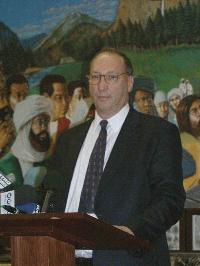
From the Brooklyn Daily Eagle
The Nets had lost three of four before a rousing 98-82 victory at Orlando on Sunday again raised hopes that the team may make a late run for the playoffs.“Hopefully, we can continue to build on this,” said Nets coach Lawrence Frank.
His boss is thinking the same thing about a valuable stretch of real estate in Downtown Brooklyn.
If only the New Jersey Nets’ offense ran as efficiently as Bruce Ratner’s push to bring the franchise to Downtown Brooklyn.
While the Nets continue to stumble out of playoff contention in the Eastern Conference, Ratner’s plan to bring big-time pro sports back to our fair borough for the first time since the Dodgers left town in 1957 keeps gaining momentum.
Last week, the real estate magnate signed his memo of understanding with the city and state, outlining his ambitious vision for a $550 million arena in the heart of Downtown, not to mention 17 other commercial and residential buildings, two million square feet of commercial space and over 4,000 mixed-housing units – all of which will cost about $2.5 billion.
All this just one week after Ratner backpedaled on his initial plan to have the Nets here by 2007. Now, the Cleveland native admits 2008 will be a more likely landing date for the Nets in Brooklyn. But what’s another year when you’ve waited almost half a century without a major pro sports franchise.
“It has been a truly extraordinary year,” said Ratner.
“Only a year ago, we unveiled (architect) Frank Gehry’s master plan and won our bid for the Nets. Today, with the help of the state and the city – and countless others who are working hard to bring the team and jobs and housing to Brooklyn – we are one step closer to creating a remarkable development that will hopefully make a proud borough and city even prouder.”
Under the MOU, the state and city will each contribute $100 million in capital contributions to fund site preparation and public infrastructure improvements on and around the arena site, including streets, sidewalks, utility relocations, environmental remediation, open space and public parking.
Forest City Ratner Companies (FCRC) has agreed to relocate and reconfigure the Long Island Rail Road Yard. FCRC will also build and maintain the overbuild platform. The rail yard will remain operable through all phases of construction.
Ratner continued his push just yesterday, dropping $1 million into the Carver Federal Savings Bank at the Atlantic Terminal Branch – the future home of the Nets.
“It is important to support local businesses through sizable community reinvestment,” said Ratner.
Especially when you’re trying to get some good p.r. in the neighborhood.
Unfortunately for Ratner, he can’t wheel and deal the Nets back into the Eastern Conference playoff race.
The three-time defending Atlantic Division champions are in serious danger of sitting out the postseason for the first time since point guard Jason Kidd’s arrival in 2001, putting a major blemish on Ratner’s first full season as owner.
Entering last night’s home game against Chicago, New Jersey had a 3-4 record in March, and was 3 ½ games behind Orlando for the eighth and final playoff spot in the East.
The Nets had lost three of four before a rousing 98-82 victory at Orlando on Sunday again raised hopes that the team may make a late run for the playoffs.
“Hopefully, we can continue to build on this,” said Nets coach Lawrence Frank.
His boss is thinking the same thing about a valuable stretch of real estate in Downtown Brooklyn.
Posted by amy at 11:30 PM
REC-U-U-USE ME!
The Brooklyn Papers hears our borough's silent screams. Dolly is recused, which means she's still in the room for negotiations, but leaves Brooklyn with no representation for the largest development the county of Kings has ever witnessed. I sure wish I had enough money to participate in democracy.
Brooklyn’s sole appointee to the City Planning Commission, one of only two city agencies with an official role in the proposed Atlantic Yards arena, housing and office complex will have no voice, the city said this week.Dolly Williams, Borough President Marty Markowitz’s sole appointee to the planning commission, will have to recuse herself from any review or other official discussion of the borough’s largest development proposal because, as first reported by The Brooklyn Papers last August, she owns a stake in the New Jersey Nets, a planning commission spokeswoman said this week.
Posted by amy at 11:16 PM
Ratner begins drilling at Yards

The Brooklyn Papers announces Ratner's early morning dental check-up for Prospect Heights. The EIS process has begun on the properties that Ratner controls.
To the surprise of many Prospect Heights residents, enormous drills have begun test borings of the earth below several sites within the 24-acre swath upon which developer Bruce Ratner plans to build his Atlantic Yards arena and high-rise development.
Posted by amy at 11:09 PM
Shaya defies Ratner, moves ahead with Atlantic Yards hotel

The Brooklyn Papers tells the tale of dueling developers. Get your banjos out.
A developer is moving forward with plans to build a hotel smack-dab in the middle of Bruce Ratner’s proposed Atlantic Yards site.
Posted by amy at 11:05 PM
Budget office greenlights Yards study
From the Brooklyn Papers:
A spokesman for the city’s Independent Budget Office told The Brooklyn Papers this week that the agency finally has a starting point to analyze the public benefit of developer Bruce Ratner’s proposed basketball arena, housing and office development in Propsect Heights.“Now that there’s an MOU we have a good place to start — we know now what the agreed upon parameters of state and city are,” said IBO spokesman Doug Turetsky, referring to the memorandum of understanding signed last week by city, state and Forest City Ratner officials.
Posted by amy at 11:01 PM
CB6 has some ideas for Atlantic Yards review
The Brooklyn Papers covers the CB6 Environmental Review recommendations. Transparency my eye.
Borough President Marty Markowitz, one of the biggest cheerleaders of the project since it was announced in late 2003, said in an e-mailed statement to The Brooklyn Papers, “Now that the MOU has been signed, the real work begins. I am committed to ensuring that there will be a transparent EIS process and ongoing public disclosure of plans.”But the wording in the agreement between the city, state and Ratner, known as a memorandum of understanding (MOU), provides for no such public disclosure, other than to the signing entity, the city’s Economic Development Corporation.
article
CB6 draft EIS scoping questions
Posted by amy at 10:56 PM
UNITY Loves Company: Ratner’s Limbo Provides Momentum for Alternate Proposal
Brooklyn Rail:
According to a recent New York Times article, Brooklyn developer (and New Jersey Nets owner) Bruce Ratner is trying “to elevate his knowledge of basketball…[by playing] the NBA Live video game on his computer.” One has to wonder if he similarly elevates his knowledge of urban development by playing the popular computer game SimCity, in which the click of a mouse can bulldoze any unwanted buildings to make way for anything the player wants to put in their place.
While the Ratner's plan waits for the MTA to get its act together over the Hudson Railyards, the UNITY plan is being presented to local community groups.
Posted by lumi at 6:42 AM
March 17, 2005
Big Projects and Bad News
 Gotham Gazette: Tom Angotti is concerned about what opposition to several large-scale developments will leave in its wake. Neighborhoods will still be vunerable to NYC's procrastination with rezoning, and box stores like BJs and Wal-Mart will be more savvy when they take another bite of the Apple.
Too many giant projects are driven by corporate developers that have rigid business plans and suburban-style designs, and at best buy off potential opposition with meaningless promises and palliatives. How about having community plans that incorporate the kind of new development that’s needed? Let the giants conform to our rules if they want to play in our ballfield. That way New Yorkers and not the Nets can control their destiny.
Posted by lumi at 7:14 AM
Carter posts 30 in big win, Nets only 2½ games out of playoff spot
The NJ Nets won't die as continue to chase the last playoff spot. On Sunday, Kidd earned his sixth season and 65th career triple-double to beat Orlando. Carter posted 30 points in last night's game to complete a sweep of the Bulls for the season. That leaves the (29-36) Nets 2½ games out of an Eastern Conference playoff berth.
NY Daily News, Vince, Nets win bullfight
NY Post, THERE'S NO KILLING NETS' PLAYOFF PUSH
NY Post, WHAM
NY Newsday, Start of playoff run?
The Newark Star-Ledger, Nets: Carter and Kidd star
Asbury Park Press, Nets inching closer to playoff spot
CBS Sportsline, Standings
Posted by lumi at 6:33 AM
March 16, 2005
CHINA WALL OF TRAFFIC: the wisdom of Robert Moses?
 IRONY ALERT:
Currents met at the crossing of Atlantic and Flatbush avenues downtown. Two subway lines join there, alongside the Long Island Railroad Depot, the tallest building in Brooklyn and the Acadamy of Music. But along Atlantic Avenue wholesale meat markets led toward slums. Condemnation proceedings begun by the Sports Authority could clear land there. O'Malley peddled Ebbets Field for $3 million, sold two minor league parks at $1 million and announced that he was prepared to put the $5 million in to a stadium in downtown Brooklyn. Robert Moses, politician, urban planner, said the stadium would create "a China wall of traffic." Until he measured Moses' power and found it greater than his, O'Malley says he did not intend to move the Dodgers.
— Roger Kahn, "The Boys of Summer," page 429
(book about the Brooklyn Dodgers)
Posted by lumi at 2:14 PM
Race to the Bottom
Alternet.org: Corporate PR campaigns have gotten savvy about playing the grassroots game. Wal-Mart's recent tactics will sound familiar to Brooklynites who oppose Ratnerville.
Padding opponents' bank accounts and exploiting racial tensions are among Wal-Mart's new and improved tactics; but they wouldn't work if communities didn't have tensions to exploit.
Posted by lumi at 2:04 PM
WAKE UP GIFF MILLER: SchoolsNotRatner.org
Bloomberg's political opponents have conveniently seized upon the opposition to the Stadium to beat up the Mayor, but still somehow support the Ratner arena. It's not hard to spoof Gifford Miller's new site when he is trying to have it both ways.
Gifford Miller wants to be the Mayor of this City and is the Speaker of this City's Council, yet it seems he's never heard of Brooklyn or Brucer Ratner's Taxpayer Subsidized Sweetheart Backroom Boondoggle©. This site is a spoof of Mr. Miller's SchoolsNotWestSideStadium.org.Though you'll notice that his position on the West Side and his support for the Ratner project are wholly inconsistent. We didn't even need to change any words other than "Stadium" to "Arena," and added only a few to emphasize why the RATNER/BLOOMBERG BOONDOGGLE IS EVEN WORSE THAN THE JETS/BLOOMBERG BOONDOGGLE.
Posted by lumi at 12:15 PM
CB6 Releases DRAFT Environmental Impact Statement Scoping Questions
In anticipation of the development of the [Environmental Impact Statement] EIS, Brooklyn Community Board 6 did sponsor through each of its standing committees a series of public meetings to solicit input from the public on the types of issues and questions they wanted addressed. Such an exercise, it was thought, would at a minimum allow for the Community Board to be in a better position to comment on the proposed scope of the EIS when released, at a maximum ensure that all of the issues raised by the public would be considered.
At this month's general meeting, CB6 released a draft, containing their work to date.
Submissions of questions for the scope of the EIS are still being accepted (contact CB6 District Manager Craig Hammerman).
Posted by lumi at 7:46 AM
Impact of Ridge Hill Village traffic fuels concerns
The Journal News: While mega developer Bruce Ratner wants to build a "neighborhood" in Brooklyn, he also is trying to build a controversial "Village" in Westchester.
Last night, the results of FCR's traffic impact survey was released for the Ridge Hill Village proposal. Local residents fear that traffic from the proposed "1,000 residential units, a 175-room hotel, offices and 1.3 million square feet of retail space" will clog already overburdened local streets.
NoLandGrab: If they think that's bad, check out Atlantic and Flatbush.
Posted by lumi at 7:32 AM
March 15, 2005
In Case You Missed It...

Coverage in the Feb. 24 Brooklyn Downtown Star of those crazy Olympic Ad Pranksters...
Just as the IOC gets to town to review NYC2012's bid, spoofs on the city's own ads are popping up around the borough. People opposed massive construction projects linked to NYC's bid are downloading spoof ads and putting them in place of real ads in various parts of Brooklyn. Don't be fooled - by any ads.
Posted by amy at 10:23 PM
DAILYHEIGHTS Expands Global Reach; Will Solve Problems for Food
DailyHeights.com is now moderating the Community Gazette for District 35 (http://www.gothamgazette.com/community/35). Post images, articles and sound off on "Major Issues for the District:" * Neighborhood Residents Divided Over Shopping Mall, * Resistance to Proposed Arena, and * Childhood Lead Poisoning.
Posted by lumi at 7:27 PM
As Manhattan Stadium Drags On, Brooklyn Arena Also Looks for a Leg Up

Bond Buyer: Scrutinizing Ratner's plan to finance the Nets arena using Payments In Lieu of Taxes (PILOT) to pay off the bonds.
No dollar amount has been set for the PILOT-backed bonds that would be issued to finance part or all of the arena have been estimated at $450 million to $600 million.
"We haven't discussed anything publicly about bonds at all," Ratner spokesman Barry Baum said regarding the level of tax-exempt bond financing the developer would seek.
Posted by lumi at 7:03 PM
Lobbyists Making Big Money in Albany's Chronic Logjams

The NY Times: How do you get to the proverbial three men in a room? If you're Bruce Ratner, Cablevision or the Jets, you hire "a team of lobbyists, each carefully chosen to command the attention of the three men who run New York State."
Read about how access is bought in Albany.
March 15, 2005
Lobbyists Making Big Money in Albany's Chronic Logjams
By MICHAEL COOPER
hen the owners of Madison Square Garden decided to lobby against the football stadium proposed for the West Side, they did not simply hire a lobbying firm to represent their interests in Albany, as big companies used to do.
Instead, they hired a team of lobbyists, each carefully chosen to command the attention of the three men who run New York State. One was former Senator Alfonse M. D'Amato, a confidant of Gov. George E. Pataki. One was Patricia Lynch, who until the end of 2000 was a top aide to Assembly Speaker Sheldon Silver, who rules the Democratic-led Assembly. And finally, they hired a firm that employs Kenneth Bruno, the son of Joseph L. Bruno, the Republican majority leader of the State Senate.
Their archrivals, the Jets, did the same thing, assembling a team of former aides and allies to handle each member of New York State's trifurcated leadership. So did Magna Entertainment Corporation, which is trying to enter the troubled horse-racing industry in New York. And so did Forest City Ratner, which wants to build a basketball arena for the Nets in Brooklyn.
With Albany controlled to an unusual degree by just three men, and with those three men in a state of near-constant, often quite bitter political warfare, the state's lobbying industry has taken full advantage of the situation and blossomed.
Companies have found that they can make a more effective case when their lobbyist has close ties to the official being lobbied. It has become increasingly common for companies like Cablevision, owner of Madison Square Garden, to hire separate lobbying firms to help them win access to each player. Some call it "stool lobbying" - hiring a separate firm for each of the state's three legs.
Government gridlock has proved to be great for business. The need to hire several firms to do what one once did helps explain why the state's lobbying industry has grown to a $144 million business in 2004, up from $39 million 10 years earlier. During the same decade, the number of registered lobbyists has nearly doubled, to 3,842 from 1,930, and the number of clients has grown to 2,224 from 1,099. While the 2004 numbers are inflated because the state now adds lobbyists of local governments to the total, officials say most of the growth has been in state lobbying.
"These days people want a specialist in each house," said Lester M. Shulklapper, 70, one of the deans of the Albany lobbyists, who started lobbying the state more than 30 years ago as a commissioner in the administration of Mayor John V. Lindsay and went on to a long lobbying career in the private sector. "That was something we never did."
Other companies that used multiple lobbyists last year include Altria, the tobacco company formerly known as Philip Morris; the New York State Trial Lawyers Association, which has been fighting proposals to limit lawsuits; Verizon, the phone company, which is subject to state oversight and regulation; and Destiny USA, which wants to build the world's biggest mall in Syracuse with tax breaks and bond issues.
And to satisfy the growing demand for lobbyists who can promise some special entree to one of the three men who run the state government, many of their friends and former associates have become lobbyists, and are now parlaying their relationships into access, clients and money. If there has always been a revolving door between government and lobbying, several lobbyists said, it is now turning faster than ever.
In the increasingly partisan atmosphere in Washington and around the country, lawmakers in power have encouraged clients to hire lobbyists with ties to their party. In New York State, though, that often means hiring several firms: the Legislature has been divided for three decades, with the Assembly controlled by the Democrats and the Senate controlled by the Republicans. And on top of the partisan divisions, the state is riven by institutional divisions, so some clients choose to hire different Republican lobbyists for the Senate and the governor.
The state's roster of registered lobbyists often looks like an old state directory. It includes a former Republican attorney general, Dennis C. Vacco, and a former Democratic speaker of the Assembly, Mel Miller. A host of Governor Pataki's close associates have hung out their lobbying shingles, including Kieran Mahoney, one of his longtime campaign strategists; Michael McKeon, his former communications director; and Thomas Doherty and Patrick McCarthy, two of his former appointments directors, who helped hire other members of the administration.
William D. Powers, who led the state's Republican Party when Mr. Pataki first ran for governor, is now a lobbyist. The staff level is represented as well: among others, there are a former counsel to the State Senate, David Dudley, and a former counsel to three Assembly speakers, Kenneth L. Shapiro.
Norman Adler, who was an aide to Mr. Miller before becoming a lobbyist, said the trick for revolving-door lobbyists is to build a reputation that outlasts their connections. "There are Pataki people doing fairly well," he said, "but if the next governor is a Democrat, they'll wind up writing a column for The New York Sun."
Critics say the situation shows that special interest groups are really paying lobbyists to get access to people in power, not for their expertise.
"Having to hire a lobbyist for each branch reflects the increasing lack of communication and cooperation between the various leaders," said Rachel Leon, the executive director of Common Cause/New York, a nonprofit organization that tracks the influence of money in politics. "It increasingly polarizes the process, and creates more layers and walls that regular New Yorkers have to break through to get their voices heard."
There are many close ties between lobbyists and those in power. One of the state's biggest lobbying firms, Bolton-St. Johns, had 73 lobbying clients last year, at the same time that it served as a political consultant to help re-elect several prominent Republican state senators. Ken Sunshine was a paid communications adviser to the Senate Democrats last year; at the same time, he was registered as a lobbyist for the New York Jets. And Senator Michael F. Nozzolio, an upstate Republican, is a partner at Harris Beach, a large law firm with a lobbying affiliate in Albany.
State officials say they do not steer people seeking the help of government to their friends and former associates for lobbying. But the close connections between lobbyists and the officials who used to employ them have become an ever-more overt marketing tool.
One prominent firm, Powers & Company, which was founded by Mr. Powers, the former head of the state's Republican Party, states on its Web site, "Our understanding of the legislative and regulatory processes from an insider point-of-view - coupled with our personal relationships with leaders and staff in all branches of government - provides our clients with what they need, when they need it."
Another big firm, Mercury Public Affairs, has a section of its Web site detailing the experience of its team, highlighting the ties of its members to the Pataki administration. It notes that Mr. Mahoney, its founding partner, was a senior adviser to all of Pataki campaigns, and that another partner, Mr. McKeon, was the governor's communications director.
The use of lobbyists with close ties to Albany officials was highlighted during a recent investigation of how a politically connected developer, Richard A. Hutchens of Buffalo, won the exclusive rights to develop private land along the Erie Canal for just $30,000. The investigation found that a high-ranking official of the state's Thruway Authority, Donald Hutton, told the developer to hire a lobbyist with close ties to members of the Pataki administration.
The lobbyist, Kerry Marsh, was a friend and golfing partner of Robert King, a friend of Governor Pataki who was then the state budget director and is now the chancellor of the State University of New York. The report by the attorney general and the inspector general said Mr. Hutton, then director of planning for the Thruway Authority, favored Mr. Hutchens for the contract and recruited the lobbyist, hoping he would help the developer's case.
According to the report, "As Marsh remembered it, Hutton said: 'There is someone you need to talk to, Kerry. He has been trying to get a really good project for the better part of a year or two. He might be able to use some help.' " (Mr. Hutton did not return a call seeking his comment.)
The report quoted Mr. Marsh as saying he could think of no other instance where he was urged to take on a client by an employee of the agency he was to lobby.
The juxtaposition of insider access by lobbyists, large campaign contributions and hobbled oversight has troubled not only civic groups but some lawmakers as well.
"If you go back to the railroad age, they talk about the robber barons, and going up to buy off the Legislature," said Assemblyman William L. Parment, a Democrat from Chautauqua County. "I think now it's just a little more refined, and there's been a structure that's been enacted - you can't take $1,000 in $100 bills and put it into a brown bag and put it on a legislator's desk. But you can contribute to a campaign."
Some states, like Maryland, have moved to ban lobbyists from organizing political committees. "There was an awful lot of pressure put on lobbyists from elected state officials with regard to supporting their campaigns, asking them to buy tables at their events," said Suzanne S. Fox, the executive director of the Maryland State Ethics Commission. "The concern became that because lobbyists wanted to please elected officials, to be in their good graces, they went to their clients and said, 'I had to take a table.' "
There are no such qualms in Albany. Last year, lawmakers held nearly 200 fund-raisers in Albany, instead of in their home districts, largely because Albany lobbyists are always willing to write checks and show up.
"We have these phony little cocktail parties, and invite folks to come by to contribute $200, $300," Mr. Parment, the upstate assemblyman said. "I plead guilty."
If Albany lobbying is a booming business, it is also a little-regulated one. A state court struck down parts of the lobbying law last year, hobbling the state's Temporary Commission on Lobbying, which is supposed to enforce its provisions that lobbyists publicly register their activities, declare their expenses and refrain from giving lawmakers gifts worth more than $75.
The lobbying commission, which collected more than $650,000 in fines and penalties from lobbyists in 2003, levied only $1,000 in fines last year. On top of that, the lobbying commission has been essentially weakened by political infighting.
The Assembly and the Senate both passed bills last year that would have overhauled the lobbying laws, but the two houses never hammered out their differences.
But chances could be better this year. The Assembly has passed a lobbying bill, the Senate is considering a similar one and Governor Pataki, whom some have accused of scuttling tougher lobbying laws in the past, introduced two lobbying bills last week that would ban all gifts from lobbyists to state officials and sharply curtail the practice of lobbying for state contracts, a hugely lucrative field not covered by current law.
Posted by lumi at 6:18 AM
Spitzer Blog
Does Spitzer read the Virtual Town Hall Meeting on his blog, especially now that Brooklynites have been posting their comments about his stand on Ratner's Plan?
Feel free to post your own comments.
Posted by lumi at 6:06 AM
March 14, 2005
Councilperson James memo to City Council re: Ratner MOU
 Last week Councilperson Letitia James distributed this memo summarizing the key points of the Ratner MOU with the City and State to her New York City Council colleagues.
Posted by lumi at 4:02 PM
Coney Island property a hot commodity
 The Brooklyn Papers: Coney Island revialization is right around the corner.
Members of the Coney Island Development Corporation (CIDC), the group charged with reinvigorating the area, expect to release a draft of their plans within months.
HYPE ALERT:
Ratner reps' and Markowitz's mantra that the Atlanatic Terminal transportation hub is the best site for a new Nets arena in Brooklyn has quelled talk that Coney Island would be a better (read below, "BUILD THE ARENA IN CONEY ISLAND).
Could the real reason be that Ratner owns all of the recently developed commercial property adjacent to the site? Na-a-a-aw!
Posted by lumi at 9:03 AM
BUILD THE ARENA IN CONEY ISLAND
Olympic and Transporation expert Brian Hatch's overview on why Coney Island is a better site for a new Nets Arena than Prospect Heights/Atlantic Terminal:
Coney Island was designed from its very inception to handle large crowds, and is the best location for an arena.
Coney Island has superior transit infrastructure to Prospect Heights. While the Atlantic Avenue & Flatbush area has many subways, they are mid-line at this location. Platforms could repeatedly overflow before a train arrives in the course of traversing its cross-city route. At Coney Island, four lines terminate at the enormous Stillwell Avenue terminal, the largest subway station in the world. This configuration allows crowds to board up to eight waiting trains of the Brighton (Q), Culver (F), Sea Beach (N) and West End (D) lines. The Brighton express (B) and former Sea Beach express (old "NX") lines can also be extended to this terminal to increase service to six lines, and provide two express services to more distant points of the city.
Being a terminal station, trains can safely and efficiently depart as soon as they fill up, then get quickly replaced by waiting trains from the adjoining Coney Island yard, the largest in the system.
Unlike Prospect Heights, Coney Island has the Belt Parkway going right by the site, providing far superior vehicle access than the choked Atlantic and Flatbush intersection.
Posted by lumi at 8:28 AM
Larry Penner gets it right (again)
Gawker.com hails Larry Penner as "by far one of the most prolific practitioners of the lost art of the letter to the editor."
Gawker.com: Larry Penner, International Man of Mystery
We recognize Penner as one of the few well informed voices who consistently gets it right. While NoLandGrab is trying to get Park Slopers to get hip to Ratner101 and realize that behind the arena will be 17 high-rise towers and more traffic than Flatbush can handle, Larry Penner from Great Neck has graduated to "following the money."
Remember the closed-door private meetings hosted by Brooklyn Borough President Marty Markowitz in fall of 2004? Everyone knows when government officials conduct a closed-door meeting, it usually means that they have something to hide.
Penner's Letter to the Editor, NY Press, March 9, 2005
Posted by lumi at 8:05 AM
March 13, 2005
Attorney General Weighs In On Nets Stadium

State Attorney General Eliot Spitzer wants to be the next Governor of New York. He also declared that he wants Ratner's proposal built. Give him a call and let him know that these two things do NOT go hand in hand...212-416-8040. Or spank him publicly on Eliot's Virtual Town Hall.
Also see Dope on the Slope's discussion of Spitzer's split personality.
Posted by amy at 10:23 AM
Understanding of a Memo
The Downtown Brooklyn Star explains the easy way to keep up with the Atlantic Yards Proposal:
So Brooklyn is now back to its accustomed obscurity from the citywide dailies. But if you weren’t able to enjoy the headlines while they lasted, keep reading the news anyway. Just switch the J’s to N’s and when you see pictures of railroad tracks, close your eyes and imagine Atlantic Avenue instead of the Hudson River. Everything else will fall into place. It’s a fight between millionaires, with the government pretending to be neutral, and plenty of regular folk crying foul.
Posted by amy at 10:17 AM
Prickly City
By Scott Stantis
www.ucomics.com
NoLandGrab: Folks down south and out west have told us that Brooklynites need an ENDANGERED SPECIES in Prospect Heights to put the brakes on Ratner's megalopolis. Alas, the only thing endangered here is "justice."
Posted by lumi at 8:45 AM
March 12, 2005
City, state & Bruce agree: ‘Yards the place for Nets
Great coverage of the "MOU" and City Councilwoman Letitia James's reaction from the Brooklyn Papers.
James released a summary this week of the MOU to her colleagues in the council, in which she calls for the council to back her in asking for a series of bills, starting with mandatory council approval of any city money dedicated to the project. She said she will also introduce a mandate that any city money for property acquisition as part of the eminent domain proceedings (which is now permitted in the MOU) be subject to council approval.James is also urging the council to encourage the MTA to open the Atlantic Yards site to a competitive bidding process, and create a fair market value for the site “exclusive of the benefits proposed primarily for Forest City Ratner.”
“The legal question for me would be whether or not the mayor has the authority to basically surrender all of this property, the city property, the city streets, and usurp the role of the City Council,” said James. “I’m certain this will be subject to litigation.”
Posted by amy at 9:50 AM
Prickly City

by Scott Stantis
www.ucomics.com
Posted by lumi at 9:47 AM
March 11, 2005
FCRC: Public Spaces, Private Places
FOOD COURT FLOP
Come one, come all to Ratner's 42nd Street Cafe! Actually, don't, since there are no doors. Part of it closed and part of it never opened. But feel free to make an offer because it's up for lease.
If Ratner can't make a profit on a food court in Times Square between two movie theaters and a wax museum, what are we hoping for with 17 skyscrapers in Prospect Heights? It's ok, though, if the project tanks we can always use his patented "Saran Wrap" technique and no one will notice...


Click on thumbnails.
Wonder how many jobs are being created here?
For more info, contact Jobs Everywhere Ratner Keeps Saying (JERKS) at 718-923-8400.
Posted by lumi at 7:19 AM
Keep eye on Nets arena
Atlantic Yards project is a must but deal needs fiscal oversight
The NY Newsday, editorial board:
loves the project;
"The Atlantic Yards project is a must."
is concerned about the lack of fiscal oversight
"And yet, there is an issue the public should watch as this deal unfolds: financial oversight."
and the large amount of taxpayer money Ratner is seeking; and
"The city and state say they are on the hook for only $100 million each in the deal - to pay for infrastructure work and other necessary changes. And yet, as recent press reports have explained, Ratner will reap tax breaks far beyond that amount, perks that will also come out of the public pocket - a fact that makes some of his critics irate."
calls for Albany, City Hall and the public to demand a full accounting of the taxpayer's tab.
"But unfortunately, the review process on deals like this looks mainly at environmental and land-use issues. So it falls to the cast in Albany and City Hall to ensure that the fiscal assumptions in this vital project are sound. And yes, it falls to the public to demand proof that its money is wisely spent."
Posted by lumi at 7:06 AM
Prickly City

by Scott Stantis
www.ucomics.com
Posted by lumi at 7:05 AM
I'd Buy That for a Dollar!
The Dope on the Slope blogger and Tennessee expat tells us what he REALLY thinks about Bloomberg's and Pataki's giveaways in the Ratner deal.
I've got news for you Mayor. These inconvenient whiners are your constituents. There's an election coming up you know. Underestimating the size, conviction or resourcefulness of this opposition could be the worse political mistake you've ever made.
Posted by lumi at 6:18 AM
March 10, 2005
Prickly City

By Scott Stantis
www.ucomics.com
Posted by lumi at 7:15 AM
Shaya Boymelgreen to build hotel in Bruce Ratner New York project
Globes, Israel's Business Arena:
The New York “Daily News” recently reported that Shaya Boymelgreen was planning to build a hotel in the center of the $2.5 billion Brooklyn Atlantic Yards project being constructed by US real estate tycoon Bruce Ratner.
Posted by lumi at 6:58 AM
March 9, 2005
DDDb Press Release:
"Develop Don’t Destroy Calls on Democratic Mayoral Candidates To Oppose Bruce Ratner’s Taxpayer-Subsidized Sweetheart Deal"
Open Letter Demands that Candidates Treat Brooklyn Like the West Side"
BROOKLYN—Develop Don’t Destroy Brooklyn (DDDB) today called on Democratic Mayoral candidates Freddy Ferrer, C. Virginia Fields, Gifford Miller, and Anthony Weiner to oppose Bruce Ratner’s development proposal in Prospect Heights, Brooklyn.
DDDB’s open letter to the four candidates begins:
We in Brooklyn have read, watched and listened intently as you have clearly stated your opposition to Mayor Bloomberg’s deeply flawed West Side Stadium plan. We admire and appreciate the principled stand you have taken on behalf of the West Side community and taxpayers around the state to stop this wasteful, anti-democratic project from being forced down our throats.
Today we are calling on you and the other Democratic candidates for Mayor to take the same strong, public stand against a very similar boondoggle that Mr. Bloomberg, along with Governor Pataki, are trying to ram through without any real public input or accountability – Forest City Ratner’s (FCR) Nets Arena and 17 High-rise Complex proposal in Prospect Heights.
“With last week’s Memorandum of Understanding, our Mayor showed that he stands on the side of wealthy developers over the people of Brooklyn and the taxpayers of New York City,” said DDDB spokesperson Daniel Goldstein. “Well, Bloomberg may be content to rip off City taxpayers for Mr. Ratner’s profit, but we don’t believe that his opponents are. That’s why we’re asking the candidates: Do you stand with the people of Brooklyn and their right to self-determination, or do you stand on the side of corporate interests at the expense of the voters and taxpayers of this City? Voters in Brooklyn are paying attention and there will be electoral consequences for candidates who ignore or dismiss the concerns of thousands of Brooklynites on this critical issue.”
Goldstein added, “In the coming weeks we intend to meet with each candidate to discuss this issue further and educate them on why the Ratner project is a raw deal, just like the Jets deal, and sets dangerous precedents for development in our city.”
–––––––––––––––––––––––––––––––––––––––––––––––––––––––––––––––––––––––––––––
For a copy of the letter sent to Mr. Ferrer, Borough President Fields, Speaker Miller, and Congressman Weiner, go to: http://www.dddb.net/candidates
To see Develop Don’t Destroy Brooklyn’s press release about last Friday’s Memorandum of Understanding between the Empire State Development Corporation and Forest City Ratner, go to: http://dddb.net/press/0404MoUPR.pdf
Posted by lumi at 12:14 PM
The Jets vs. Nets: Brooklyn Arena Deal Template for Stadium
Have to you gone blind trying to read the MOU? Try reading the New York Observer article by Matthew Schuerman instead.
The article outlines the similarities between the West Side Stadium and Ratner's plan and goes on to expose the litany of other tax breaks, subsidies and outright land grabs sought by Ratner.
If you've been wondering what you can still buy for a dollar in NYC, would you believe a couple of City streets, sidewalks and city-owned lots? Read on folks!

|
The Jets vs. Nets: Brooklyn Arena Deal Template for Stadium
by Matthew Schuerman
The Mayor’s after-hours announcement on March 3 of a deal on the Brooklyn arena for the Nets basketball team was first seen as a pleasant distraction from his troubled negotiations over the West Side football stadium.
Except the two projects sound remarkably the same.
It’s not just that a sport facility would go over Metropolitan Transportation Authority train yards—one in Brooklyn, the other in Manhattan. It is also that, in each case, the developer gets a nice check from the government, state override of local zoning laws and years of tax-free living.
The announcement came as something of a surprise. Fourteen months ago, Forest City Ratner Companies announced its plan to move the Nets to a Frank Gehry–designed arena at the intersection of Flatbush and Atlantic avenues in Brooklyn. Plus, in the part of the deal that would make real money, chief executive Bruce Ratner would erect 17 office and residential towers in the rapidly gentrifying Prospect Heights, for a grand total of $2.5 billion.
Since that time, Mr. Ratner has been engaged in a little friendly "Mau-Mauing of the Flak Catchers," as Tom Wolfe would call it: offering jobs, affordable housing and a community center to gain support from community activists. Then, once the brouhaha over the West Side erupted this winter, little was heard about the 21-acre complex. Opponents thought the deal might even have fallen through.
Ka-boom! Out comes the press release from the Mayor’s office proclaiming "an historic project that will continue to energize the borough of Brooklyn" and bring 12,000 construction jobs and 8,500 permanent jobs. The city and state will chip in $200 million "in site preparation and public infrastructure improvements," the press release added.
That didn’t sound too bad compared to the $600 million that the public is supposed to ante up for the West Side stadium. But wait—there’s more!
The actual memorandum of understanding, which has so far escaped the notice of the press, shows that Mr. Ratner will be able to finance the arena through tax-free bonds. While he pays those bonds back, he will not have to pay property taxes or even payments in lieu of taxes. These PILOTS, as they are fashionably known, are what commercial developers of tax-exempt property often have to pay.
The city will even throw in a couple of lots that it owns, along with portions of streets and sidewalks, for $1—the mere price of a watery cup of coffee at a corner deli.
But wait—there’s more!
The state’s Empire State Development Corporation, which will take control of the project, will "consider" exempting Forest City from mortgage-recording taxes and from sales taxes on construction materials that it will use to build the towers and the arena.
"They are getting every tax break known to man," said City Council member Letitia James, whose district includes the proposed project and who has fought it from its inception. Bettina Damiani, project director of the nonprofit watchdog group Good Jobs New York, remarked, "I think the concern here is that sales taxes and other taxes are some of the reasons why we want development, because they are supposed to go back to the city."
Wasn’t it just a few months ago that Mayor Bloomberg called on Madison Square Garden, his enemy in the West Side negotiations, to give up its tax breaks? It was four months ago, in fact. But, City Hall says, the two situations are not the same. "After the bonds are satisfied, the PILOT will return to the city," said Janel Patterson, spokeswoman for the Economic Development Commission. "The Madison Square Garden legislation granted a tax break in perpetuity."
As for how long it will take before Forest City pays off its construction bonds and becomes a responsible, tax-paying citizen, well, no one quite knows.
Nevertheless, it will all be worth it, said Ms. Patterson. "This project will create about a billion in benefits for the city and the state, and it will create 8,500 jobs. It is a reasonable investment on our part."
Just how much of a payback the Brooklyn development will create is up to debate. A study paid for by Forest City put the total at $3.6 billion, while another study commissioned by neighborhood opponents found that the project would end up losing $500 million for the city. The city estimates a $1 billion return—which is good, because a new study by the Pratt Institute (the most objective source to conduct a study to date) finds that all these tax breaks could end up costing the city about $1 billion.
Local opponents, though, have even bigger problems with the notion of the state seizing their property through eminent domain and then turning it over to a private developer—albeit in exchange for fair market value.
The new deal makes clear that the state intends to do just that—and that the city may in fact even use some of its $100 million contribution to buy up properties that reluctant property owners refuse to sell.
The M.T.A., however, hasn’t gotten with the program. Just as on the West Side, it’s the M.T.A. which could end up making the whole project extremely expensive for the developer. The Feb. 18 agreement stipulates that Forest City Ratner Companies will have to pay market price—whatever that means—for the 10 acres of M.T.A.-owned property on which the towers will be built. The M.T.A., in a separate letter dated Feb. 24, said that it reserves the right to put the railyard out to bid—but that if it agrees to sell to Mr. Ratner, it will charge him for every sixpenny nail it has to use to renovate or relocate because there is something historic going on overhead.
Go, Nets!
Posted by lumi at 12:06 PM
ELIOT: STADIUM CAN WAIT
NY Post: State Attorney General and gubernatorial candidate Eliot Spitzer voiced his opinion that the, "Olympics are not contingent upon" the West Side Stadium.
NoLandGrab: The BIG question is, where does he stand on the West Side Stadium in general and the Ratner's arena plan. Stay tuned.
Posted by lumi at 7:05 AM
Arena foes: Where do Dem bigs stand?
NY Daily News
By Hugh Son
Where do the Democratic Mayoral candidates stand on Ratner's arena plans?
Despite the similarities between the West Side Stadium and Ratner's arena project (see DIRTY LAUNDRY LIST), Miller and Weiner have stated lukewarm support, while Ferrer and Fields have stated lukewarm opposition.
"They all need to get off the fence and take a firm position by looking deeply into the details of this project," said Daniel Goldstein of the anti-arena group Develop - Don't Destroy Brooklyn.
The group sent candidates letters this week demanding they oppose the Ratner project on the same grounds they oppose the West Side development.
Posted by lumi at 6:57 AM
Prickly City
 By Scott Stantis
www.ucomics.com
Posted by lumi at 6:38 AM
DIRTY LAUNDRY LIST
West Side Stadium & Nets Arena Comparison
Now that the MOU has been released and more details about Ratner's plan have emerged the list of issues tied to the West Side Stadium controversy have become clearer. Here's NoLandGrab's Dirty Laundry List so that you can tell your friends why they should scrap Ratner's arena along with the West Side Stadium.
DIRTY LAUNDRY LIST
- MTA sale of public land must go to highest bidder
- Taxpayer financing ($300 million and $100 million for the Stadium and Arena, respectively, while slashing $1.3 BILLION from schools)
- No legislative oversight (no local review & no legislative approval of taxpayer financing)
- Bloomberg going to the mat for big business
Plus: Ratner wants to use eminent domain to displace residents and small businesses.
Posted by lumi at 6:06 AM
March 8, 2005
Marty Reads Script, Then Splits
Daily Heights: Review and comments on Marty's performance at last night's PICCED Impact Analysis presentation.
Posted by lumi at 11:45 PM
Council may get say on stadium
NY Daily News columnist Juan Gonzales has learned that City Council Speaker Gifford Miller plans on introducing a bill tomorrow to prohibit the Mayor from diverting funds from the PILOT (Payment in Lieu of Taxes) fund to pay for the City's $300 million tab for a new Jets Stadium on the West Side.
What does this have to do with the arena?
The PILOT fund is being raided by the Mayor for the $100 million dollars he has promised to the Ratner development. Make sure that your fellow New Yorkers understand that these issues are one and the same.
Since the NoLandGrabbers spent the entire marketing budget on beer at our last meeting, we won't be running commercials on local television stations. So it is up to you to get out the word.
Posted by lumi at 4:39 PM
Independent Study Mixed On Nets Arena In Brooklyn
NY1:
A community meeting in Brooklyn Monday night heated up over plans to build a new arena for the Nets.
Presenters from the Pratt Institute shared the findings of an independent impact study on the Atlantic Yards project. The report says the construction would create more affordable housing and jobs, but it also says more information and public input is needed on issues like traffic.
View NY1 News report or read transcript.
Posted by lumi at 4:29 PM
'Open Court Steal' At Atlantic Yards?
If the MTA auctions off the Atlantic Railyards to the highest bidder, delveloper Shaya Boymelgreen may make an offer. The developer and Pacfic St. property owner is also seeking to build a hotel on the property he owns in the footprint of Ratner's proposal.
Park Slope Courier
By Stephen Witt
A spokesperson for one of the city's larger developers, who own property in the footprint of the proposed Atlantic Yards development, said building an arena and bringing the NBA’s Nets to the area would be great for the borough.
However, the spokesperson for the developer, Shaya Boymelgreen, also did not rule out putting in a play for the 11-acre Atlantic Yards site if is went to open bidding.
“It [building the arena and bringing basketball to the Atlantic Yards] would be great for Brooklyn and will surely bring a lot of jobs and cash into the borough,” said Boymelgreen spokesperson Will Kim.
“If [Bruce] Ratner has that capacity and right [to develop the Atlantic Yards], all the best to him, but if that’s not the case, all who have the capacity would look at it,” he added.
Kim said that if Ratner gets approval and is ready to go, that is what will happen at the site, but if it goes to open bidding, the company for which he works is “very opportunistic and aggressive” and in any market environment, buying is considered.
Kim said Boymelgreen is not interested in bidding for the Far West Side’s Hudson Yards out of respect to the city, which has certain goals [a Jets Stadium] for the property.
Kim identified two properties that Boymelgreen owns in the footprint of Ratner’s 21-acre proposed development site. They are 800 Pacific Street and 752 Pacific Street.
Boymelgreen is in preliminary discussions with several hotel operators to turn the 800 Pacific Street site into a 150- to 200-room hotel, said Kim.
Kim said Forest City Ratner Companies (FCRC) has had discussions with Boymelgreen’s company about purchasing the property, but it is doubtful they will sell it.
“We’re trying to market it in the most economic kind of way we can,” said Kim.
Kim said the company is also trying to co-market 750 Pacific Street with the property’s owner, Henry Weinstein.
Weinstein said it hasn’t been determined yet how the property should be marketed.
“I’m against the arena, “ said Weinstein, who also owns several properties adjacent to the proposed FCRC footprint. “It would overload services and make transportation extremely difficult.”
Weinstein said he also opposes the taking of any property for the project under eminent domain laws.
There would be a lot of developers who would be interested in the Atlantic Yards site should it to to open bidding, Weinstein said.
FCRC Spokesperson Barry Baum refused to comment.
Posted by lumi at 3:53 PM
MTA NO SLAM DUNK FOR NETS
NY Post: While the NY Post editorial board has already jumped to the conclusion that the arena and highrise development will be good for Brooklyn, reporter Patrick Gallahue uncovers the dirty little secret about Ratner's deal with the State, the MTA is comitted to get "fair market value" for the railyards.
Posted by lumi at 1:30 PM
Fans For Fair Play: The New York Post's Campaign of Avarice
Fans for Fair Play goes to the mat for Brooklyn against yesterday's partisan NY Post editorial, which heralded the coming of the "phenomenal boost to an area that, quite honestly, has languished sinfully — seemingly forever."
The New York Post... is stuck in a Tammany Hall mindset of graft, political back-room deals, and siding with a rich Cleveland native whose mega-developer aesthetics will destroy what’s left of the Brooklyn of New York Post editorial-writers’ youths.
Read the point-by-point rebuttal.
Posted by lumi at 1:20 PM
West Side Stadium Insanity
The Gothamist
The funniest thing to come out of this is how Bruce Ratner's Brooklyn Nets arena is not a sure thing (in spite of Ratner, the city and the state signing an agreement last week) because there were no other bids on the site and the MTA may pursue an auction. What's crazy for these developers is that it's like the MTA suddenly remembered, "Hey, we can make more money if we put the lots onto the open market." Again, who are the dopes running this agency? And speaking of the Nets, you guys are killing us. Rebuilding, reschmuilding - this is just sad.
Posted by lumi at 12:44 PM
Editorial pages still grumbling about eminent domain
Though there's not anything that hasn't been said in these post-Kelo commentaries, the local editorial pages across the nation are still grumbling about the current state of eminent domain.
Lancaster Eagle-Gazette:Property must be protected
Missoulan: Court will decide if property rights exist
Posted by lumi at 7:49 AM
Bridging the gap
The next cool places to live
The Economist:
“Bridge and tunnel” used to be the Manhattanites' dismissive term for insufficiently stylish visitors to the island from further out. Now Brooklynites use the term too, and count themselves among the insiders.
NoLandGrab: Brooklynites wonder, how can the neighborhood Ratner proposes to eliminate be cool and blighted at the same time?
Posted by lumi at 7:30 AM
March 7, 2005
NY teams hoping for new stadiums
NY Newsday:
After watching so many of their competitors generate tens of millions of dollars in additional annual revenues from their new venues, the owners of New York and New Jersey's pro franchises have jumped into the game. All nine teams are proposing new or renovated homes to replace their aging buildings over the next five years. The projected cost: more than $5 billion.
Posted by lumi at 7:53 AM
Getting to the truth about Jets stadium
NY Daily News, Editorial:
It was astonishing to hear Metropolitan Transportation Authority Chairman Peter Kalikow - he of the fare hike - say recently that a chance to reap hundreds of millions of dollars for the all-but-bankrupt agency was a lamentable "distraction." The estimable Mr. Kalikow has much on his plate, but getting top buck for the right to build over the MTA's West Side rail yard should be squarely atop his to-do list.
Posted by lumi at 7:30 AM
BROOKLYN'S NET GAIN
NY Post, Editorial:
But let's be blunt: If Gotham won't allow a blighted swath of land in Brooklyn to be turned into a beautiful, spanking new development that spawns jobs, housing, economic activity and tax revenues — and brings pro sports back to Brooklyn, to boot — then what will it allow?
Posted by lumi at 7:28 AM
TONIGHT: Atlantic Yards Proposal: What Would be the Impact to Prospect Heights?
The Pratt Institute Center for Community and Environmental Development (PICCED, www.picced.org) presents the findings of their study of the impact of the proposed Forest City Ratner Brooklyn Atlantic Yards project in Prospect Heights and surrounding neighborhoods.
When and Where
Monday, March 7
7:00 PM
P.S. 9, 80 Underhill Avenue (between St. Marks Ave. and Bergen St.)
Posted by lumi at 7:20 AM
This land is their land
The Bergen Record carries a Steven Greenhut editorial. Greenhut is a columnist at the Orange County Register and author of, "Abuse of Power."
AFTER A LANDMARK eminent-domain case was argued before the U.S. Supreme Court last month, I was left with the depressing realization that the court is populated with justices who are not capable of making the most basic constitutional distinctions, or of even understanding the crucial property-rights issue at stake.
Also:
Fort Worth Star-Telegram, Eminent domain case tilting towards cities
CounterPunch.com, When Pfizer Came to New London. Corporate Giveaways vs. Eminent Domain
The Washington Post, Homeowners Challenge Government Seizures of Property to Generate Higher Tax Revenue
Posted by lumi at 7:09 AM
This Land is Your Land -- Maybe
CBS News Correspondent Joie Chen reports on Kelo v. New London in the cover story of CBS News This Morning (March 6, 2005).
If you're a homeowner standing in your yard, you probably think this land is your land. But it may not stay your land if your local government wants somebody else to have it.
Posted by lumi at 6:58 AM
NETS NOT SHOWING REAL SIGNS OF LIFE
NY Post: Though the Nets could still make the playoffs, they aren't playing that way -- including Jason Kidd, who has been quiet on and off the court since Ratner and Rod Thorn have stated publicly that they have no intention to trade him.
Posted by lumi at 6:36 AM
March 6, 2005
TODAY: PRESS CONFERENCE, 2PM, City Hall
Media Alert
For Immediate Release
March 4, 2005
Contact: Kate Suisman
Office of Council Member James
w. 212-788-7081
Council Member Letitia James and Senator Velmanette Montgomery to hold press conference Sunday in response to Memorandum of Understanding on Atlantic Yards
Agreement signed between Ratner and the city/state but MTA reserves the right to sell to higher bidders
(Brooklyn, NY) –Council Member James and Senator Montgomery will be joined by community members at a press conference on Sunday responding to the announcement of a Memorandum of Understanding between Forest City Ratner and the city and state. The elected officials who represent the Prospect Heights area that would be condemned to make room for Ratner's $2.5 billion project will be joined by the Pratt Area Community Council, Darnell Canada of Rebuild, Bob Law and others.
"The Administration has made it clear that they care more about building sports facilities than they do about building schools. We're facing over a billion dollars in cuts to the education budget. Yet the Administration can find hundreds of millions of dollars for the Nets and Jets," said Council Member James.
"This agreement is non-binding. This is a PR stunt to convince the public that the arena and skyscraper complex is a done deal. That is far from the truth. The MTA reserved the right to sell the land to a higher bidder. Just like with the West Side stadium, we need open bidding to get fair value for this land." Senator Montgomery stated.
WHAT: Press Conference
WHERE: City Hall Steps
WHEN: March 6, 2005, 2 pm
WHO: Council Member James, Senator Montgomery, Congressman Major Owens, Council Member Charles Barron, Pratt Area Community Council, Develop Don't Destroy Brooklyn, Downtown Brooklyn Leadership Coalition, Bob Law, Brooklyn Vision, Prospect Heights Action Coalition
Posted by lumi at 6:15 AM
March 5, 2005
Nets OK deal to play in N.Y.
From North Jersey:
Nets owner Bruce Ratner said Friday he doesn't expect to break ground on a $450 million arena in Brooklyn until the middle of 2006. That timetable, he concedes, may mean the National Basketball Association team will not be able to move out of Continental Arena before 2008. A host of environmental, legal and logistical hurdles also stand in the way.
Posted by amy at 5:14 PM
Ratner Regresses

From the Brooklyn Daily Eagle:
“You’ll find that you have opposition to anything that you try to do anywhere,” said Ratner, who claimed that getting the rights to the land for his MetroTech project was far more difficult, but less publicized than his play for the Nets’ move.“But that’s a good thing. It’s always good to have a different point of view. We expect that and know that it’s part of the process.”
A process that may be getting a little bit tougher than Ratner anticipated just a few weeks ago.
Posted by amy at 5:07 PM
MTA on Nets site: ‘Bid Away’
From the Brooklyn Papers:
And this week, according to Bloomberg News Service, the Nets move to Brooklyn was announced to be “more likely” to happen in the 2008-2009 basketball season, according to Ratner.And it may take even longer, if the Ratner team is, like the Jets, trying to pass off the costs of building a platform over the rail yards onto the MTA. Kelly said the authority would favor bids with fewest liabilities.
Posted by amy at 4:58 PM
Arena foes stuck in Olympic spin cycle

The Brooklyn Papers tells the story of the IOC visit, and NYC2012's disregard for opposing views.
The representative said the four members of the 13-member IOC listened with careful attention and seemed “particularly concerned” when she characterized the use of the bid as “an excuse for a land grab” and that community process, at least in Brooklyn “was being co-opted.”
Posted by amy at 4:54 PM
Nets arena to cost public $500M?
Neil deMause breaks down the costs to the public as described by the MOUs in Field of Schemes.
Posted by amy at 4:51 PM
TONIGHT: Dance Don't Destroy II

ALL proceeds go to pay for DDDB's legal fees and to hire environmental experts.
Saturday, March 5th
8 p.m. onward
Galapagos Artspace
70 North 6th Street, between Kent and Wythe
Williamsburg, Brooklyn
www.galapagosartspace.com
718-782-5188
The L Train is not running this weekend. Please click here for directions.
Posted by lumi at 6:54 AM
March 4, 2005
Brooklyn Arena to be Built With Bonds
WNYC's Andrea Bernstein sheds some light on the taxpayers tab for Ratner's arena:
The developer of the proposed Brooklyn Nets Arena will be asking for hundreds of millions of dollars in tax free bonds to construct the $500 million arena.
They say the $2.5 billion project is unprecedented for an outerborough. But they acknowledge there's a public cost to all of this on top of the $200 million the city and state will pay for infrastructure inprovements.
The developer, Forest City Ratner, hopes to get hundreds of millions of dollars in tax free bonds which it would essentially pay back with its own property taxes. A Forest City spokesman also says Ratner will ask for an undetermined amount of housing subsidies and tax breaks for the affordable housing.
NoLandGrab: Folks, FCR wants hundreds of millions of dollars to finance a project of "unprecedented" scale, with no local review process, real community input or legislative oversight.
Posted by lumi at 4:46 PM
NON-BINDING(?) MOU SIGNED BY RATNER, BLOOMBERG & PATAKI
The NY Times: Deal Is Signed for Nets Arena in Brooklyn
NY Newsday, AP: Brooklyn basketball arena is a step closer
NY Daily News: Mike, gov: arena good to go
The NY Sun: RATNER SIGNS DEAL TO BUILD NETS ARENA
GlobeSt.com: Brooklyn Stadium Plans Moves Forward
WNBC: Brooklyn Basketball Arena Is A Step Closer
WCBS: City, State Each Pledge $100 Million For B'klyn Arena Project
MOU ANNOUNCEMENT
A "non-binding" (NYT) Memorandum of Understanding (MOU) has been signed by the Mayor and Governor, who have committed $100 million by the City and State to the project. The Mayor will announce the agreement on his weekly radio address on 770AM at 10:00 this morning.
MTA & ATLANTIC RAILYARDS
The MOU was signed without the MTA making public the appraisal for the Atlantic Railyards first. The only info reported this morning is in the NY Times, "In a separate agreement with the authority, [Ratner] agreed to pay fair market value for the property. But the authority also reserved its right to hold an auction to determine that value and to sell it to another bidder."
JOBS & HOUSING CLAIMS
Also, the Mayor's office claims, "The project is expected to create 12,000 construction jobs and 8,500 permanent jobs..." (AP). The NY Times reports, "The project originally called for four office towers. Executives who have talked with the developer say he plans to scale back the office space to add as many as 1,000 apartments." Look for clarification on these claims and figures in the next couple of days.
Posted by lumi at 7:25 AM
Eminent domain, still being discussed in editorial pages and letters
More than a week after the Supreme Courts heard the oral arguments in the case of Kelo v. New London, local editorial pages are still sounding the clarion call that eminent domain causes great pain and suffering to local communities. The continuing coverage in the New London daily, The Day, illustrates a community who is deeply troubled by events in their city.
The Day, Letter to the Editor: Courts Must Halt the Abuse of Eminent Domain
The Washington Post: Fort Trumbull Case Of Interest To All Homeowners
Lebanon Daily News: Property ruling of supreme importance
The Washington Times: Property-gobbling cities
The Fullerton College Hornet: What's Yours is Mine
Posted by lumi at 6:08 AM
March 3, 2005
Obstacle Rises for Bloomberg on West Side Stadium Plan
The NY Times:
With the Far West Side stadium emerging as a central issue in the mayoral race, Council Speaker Gifford Miller yesterday sought to take the lead in opposing the Bloomberg administration by introducing legislation to require a public review of any taxpayer money used for the stadium.
Posted by lumi at 9:48 PM
Stadium losing support in NYC: poll
Crain's NY Business:
A new Quinnipiac poll not only shows that New Yorkers are opposed to the West Side Stadium and a sweetheart deal for the purchase of the Hudson Rail Yards.
Fifty-three percent of respondents said the Metropolitan Transportation Authority should sell the site to the highest bidder, even if a new stadium is not part of the plan.
Posted by lumi at 9:29 PM
Rival elbowing in on Ratner
NY Daily News:
As Ratner's Atlantic Yards proposal seems to have stalled, rival developer Shaya Boymelgreen is "plowing ahead with plans" to convert a former bread factory in the footprint of the development proposal into a hotel. Boymelgreen is also working with another landowner, Henry Weinstein, to build office space and housing on more property sought by Ratner down the street. None of Ratner's dozen or so spokespersons would comment on Boymelgreen's plan.
Posted by lumi at 8:25 AM
Thinking about Eminent Domain
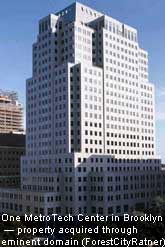
The Manhattan Institute
Center for Rethinking Development
by Senior Fellow Julia Vitullo-Martin
The track record of NYC's increasing reliance on eminent domain to condemn land for private development is worse than supporters will admit. Often paired with more government subsidies, sometimes the unintended consequences are depressed real estate prices and more blight. Will Kelo v. New London have any effect?
Posted by lumi at 8:11 AM
Harlem residents express concern over rapid growth
Amsterdam News: City planners, residents and development interests met to discuss residents' concerns about zoning changes and redevelopment of 125th St.
Though no speakers at the meeting identified themselves with any of the numerous private development projects in the works for 125th Street, the River-to-River Advisory Committee does include corporations invested in the area including Columbia University and Forest City Ratner, a Manhattan based company who pioneered 125th Street retail with Harlem Center, a 126,000-square-foot property anchored with a CVS and Marshalls.
NoLandGrab: FCR is usually identified as a "Brooklyn-based company," in reference to "Metrodreck," Atlantic Yards, and even Yonker's Ridge Hill Village (yes, FCR wants to build a "village," like Gehry is looking forward to designing a "whole neighborhood from scratch."). FCR is headquartered in Brooklyn, where they have built most of their particular brand of blight.
Should residents in Harlem be taking a skeptical look at the composition of the River-to-River Advisorry Committee? Ask the West Harlem Business Group and DDDb.
Posted by lumi at 7:39 AM
March 2, 2005
Neighborhood Activist as Sex Symbol
Curbed.com: While we werer musing about whether Leo or Brad would play Dan Goldstein in the movie about the arena fight, others were dreaming about the real thing.
[Dan Goldstein's] determination has made [him]an unlikely sex symbol for preservationists, and at least one female Curbed reader, who emails, "He's our dreamboat spokesperson. Maybe I want him for myself. He's certainly got a nice apartment." Neighborhood activism—so hot!
Posted by lumi at 5:59 PM
SCARY GEHRY: Plan Underway to Reduce Disney Hall Glare
NY Newsday: Gehry's Walt Disney Concert Hall will be undergoing a facelift to reduce the glare of the polished silver siding that has been reflecting heat energy and overwhelming the air conditioning systems of nearby residents.
WARNING: A McGehry franchise coming to a site near you.
Posted by lumi at 5:45 PM
Nets: Zo still showing N.J. little respect
Newark Star-Ledger:
In the same day, Mourning continues to complain about the Nets (25-32), even as he signs with the Heat, the Nets buy out its current aging center, Elden Cambell, so he can sign with Detriot, and Ratner admits his mistake in trading Martin in a live interview with Mike and the Mad Dog on WFAN.
Posted by lumi at 8:02 AM
NET 'FOOLISHNESS' IRRITATED ALONZO
NY Post:
Alonzo Mourning felt stuck in "foolishness," a situation he is glad to escape in Miami, where he'll continue his quest for an NBA title. Mourning signed with the Heat yesterday, completing a plan he developed last summer when he saw the Nets dissolving through the fire sale of Kenyon Martin.
NoLandGrab: The fans and media are growing tired with Mourning's whining about the Nets. Sort of makes you feel sorry for Kidd though.
Posted by lumi at 7:54 AM
Can the Supreme Court Curb Blight?
The Washington Times, commentary:
Where will the Supreme Court draw the line and will they look into the definition of blight?
Also, Yahoo! News, Op-Ed, TWO RIGHTS MAKE A WRONG
Posted by lumi at 7:45 AM
March 1, 2005
Nets' move to Brooklyn pushed back
Northwest Herald (Bloomberg News Service):
The owner of the New Jersey Nets said the team probably would not move to Brooklyn, N.Y., until the 2008-09 season, a year later than originally planned.
Posted by lumi at 12:31 PM
Ratner to be guest on Mike and the Mad Dog at 5PM
 WFAN Sports Radio, 660 AM:
The word is that Caring Bruce Ratner will be a guest on Mike and the Mad Dog, WFAN Sports Radio's afternoon sports-talk show at 5:00.
Mike Francesa and Christopher Russo don't take on-air calls during interviews, but you can still call and email the station with your questions and comments if they start pitching softballs and Ratner starts blaming everyone but himself for his mistakes. And above all, defend your neighborhood, because the last time we checked, the neighborhood is not blighted.
Telephone: 718-937-6666
Internet: http://wfan.com/instantaccess/
Posted by lumi at 12:31 PM
Letitia James Interview
 WNYC, Brian Lehrer: Brian Lehrer and Councilperson Letitia James discuss culture, education, ethnic diversity, affordable housing, the arena controversy, food and more.
James on Ratner:
This developer is a stealth developer who has done nothing but engage in secret meetings, behind closed doors and wants this project approved by “three men in a room.”
James on the arena:
The dichotomy between this development and jobs is a false dichotomy. The reality is that we want development at that site. The question is, "what type of development?"
I don’t think anyone would disagree that I should be involved with this project in some way, shape or form -- not to be invited to the table to have secret negotiations. It should be out, in the public, and be subject to some oversight.
Posted by lumi at 11:50 AM
WOW: editorial pages still afire a week after oral argements for Kelo
NY Post: A NEW BREED OF TAX TYRANT
If the mere possibility of increased tax revenues from a targeted private property is enshrined by the Supreme Court as a "public use," elected officials everywhere will have a potent new weapon with which to displace entire swaths of modest taxpayers and plan whole new "economically developed" societies.
Fort Wanye News-Sentinel, (KRT):
In eminent domain case, court threatens to shred a bedrock protection of private property
In-depth commentary Steven Greenhut, the author of "Abuse of Power," published last year.
So, the government cannot kill you, imprison you or take your stuff without giving you a chance to make your case, and it can take your stuff only for a public use. And it must pay you a fair price for it. Yet the justices, like those medieval scholars who argued about the number of angels who can dance on the head of a pin, seemed to be focused on irrelevancies and unable to grasp the fundamental issues.
Toronto Free Press: The most important property rights case in 50 years
If New London wins, no person anywhere in the United States can be secure in the ownership of private property. Just as the government has broadened its power of eminent domain to cover economic development and environmental protection, it will use this power to achieve whatever goal it chooses.
Tech Central Station: Eminent Domain, Imminent Theft
Well researched article with links to primary sources.
LA Daily News: Supreme Court pondering 'public use'
This op-ed piece explores how Kelo could affect property rights in CA and how Proposition 13 provided relief to property owners only to be supplanted by absurd findings of "blight."
Also:
MortgageNewsDaily.com: Eminent Domain - Your Home Is Your Castle !
American Daily: Condemning Private Property Rights
Quote of the day:
"The moment the idea is admitted into society that property is not as sacred as the laws of God, and that there is no force of law and public justice to protect it, anarchy and tyranny commence. Property must be secured or liberty cannot exist." -- John Adams
Posted by lumi at 9:33 AM
Ridge Hill funds may aid schools
The Journal News
Local governments use divide and conquer tactics in use to get controversial Forest City Ratner project approved. Only, this time it's Yonkers.
"We had fears long ago that they were going to pit groups against each other (to win support for the project)," said John Larkin, president of the Nepera Park-Grey Oaks Neighborhood Association. "They're painting this as the salvation of the schools, and it's not."
And, don't forget those government-based corporations that are running the show (Or is it corporation-based governments? We can never tell.):
Ridge Hill Development Corp., a quasi-governmental agency created by the Yonkers Industrial Development Agency to advance the project, could stand to gain $450 million in payments from Ratner through a proposed 77-year land lease if the City Council approves zoning changes that allow the project to happen.
Posted by lumi at 9:23 AM
Woj: Marv not so marvelous
Bergen Record
Columnist Adrian Wojnarowski takes Ratner, Inc. to task for shoving aside the highly-respected Ian Eagle to sign Marv Albert.
Eagle, out of the SU Class of '90, was one of those fast-rising stars, ending up on the Nets' sideline not long out of school, just like Albert had done with the Knicks. Eagle grew up in Queens, and as it turned out, that's the wrong borough to get to sit at the big kids' table with Bruce Ratner, Barry Baum and the rest of this Pocket-Protector Posse running his office now.
Together, they sucker punched Eagle, with Ratner, his pipsqueak lackeys and the YES Network executives holding Eagle's arms behind his back. It was a long, public and cruel emasculation. Albert crushed Eagle like a bug, because he could.
Posted by lumi at 9:10 AM
STERN HAND GAVE NETS MARV PUSH
NY Post
NBA Commish Stern played matchmaker in the Marv Albert-YES! deal, by pointing out to Ratner that bringing the Brooklyn-born play-by-play man on board would help with the Nets move to Brooklyn.
NoLandGrab: Been wondering why Ratner has been going around touting the Brooklyn connection? He's obviously more impressionable than most Brooklynites if he buys that sports-marketing swill.
Also:
The NY Times: Is Albert Nets' New Yes Man? 'Yes!' and No.
NY Newsday, Steve Zipay, Some Marvelous meals
Newark Star-Ledger: Nets: Marv a million-dollar YES man
SI.com, AP: Albert to join Nets telecasts in '05-06
Ratner said an arena in Brooklyn could be ready for the 2007-08 season, but that 2008-09 is more likely. -- SI, AP
Posted by lumi at 8:53 AM
Bruce Ratner Hopes...
Fans For Fair Play:
Ratner hopes you buy the lie that his project is a done deal, when in fact there are dozens of high hurdles for Ratner to get over.
Sports, politics, finance, unions and broken promises are the weapons of mass distraction Ratner uses to fight the long-term aspirations of a diverse community. Read the litany of hopes and lies that Ratner uses to sustain the belief that the arena is a "done deal."
Posted by lumi at 8:14 AM