September 17, 2012
In the Boroughs: Biz eyes kick from soccer
But park advocates wary of Flushing Meadows stadium.
Crain's NY Business
by Amanda Fung
New York City has green space out the wazoo, right? But what we don't have enough of is publicly subsidized sports stadiums.
The prospect of a big new soccer venue coming to Queens' largest park—the site of two World's Fairs—is winning the thumbs-up from everyone from soccer fans and local business owners to community and elected officials. But already, park advocates are up in arms over the possible loss of public space for yet another sports stadium. Nearby, the U.S. Tennis Association took 42 acres out of circulation for its three stadiums, the last of which was completed in 1997. At this point, however, it looks as though soccer's supporters have the upper hand.
"The stadium will create jobs and bring money to the shops and restaurants in the area," said Assemblyman Francisco Moya, a soccer fanatic who learned how to play at Flushing Meadows with his friends as a kid, and is today actively involved in negotiations to bring the stadium to the park. "It's a win-win for Queens. Rarely does a project come along that is beneficial to the local community and city."
He got that last part right, at least.
"They need to find a home for the stadium that does not displace valuable parkland," said Geoffrey Croft, president of NYC Park Advocates. "We have seen many acres of park taken away for commercial purposes."
..."I believe Major League Soccer intends to do the right thing when it comes to parkland," said Mr. Moya. "I am optimistic."
Not to mention a fool.
Posted by eric at 11:51 AM
September 14, 2012
Sports Plan Faces Fight
Community Opposition Swells in Queens Over Proposal for New Arenas and Mall
The Wall Street Journal
by Laura Kusisto
An ambitious Bloomberg administration plan to remake a corner of Queens with two professional-league sports arenas and a roughly 1-million-square-foot mall is meeting with unexpected and growing opposition that could stymie the effort.

Although the projects are separate from each other, they are all in or near Flushing Meadows Corona Park and have roiled groups that accuse the city of eroding green space without considering the impact of an influx of traffic and thousands of new spectators and shoppers.
Importantly, the coalition of about a half-dozen groups has the initial support of the local City Council member—who, in the tradition of the council, has almost unilateral power to hold up necessary approvals.
Just like with Atlantic Yards, where Council Member Letitia James... oh, wait a minute.
The challenge could stall the projects, which are among Mayor Michael Bloomberg's signature development plans: an 8,000-seat U.S. Tennis Association stadium, a possible 25,000-seat Major League Soccer stadium—both in the park—and the mall on a gritty swath near Citi Field, across from the park.
...A Bloomberg spokesperson said the projects are vital to reviving the area. "In all of our conversations with Queens community groups, we hear the same message consistently: the borough needs more jobs and economic activity. These projects would meet that need in spectacular fashion and provide employment to thousands of Queens residents," said spokeswoman Julie Wood.
And surely they're clamoring for less park space, which New York has in spades, right?
Related coverage...
Curbed, Flushing Sports Arenas: the Barclays Center of Queens?
It's a familiar story: local residents are speaking out against a plan to bring a new sports arena to their neighborhood. But instead of the middle of Brooklyn, this is the biggest park in Queens. And instead of one NBA arena, it's two sports arenas.
...All of the plans are a ways away from even breaking ground, but clearly the local fight is picking up steam. Will the people have Queens have more power than the anti-Barclays Brooklynites?
Posted by eric at 11:43 AM
September 9, 2012
WSJ: Public benefits for big projects like Atlantic Yards lag without "carefully drawn contracts;" actually, the AY contract was carefully drawn, just with provisions giving the developer 25 years
Atlantic Yards Report
The Wall Street Journal published a round-up yesterday headlined When Big Projects Stall: Brooklyn's Atlantic Yards, Like Others Across the Country, Brings Mixed Results. It's got some insight, but I have to think that when reporter Eliot Brown was writing for the New York Observer, he was allowed to be a wee bit more skeptical:
...But as the borough gears up for the brown, metal-wrapped arena's opening event, a Jay-Z concert on Sept. 28 before the Nets take court this fall, the surrounding neighborhood still is waiting for housing and other benefits once touted by the developer as part of a planned $4.9 billion real-estate project known as Atlantic Yards.
As one of the largest mixed-use projects under way in the country, Atlantic Yards was meant to transform a swath of Brooklyn. But the missing pieces of the project highlight the challenges many U.S. cities face with large-scale real-estate developments that have become stalled amid a slow economic recovery, leaving them without taxes, jobs and amenities once pledged to the public.
Historically, such delays or loss of pledged benefits have been common for large private and public projects alike, said Jerold Kayden, an urban planning professor at Harvard University. "Too often, without carefully drawn contracts, the project gets built without these things," Mr. Kayden said of public benefits to large developments, "and the public ends up with the short end of the stick."Well, there is a carefully drawn contract with Atlantic Yards. It was just carefully--and quietly--drawn so Forest City Ratner would have 25 years to build the project. The failure to study the impact of that buildout was ruled illegal, but nobody gets sanctioned for delaying the benefits.
Moreover, nobody gets sanctioned for providing cost-benefit scenarios that assumed a full buildout within a decade, rather than a range of scenarios, from optimistic to pessimistic.
Posted by steve at 10:25 PM
August 16, 2012
The MTA and a Flushing Meadows soccer stadium
2nd Ave. Sagas
by Benjamin Kabak
More on the potential park-grab for a Major League Soccer stadium, which may also include part of a rail yard — and we know how well that always goes.
Despite two new baseball stadiums and a basketball arena, New York City’s appetite for sports venues has seemingly not been sated as rumors are swirling of Major League Soccer’s interest in Queens. Looking to expand into New York City proper, the U.S. professional soccer league has its eye on a parcel of Flushing Meadows Corona Park, and although these plans have a long way to go, the MTA has a role to play yet.
Stories and support for a Queens soccer stadium have been percolating out of Albany for much of the summer. The story took off earlier this week when Fredric Dicker of The Post ran a piece relying heavily on a few anonymous sources. MLS, he alleged, is nearing a deal for the stadium. The catch is that the city would have to give up at least nine acres of park land in Flushing Meadows, and the MTA would have to sell some of the land it owns near the LIRR tracks and Corona Yard.
...For years, we’ve watched a parade of MTA higher-ups sell off authority land for next to nothing. The sweetheart deal the Authority gave Bruce Ratner for his Atlantic Yards development has rankled politicians and Brooklynites for years, and even the Hudson Yards deal had to be further incentivized for the MTA to realize any money. Lhota though seems to get what’s at stake. The MTA isn’t in a position to give up its assets without drawing value for them, and if the time comes to sell some land in Queens for a soccer stadium, the MTA should maximize its revenue. That day though may be a long time coming.
Posted by eric at 5:02 PM
August 14, 2012
Queens MLS stadium could start construction by spring! Or not
Field of Schemes
by Neil de Mause
Neil de Mause's report on efforts to locate a soccer stadium in Queens' Flushing Meadows-Corona Park (since New York City has plenty of surplus park space, we're guessing) elicited this comment from reader John Bladen:
Surely the MLS guys are missing the obvious here, Neil? I mean, Citi Field has been in place for, well, several years now. It clearly qualifies as a blighted landscape (as would the rest of the park and Arthur Ashe stadium) under the court approved process used by Mr. Ratner to ram through his Atlantic yards proposal (which, of course, hasn’t been finished, and will never be finished as it was originally designed and sold to the public… or at least the legislators who gave approval).
I say, use eminent domain. Declare the whole complex (including the trees, which are a danger to lightning, in the words of the late great Spike Milligan) blighted, evict the moribund tenants, bulldoze everything, and build whatever you want.
Is this a Big Time City or isn’t it?
Posted by eric at 10:29 AM
August 9, 2012
Do Basketball Arenas Spur Economic Development?
The Atlantic Cities
by Richard Florida
Three guesses, and the first two don't count.
Brooklyn’s Barclays Center, the Nets' generously tax-payer subsidized new home, was originally sold to the borough as a showcase for starchitect Frank Gehry (who ended up not designing it). It was supposed to be the anchor of a vast office and residential complex, The Atlantic Yards, which has yet to be built and will likely be downscaled. As neighborhood residents brace themselves for monster traffic jams and noisy crowds in anticipation of its September opening, a compelling new study by Geoffrey Propheter of George Washington University in The Journal of Urban Affairs sheds new light on precisely the question that should have been addressed before ground was broken: Are basketball arenas catalysts of economic development, or not?
Major public financing for arenas began in the 1950s and 1960s as older stadiums built in the early 1900s began to show signs of age. By the 1970s, a majority of major sports venues were publically subsidized. The study notes than "since 2004, voters in five cities have supported more than $1.5 billion in tax subsidies for new sports facilities or upgrades to existing ones."
Sports boosters claim the new stadiums bring economic benefits and add to a city’s "big league" status. But objective academic studies have countered this view, noting that stadiums add little in the way of actual economic benefit.
Posted by eric at 12:37 PM
August 5, 2012
What's behind the rocketing value of the Brooklyn Nets? Not just Prokhorov and Jay-Z, but public assistance
Atlantic Yards Report
An article in Crain's New York Business is headlined Nuts for the Nets: How a freewheeling Russian businessman turned the NBA's doormat into its hottest property.
Buoyed by the basketball team's move to Brooklyn from New Jersey, the duo have turned the Nets from a laughingstock that played to empty arenas and hemorrhaged cash into a franchise expected to sell out nightly and increase revenue by more than $50 million this season. Sponsorships are soaring, merchandise is flying off the shelves and the once-shunned Nets have become a desired destination for NBA stars.
Mr. Prokhorov's free spending—he committed about $340 million to player salaries last month alone—and his move to tap Jay-Z's star power have made the Nets the talk of the league. If that chatter translates to wins, the Nets could become the NBA's hottest story of the year.
There's something barely hinted in the article: a new arena, with luxury suites and enormous sponsorship opportunities, in the country's biggest media market, is key to Prokhorov's willingness to spend money and the new attention paid to the team.
And what enabled that? Public subsidies and other assistance, including the gift of naming rights for a (nominally) publicly-owned arena.
In other words, the upside goes significantly in one direction.
Posted by steve at 7:11 PM
August 1, 2012
Who's Against the Olympics? Taxpayers Most Notably
Real Clear Markets
by Steven Malanga
On July 6, 2005, Londoners celebrated in Trafalgar Square as giant television screens carried the announcement by the International Olympic Committee that the city had won the right to host the 2012 Summer Olympics. Back in New York, Mayor Michael Bloomberg apologized to America because his city's bid to host those games, which Bloomberg had pursued ardently, fell short.
...But these sorts of experiences don't stop elected officials. In New York may Mayor Bloomberg lost the Olympics' bid but then turned his attention to helping push through the massive Atlantic Yards redevelopment project in Brooklyn, whose centerpiece is the new Barclay's Center arena where the former New Jersey Nets will now play. To make the 22-acre project possible in the middle of the borough New York government used the threat of eminent domain to displace some 400 residents and two dozen businesses. Politicians also gave the developers hundreds of millions of dollars in tax incentives to construct the arena, all on the basis that the project would upgrade a neighborhood where people were already paying upwards of $500,000 for condos and co-ops. Of course, the marketplace has a way of intervening with the best laid plans of government, and so while the Barclays arena is scheduled to open this fall, the developers have pushed back construction of the project's residential towers thanks to the housing bust.
After Chicago lost its bid in 2009 to host the 2016 Olympics, President Obama criticized naysayers who urged the city not to try. "I mean, who's against the Olympics?" he said. Right now in London I'm betting there are quite a few taxpayers and business owners who can provide the President with an adequate answer to that question.
Posted by eric at 8:04 PM
July 13, 2012
Arena and Stadium Names – Stupid As Ever
Is Every Arena Owner A Corporate Whore?
Stuff Nobody Cares About
Um, yes?
Looking at Rush’s upcoming concert tour of North America I noticed something interesting. Take a look at this schedule:
 |
Only one arena is not named after some corporation (The Palace in Michigan). [NLG: This list is just a snippet of the list — click through for the full roster.]
No arena except The Palace has the name of the city it is located in or attaches the local sports team to its name. Virtually every arena has sold its “naming rights.” Yes, arenas today still have unique names if you consider auto companies, airlines, tech companies, mega-banks and their ilk to be representative of the city.
If someone asked me where The Quicken Loans Arena, The Jiffy-Lube Live Amphitheater or The Honda Center was I’d be hard pressed to tell you. What do these corporate names say about the cities and the arenas they stuck their names on?
...What we have is endemic of America as a whole – get every dollar you can. Letting the teams or cities who control the naming rights sell out to the highest bidder. Slap some temporary name on an arena or stadium for big money. How does this benefit the public who usually pays for the facility?
Posted by eric at 11:19 AM
July 9, 2012
More Sports Glummery
Noticing New York
As discussed in my previous Sports Glummery article there are those who dream of inaugurating a moderated form of fandom whereby individuals of conscience can with proper restraint avoid complicity with the dastardly deeds done in the pursuit of profit by the highly commercialized sports industry. Others, like myself, would prefer to keep life simple: We would shun the industry to effect a clear-cut divorce and separation. Whatever one may wish for, escaping complicity may not be so easy.
It turns out, according to recent analysis that even those of us who never watch professional sports can blame the franchises running that industry for significantly driving up the cost of our cable television bills: 90 percent of Americans pay for cable, satellite or fiber optic television, and according to the Wall Street Journal in 2010, about 40 percent of consumers' basic cable bills probably went towards sports programming.
Posted by eric at 12:22 PM
June 26, 2012
Funding questions resurface for San Francisco 49ers stadium after board yanks $30 million
San Jose Mercury News
by Mike Rosenberg
Schools before stadiums? Why, that's downright un-American.
Following a sudden $30 million loss of tax funds, the San Francisco 49ers and Santa Clara leaders said Monday they would not slow stadium construction even as they scrambled to figure out how the cut could affect the rest of the money needed to build the project.
An oversight board consisting of officials from around Santa Clara County on Friday used a new state law to claim the redevelopment funds, which voters had earmarked for the stadium, should be used on things like education and not a pro sports stadium.
While the money is a tiny fraction of what's needed for the $1.2 billion stadium, it served as the initial building block to fund the rest of the project, similar to a down payment on a home mortgage. The tax funds were used to secure up to $950 million in bank loans, which capped the team's decade-long saga to finance a new home field.
If the loans disappear or shrink, it could delay the project -- or worse -- just months after a festive groundbreaking in April. But officials first are preparing their legal strategy, starting with an appeal to the state and negotiations with the county.
Posted by eric at 9:48 AM
June 25, 2012
Sports Glummery
Noticing New York
Michael D.D. White bills this as a post [about] sports fandom [in which you are] going to get to read about Jane Jacobs quoting evolutionary biologist Stephen Jay Gould on the subject of baseball using language you have to look up in the dictionary.
 |
(Above, a cartoon by Mark Hurwitt, that perhaps doesn’t precisely coincide with what I am saying in this article, except at the very end. More about Mr. Hurwitt here. Judy Gorman, Mr. Hurwitt’s wife, a singer musician whose repertoire includes a number of activist protest songs- including Leonard Cohen’s “Everybody Knows”- is performing at the Brooklyn Heights Cinema on Wednesday night, June 27, 1912, at 9:00 PM. I am expecting that one of her songs will be “Everybody Knows” – See DDDB’s open letter to Mr. Cohen mentioning this song.)
...Even without putting adolescence into the mix, sports fandom seems to be frequently accompanied by a lack of critical thinking, an abandonment of judgement. That doesn’t mean that sports fans should be denied their own choices, but when such a lack of critical thinking and judgment is abused as an opportunity to hurt others who are not in a position to look out for themselves it becomes highly objectionable. Children and student athletes shouldn’t be taken advantage of, just the same way as I object, when the lack of critical thinking associated with sports fandom is abused to divert my taxes into the pockets of the wealthiest or to spearhead their unfair land grabs at the expense of the poor and others through eminent domain abuse.
When sports fandom collides with critical thinking about abuses it would seem that it ought to be a teachable moment where we as adults can educate the younger generation that there are limits that should not be surpassed in the name of uncritical fandom: Why then is it that we so often feel that it must instead be the reverse and that adult judgment, knowledge and experience must succumb to the childish urge to cater to fandom at all costs?
Posted by eric at 11:52 AM
June 16, 2012
Columnist Zirin: the story behind Oklahoma City's popular basketball team
Atlantic Yards Report
Dave Zirin, writing Red State Hoops: The Oklahoma City Thunder and the value of Seattle's rage for The Nation, reminds us that the popular basketball team has an ugly back story, based on moving it from Seattle and leveraging public support.
Seattle, he predicts, will again get pro hoops:
But on what terms will the Sonics come back? The people of Seattle took a principled stand against being ripped off by the NBA, and handing billionaires a $300 million bounty of corporate welfare. All of that courage, drama, and pain will have been for nothing if they just accept the terms that David Stern will attempt to impose. There is much you can do especially when the NBA demands a new arena as a precondition for pro ball to return. You can demand private funding for the new facility like they did in Philadelphia. Or you can demand a dollar of public ownership for every tax dollar that goes into the team. You can point to Green Bay and say, “If the Packers have fan ownership, then why can’t we?” It’s not just about having the Sonics return but how they return. Until that day, we should all hope to see the Thunder fall flat. Let every owner itching to move their team to greener pastures, see that it’s not all parades and glory. If [Thunder owners] Clay Bennett and Aubrey McClendon don't believe in climate change, let them believe in karma.
Just think: what if the city and state of New York had asked for a piece of the Barclays Center arena in exchange for, say, giving direct subsidies (both) and giving away naming rights (state)?
Posted by steve at 2:30 PM
June 1, 2012
Warriors' owners scout arena ideas in New York
San Francisco Chronicle
by Rusty Simmons
Be afraid, San Francisco. Be very afraid.
This week's visit to New York wasn't just good for [Golden State Warriors' co-owner Joe] Lacob's ego. The lottery trip was also a chance for Lacob and co-owner Peter Guber to tour the new Barclays Center in Brooklyn, talk about the renovations at New York City's Madison Square Garden and continue to work on their vision for their own state-of-the-art arena on the San Francisco waterfront.
The Warriors are planning a privately financed arena on Piers 30 and 32, with adjacent retail and restaurant space, to open for the 2017-18 NBA season. The project is expected to cost nearly $1 billion, including construction, refurbishment of the piers and possible bond payments in Oakland.
Here's betting that "privately financed" means that the taxpayers kick in about $700 million of the final total.
They learned quite a bit, and had their opinions, about the New York arenas, too. The Barclays Center is being built on a platform that is triangulated by three busy streets, making traffic and parking a potential mess.
The Warriors could have similar problems, but Lacob said he's hoping to secure more acreage that could be used for parking in San Francisco.
Because building more parking means less traffic? If you build it, they will drive.
[Lacob] even joked with a Nets executive that the Warriors might hire renowned architect Frank Gehry, who originally designed a $1 billion version of the Barclays Center.
Posted by eric at 9:43 AM
May 24, 2012
Today - 4:30 PM City Hall - Minneapolis Says NO to Stadium Tax Scam!! VampireSquid!
Daily Kos
Why, Minneapolites might get a brand-new football stadium! Why might that be bad?
FYI - this rally announcement is propagating on facebook and the list-serves of traditionally DFL allies in our area... a referendum is what voters put into place and deserve, and I think it is apalling that we would use our limited taxing and bonding capacities to subsidize a billionaire's pro sports team while expanding gambling. There is time to stop this theft and show the State Legislature and Governor Dayton that we hold schools, hospitals, basic functions of civilization to be higher priorities than corporate mass spectacle.
The Minneapolis City Council has taken a novel legislative approach.
In 1997, Mpls residents voted overwhelmingly to protect us from the power of the City Council to tax us for professional stadiums. As a result, our City Charter (Constitution) requires a referendum for any such costs over $10 million. City leaders asked for and received a State exemption from their own Charter! If the Council votes Yes on this plan, they will take away your hard-won right to a vote by the people!
If this makes you angry, DO SOMETHING NOW! Come to the rally, come to the Council meetings, and contact the members of the Mpls City Council!
Posted by eric at 10:42 PM
May 23, 2012
Golden State Warriors Officially Moving To San Francisco
SFist
by Andrew Dalton
Congratulations, San Francisco! You're getting your very own privately funded [wink, wink] pro basketball arena!
 |
At 10 a.m. Tuesday, Mayor Ed Lee and the Golden State Warriors front office are scheduled to make good on months of rumors by officially announcing a deal to bring the NBA franchise back to San Francisco proper. According to the Chronicle, the deal will bring a $500 million, privately financed 17,000 - 19,000-seat arena to Pier 30 along the southern Embarcadero. The new arena is expected to be completed in time for the team to start hosting home games on the waterfront during the 2017 - 2018 season.
The team hasn't drawn up any blueprints for the arena yet, but they are confident they can rehab the aging pier to the point where it can support the scores of basketball fans. In exchange for fixing up the pier, the team gets a long-term lease on the 13 waterfront acres as well as a 2-acre parking lot across the Embarcadero. As part of the deal, the new stadium will need to include a "maritime element," which could include ferry or water taxi service directly to the arena.
...The deal sounds like a win for city residents as well. According to the Mayor and team officials, the project won't require any money or new taxes from the city and will be 100% financed by the team's investment group.
NoLandGrab: You can absolutely, positively bank on two things here — when they say it "sounds like a win for city residents," it most surely won't be, and when they say it "won't require any money or new taxes from the city" and will be "100% financed by the team's investment group," that "investment group" will include the taxpayer's, and plenty of their money.
Image: The Warriors/Future Cities
Posted by eric at 10:43 AM
May 14, 2012
N.Y. arena subsidized
Edmonton Journal, Letters to the Editor
Some guy wrote a letter to the Edmonton Journal to correct some misperceptions in a letter the paper published last week.
Re: "Two cities, two arenas," by M.L. Clark, Letters, May 11.
M.L. Clark is grossly misinformed in writing that "another, presumably successful funding model appears to be in the works using American ingenuity and entrepreneurship" for the Barclays Center in Brooklyn, N.Y.
In reality, developer Bruce Ratner is receiving at least $726 million in taxpayer subsidies, according to a report issued by New York City's Independent Budget Office in 2009 (ibo.nyc.ny.us/iboreports/AtlanticYards091009.pdf).
However unwise the City of Edmonton's proposed subsidy package for a new arena may be, it surely pales beside the pork being larded on Ratner.
If Edmonton taxpayers are looking for a smarter, fairer way to fund a new arena, they most assuredly won't find it in Brooklyn.
Eric McClure, Brooklyn, N.Y.
Posted by eric at 11:09 AM
May 11, 2012
Two cities, two arenas
Edmonton Journal, Letters to the Editor
Ha! "M.L. Clark" must be a nom de plume for B.C. Ratner, since Mr. Ratner's [Charles?] "Barkley Center" is being subsidized to the tune of $726 million — at least.
Re: "Isles could be rolling into new Brooklyn arena," the Journal, May 1.
Help me understand why the City of Edmonton is contemplating funding a disproportionately large portion of the Daryl Katz boondoggle with taxpayers' money when another, presumably successful, funding model appears to be in the works using American ingenuity and entrepreneurship.
If by "American ingenuity and entrepreneurship" M.L. Clark means "backroom-dealing and subsidy-plundering, with some eminent-domain-abusing tossed in," then yes, American ingenuity and entrepreneurship are alive and well in Brooklyn.
The New York Islanders could be moving into Brooklyn's new state-of-the-art Barkley Center, owned and developed by Bruce Ratner, after Nassau County residents voted down a proposal that would earmark $400 million in public funds for building a new Nassau Coliseum.
Perhaps Katz and Mayor Stephen Mandel should have sought advice from Ratner rather than National Hockey League commissioner Gary Bettman on their recent trip to the Big Apple.
NoLandGrab: Seeking advice from Bruce Ratner on protecting taxpayers' money from boondoggles is like asking Willie Sutton to guard your bank vault. Mr. Sutton, of course, was ultimately apprehended a stone's throw from the site of Mr. Ratner's biggest score.
Posted by eric at 11:42 AM
May 10, 2012
Glendale's Public Hockey Project
The Cash-Strapped Arizona City Loses $12.9 Million a Year Supporting the NHL's Coyotes
The Wall Street Journal
by Brad Parks
And if neither the drunks nor the thugs get you, the never-ending debt payments just might.
On Monday, the Phoenix Coyotes advanced to the NHL's Western Conference finals for the first time since moving to the desert in 1996.
But here in Glendale, the Phoenix suburb where the Coyotes play, not everyone is cheering. "If you need a poster boy for how to pour your whole budget down the drain of professional sports, Glendale is the place," says Glendale resident Ken Jones, a retired construction superintendent, who calls the team a financial albatross.
...The city is obligated to make debt payments on the arena that average $12.6 million a year. To keep the team afloat, moreover, the city has been paying a so-called "arena management fee" of nearly $25 million a year to the NHL, which three years ago bought the Coyotes out of bankruptcy.
The NHL has announced a tentative sale to a group headed by former San Jose Sharks executive Greg Jamison, under terms that would essentially institutionalize Glendale's commitments. Under the proposal that the NHL has laid out for city council members, the city would continue paying an arena-management fee that would average about $14.5 million a year.
On top of the city's average $12.6 million in debt service, that amounts to annual expenses of about $27.1 million—to be offset by anticipated Coyotes-related revenue of $14.2 million, according to projections by Glendale's city management department. That adds up to a projected annual loss for Glendale of $12.9 million.
By the time the new ownership deal ran its course in 2033, Glendale would have paid $271 million—nearly $1,200 for each of its 226,721 citizens—to keep the team.
These expenses outweigh Glendale's Coyotes-related revenue by such a degree that Moody's has downgraded the city's bond rating twice in the last 18 months, citing the city's ongoing hockey payments. In part due to the Coyotes, the city's reserve fund has fallen to $11.7 million from $72.5 million six years ago. Facing a projected $35 million budget gap—in a city whose general revenue funds in the most recent fiscal year amounted to $142.6 million—Glendale is proposing to raise its property and sales tax rates, while slashing library hours and hiking fees for city services.
NoLandGrab: "Jobs, Housing & Hoops?" More like Drunks, Thugs and Debt.
Posted by eric at 12:57 PM
April 7, 2012
Does the NYC EDC's Seth Pinsky deserve credit for the Atlantic Yards arena? Not quite (but he does for other things)
Atlantic Yards Report
A New York Observer article, headlined online as Let’s Make a Deal! How Mike’s Mild-Mannered Closer Seth Pinsky Got the City Building Again: Dan Doctoroff's protégée picks up the mantle for PlaNYC., in print, as noted below, suggests that New York City Economic Development Corporation (NYC EDC) President Seth Pinsky also deserves credit for Atlantic Yards.
Here's the lead-off to the article:
Imagine, if you will, the landscape of New York City 15 years hence. A drive to Citi Field in Willets Point takes you past a pleasant if overpriced cluster of residential buildings, rather than seedy chop-shops. Roosevelt Island is home to a sprawling $2 billion applied-sciences campus spinning out an army of developers to populate ping-pong-table-clad start-up clusters from Dumbo to Union Square. On Manhattan’s far West Side, the rezoned stretch of Hudson Yards offers millions of square feet for office space, housing and retail and 14 acres of open public space. You can already see traces of a more built-up, scrubbed-down New York in Luna Park’s freshly-painted Scream Zone, the first new roller-coasters Coney Island has seen in 80 years, and the rapidly-metastasizing arena at Atlantic Yards, which will soon play home court to the rebranded Brooklyn Nets.
It’s hardly a scenario Seth Pinsky could have imagined in September 2008, when Lehman Brothers collapsed just seven months into his tenure as president of the New York City Economic Development Corporation (EDC), a not-for-profit arm of the Mayor’s office charged with fostering economic growth across the five boroughs.
...Under Mr. Pinsky’s leadership, however, observers say the EDC has transformed itself from a real estate matchmaker for companies seeking office space into a policy-setting organization, spearheading diversification away from the finance, insurance, real estate economy (also known by the unofficial acronym, FIRE, which had rarely seemed more apt). Thanks to what one former employee called Mr. Pinsky’s “savant”-like facility with financing and structuring deals, a number of projects first proposed in the ambitious early years of the Bloomberg administration have begun making real progress. Some of the projects, like Willets Point, have “bedeviled administrations for decades,” noted Mr. Pinsky. And then there’s the EDC’s ultimate sleight of hand: convincing Cornell and Stanford to engage in a bitter rivalry to build a $2 billion tech campus, all by waving a $100 million grant and a swath of land on a sleepy East River isle.
Does Pinksy deserve credit for that "rapidly-metastasizing arena" (which strikes me as a rather poor choice of words)? The article actually doesn't make that case, though NYC EDC did, from the beginning (and before Pinsky's presidency) coordinate the role of other city agencies.
NYC EDC did, however, recommend the use of EB-5 immigrant investor money, in which Forest City Ratner raised more than $200 million of low-interest financing from foreign (mostly Chinese) who were told they were investing in an arena. That may be crafty tactics, but I'm not sure Pinsky should be too proud of it.
Posted by steve at 3:03 PM
April 6, 2012
Yankee Stadium controversy down the memory hole: prominent coverage of belated ballfields, no dissenters heard
Atlantic Yards Report

Beaten again by AYR (and FOS)! But we wondered too how The Times was incapable of finding anyone still upset by the Yankees park grab.
Perhaps what Mayor Mike Bloomberg once said about the Atlantic Yards arena--“Nobody's going to remember how long it took, they're only going to look and see that it was done” --applies to the promises regarding the Yankee Stadium.
I wasn't the only person to notice something odd about the prominent and uniformly positive New York Times coverage today of the ballfields finally built to replace those lost for Yankee Stadium, A Public Park to Rival the Yankees’ Playground, complete with a front-page photo in both local and national editions.
Neil deMause wrote on Field of Schemes, New Bronx ballfields open, six years after old ones razed by Yankees:
For those of you who've been wondering when the new public ballfields on the site of the original Yankee Stadium would finally be opening, well, here they are, only 16 months late, and nearly six years after the neighborhood's old ballfields were bulldozed to make way for the Yankees' new $2 billion stadium and parking garages. As the New York Daily News reports, "The new fields are open to local kids, but only when not under maintenance or being used by teams that buy permits."
Curious choices
de Mause pointed out that the Times never covered "the actual debates over whether [to] build the Yankees' new stadium" that prominently. Remember the Yankees' dubious claim that they would move to New Jersey--away from their historic home and the city's media market--without sufficient subsidies and government help?
Related content...
Field of Schemes, New Bronx ballfields open, six years after old ones razed by Yankees
What's this? A critic has come out of hiding?
Jordan Moss of Bronx Matters further notes that "in a story regarding a land use issue this big for the Bronx an interview or two with one of the prominent local activists or former community board members who opposed the stadium deal (they were ditched from CB4 by then-BP Adolfo Carrion, Jr.) would have been warranted..."
The New York Times, A Public Park to Rival the Yankees’ Playground
Even onetime opponents of the stadium deal are coming around. “I figured they were going to pull a fast one and give us a little corner somewhere,” said Jerry Figueroa, 43, as he watched his son play ball. “But they’ve made a believer out of me.”
Paul Bales, who exercises in the new parks, said he used to hear people carping about their lost parks at every turn, on trains and buses and in convenience stores.
“Now nobody’s complaining,” Mr. Bales, 40, said. “Everybody got what they wanted: the fans got their stadium, and the community got their parks back. Everything is better.”
NoLandGrab: Aw, everyone loves a happy ending.
Posted by eric at 10:04 PM
April 3, 2012
New Macombs Dam Park ballfields in Bronx on site of former Yankee Stadium open for first baseball game
All Hallows plays Cardinal Hayes on lush new ballfields
NY Daily News
by Daniel Beekman
Right on time? Not even close.
The grass was green, the sky was blue and the players were in heaven Monday as the new Macombs Dam Park ballfields hosted their first baseball game.
Built on the former site of the House That Ruth Built to replace parkland bulldozed to make way for the new Yankee Stadium, the fields boast lush Kentucky bluegrass, sturdy bleachers and plaques to honor baseball history.
Frieze panels from the old stadium overlook the three fields and a blue outline marks the historic Bronx Bombers diamond.
"It feels great to play here," said Lance Montano, 17, an All Hallows High School senior who plays first base. "The park is brand new and the grass is perfect."
But neighbors and players who still feel "shortchanged" by the project described the opening day matchup between All Hallows and Cardinal Hayes High School as bittersweet. The new stadium opened on schedule in 2009 but work on the new Macombs Dam fields only began in 2010.
Local ballplayers went nearly six years without a regulation baseball diamond in their nabe. Pickup play halted and the All Hallows Gaels bused to home games on Staten Island.
Posted by eric at 9:31 PM
March 22, 2012
Prohibition-Era Liquor Store Near Yankee Stadium Closes Doors
DNAinfo
by Patrick Wall
Not only did the new Yankee Stadium kill the neighborhood's trees — it's killing the Bronx's mom-and-pop businesses, too.
It sold its first bottle of liquor in 1934, one year after the end of Prohibition, in the depths of the Great Depression, in the shadow of Yankee Stadium.
It continued to sell spirits from its narrow perch in the Bronx when the neighborhood bustled, then went down in flames during the arson-filled 1970s, and was later rebuilt.
But at the end of this month, after more than 75 years in business, Stadium Wines and Liquor will shut its doors, a victim of raised rents and sluggish sales that the owner, like other nearby merchants, said were at least partly caused by the construction of the new Yankee Stadium.
"The store had been here for 70 years," Manuel Mercedes, the store’s fourth and current owner, recently recalled thinking in 2006 when construction on the new stadium began. "I couldn’t think why it wouldn’t stay here."
...But six years later, the shop’s yearly revenues have plummeted back to about $800,000, while rent has jumped to about $11,100 per month, according to Mercedes.
He, along with several other merchants on East 161st Street, acknowledge that the recession took a big bite out of business. But they say the deepest dent in their bottom lines came in 2009, when the new Yankee Stadium opened.
"It killed business here," said Joe Bastone, owner of the Yankee Tavern, which opened in 1923 and has served the likes of Babe Ruth and Joe DiMaggio.
"The first day the stadium opened my food business was down 75 percent," Bastone said, adding that sales have since inched up, but not to their pre-move levels, and only after he lowered prices.
The merchants cite several problems with the new stadium.
Posted by eric at 11:33 PM
March 1, 2012
Barclays has lesson for arena advocates
Edmonton Journal
by Paula Simons
Edmontonians are debating the merits of a proposed new arena...
But as Battle for Brooklyn, an award-winning documentary film by Michael Galinsky and Suki Hawley illustrates, it's easy for municipal politicians and civic boosters to get swept up in the excitement of glitzy arena proposals without considering all the economic and social costs.
"No arena or stadium ever ends up being a net benefit," Galinsky says. "How much public investment is there per job? When is that money going to come back? There's a cost to these things, and who's going to bear it? The public."
Galinsky's film, which plays in Edmonton this Sunday as part of the Global Visions Film Festival, documents the fight between the developers of the Atlantic Yards project, Forest City Ratner, and a group of feisty Brooklynites opposed to the project.
...It's like a giant shell game, as municipalities scramble to lure or retain pro sports teams with shiny new facilities, promising taxpayers wonderful economic and social benefits, which may or may not materialize. And the more a community like Newark or Brooklyn or Edmonton suffers from an inferiority complex, it seems, the more vulnerable it is to the pressure and the promise.
"I think it's because we're all so easy to roll over and we don't pay attention," says Galinsky.
"We look at our politicians and we think, 'They can't be that out of their minds.' And then it turns out that they are."
Posted by eric at 9:49 AM
February 8, 2012
Super Bowl 2012: Are Sports Stadiums Ripping Off Cities?
International Business Times
by Roland Li
Um, yes?
When the New York Giants and New England Patriots battle in Super Bowl XLVI on Sunday, they'll be playing in a stadium that was largely financed by taxpayers.
Don't worry, you didn't miss it. We missed this article.
Lucas Oil Stadium in Indianapolis cost roughly $720 million, with the majority of costs financed by state and city taxes increases. The Indianapolis Colts, valued at $1.06 billion by Forbes, contributed $100 million and pays $250,000 per year in rent.
The stadium was projected by planners to contribute $2.25 billion in economic benefit over ten years and create 4,200 new jobs and 4,900 temporary construction jobs. But there's never been a conclusive study that directly ties the construction of new stadiums to economic growth, and some critics dispute the positive benefits of stadiums, which have collectively received around $20 billion in U.S. subsidies in the last two decades.
...But the most controverial arena has been Forest City Ratner's Barclays Center at Atlantic Yards in Brooklyn. Conceived in the early 2000s, the project received $511 million tax free bonds in 2009, but had to clear lawsuits challenging the use of eminent domain to seize private property. A design by Frank Gehry was later dropped in favor of SHoP to cut costs, and prefabricated steel is being used on residential towers for more savings. The arena is set to open later this year.
Although Kroessler declined to speculate on the potential for tax subsidies for the next generation of stadiums, the trend appears to be continuing throughout the country.
"I don't see any great pushback," said [John Jay College professor Jeffrey] Kroessler.
Posted by eric at 11:36 AM
February 5, 2012
As Super Bowl Shows, Build Stadiums for Love and Not Money: View
Bloomberg View
As you watch the Super Bowl Feb. 5, spare a thought for the taxpayers in the host city of Indianapolis. The stadium in which the game will be played has been financed largely at their expense and, like so many sports venues built with public money, the cost just keeps growing.
Lucas Oil Stadium, where the Colts play eight regular season games per year, has every amenity: a retractable roof, state-of-the-art turf, seven locker rooms, 137 luxury suites, 1,000 flat-screen televisions. And well it should: It cost $720 million to build.
Of this, the Colts paid only $100 million. To cover the rest, local officials raised taxes on hotels, restaurants and rental cars, and issued bonds that soon led to ballooning financing costs.
...
Although the economic rationale for publicly financing stadiums is poor, an important fact remains: People really, really like sports. And they will often be willing to pay a high price to keep their favorite teams or lure new ones. Sports are part of what makes a city a city -- what would Boston be without the Red Sox, or Chicago without the Bears?
But this calculus is an ethereal one. What price could a city government place on its citizens’ love for their sports teams?
The answer is that public funding for new sports stadiums should be up to voters to decide. Cities should make sure the public has access to independent evaluations of the costs and benefits of building a stadium -- not just the inflated “economic-impact studies” done at the behest of team owners and publicized in the media. It should also be made clear exactly what other subsidies the sports teams will be getting: from cheap loans to cheap rent to cheap land.
Related coverage...
Atlantic Yards Report, Bloomberg (well, his media company) calls for public vote on funding for sports facilities
Now the Brooklyn arena, as well as the two new baseball stadiums, have relatively less direct subsidy than many other deals.
But they didn't need it. They get indirect subsidies, access to sponsors in the nation's biggest media market, and other revenue opportunities.
The city government--hello, Mr. Bloomberg--produced and embraced cost-benefit analyses for the arena that differed significantly from that produced by the NYC Independent Budget Office.
And there was never a vote.
Posted by steve at 1:01 PM
February 3, 2012
Pricey Yankee Stadium parking garages hardly used and owner heading for default on $237 million in bonds
Lots part of new stadium deal but have turned into waste of space — 21 acres — producing nothing for taxpayers
NY Daily News
by Juan Gonzalez
Pshaw! Parking garages surely are a good deal for the taxpayers. Uh...
THE FIRM that built and manages the new Yankee Stadium parking garages can’t repay $237 million in tax-exempt bonds the Bloomberg administration arranged for it four years ago, new financial records show.
Bronx Parking Development Company LLC is running perilously low on cash reserves and faces a looming default by the end of the year, according to a report filed Friday by a trustee for the firm’s bondholders.
Time is running out, in other words, to avoid one of the biggest failures in decades of bonds issued by a New York City agency.
The simple fact is that Bloomberg and his aides made a costly mistake when they succumbed back in 2005 to the Yankees’ demand for a 9,000-space garage system. It was all part of the deal for the team to build a new stadium in the Bronx.
...Bronx Parking Development has turned into a giant tax deadbeat. The firm, which is not connected to the Yankees, has failed to pay any rent or property taxes, even though the garages sit on 21 acres of leased public land.
It currently owes the city a whopping $25 million.
Posted by eric at 1:01 PM
Super Bowl Lands on Taxpayers’ Backs as Stadium Deal Turns Sour
Bloomberg Businessweek
by Aaron Kuriloff and Darrell Preston
Hosting the Super Bowl has to be a civic moneymaker, right? Guess again.
While Super Bowl fans are riding zip lines through downtown Indianapolis this week in the runup to the National Football League’s championship game, taxpayers are digging deeper in their pockets to pay for the stadium where the game will be played.
The $720 million Lucas Oil Stadium, where the New York Giants meet the New England Patriots on Feb. 5, has prompted local officials to raise hotel, restaurant and rental car taxes, and make other payments on top of about $43 million in unexpected financing costs related to their sports and convention facilities.
“They said, ‘We’re going to have one great fantastic party with an unbelievable advertisement for Indianapolis and it isn’t going to cost taxpayers a dime,’” said Pat Andrews, 60, a blogger and community activist who ran unsuccessfully for City Council last year. “Well, baloney.”
Posted by eric at 12:57 PM
January 2, 2012
RebelMart's Mimeograph Machine, on sports: "we sit in silence when owners and leagues rip us off"
Atlantic Yards Report
Musician/designer/activist Scott M.X. Turner, he of the website/group Fans for Fair Play and the one-man band RebelMart, has moved from Brooklyn to Seattle, but he still keeps in touch with his daily Mimeograph Machine, a newsletter/broadside. (Sign up at rebelmartmx[at]gmail[dot]com.)
Below, with his permission, is Volume 1, Number 25, from 12/28/11, expressing some of the dismay regarding big-time sports that's going around.
RebelMart's Mimeograph Machine, on Sports
VOL. 1, NUMBER 25
Sports...
Fun. Despicable. Macho. Colorful. Epic. Eccentric. Racist. Capitalist. Good exercise. Sexist. Drunken. Homophobic. Adrenalizing. Musical. Classist. Memorable. Bonding. Violent. Lucrative. Divisive. Seductive. Life-affirming. Deadly.
I find it hard to explain to people why I like sports. It used to be because I ran with lots of political activists who deplored sports. They're right to. But they're wrong to toss it out with the bathwater.
They were also wrong to dismiss sports' enormous implications in the world today. A lot of sporting elements flail about in the world of political activism. In the battle royale of The People vs. The Man, knowing about sports is a vital thing. I'd say "tactic," but that makes the whole world-revolution thing sound exploitative. I like the whole world-revolution thing, you know.
I'm still a lefty and I still have that discussion all the time. I guess what I really mean is, I find it hard to explain to myself why I like sports. At least, still like sports.
And that's the rosin-caked razor's edge my sports-love balances atop.
I like sports and deplore sports. What other thing, besides life itself, contains as many descriptives as the top of this issue of the Mimeograph Machine?
Michael O'Keeffe, one of New York's best sportswriters -- hell, one of the Apple's best journalists, period -- once told me "Sports makes it hard to like sports."
Yeah!
I got on this jag about sports today after reading an article in the New York Times today -- about the New York Mets' desperate finances. Too many belly-button-examining books have been written about sports'n'culture'n'politics. Still, it made me think again about a very basic issue.
Sports fans are incredibly smart. Via sports, we can crunch numbers, solve complex geometry in milliseconds, explore military strategies, fathom chemistry, analyze financial formulas, present a sprawling vista of facts at the drop of a hat, beat Lincoln and Douglas in a debate, and most importantly, detect bullshit instantaneously.
So how come we sports fans are such fucking idiots?
We love our teams, our players, our games all the while knowing they're none of those things "ours." Jerry Seinfeld once famously said "you're actually rooting for the clothes." [AYR: see the video] Civic pride is a pretty unquantifiable thing -- yet it's always used to justify all the wasteful projects spend taxpayer dollars on.
Posted by steve at 4:26 PM
December 6, 2011
Feds open SEC probe into Miami Marlins stadium deal
The U.S. Securities & Exchange Commission has subpoenaed records from Miami-Dade County and Miami over the deal to build a new ballpark for the Marlins.
Miami Herald
by Charles Rabin, Martha Brannigan and Patricia Mazzei
Look who's just catching on!
Federal authorities have opened a wide-ranging investigation into the Miami Marlins’ controversial ballpark deal with Miami-Dade County and the city of Miami, demanding financial information underpinning nearly $500 million in bond sales as well as records of campaign contributions from the Marlins to local and state elected leaders.
In a pair of lengthy letters delivered to government attorneys Thursday, the U.S. Securities & Exchange Commission gave the city and county until Jan. 6 to deliver everything from minutes of meetings between government leaders and Marlins owner Jeffrey Loria and Major League Baseball Commissioner Bud Selig, to records of Marlins finances dating back to 2007.
In the almost-identical subpoenas, the SEC also requested documents concerning stadium parking garages built by Miami. The Miami Herald reported Nov. 22 that city leaders are now complaining they were hoodwinked into likely having to pay an annual $2 million tax bill on the garages.
The financing agreement to build the controversial new stadium in Little Havana left the county and city on the hook for almost 80 percent of the overall $634 million tab, which critics considered a giveaway to the Marlins. The deal was a contributing factor in the recall of Miami-Dade Mayor Carlos Alvarez, who championed it.
...Neither subpoena said exactly what the SEC was looking for, though federal investigations into municipalities generally focus on whether bond holders were misled about finances while being enticed to purchase the bonds.
Two former SEC attorneys who reviewed the subpoenas for The Herald said government investigators are likely looking at whether the city and county did proper due diligence into the Marlins’ finances, and whether there was any influence peddling to local politicians.
“There’s always the issue of pay-to-play. They want to know whether there were unlawful contributions,” said William Nortman, a Fort Lauderdale attorney and former SEC regional administrator. “Don’t forget, there was a lot of controversy over the building of this in Miami. They are examining how this came to be. They want to know whether inappropriate payments were made.”
NoLandGrab: Hey, SEC, you might want to look into another recent deal in which approximately $500 million of bonds were sold to fund construction of a basketball arena.
Posted by eric at 1:25 PM
November 8, 2011
Rogues Gallery: The AIANY (“American Institute of Architects New York”) Subway Corridor Posters Under the IFC Center Showing “Urbanized”
Noticing New York
Michael D.D. White notices something familiar on a subway advert, and offers a remedy.
On our way to catch and write about “Urbanized,” the new Gary Hustwit documentary about urban design we discovered, heading up from the A Train, that the subway corridor directly under the IFC Center theater hosting the film is lined with AIANY (“American Institute of Architects New York”) posters featuring different architectural projects. Some of those images are of Hall of Shame subsidy grabbers, and for sure at least the pictures of the of the net-public-loss Atlantic Yards Prokhorov/Ratner (“Barclays”) basketball arena are destined to be disgruntling.
 |
...
The subway images promoting the Prokhorov/Ratner arena and these other government assisted, government subsidized projects is also part of something else that has been a Noticing New York preoccupation recently: The pummeling we are getting everywhere we go reflecting a severe imbalance in the public dialogue delivered via paid speech. Big picture, the skewing of wealth in this country is working in conjunction with the increasing privatization of the traditional avenues and elements of public speech (including but not limited to public spaces and streets in which to speak). That means that we are forever being subjected to ubiquitous, insistent cues and reinforcements of (for example) the way Forest City Ratner wants things perceived.
Posted by eric at 9:58 AM
November 7, 2011
Political Footballs: L.A.'s Misguided Plans For A Downtown Stadium
Forbes
by Joel Kotkin
When is a stadium deal a bad deal? Um, always?
Indeed years of independent investigations have discovered that urban vanity projects like sports teams and convention centers add little to permanent employment or overall regional economic well-being. As a Minneapolis Fed study revealed, consumers simply shift their expenditures from other activities to the new stadium. Certainly mega-stadiums have done little to boost sad-sack, depopulating cities such as St. Louis, Baltimore or Cleveland.
Commitments to mega-projects tend to further drive urban areas into debt, largely by issuing more bonds that taxpayers are obligated to pay back. One particularly gruesome case can be found in Harrisburg, Pa., whose underwriting of a minor league baseball team helped push the city into bankruptcy. To get the stadium deal, Los Angeles, already over-indebted and suffering a poor credit rating, will issue another $275 million.
Such projects often obscure the real and more complex challenge of nurturing broad-based economic growth. This would require substantive change in a city or regional political culture. Instead the football stadium services two basic political constituencies: large unions and big-time speculators, particularly in the downtown area. The fact that the stadium will be built with union labor, for example, all but guaranteed its approval by the city’s trade union-dominated council.
Posted by eric at 11:11 AM
October 10, 2011
Want to be NFL owner? Packers near 5th stock sale
AP via Yahoo! Sports
by Dinesh Ramde
Here's a novel idea — a stadium renovation being done without public money.
The Green Bay Packers, the NFL’s only publicly owned team, are moving toward a new stock sale by the end of the year to raise money that would help pay for $130 million in renovations at historic Lambeau Field.
Each share would likely cost about $200 and include voting rights, though the value wouldn’t appreciate and there would be no dividends. Stockholders would be able to attend annual meetings at Lambeau, and they’d enjoy such perks as tours of the playing field and locker rooms.
We're not sure that stock that doesn't appreciate or pay dividends and can't be resold is a good investment, but heck, that's true of most investments these days.
The Packers plan to add thousands of seats and other stadium amenities in time for the 2013 season. While other teams often ask taxpayers to help pay for building upgrades, the Packers will foot the entire bill themselves through the stock sale and private financing.
That’s one reason Michael Constantine, a 26-year-old Wisconsin native who now lives in Seattle, intends to buy a share or two.
“I feel like the American public has spent enough over the last 20, 30 years to build and renovate stadiums,” said Constantine, a staunch Packers fan. “I prefer the sale of stock to raising any sales tax.”
Posted by eric at 10:47 PM
October 7, 2011
Silver lining in the Yankees disaster
Crains NY Business
by Greg David
The former Crain's editor, who has championed Atlantic Yards and its taxpayer-burdening arena from the get-go, is suddenly a critic of subsidies for sporting venues.
He must've listened to the clip of The Brian Lehrer Show we posted this morning.
The Yankees are crying in their beer (or cursing A-Rod) but there is one silver lining to their unexpectedly quick loss in the baseball playoffs: The defeat won’t damage the city’s economy much. Baseball, you see, isn’t like the sporting events that really power the economy—namely the New York City Marathon and US Open Tennis Championship.
It's more like basketball. Nets basketball.
The best study of the economic impact of a major league playoff game was published in 2008 by economics professors Victor Matheson and Robert Baade. It should be noted that Mr. Baade has been a critic of public money that is used to subsidize sports stadiums. Nevertheless, his research is pretty thorough. He found that the average playoff game generates about $7 million in economic impact for the home city. The figure would probably be a little higher in New York, so let’s say the benefit might be $9 million.
...None of this should come as a surprise. While the Yankees are a tourist attraction, the majority of fans are New Yorkers. Season and multi-game ticket packages account for the vast majority of ticket sales for the Yankees, as anyone trying to go to a single game knows. Many tickets are resold by Yankee fans looking for some extra dough, so the number of out-of-towners is larger for playoff games, as is the out-of-town media contingent. Still, seats are primarily occupied by New Yorkers who drive and take public transit, and go home after the game.
...The irony, say people like Professor Baade, is that baseball stadiums get the biggest subsidies. In New York, the situation is more perverse. The Bloomberg Administration wants to charge the marathon a fee for the police and other services it provides. That may be understandable, but shouldn’t Yankees pay for the extra burden of the playoffs too?
NoLandGrab: As Baade explained this morning, people who attend baseball (or basketball) games are spending money that they might spend on other entertainment, like a movie or theater. They don't generate new and separate economic activity. Plus, movies and theater aren't subsidized like baseball (or basketball) games are. And no one ever factors in the substantial costs, like police overtime (or massive - and noisy - infrastructure upgrades.
Posted by eric at 4:16 PM
Stadium and Dollars
WNYC's Brian Lehrer Show
Stadium-finance expert Robert Baade joins guest-host Mike Pesca to poke gaping holes in claims that stadiums and arenas are economic engines.
Posted by eric at 1:34 PM
September 24, 2011
Yankee Stadium Parking Woes Drag On
Transportation Nation
by Jim O'Grady
The new Yankee Stadium, and its excessive parking, continues to pay great dividends for Bronx residents.
The New York Yankees are headed to the playoffs. But the company running Yankee Stadium’s parking garages remains mired in a slump. With the baseball season just about over, the numbers are in: paying customers have filled only 45 percent of the stadium’s 9,000 parking spots on game days this season.
And now development officials say they are looking to tear down one of the garages and replace it with a first class hotel and conference center. The idea is that development will bring in extra revenue and make the remaining parking spots more valuable.The Yankees argued when seeking city council approval that it’s new stadium would require more parking. But the opposite happened.
...The Bronx Parking Development Company, which owns the eleven garages and surface lots that serve the new Yankee Stadium, built thousands of extra spots. One garage was erected on parkland that New York City, over many residents’ objections, gave to the company. The city has worked since then to create an equal amount of parkland in the area, but progress has been slow: the All Hallows High School baseball team, just four blocks from the stadium, has been without a home field for five years.
...The new Yankee Stadium opened in 2009. Its extensive parking system has underperformed from the start. Now the Bronx Parking Development Company is struggling to pay back the $237 million dollars it owes in tax-exempt bonds.
The company’s next bond payment is November 1. Company vice president Chuck Lesnick said he didn’t know whether the company will need to dip into its cash serves to meet the obligation, a sign that the enterprise could be teetering on default. Lesnick said in an interview that he’d even be open to selling off surface parking lots around the stadium to raise extra money.
Posted by eric at 10:30 AM
September 22, 2011
Adding context to coverage of the MSG renovation; will that come with Barclays coverage too?
Atlantic Yards Report
A New York Times Dining section article yesterday on the upgrade in food offerings at Madison Square Garden, headlined At Madison Square Garden, it’s Hey, Getcher Lobster Roll, contained this piece of welcome context:
The Garden is being renovated without state or city subsidies, although it will continue to benefit from its longtime property tax exemption. To pay for the work, the Garden has said that the cost of Knicks season tickets will jump an average 49 percent, and Rangers seats will go up by 23 percent. Twenty new courtside-access suites (fitted with bathrooms and fireplaces) have a yearly rental fee of about $1 million each; all are spoken for. Their food spectrum will be drawn from Mr. Vongerichten’s suite menu and the other upscale concessionaires.
Will the future coverage of the Barclays Center, describing all the ways the Nets are trying to play to the public, mention the subsidies, tax breaks, naming rights and luxury suites behind the new building?
NoLandGrab: Yes! All Dining Section coverage of the Barclays Center is sure to add that context.
Posted by eric at 11:15 AM
August 5, 2011
Why Do Mayors Love Sports Stadiums?
The Nation
by Neil deMause
A must-read from the expert in sports swindles. And after you read it, send a copy to every one of your elected representatives.
On a busy streetcorner in downtown Brooklyn, the steel girders are starting to rise. After a decade of protests by residents (including local celebrities like Steve Buscemi, Jennifer Egan and Jonathan Lethem) and innumerable lawsuits, developer Bruce Ratner’s vision of a new arena to bring the New Jersey Nets basketball team to Brooklyn—with the aid of about $500 million in city and state subsidies—is taking root, with a scheduled opening in September 2012.
Yet Atlantic Yards, as Ratner has dubbed his twenty-two-acre development project on the edge of the bustling neighborhood of Prospect Heights, won’t look much like the image he first unveiled in 2003. The “Miss Brooklyn” office tower, which was supposed to bring jobs to the community, is gone, a victim of the virtual collapse of New York’s commercial real estate market. Meanwhile, the condo towers that were supposed to provide more than 2,250 units of affordable housing are unlikely to be built anytime soon, if at all. (The latest plan involves a “modular” building, akin to stacking shipping containers thirty-four stories high.) The Nets, meanwhile, are spending two seasons playing in Newark’s Prudential Center, another heavily subsidized building ($200 million fronted by taxpayers) that was supposed to revitalize its surrounding neighborhood but that still rests among the same discount stores and fast-food joints that lined Market Street before the arena opened in 2007.
It’s a story that could have been told in almost any American city over the past two decades. Owners of teams in the “big four” sports leagues—the NFL, MLB, NBA and NHL—have reaped nearly $20 billion in taxpayer subsidies for new homes since 1990. And for just as long, fans, urban planners and economists have argued that building facilities for private sports teams is a massive waste of public money. As University of Chicago economist Allen Sanderson memorably put it, “If you want to inject money into the local economy, it would be better to drop it from a helicopter than invest it in a new ballpark.”
The article is also cross-posted on the NPR web site under the headline "Stop The Subsidy-Sucking Sports Stadiums."
Related coverage...
Atlantic Yards Report, From Neil deMause in The Nation: Why Do Mayors Love Sports Stadiums?
Here's the basic explanation:
Why do new sports facilities have such a hold on local elected officials? The simplest explanation is fear: because team owners can choose new cities but cities can't choose new teams — thanks to the leagues' government-sanctioned monopolies over franchise placement — mayors feel they must offer owners anything they want.
However, as described, most teams don't leave, just use the potential as a threat.
Other justifications: sports facilities serve as monuments to the people who helped get them done. (As we've learned, elected officials like groundbreakings and ribbon-cuttings.)
Consulting firms produce glowing "economic impact studies," leading one public official to comment, "Unfortunately, it doesn't appear that elected officials are much into evidence-based decision-making."
And, deMause also cites "[o]utright manipulation" and increasingly clever financing deals, as with the two baseball stadiums in New York.
Posted by eric at 11:48 AM
August 4, 2011
The inconsistency of the New York Times editorial page: Islanders owner should build new arena on his own, but request that Ratner "pay his own way" forgotten
Atlantic Yards Report
Is the New York Times editorial page consistent when it comes to public subsidies for sports facilities? Of course not.
An editorial in yesterday's New York Times was headlined Voters Nix $400 Million Hockey Tix:
Voters in Nassau County, showing far better sense and grasp of arithmetic than their elected leaders, have rejected a scheme to raise their taxes so their county could borrow $400 million to build a new hockey arena.
The Times, sounding like it's channeled the collected works Neil deMause, observes:
1. The deal stunk. That’s usually so when governments throw money at sports teams. Mr. Mangano was asking for a 4 percent tax increase, an estimated $14 to $58 more a year per household, in return for gauzy promises of new jobs and tax revenue...
...3. If [Islanders owner] Mr. [Charles] Wang needs a new arena, let him build it. Last we checked, professional sports was still a private (and highly lucrative) business, not a public utility.
What happened to "Mr. Ratner should pay his own way"?
All well and good, but the Times is not exactly consistent. Remember the newspaper's stance in a 3/27/05 editorial headlined A Triple Play for New York Teams:
But the city and state are each supposed to contribute $100 million to build streets and sidewalks and prepare the site for development. That's unnecessary: Mr. Ratner should pay his own way.
(Emphasis added)
That position was forgotten in all subsequent editorials.
Related content...
The New York Times, Voters Nix $400 Million Hockey Tix
Posted by eric at 10:30 PM
August 3, 2011
What the Long Island Vote Means for the Islanders (and NHL Fans)
Grantland
by Katie Baker
The vote returns had scarcely been counted by the time many settled on that most universal of solutions: "Move to Brooklyn!"
With a brand new arena rising in Atlantic Yards that will soon hold the Brooklyn s, it seems like an obvious fit. But fit is actually exactly the problem: the arena's original design was tweaked (as these things always are) to lower costs, and the result is less than ideal. The ice surface could be regulation size, but so many seats would have to be taken out to make it so that the arena would end up with the smallest capacity in the league. And the Isles would be the Barclays Center's lowly second tenant. Those are worrisome limitations for a franchise trying to forge a fresh start.
Posted by eric at 8:54 AM
August 2, 2011
Are the Islanders Moving to Brooklyn Now or What?
Runnin' Scared
by Neil deMause
Everyone's favorite critic of publicly funded sports facilities weighs in on the Nassau Coliseum fallout.
So Nassau County held its vote on the $400 million New York Islanders arena plan yesterday, and for team owner Charles Wang things went about as well as ... it's tempting to say "as well as a typical Islanders game," but that'd be cruel. In any case, the final vote was 57-43% against funding a new arena (plus a new minor-league baseball stadium for an as-yet nonexistent Atlantic League team) with a 4% property tax hike, one that just might have been illegal.
...The question, though, is where the Islanders would go? CBSSports.com runs down the likely leading candidates, marking Brooklyn, Quebec City, Kansas City, Houston, Seattle, Milwaukee, and Hamilton as the front-runners. But each option comes with significant hurdles.
...Brooklyn's new Barclay Center, the home of the Nets starting next year that is rapidly taking shape atop the ghost of Freddy's, has been widely talked up as a prospective landing place for the Islanders: It's new, and it's easily accessible by Long Island Rail Road if you don't mind the change at Jamaica. Unfortunately, as part of developer Bruce Ratner's plan to downsize the Brooklyn arena's budget, he shrunk the arena as well — to the point where the floor is now far too small to accommodate an NHL rink. (The Post reported today that the Barclays would be an "NHL-regulation size arena," but they appear to be talking about seating capacity, not floor size.) Tearing out the lower seating bowl and rebuilding it to fit hockey might be feasible, but would no doubt be pricey.
(Barclays Center CEO Brett Yormark tells the Voice in an emailed statement: "The Barclays Center will have an ice rink that can support professional hockey. Due to the venue's design, the capacity for hockey would be a few thousand seats less than for basketball. While we hope to explore hockey opportunities in the future, our primary focus at the moment is to build the best sports and entertainment venue in the world." Which doesn't answer much about what "can support" means — would it end up like the old America West Arena in Phoenix, with some seats that couldn't see the nets? — and Yormark didn't respond to questions about cost.)
Posted by eric at 2:13 PM
With voters defeating bond for Nassau Coliseum, a big boost for the Barclays Center (if no new plan in Long Island emerges)
Atlantic Yards Report
Nassau County voters (those that bothered to turn out), given an actual opportunity to weigh in on the public funding of a new arena for the NHL's Islanders, resoundingly rejected a proposed $400 million bond issue.
Barclays Center promoters got a big boost with the defeat yesterday by Nassau County voters (well, about ten percent of them) of a bond measure to replace the Nassau Coliseum, home of the hockey Islanders and numerous concerts and shows.
While it's possible some new plan may arise to house the team, or refurbish the building, where the Islanders have a lease until 2015, the demise of the Coliseum, with no replacement, would divert events to other venues.
The closest? The Barclays Center, accessible to many Long Islanders via the Long Island Rail Road. So, even without the Islanders, the Barclays Center would gain.
...The package for the Atlantic Yards project, of course, was never put to a vote, nor presented as starkly, as tax breaks and direct subsidies were spread among city, state, and federal taxpayers.
The vote yesterday, scheduled on a summer Monday rather than Election Day, drew only about ten percent of voters--likely those motivated pro and con.
Meanwhile, let the ridiculous speculating about the Brooklyn Islanders resume.
Related coverage...
The Brooklyn Blog [NYPost.com], Nassau nix leaves door open for Islanders move to Brooklyn
For some time, officials overseeing the planned Barclays Center being built for the NBA’s Nets in Brooklyn have said the arena would be too small for NHL hockey.
However, arena officials yesterday confirmed the Barclays Center will be fitted with an NHL-regulation size arena when it opens in Sept. 2012, although they declined comment on potential interest in the Islanders.
The arena holds 18,000 seats for basketball, but some seating would have to be removed to accommodate hockey. Sources said the arena could hold about 14,500 seats for hockey.
Marty Markowitz, who, surprisingly, was not on an illegal foreign junket, had two cents left over after his recent $20,000 fine:
"If they come here, I would personally take the first spin on the Zamboni."
NoLandGrab: No doubt accompanied by Jamie.
Yahoo! Sports, After voter rejection, Islanders to Brooklyn noise pollution
NetsDaily, With Islander Arena Voted Down, Is Barclays Center A Possibility?
Posted by eric at 1:37 PM
August 1, 2011
When it comes to Nassau Coliseum coverage, Times reporters express skepticism for sports facility projections, give prominence to critic saying emphasis on sports distracts from real estate deal
Atlantic Yards Report
Today's Times article, $400 Million Plan on Nassau Coliseum Goes to Vote, contained a couple of astonishing paragraphs.
First, a declaration, sans caveat, that projections are generally overblown:
As cities like Cincinnati, Houston and Seattle have learned, the construction of stadiums and arenas almost always costs more than expected, rarely produces the economic benefits initially promised and can saddle local governments with tens of millions of dollars in debts, driving holes through budgets.
Ok, so why did that Times, at the arena groundbreaking last year, uncritically quote outlandish statements about Atlantic Yards benefits?
The article closes with a gimlet-eyed view of what's at stake:
“[Islanders owner Charles] Wang wants to make money and [County Executive Ed] Mangano wants to save the Islanders,” said Clifford B. Sondock, the president of the Land Use Institute, which opposes the project. “Ed and Charles have made this an issue of the Islanders when it is really a real estate deal.”.
And what about "Jobs, Housing, and Hoops"?
Posted by eric at 10:09 PM
A Story of Three Arenas: Of Sports, Money and Democracy
MetroFocus
by John Farley
Why does the mixture of sports and building incite such furious debate?
The current dispute over whether to replace the aging Nassau Coliseum has elicited significantly more controversy than most big development projects, but that shouldn’t come as a surprise to Tri-state residents. Similar controversies have consumed the planning and construction of two other arenas in recent years: Atlantic Yards’ Barclay Center in Brooklyn and Newark’s Prudential Center in New Jersey. MetroFocus looks at why these projects, which pit the public’s love of sports against its fear of economic waste and exclusionary political processes, continue to get built.
...The Atlantic Yards project is perhaps the most glaring example of arena-mania bumping awkwardly up against the democratic process. The project began in 2003 when developer Forest City Ratner announced its plan to build a $2.5 billion development featuring affordable housing and a new arena that would bring the New Jersey Nets to Brooklyn. Since then, an organized opposition claims that a small group of powerful politicians teamed up with wealthy corporate interests to bypass the city’s public land review process and used illegal eminent domain procedures to force residents from their homes. Daniel Goldstein of the opposition group Develop Don’t Destroy Brooklyn has called the project “a corrupt land grab” and “a failure of democracy.”
NoLandGrab: At least Nassau County voters get to have their say about a new Coliseum. On a Monday. In August. With some uncertainty over polling locations.
Posted by eric at 2:13 PM
Residents Divided Over New Nassau Coliseum Proposal
CBS New York
Hey, just what Nassau County taxpayers need! A $400 million "investment" in a hockey arena.
Monday’s special election will decide the fate of the project. Voters will decide if the county should borrow $400 million for a new Nassau Coliseum and a minor-league baseball stadium.
Islanders’ owner Charles Wang says he’ll move the team without a new arena.
There's a threat.
“Nassau County is effectively bankrupt. They have too much debt. They can’t pay their bills. So it flies in the logic of them going to borrow $400 million to build a stadium,” said Clifford Sondock of the Land Use Institute.
The plan with interest would cost each homeowner about $58, though County Exec. Ed Mangano estimates it will cost homeowners $13.80, based on revenue sharing from sales, hotel and entertainment taxes, and the creation of more than 1,500 construction jobs and 3,040 permanent jobs.
Hmm, these promises seem vaguely familiar.
“I’m a resident in East Meadow, near the coliseum, love hockey, I don’t want to pay for it,” said resident Irwin Kahn.
Posted by eric at 10:03 AM
July 31, 2011
Public vote (!) tomorrow to replace Nassau Coliseum; demise would boost Barclays Center; Daily News, Post, slam (!) public arena funding; economist warns of "corporate welfare to pro sports team owners"
Atlantic Yards Report
There's a referendum Monday in tax-strapped Nassau County on a $400 million plan to replace the Nassau Coliseum (and build a minor league ballpark), and you can bet that Barclays Center backers are hoping the whole thing blows up, thus sending events--no, not the main tenant, the hockey Islanders, but concerts and shows--to that new arena rising near the Long Island Rail Road terminal in Brooklyn.
There's reason for question the plan, as I'll describe below, but it's notable how the New York Daily News and New York Post editorial pages, steady backers of Atlantic Yards, have discovered their inner Daniel Goldstein, fervently denouncing the "scheme."
(It's also notable that the public gets a voice decide--though it should be pointed out that a Monday in August is not exactly designed for mass turnout. Neither the public nor local elected officials voted on support for Atlantic Yards. Note that the Nassau County Legislature and then the Nassau Interim Finance Authority would then decide.)
Were the editorial pages just bamboozled by "Jobs, Housing, and Hoops"? Is this "good government" week? Or did someone (Rupert, Mort?) make the call?
Meanwhile, "thousands of union workers, Nassau County officials, hockey fans and Islanders players" held a rally this week, the business community is opposed, the rival teams Devils and Rangers registered their support, and Governor Andrew Cuomo stayed studiously neutral (in contrast with his office's unyielding support for Atlantic Yards, a state project).
...
It's not at all the same funding mechanism as that for the two baseball stadiums in New York City and the Atlantic Yards arena--the questionable but legal use of tax-exempt bonds as PILOTs (payments in lieu of taxes), a magic trick that requires tax-exempt land and diverted phantom taxes.
Nor is the $400 million sought from voters to be used for land purchase and infrastructure, as the nearly $300 million in direct funding (plus much, much more in indirect support) for Atlantic Yards.
Rather, Nassau Coliseum backers want voters to pay for construction--but, unlike with Atlantic Yards and the two stadiums, at least the government would get a percentage of rent.
Posted by steve at 8:15 PM
July 29, 2011
Losing $30M in annual fees shows city whiffed big-time on new Yankee Stadium, Citi Field
NY Daily News
by Juan Gonzalez
Here's a shocker — New York City's park users are getting screwed at the expenses of the Yankees and Mets.
If you want to know why more than 450 city park workers are about to be laid off or why the Parks Department has imposed outrageous fee increases, just take a look at the new Mets and Yankees ballparks.
Deals the Bloomberg administration negotiated in 2006 have stripped some $30 million in annual revenue the Parks Department once generated from Shea Stadium and the old Yankee Stadium.
This is not something City Hall wants you to know. Parks officials only confirmed the revenue loss after the Daily News asked why budget documents showed a dramatic drop in the agency's franchise income since 2008.
...As recently as 2008, the two ballparks represented nearly half of the $51 million in concessions revenue generated by the entire Parks system.
On top of that, the city was taking in an additional $6 million annually from parking fees at Shea and the old Yankee Stadium.
Once the new ballparks opened, all that revenue disappeared - even the parking money.
..."The elected officials who voted for this welfare for rich professional teams should be ashamed of themselves," said Geoffrey Croft, director of New York City Park Advocates.
NoLandGrab: Don't worry. Surely that lost revenue will be made up with the Barclays Center, right?
Posted by eric at 1:00 PM
July 6, 2011
Chargers Say They Don't Have to Pay Rent in Lockout
voiceofsandiego.org
by Andrew Donohue
As if we needed it, here's another reminder of why stadiums and arenas are such a bad deal for taxpayers.
The first stop in our exploration of whether an NFL lockout will cost San Diego taxpayers: figuring out if the Chargers still have to pay rent at Qualcomm Stadium.
There's a clause buried in the city of San Diego's contract with the team that allows it to forgo paying the $2.5 million rent if a "force majeure event" prevents the team from using the stadium.
Force majeure literally means a "superior force" and is an unexpected event, like a natural disaster, war or other "act of God," that would keep a party from living up to its contract.
The National Football League's 32 teams collectively have decided that they need a greater share of the league's revenues and have begun a battle that threatens the upcoming season. It's not entirely unforeseen, either. This labor strife has been simmering for years.
The Chargers say, though, that the lockout is indeed a force majeure.
Here's a little icing on the cake.
Intuitively, losing out on $2.5 million in rent would seem bad. But there are years in which the city actually sends the Chargers more money than it receives from the team because the team gets rent credits for things such as property taxes on skyboxes and compensation for lost ticket sales because of the addition of disabled seating.
NoLandGrab: This sounds like the equivalent of throwing out one's tenants and then using it as an excuse to stop paying the mortgage.
Posted by eric at 10:51 AM
June 23, 2011
New plan to replace Nassau Coliseum touted as a win-win, must be approved by residents, but questions linger
Atlantic Yards Report
So, it looks like the Islanders--who couldn't fit into the Barclays Center, which can't accommodate major league hockey--might get a new arena, according to this press release:
Uniondale, NY - Nassau County Executive Edward P. Mangano today announced an important step in creating a state-of-the-art sports-entertainment destination center at the Hub in Nassau County. Joined by New York Islanders owner Charles Wang, County Executive Mangano announced that the County has reached a lease agreement that retains Long Island’s only major professional sports team in Nassau County through 2045 should residents approve building a new arena at the site of Nassau Veterans Memorial Coliseum. According to an independent economic impact analysis conducted by Camoin Associates, a nationally recognized firm in public and private sector economic development, the agreement will generate $1.2 billion. This revenue will be used to pay off the $350 million in construction costs associated with the new arena, $433 million in debt service payments and provide an additional $403 million for the County to hold the line on property taxes. Furthermore, Camoin Associates estimates the creation of 1,515 new jobs during the arena construction phase and the creation of 3,040 permanent jobs beginning in the first year the arena is operational.
Words of caution
Is this a good deal? Well, Neil deMause of Field of Schemes wrote about this 5/12/11:
So who exactly would be paying off the bonds? As noted above, Mangano wasn't exactly saying. "Revenue from the sales tax generated by the new arena" sure sounds like a STIF [Sales Tax Increment Financing], though, which is an extremely dangerous funding method given that 1) you could just end up cannibalizing existing sales tax receipts and 2) there's always the danger that if the economy slumps, sales tax receipts will go down, and then you end up having to dip into the general fund to make the bond payments. The Nassau Interim Finance Authority, which took over the county's finances in January, seems to agree, issuing a statement that it's "deeply concerned" about the arena plan and its "fiscal implications for the county."
Posted by eric at 11:27 AM
Republicans Support Massive Debt Increase
The Capitol
by Richard Brodsky
The former Assemblyman, noted critic of Yankee Stadium, and surprising Atlantic Yards mute weighs in on Nassau County's plan for a new Nassau Coliseum.
The county has the highest property taxes in the world, is nigh on bankrupt, has a control board running its finances and has a bus system close to shutting down. Therefore, the Republicans who control the county Legislature just approved a referendum to allow the borrowing of $400 million to build a new home for the local ice hockey team, the New York Islanders, to be paid back by those same beleaguered property-tax payers.
This follows another Republican’s successful initiatives to build three new sports facilities with taxpayer money. Mayor Michael Bloomberg structured $10 billion or so worth of deals for the Yankees, the Mets and the Brooklyn Nets. With Republicans like these, who needs Socialists?
The economics of taxpayer-built sports facilities are almost always awful, with taxpayers receiving little or no benefit in return for massive outlays of public dollars.
...What Mangano and his allies have figured out is that the electorate and politicians go slightly nuts when professional sports and government intersect. All the ideological purity and defining political slogans go out the window. There’s a real pattern of distressed and broke governments cutting schools, hospitals and libraries—you name it—but finding the money to build a stadium.
...The real question is whether Nassau voters will drink the same Kool-Aid. In what passes for political strategy, Mangano has scheduled the referendum for August 1, apparently on the theory that there will be little public debate, the press will not pursue the reality of the deal, nobody will be around and a targeted get-out-the-vote effort can muster enough support to pass it.
NoLandGrab: Why are stadium referenda and public hearings ever held in November? That's a rhetorical question.
Posted by eric at 11:11 AM
June 10, 2011
Red Bulls’ Stadium Bonds Sap New Jersey Town as Condominium Visions Vanish
Bloomberg
by Romy Varghese
A cautionary tale from across the Hudson. When will politicians ever learn that arenas and stadiums ≠ economic development?
On a May evening, soccer fans streamed down a Harrison, New Jersey, sidewalk lined with posters depicting cafes and parks that don’t exist. They were headed to the $200 million Red Bull Arena, which rises above warehouses and industrial wreckage that were to become condos for New York City commuters and transform the town.
Harrison predicted that redevelopment revenue would cover its $39 million debt to buy and clean up land under the stadium for the Major League Soccer team owned by Dietrich Mateschitz, billionaire founder of the namesake energy-drink company. Instead, most construction projects haven’t begun. The community, across the Passaic River from Newark with a per- capita income 69 percent of the state average, had its credit rating slashed and is firing police and firefighters.
“The numbers didn’t make any sense; the economics didn’t make any sense,” said George Zoffinger, who criticized the deal in 2006 as president of the New Jersey Sports & Exposition Authority, a state agency that runs sporting and entertainment complexes. “Now the taxpayers are going to pay.”
Larger communities have been stung, too: The recession undermined the finances of stadium deals in Houston and Cincinnati. Harrison, a town of 14,000, spent years wooing a soccer team, only to see its prize become a burden.
...Town officials in December had to borrow $3.1 million -- 21 percent of its municipal tax collections -- to make the debt payment on the 2006 issue, and they anticipate doing so again this December, Moody’s said.
Meanwhile, the New York Red Bulls, whose owner is No. 208 on Forbes magazine’s list of the world’s billionaires, are challenging their taxable status. The team refuses to pay a $1.4 million property levy, according to Moody’s.
To close its $6 million budget gap, Harrison plans to dismiss 17 percent of its police and 29 percent of its firefighters on July 1, according to an e-mail from Town Clerk Paul Zarbetski.
Posted by eric at 10:22 AM
May 21, 2011
The Miscalculations Encouraged By the Fuzzy Math of Subsidies: Yankee Stadium Bonds on Verge of Default- A Case Study
Noticing New York
This article reviews the imminent financial disaster of publicly-subsidized Yankee parking garages and includes a cautionary note regarding Atlantic Yards.
The default is illustrative of a danger everyone should be on guard against when it comes to development through subsidies: Beware of miscalculation because those involved in development are likely to have put away their sharp pencils. Subsidies, generate fuzzy math, fuzzy thinking and they take peoples' eyes off reality and real costs. Those who are expert at working City Hall to finagle subsidies do not necessarily have the same skill sets as those who know how to shave a profit out of the real world, and frequently there is also the danger that their thinking is that if and when they are off on their numbers they will be patching things together at the back end with additional subsidy flows, perhaps with a “too big to fail” argument. That seems to be the case with Atlantic Yards. (The latest about Atlantic Yards fuzzy math was reported upon by Atlantic Yards Report yesterday.)
In the case of Atlantic Yards, say for example with the mega-project’s implausible initial job-projection numbers, fuzzy math is cultivated as a habit to get a foot in the door for what would otherwise have been an unacceptable project. Atlantic Yards' false projection of a ten-year build-out rather than a multi-decade build-out is another example.
Posted by steve at 11:36 PM
May 20, 2011
After Hundreds Of Millions Of Dollars Of Public Subsidies, Barely Used Yankees Parking Garages Face Financial Collapse
Transportation Nation
by Jim O'Grady
The Bronx's All Hallows High School baseball team has been rendered nomadic by the Yankees, having to play all its games on the road. But that's not the half of it. This is a must-read story for those who want to learn how an auto-centric stadium plan has turned into a fiscal and urban-planning fiasco.
The team, like the rest of the neighborhood around Yankee Stadium, is still waiting for promised replacement fields.
But so few Yankee fans are parking at eleven garages and lots around the new stadium that the company managing them may soon default on $237 million in tax exempt bonds used to build them. In an effort to stave off collapse, the garages recently hiked prices to $35 a game. But as of last month, they were two thirds empty on game days.
These guys must have slept through Econ 101. No one's parking here, so we'll raise the price of parking?
According to public documents and two separate analyses, the Bronx Parking Development company owes the city $17 million in back rent and other payments. The city is paying $195 million to replace the parkland it gave to the Yankees. And New York State spent $70 million to build Parking Garage B. That’s where Derek Jeter and his fellow players park, along with VIP ticket holders. The garage is not open to the public, and allows those who use it to enter directly into the stadium.
Bettina Damiani is project director at Good Jobs New York, a government watchdog group. “It doesn’t seem to make sense to publicly subsidize the stadium and also publicly subsidize the parking garages,” she said, adding it isn’t just about the money. “This is about the impact it’s had on an entire generation of kids who have not had access to open public park space the way they did have.”
The new Yankee Stadium is smaller than the old one. But when the team insisted in 2006 that it needed 2,000 extra parking spots, the New York City Industrial Development Agency issued 237 million dollars in tax exempt bonds for an expanded parking system–paving over the neighborhood’s only regulation baseball diamonds to do it.
The Yankees insisted from the beginning that they needed 9,000 parking spots, 2,000 more than before. They even made it a legal condition for not moving out of the Bronx.
...But the MTA tells WNYC that more than 50% of a typical sell-out crowd arrives by train, bus or ferry. Many fans who do drive skip the $35 dollar charge for a spot at a Yankee garage and either park on the street or at cheaper lots in the neighborhood. One local garage advertises on a flyer that says, “Don’t pay 35 dollars.” Its prices start at $15.
Little has changed from 2006 outside the stadium on game days. Traffic cops stand on corners directing the circling cars. By first pitch, every one of the area’s 3,200 curbside spots is filled.
Angel Castillo, a car-owner who lives four blocks from the stadium, sees it all season. “Oh my God, sometimes if I come and the game starts, I gotta wait when the game finished one hour after the game,” he said. “After midnight.”
NoLandGrab: Mayor Bloomberg, Council Speaker Christine Quinn, Yankees management and others responsible for this disaster were egged on in 2006 by discredited "sports economist" Andrew Zimbalist Jr., who wrote then in a New York Times Op-Ed that "all parking revenue would go back to the state and more than pay off the investment."
Related coverage...
ESCHATON, Getting Everything Wrong
Nobody could have predicted rich out of touch assholes would get everything wrong. First, it's New York. Not everybody drives. Second, if you charge $35 for a parking spot people are going to look for cheaper options, even in New York. Third, a big f**k you from the kids whose ball field you took away. Fourth, stop handing taxpayer money to rich assholes, especially if those rich assholes are building unnecessary parking garages in New york City.
Posted by eric at 12:19 PM
May 17, 2011
Company’s Arenas Leave Cities With Big Problems
The New York Times
by Ken Belson
If Karl Marx were around today, he would be calling publicly funded arenas, rather than religion, the "opium of the people." Or at least of the political "leaders" elected by those people.
The plan sounded great during the real estate boom: build a midsize arena, stuff it with sports, music acts and monster trucks and create a centerpiece for the new city center being developed on a dusty mesa here, 20 miles north of downtown Albuquerque.
But trouble started almost from the day the doors of Santa Ana Star Center opened in 2006. Global Entertainment, the company hired to build and manage the arena, failed to book enough events, and the minor league hockey team it recruited folded. Attendance was light because of high ticket prices and the arena’s remote location. Unrealistic sales targets and high turnover among the arena’s staff added to the problems.
The arena, which Global Entertainment said would be profitable in a year, has lost so much money that Rio Rancho has had to spend millions of dollars each year to keep it afloat. The city fired Global Entertainment in 2009 and sued it to recoup hundreds of thousands of dollars in unpaid bills.
A new arena manager has brought in more business, but the losses have continued to mount, eating into the city’s already tight budget and pushing lawmakers to eliminate jobs and cut costs, including asking police officers to buy their own practice ammunition.
NoLandGrab: The "opium of the people" quote is particularly apt, since despite example after example after example of the failure of publicly funded arenas and stadiums to deliver on the promises made about them, politicians and developers and team owners continue to succeed in getting them built on the taxpayer's dime.
We also wonder what Marx would make of the fact that so many failed arenas end up as home to mega-churches.
Posted by eric at 12:53 PM
May 5, 2011
Like, OMG, NJ, a mall is not public infrastructure!!!!!!!!!!!
The Torch
by Nicole Gelinas
This blog focuses on New York. But the new managers of the Xanadu-cum- “American-Dream@Meadowlands” mall project over in Jersey noted helpfully yesterday that “Manhattan can see us.”
OK, then. What Manhattan sees today is an unwise leadership decision on the part of New Jersey Gov. Chris Christie.
Yesterday, Christie officially threw state support behind the resurrection of this long-failed project to build a mega-mall in northern New Jersey.
Having called the unfinished building “the ugliest damn building in New Jersey and perhaps America,” Christie pledged to see the supposedly private-sector project through under new ownership.
To that end, the state will offer $200 million in new financial help.
...If the dozens of other political vanity projects — from sports stadiums to Atlantic Yards to Destiny USA — that came before this one are an indication, the mall will continue to be a boondoggle.
NoLandGrab: This is the same Chris Christie who wouldn't spend NJ taxpayers' money on the badly needed ARC tunnel project. We guess an indoor ski slope is more important than good commuter-rail access.
Posted by eric at 10:14 AM
April 6, 2011
CITYNOTES: Mod Times
The Brooklyn Rail
by Theodore Hamm
A must-read piece on the public funding of sports facilities, and the broken promises that inevitably litter their wake.
Since its inception in 2003, the Atlantic Yards project has experienced many setbacks, but never a shortage of hype. Its initial monumental Frank Gehry design promised to make Downtown Brooklyn another Bilbao; the arena and series of 16 towers would rain manna, not just on the starting squad of the Nets, but on the local black community; and the mantra of “affordable housing” spoke for itself. Such grand plans enabled the developer to rake in more than $300 million in direct public subsidies, and much more in indirect ones, including some seriously sweet deals from the MTA. Now, going on eight years later, a standard fare arena is being built, and we’re facing the frightening prospect that it will be surrounded by modular housing towers.
Whether a prefab high-rise can withstand all of the elements is a question for wind engineers. My focus instead is on what this prepackaged model, microwave-ready and recyclable, suggests about the views of the city’s future held by our leading players. For clues into the present outlook, let’s turn to the not-so-distant past.
In the early 1970s, prior to the ascension of their recently departed figurehead, the Yankees were owned by CBS, and their president was a charismatic fellow named Michael Burke. At the time, the ballclub sought to renovate Yankee Stadium, and wanted the city to help pay the cost. The Giants had already decided to move to Jersey, and there stood a real chance that the Yanks could follow suit. But Burke helped convince Mayor Lindsay, with whom he shared a stylistic affinity, to ante in $24 million in order to keep the Bombers in the Bronx.
It was the first in a series of shakedowns, but it was done with high-minded intent. As Burke told New York magazine in 1972, “What sets a baseball team apart from, say, a dry cleaning business is that because of the peculiar nature of the ball club, you’re a citizen of the city with civic responsibilities. If you have any sense of the city, you have a commitment.” By commitment, Burke was referring to the rejuvenation of the area surrounding the stadium. That same article reported that a Lindsay administration official named Paul Levine had circulated blueprints for how the neighborhood would look by the time renovations were completed in 1976. Presumably those forecasts did not include arson and the other forms of mischief that set the Bronx on fire.
Things didn’t quite go according to plan, of course.
Posted by eric at 11:28 AM
March 31, 2011
In Shadow of Yankee Stadium, 3 Unfinished Ball Fields
The New York Times
by Corey Kilgannon
Boston Red Sox president Larry Lucchino called the Yankees the "evil empire" a few years back. Which makes their enablers in New York City government Darth Vader.
On Thursday, the New York Yankees begin their regular season at Yankee Stadium, a gleaming $1.5 billion behemoth that opened in the Bronx in 2009 as the new home of one of the richest franchises in sports.
But next to the stadium is a lingering eyesore – a protracted construction project that was supposed to have been transformed into three public ball fields months ahead of opening day. Instead, some coaches and neighborhood residents say, it remains a joyless Mudville.
Just as the new stadium was enveloped in controversy, from its financing to its ticket prices, the construction of the three fields has also prompted debate.
The city promised to build the fields, which are starting to take shape directly across 161st Street to the south of the stadium, to replace others that were bulldozed in 2006 to make way for the stadium.
The razed fields, in Macombs Dam Park, were the only regulation baseball diamonds nearby, and were home to neighborhood pickup games and youth leagues, and to teams from schools like All Hallows High School, a parochial institution several blocks away.
“We’ve gone five years now with no ball fields here,” said Sean Sullivan, 55, the principal of All Hallows and a coach of its baseball team, which has spent five years scouring the city for home fields. “They took the parks away from my kids, and now our team is a bunch of gypsies.”
The team, which played part of its 2009 season in Staten Island, is still searching for a site for its league opener on April 7.
The fields were originally to be completed late last year, as the centerpiece of Heritage Field, a 10-acre park where the former Yankee Stadium stood. But the groundbreaking was delayed until last June, and city officials now say the fields will not open until fall 2011.
“They built the new stadium in record time, but building replacement parkland for the community is literally dragging,” said Helen Foster, who represents the neighborhood on the City Council.
...Ms. Foster accused the Yankees of doing little to help local residents in one of the poorest parts of the country. “There’s this perception in this area that the Yankees’ needs come before everyone else’s,” she said.
Posted by eric at 11:14 AM
March 27, 2011
The American Jobs Creation Act, Job Creation That Wasn’t: What Happens When Government Doesn’t Manage Its Programs
Noticing New York
This blog post begins with a review of a federal program that has"jobs creation" in its title, but managed not to create any jobs, but did improve the bottom line of participating corporations . One can't help to think about Atlantic Yards as another example of government-gone-missing when it's time to get public benefits for public resources expended.
In the case of Atlantic Yards we have two levels of AWOL government, each level with its own fictional job creation program that is not fulfilling its ostensible purpose: At the state level the ESDC (the “New York State Urban Development Corporation” doing business as the “New York State Urban Development Corporation”) does not monitor or pay attention to how many jobs are created at the megadevelopment and on the federal level (Congress again neglecting the declared core of a program) we have the non-job-creating EB5 program that we will get to in a minute. Perhaps what mightily facilitates the ease with which the EB-5 program is abused is that it is not known by any formal title, like the American Jobs Creation Act, leaving the New York Times to struggle as it refers to Ratner’s 'enrollment’ of “498 Asian investors” in “an obscure federal program that grants [“sells” is a better word] green cards in exchange for a $500,000 investment in a job-producing American project,” thereby stumbling compliantly into having referred to `job-production’ which is, as discussed, actually nonexistent.
As for ESDC, it pushed through Ratner’s net-loss-to-the-public basketball arena (now the Ratner/Prokhorov arena) with the unsound idea that even if public money would be lost on it, at least jobs would be created. But there are numerous problems with the idea that ESDC or the government is on the case in this regard:
ESDC doesn’t have a place to start from in tracking jobs, since all the job creation figures bandied about to promote the project were insanely phony to begin with.
ESDC doesn’t itself actively keep track of or monitor job creation. When stories surface about the number of jobs being created (or lack thereof) it is Forest City Ratner that is supplying the figures.
The actual jobs, to the extent that they can be detected, are much lower than (expected?- NO) originally bruited. Very low indeed.
Ratner is doing what he can to keep employment resulting from the megadevelopment at a minimum, particularly union employment, including through the use of untested modular construction.
The role of government to monitor and administer its own job creation programs really oughtn’t be delegated by abdication as, for instance, to the CBA (so-called “Community Benefits Agreement”). Rather, to the extent that this is what ESDC did with Atlantic Yards, Forest City Ratner has actively gone out of its way to avoid hiring an Independent Compliance Monitor as called for by the CBA.
To the extent that any part of the provision of jobs is meant to be related to the provision of minority jobs, the responsibility for tracking that remains in the hands of someone Ratner hired, Darrle E. Greene, best known for being indicted for (and ultimately having to make restitution for) falsifying numbers he was submitting to government. When the disgraced Greene was found to be involved in the Aqueduct Raceway scandal (involving multiple parallels to Atlantic Yards) Greene was forced to withdraw from the Aqueduct transaction but he is still around for Atlantic Yards.
Posted by steve at 8:55 PM
March 12, 2011
Sports costing taxpayers billions
NewJerseyNewsroom.com
by Evan Weiner
Evan Weiner takes a look at America's bottomless stadium sinkhole.
As National Football League Commissioner Roger Goodell and his owner team personnel continue bargaining with National Football League Players Association Executive Director DeMaurice Smith to reach a new agreement that covers players working conditions, New Jersey Governor Chris Christie wrestles with his state's budget and the possible layoffs of government workers and still has one budget item that will not go away. New Jersey still owes about one hundred million dollars on a facility that no longer exists — Giants Stadium.
More than 100 days from now, National Basketball Association Commissioner could announce that NBA owners have voted to lockout their employees — NBA players — because the owners and the players could not reach a new collective bargaining agreement. NBA owners claim they are losing copious amounts of money yet in Manhattan, the owner of Madison Square Garden (Cablevision's James Dolan) is pocketing money from his regional cable TV network and sellout crowds at Knicks games and not paying some $13-14 million annually in property taxes on a prime piece of real estate between 31st and 33rd Streets and Seventh and Eighth Avenue. Dolan is paying two players more than $20 million a year each (Amar'e Stoudemire and Carmelo Anthony) which suggests he has the means to pay the taxes.
In cash strapped New York City where Mayor Michael Bloomberg has declared war on teachers’ tenure and salaries and New York State where Governor Andrew Cuomo has promised that he will change the way Albany does business and cut expenses, there is no stomach to put the Garden back on the tax roll. Some of those Knicks fans who love STAT (Stoudemire) and Melo (Anthony) may be out of jobs but as long as the team gets tax breaks that seems to be okay with the fans. The more tax breaks, the more money that can be spend on a player.
New York has laid out hundreds of millions of dollars for infrastructure at the new Yankees and Mets stadiums as well as giving the two franchises many tax breaks and incentives. Former New Jersey Nets owner Bruce Ratner has gotten a slew of tax breaks and incentives to build a Brooklyn arena. New York City Mayor Rudy Giuliani built the two most expensive minor league baseball stadiums ever in Brooklyn in Coney Island and on the Staten Island waterfront.
Posted by eric at 12:04 AM
March 11, 2011
A year after the ceremonial groundbreaking for the arena: Where's the affordable housing? The other promised benefits? The Carlton Avenue Bridge?
Atlantic Yards Report
A year after the ceremonial groundbreaking (coverage, columns) for the Atlantic Yards arena, what have we?
Yes, Forest City Ratner can invite their useful enablers, like Daily News columnist Denis Hamill and Nets Daily's "Net Income," to the top of the Atlantic Center to cast their appreciative eyes on an arena rising. And a sports fan blogger can chronicle the construction.
Barclays Capital, thanks to naming rights the state gave away, can use the arena as a giant billboard, helped by a good deal for branding the adjacent subway and rail station.
Mikhail Prokhorov, the Nets' majority owner, can bask in his newfound global profile, enabled by the myopic media.
What about the benefits?
But what about the rest of the project and all the promised community benefits, the justification for city and state subsidies, and override of zoning, and other special assistance?
The first tower is delayed, despite promises from the developer and happy talk from the city.
The job numbers are far smaller than promised--last month, 150 workers were reported by FCR to be at the site.
Projected tax revenues? Inevitably well below estimates, given delays in the project, especially the office tower, Building 1.
The open space? Well, they'll make a temporary plaza on the arena block instead of Building 1 and the Urban Room.
The Carlton Avenue Bridge? Forest City Ratner, rather than come up with $14 million on its own, wanted state taxpayers to put up $9 million.
The timetable? Bruce Ratner, who in May 2008 insisted that "We anticipate finishing all of Atlantic Yards by 2018," asserted last September that a decade was "never supposed to be the time we were supposed to build them in.”
NoLandGrab: To paraphrase a recently indicted, disgraced, Atlantic Yards-boosting politician, "f*ck the affordable housing, f*ck the other promised benefits, f*ck the bridge. And f*ck the public!
Posted by eric at 11:49 PM
March 6, 2011
Atlantic Yards and "great unbuilt stadiums" (and the "same site" error)
Atlantic Yards Report
There's a certain Frank Gehry Brooklyn arena missing from Slate's If You Don't Build It … A slide-show essay on Seattle's floating dome, Edmonton's Omniplex, and other great unbuilt stadiums.
Still, it's worth a read:
While the stadiums we erect can embody both civic pride and civic catastrophe, unbuilt stadiums reflect our ambitions and our shortcomings more brightly. The ballparks we imagine, design, and fail to see through to completion are testaments to our egos, our metropolitan insecurities, our ever-changing sense of aesthetics, and our growing economic expectations.
I'd say that thinking an arena could be wrapped in four towers housing 10,000 office jobs was a tad overoptimistic.
Getting AY wrong
Unfortunately, the slide show has an incorrect reference to Atlantic Yards:
O'Malley had been hoping to secure land for a privately built stadium at the Brooklyn site now known as Atlantic Yards (currently home of a modern, divisive stadium project).
It's not the same site.
Posted by steve at 10:20 PM
March 3, 2011
Did Barclays do the Nets a favor in buying naming rights, or was the favor from New York State, which gave the rights away?
Atlantic Yards Report
The Nets are in London as part of the NBA's (and their) march toward world branding.
In Nets Repay Barclays for the Favor, Nets Daily blogger Net Income (aka "the Leni Riefenstahl of the New Jersey Nets") has an exclusive:
This much is indisputable about the Nets' move to Brooklyn: If Barclays hadn't agreed to a $400 million naming rights deal in 2007, the arena now known as Barclays Center would never have been built. It was the critical commitment at the critical time for the Nets. Without it, the whole effort would have lacked credibility.
So dressed in suits and ties (Jordan Farmar and Johan Petro wore bow ties), Nets players and Avery Johnson spent part of their first day in London at a presentation to some 300 Barclays Capital executives and employees Wednesday. It was the first team event, other than a photo at the London Tower Bridge.
The "favor" did not come from Barclays.
Barclays made an investment, from its advertising budget. (You could argue that American taxpayers sure helped.)
The favor came from the state of New York, which gave away naming rights, and then neglected to count that gift as a subsidy.
And, of course, what was announced as a $400 million deal was cut significantly, after two renegotiations nearly in half.
Posted by eric at 11:23 AM
March 2, 2011
In Edmonton, at least, Atlantic Yards haunts Andrew Zimbalist
Atlantic Yards Report
Somehow my critique of sports economist Andrew Zimbalist's contradictions is getting taken seriously in Edmonton, Alberta.
Related coverage...
Edmonton Journal, Sports economist Zimbalist under attack for his shifting views on arena building
In an interview with the Journal's Gary Lamphier, Zimbalist made it clear he's no fan of the Community Revitalization Levy mechanism (which is proposed in Edmonton) as a way to generate public funding for arenas or stadiums. Too often, he told Lamphier, CRLs fail to live up to initial forecasts.
Zimbalist also liked to see solid commitments from developers before a project proceeds, not just vague promises. Zimbalist also challenged Katz's argument that the Oilers' financial viability depended on a new arena. "Citing Forbes magazine's annual survey of NHL franchises -- the only source of public information available -- Zimbalist said the team ranked among the most profitable in a league where half the 30 clubs are mired in red ink," Lamphier wrote.
Lamphier's article caught the attention of gadfly Norman Oder, who has been keeping a close eye on the multi-year attempt to build a new arena at the Atlantic Yards in Brooklyn.
Oder wrote on his blog, Atlantic Yards Report, that the somewhat pessimistic and definitely tough-talking position that Zimbalist took in Edmonton with Katz is in conflict with the much more optimistic view that Zimbalist took when he was hired by the Brooklyn arena developer, Bruce Ratner, to do a feasability study.
NoLandGrab: Guess it all depends upon who's signing Mr. Zimbalist's paycheck.
Posted by eric at 12:39 PM
February 27, 2011
Everyone is getting a break because who can afford to pay retail on taxes?
Daily News
by Adam Lisberg
It's no surprise that developer Bruce Ratner, via his Atlantic Yards project, can be seen feeding heartily from the public trough.
Nobody pays retail in New York, right?
That's true for the city's buildings, too.
Every one of the biggest new private construction projects in New York is helped along by some sort of public subsidy.
The World Trade Center floats on a sea of tax-free subsidized bonds and taxpayer-funded infrastructure. Same with the Barclays Arena under construction at Brooklyn's Atlantic Yards.
...
"These days, a publicly subsidized project doesn't necessarily equate to a large public benefit," said Bettina Damiani of the watchdog group Good Jobs New York, which is still smarting from the giveaways for the new Yankee Stadium.
Related coverage...
Atlantic Yards Report, Everyone's getting tax breaks, says Daily News columnist, who neglects the ironies of the free-market Bloomberg administration
Daily News columnist Adam Lisberg, in Everyone is getting a break because who can afford to pay retail on taxes?, points out some ironies:
...
But he doesn't go far enough. After all, it's Mayor Mike Bloomberg who regularly invokes the free market when talking about the sports industry or the entrance of Wal-Mart.
Instead, Lisberg lets an apologist speak:
"If it was a more rational level of taxes, we wouldn't need it," said Steven Spinola, head of the Real Estate Board of New York.
Posted by steve at 6:39 PM
February 21, 2011
Jesse Jackson, 1996: "Between these mountains of the ball parks and the jails was once Campbell's Soup and Sears and Zenith... and stockyards."
Atlantic Yards Report
Once upon a time, before developers muddied up sports facility projects with mixed-use add-ons that might or might not deliver jobs and taxes and publicly-accessible open space, such projects could be seen plain.
Consider the Rev. Jesse Jackson's stirring 8/27/96 speech at the Democratic National Convention in Chicago. The prepared text was amplified and amended in the remarks as delivered; Jackson, among other things, went off on stadiums and called--15 years before it became more mainstream--for investment in infrastructure.
As Michael Lewis explains in his book Losers: The Road To Everyplace but the White House, Jackson abandoned his notes and became the only speaker to fully engage the crowed, addressing the issue nearly everybody had ignored: economic justice.
Sports facilities as mountain tops
Jackson said, in part:
The Republicans in San Diego put forward the image, the vision of a big tent. On the cover was Gen. Powell and Jack Kemp. But clearly you cannot judge a book by its cover. For inside the book was written by Newt Gingrich and Ralph Reed and Pat Buchanan, all the rights that made Gen. Powell possible are now under assault for the next generation and all that Kemp believed in until last week is now under assault.
What is our challenge tonight? Just look around this place. This publicly financed United Center is a new Chicago mountain top. To the south, Comiskey Park, another mountain top.
To the west, Cook County jail. Two ball parks a jail. That jail, mostly youthful inmates 80 percent drug-positive, 90 percent high school dropouts, 92 percent functionally illiterate, 75 percent recidivist rate. They go back sicker and slicker.
Between these mountains of the ball parks and the jails was once Campbell's Soup and Sears and Zenith and Sunbeam and stockyards. There were jobs and there was industry; now there's a canyon of welfare and despair. This canyon exists in virtually every city in America. One-tenth of all American children will go to bed in poverty tonight. Half of all America's African-American children grow up amidst broken sidewalks, broken hearts, broken cities and broken dreams. The number-one growth industry in urban America -- jail. Half of all public housing built to last 10 years. Jails. The top wealthiest 1 percent wealthiest Americans own as much as the bottom 95 percent -- the great inequality since the 1920s. As corporations downsize jobs, outsource contracts, scab on workers' rights, a class crisis emerges as a race problem. But the strawberry pickers in California, the chicken workers in North Carolina deserve a hearing. We must seek a new moral center.
And today?
This new moral center does not come, as the Rev. Al Sharpton suggested last March at the Atlantic Yards groundbreaking, via fractional team ownership by one very rich celebrity.
"I'm glad I lived to see the color line in ownership broken in Brooklyn, where we've gone from Jackie to Jay-Z, where we can not only play the game but we can own a piece of the game," Sharpton asserted. "So my mother saw Jackie and my daughters will see Jay-Z--we have come a long way."
Sharpton was wrong not just on theory but on facts: the majority owner of the Charlotte Bobcats when it was established in 2002 was Robert L. Johnson, founder of Black Entertainment Television.
Posted by eric at 9:16 AM
February 16, 2011
Sports territorial rights put Newark, Brooklyn and the N.Y. Islanders at a disadvantage
NewJerseyNewsroom.com
by Evan Weiner
An interesting perspective on the business of sports, especially as it pertains to the New York metropolitan area.
When Mikhail Prokhorov arrives in Brooklyn with his New Jersey Nets franchise, can he bring with him a National Hockey League team — specifically the New York Islanders? The answer according to someone who has been around hockey for a long time is no because the Madison Square Garden's owners, the Dolan family, and the league won't allow Charles Wang's Islanders to invade New York Rangers territory.
...NHL Commissioner Gary Bettman has thrown water on the idea that Wang's Islanders could move about 20 miles west of the franchise's present location in Uniondale. The NHL does have the right to control franchises shifts as does the National Basketball Association according to the latest court case (the 2009 Phoenix Coyotes bankruptcy proceedings in Judge Redfield Baum's courtroom in Phoenix) involving a league and that league's ability to control franchise shifts. In 1994, NBA Commissioner David Stern and the majority of the league's 27 owners blocked the sale of the Minnesota Timberwolves to New Orleans interests led by boxing promoter Bob Arum. The Arum group planned to move the Minneapolis franchise to New Orleans.
New Jersey Governor Chris Christie has already met with Stern to discuss the possibility of replacing Prokhorov's Newark-based franchise with another NBA team. It is hard to imagine Stern warming up to the idea of putting a third team in the New York metropolitan area although ultimately it is the NBA owners, not Stern, that decides where a franchise can operate.
...American sports is not a private entity.
It is a government-subsidized business. Cities are building stadiums and arenas for teams and in some cases paying owners outright to make sure the owner keeps a franchise in town like Louisiana does with New Orleans Saints owner Tom Benson. The "major league" sports industry has grown financially thanks to antitrust exemptions and all sorts of tax breaks for owners.
NoLandGrab: Just a couple quibbles. First, the arena would have to be substantially retrofitted to accommodate professional ice hockey, and given the Bruce's money woes, that's not likely to happen any time soon. Second, many Brooklynites would have been much happier if the Dolan's had had a kill button for the Nets, too.
Posted by eric at 10:54 AM
January 25, 2011
Dave Zirin on the Green Bay Packers and the road not taken in professional sports
Atlantic Yards Report
Edge of Sports columnist Dave Zirin is now blogging for The New Yorker, and his first piece, Those Non-Profit Packers, reminds us of the the way professional sports didn't go, toward non-profit ownership, with the unique example of the Green Bay Packers:
In 1923, the Packers were just another hardscrabble team on the brink of bankruptcy. Rather than fold they decided to sell shares to the community, with fans each throwing down a couple of dollars to keep the team afloat. That humble frozen seed has since blossomed into a situation wherein more than a hundred thousand stockholders own more than four million shares of a perennial playoff contender... Shareholders receive no dividend check and no free tickets to Lambeau Field.
....The Packers’ unique setup has created a relationship between team and community unlike any in the N.F.L. Wisconsin fans get to enjoy the team with the confidence that their owner won’t threaten to move to Los Angeles unless the team gets a new mega-dome. Volunteers work concessions, with sixty per cent of the proceeds going to local charities. Even the beer is cheaper than at a typical N.F.L. stadium.
And while a member of the Packers board thinks costs today would make it tough to duplicate the ownership structure, even if the N.F.L. allowed it, Zirin sees a counterargument:
It may be exorbitantly expensive to run a team, but people don’t buy N.F.L. teams as a civic service. Being an N.F.L. owner is like having a license to print money... In the United States, we socialize the debt of sports and privatize the profits.
NoLandGrab: "Socialize the debt... and privatize the profits?" Why, that's the same business model as real estate development.
Posted by eric at 4:11 PM
January 6, 2011
Teams and Owners Find Public Money Harder to Come By
The New York Times
by Ken Belson
Amazing! Ken Belson, who frequently covers the Nets for The Times, manages to write a news-analysis piece on the public funding of sports facilities that doesn't mention the Nets or Atlantic Yards. The article does, however, mention the Yankees, Mets, Giants, Jets and Red Bulls, none of which are owned by the developer of The Times's headquarters building, aka Nets' minority owner, Atlantic Yards developer and corporate-welfare queen Bruce C. Ratner.
The sports world is littered with examples of governments spending hundreds of millions of dollars to host the World Cup or Olympics or to help build stadiums and arenas for privately owned home teams.
But the tide may be turning, ever so slightly. In the last few years, owners of the Mets and the Yankees in New York, the Jets, the Giants and the Red Bulls in New Jersey and the Cowboys in Texas built stadiums that they financed primarily themselves. Last week, San Francisco was chosen to host the next America’s Cup even though the city had no money to offer the race organizers.
The question for economists, fiscal hawks and even Tea Party activists who oppose public subsidies for professional sports is whether these examples represent a growing resistance or are exceptions to the rule. The answer is a little bit of both.
Cities that are short of cash can no longer afford to build stadiums, which is why teams in Sacramento, San Diego and San Francisco have struggled to win support for public subsidies.
Really? Nobody told New York City.
“I would like to be hopeful about the end of subsidies, but I’m not,” said Dennis Coates, who teaches sports economics at the University of Maryland-Baltimore County. “The bottom line is, no matter how often the public sector says no, the people who want to build a facility will come back to that well because no is not permanent, but yes is.”
Coates and other economists note that while voters are increasingly reluctant to shoulder the entire cost of new stadiums, politicians are finding new ways to keep their home teams happy, either by providing land, paying for parking structures, public transportation and access roads, and offering tax breaks.
Posted by eric at 11:34 AM
December 28, 2010
Brodsky, in final report, warns of importance of further public authorities reform, "failure to receive value for investments," doesn't mention AY
Atlantic Yards Report
AYR remains the only source of Atlantic Yards news that has dug out from under the snow.
Departing Westchester Assemblyman Richard Brodsky, the crusader for public authority reform who focused on the new Yankee Stadium rather than the Atlantic Yards project, has left with a valedictory report warning of the need for further reform, including this common-sense statement, "In an era when government is instructed to behave more like business, the failure to receive value for its investments is a crisis that can no longer be ignored."
Unmentioned in the six-page report (embedded below) is Atlantic Yards, nor the state's failure to receive any value for giving away arena naming rights.
Indeed, "the massive transfer of public property into private hands... not... accompanied by commensurate public benefits" hints at Yankee Stadium ("publicly funded sports facilities by IDA's") and the Columbia University expansion ("university construction using eminent domain powers") but not the equally controversial Atlantic Yards.
But Brodsky, who ran unsuccessfully for Attorney General, does get the politics:
To be sure, the rhetoric of job creation and economic development is powerfully expressed by elected officials, authority leaders and private sector beneficiaries of these transfers. But in the end the State has failed to protect its assets and interests.
And the issues he cites in the report, including added staff and increased power for oversight (the need for which I've previously reported), remain basic. Brodsky told City Hall News the future if very much up in the air:
Ultimately, ensuring that PARA is enforced is up to everyone in state government, he said, not just one legislative chamber or one governor.
“Everyone, the speaker, the new chair, the members, the governor, the comptroller. This is real and big and it has enemies,” Brodsky said. “Everyone is on the hook.”
Posted by eric at 9:57 AM
November 8, 2010
NBA's Financial Situation: David Stern's Conflicting Message About the Thunder
Bleacher Report
by Phil Caldwell
After hearing David Stern’s rhetoric this past summer, perhaps Seattle’s barren professional basketball scene might soon be shared by another 32 cities? This past July, the hated commissioner claimed the NBA was losing “huge amounts of money” and put the number in the $350 to $400 million range for the 2009-10 season alone.
If that is anywhere close to truth, perhaps Seattle ought to be celebrating escaping this mess, rather than mourning their lost franchise?
Stern has an impossible, conflicting task this year. While trying to convince skeptical city council members across the nation to pony up hundreds of millions to replace arenas barely two decades-old, he’s also pleading poverty in an effort to lower the NBA players' salary structure.
Sources confirm the poverty argument, listing that the teams losing money include Atlanta, Memphis, Detroit, Miami, Orlando, New Orleans, Oklahoma City, Indiana, New Jersey, Minnesota, Charlotte, Milwaukee and Philadelphia—news that makes Seattle and Vancouver fans a bit gleeful.
Build new billion-dollar arenas using public taxpayer money for a league that is losing hundreds of millions? How does this make sense?
NoLandGrab: Why, that's a good question. One way around having to answer is by circumventing the city council via a state override, since New York's state government — and its courts — seem to be plenty gullible.
Posted by eric at 10:07 AM
September 28, 2010
Sports debate between Zirin ("The socializing of debt and the privatizing of profit") and Leitch ("I know I am willfully putting on blinders")
Atlantic Yards Report
Norman Oder relates an interesting debate between two sportswriters at the recent Brooklyn Book Festival.
"It makes no sense to be a sports fan," says Will Leitch, founder of the influential sports blog Deadspin and now a contributing editor to New York magazine. "It's kind of dumb that we do it, but we do it, because it's awesome."
Leitch said that at the Brooklyn Book Festival on September 12, and his take on sports--savvy and clever, but willfully divorced from any overarching politics--deserves notice, because it's far more prevalent than that of fellow panelists Dave Zirin, who writes about the politics of sports for The Nation and his syndicated Edge of Sports column.
And Leitch and Zirin got into a forceful but friendly disagreement about that overarching frame.
..."The problem is that Bruce Ratner is following a template which unfortunately we know the answer to," Zirin continued. "There used to be a time ten years ago when you would debate this question of public stadium funding... and there would be dueling opinions, one side saying they bring a benefit . This cannot be seen as a debate anymore ."
(The subsidies for the New York arena and stadium deals are more subtle than in other states, but still substantial.)
Zirin said sports facilities serve "like neoliberal Trojan horses," gaining subsidies even as local leaders neglect infrastructure.
"We're talking about very real choices," he said. " Ralph Nader says you better turn on politics or politics turns on you . I feel, as a sports fan, we better turn on sports, or sports are going to turn on us with an absolute vengeance ."
...Leitch acknowledged that fandom is illogical and said he agreed with most of the "vast majority" of Zirin's take.
But not all.
"There are so few things in the world that are black and white," he said. "If you win you're happy; if you lose you’re sad. Everything else is gray. Sports is the one thing that I have. I know that everything that goes into it is gray, but for three hours, if they win, I'm happy, if they lose I'm sad. That's something I want to protect."
"I know I am willfully putting on blinders," Leitch said. "I'm fully aware of that... but, sorry, life's hard enough, give me sports."
"Because I love sports," Zirin responded, "I don't want to be affected by a lot of the racism, sexism, homophobia, hyper-corporatism... we have an obligation to fight for sports." He suggested that, despite the offensiveness of the team name Washington Redskins, "you let it go because it's sports."
He also suggested that the economy of sports has changed drastically. However hated Dodger owner Walter O'Malley was, Zirin noted, he made money from fans buying tickets (and, I'd say, television).
Now, said Zirin, "we're scenery. Now it's public funding of stadiums, personalized seat licenses, sweetheart cable deals, corporate sponsorships."
NoLandGrab: And don't forget eminent domain abuse.
Posted by eric at 11:33 AM
September 25, 2010
Sport Culture Capper: Yankees, Professional Sports and Criminals Wearing Yankee Hats
Noticing New York
This blog entry uses a New York Times story as a jumping-off spot. The story is about how many criminals are wearing Yankees garb.
I don’t usually pay much attention to the world of sports fan culture when I analyze the urban planning concerns of locating huge stadia in the middle of the urban fabric or complain about the unfairness of how these private profit-making enterprises are being financed on the backs of all of the rest of us, but I have an irresistible temptation to write about the subject now and before I’m through maybe I will have made clear why I personally am not much of a professional sports fan. . . .
. . . . Did everyone catch the story on the front page of the New York Times last week about how New York Yankee caps and baseball jackets seem to have become the apparel of preference for the city’s criminal element?:
A curious phenomenon has emerged at the intersection of fashion, sports and crime: dozens of men and women who have robbed, beaten, stabbed and shot at their fellow New Yorkers have done so while wearing Yankees caps or clothing.
...
Somehow it did not seem so surprising to our Noticing New York sensibility that predatory criminals, the bank robbers and thieves written about in the article, should identify with the Yankees who along with their owners have turned professionalized theft from the community into a business. While the recent new stadia including Yankee Stadium have fewer seats (to boost prices) the Yankee Stadium is actually bigger than the old in order to suck up “inside the cloister of its privately-owned walls the economic activity that once upon a time existed in the surrounding Bronx community.” (See: Saturday, November 14, 2009, The Yankee’s Hoggish New Stadium Monopoly Taxes The Rest of Us.) As reported by WNYC, and what we wrote in that story, the new Yankee Stadium includes: “a `mega-mall’ that is in decimating competition with local merchants taking away the business that used to be theirs.”
Read the rest of the post to why it makes a kind of sense for criminals to emulate owners of sports franchises. There is also a critique of sports fan culture and why fans might channel their energies more constructively and keep from becoming antisocial.
Posted by steve at 7:50 AM
September 12, 2010
Yankees parking garages nearing default on bonds
Field of Schemes
The publicly-subsidized parking garages for the new Yankee Stadium are losing money. This is an example why claims like the $6 billion lie for the Atlantic Yards project need to be examined closely so that government doesn't give away taxpayer money while receiving no public benefit.
When New York Daily News columnist Juan Gonzalez reported back in June that the parking garages at the new Yankee Stadium were losing money and could cause the garage operator to skip rent payments to the city, city Economic Development Corporation spokesperson David Lombino wrote to Gonzalez (and to me):
When the bonds were issued, an independent analysis found that typical parking demand would eventually generate enough revenue to cover bond expenses, rent and PILOT. Last year, occupancy was lower than the analysis predicted. As the economy improves, we can expect that occupancy would improve. So far this year, there are more vehicles using the parking lots (through April), and if occupancy returns to typical historical levels in line with the independent analysis, revenues will increase and based on these assumptions the lots will generate enough revenue to cover bond expenses, and to begin paying rent and PILOT. That could be as soon as this year.
Or not. Gonzalez writes in today's News that the garages are on the verge of defaulting on their bonds, with the nonprofit Bronx Parking Development warning bondholders that it has "insufficient funds" to make a $6.8 million payment due October 1. The problem: Too many Yankees fans are taking the train to the game, or parking at the nearby Gateway Center mall where rates are much cheaper.
Posted by steve at 10:48 AM
September 9, 2010
Sports facilities win as libraries lose: Times columnist points to New Jersey, but the case is even stronger in New York City
Atlantic Yards Report
Following up on some tough coverage of how stadiums in New Jersey soak taxpayers, New York Times sports columnist George Vecsey today points out the parlous state of Camden libraries, which will be closed now on Fridays.
He writes:
Obviously, there is no direct economic link between stadiums new and vanished and libraries shuttered or unshuttered. But the cost of extravagant new stadiums all over the country suggests a skewed sense of priorities in all of us.
Bringing it home
Um, actually, there is a link. Right here in New York City.
Mayor Mike Bloomberg wanted to cut libraries by, oh, about $75 million. Most of that proposal was scaled back to "only" about $15 million, so five-day service was "saved," which is another way of saying a day of service was lost.
The city gave $100 million in direct subsidies for Atlantic Yards, then added $105 million, and since has said--though it's questionable--that the total is under $180 million.
Either way, that's money that could have gone to libraries (unlike in New Jersey, where Camden libraries rely mainly on city, not state funds).
Posted by eric at 11:46 PM
September 8, 2010
As Stadiums Vanish, Their Debt Lives On
The New York Times
by Ken Belson
Shocker! The Times discovers that stadiums are a money-suck for taxpayers. Double-shocker! They focus on New Jersey, with nary a mention of business-partner Bruce Ratner's super-colossally expensive basketball palace.
It’s the gift that keeps on taking. The old Giants Stadium, demolished to make way for New Meadowlands Stadium, still carries about $110 million in debt, or nearly $13 for every New Jersey resident, even though it is now a parking lot.
The financial hole was dug over decades by politicians who passed along the cost of building and fixing the stadium, and it is getting deeper. With the razing of the old stadium and the Giants and the Jets moving into their splashy new home next door, a big source of revenue to pay down the debt has shriveled.
New Jerseyans are hardly alone in paying for stadiums that no longer exist. Residents of Seattle’s King County owe more than $80 million for the Kingdome, which was razed in 2000. The story has been similar in Indianapolis and Philadelphia. In Houston, Kansas City, Mo., Memphis and Pittsburgh, residents are paying for stadiums and arenas that were abandoned by the teams they were built for.
...How municipalities acquire so much debt on buildings that have been torn down or are underused illustrates the excesses of publicly financed stadiums and the almost mystical sway professional sports teams have over politicians, voters and fans.
Rather than confront teams, they have often buckled when owners — usually threatening to move — have demanded that the public pay for new suites, parking or arenas and stadiums.
...With more than four decades of evidence to back them up, economists almost uniformly agree that publicly financed stadiums rarely pay for themselves. The notable successes like Camden Yards in Baltimore often involve dedicated taxes or large infusions of private money. Even then, using one tax to finance a stadium can often steer spending away from other, perhaps worthier, projects.
Unless those economists, like Andrew Zimbalist, are paid by the developer.
“Stadiums are sold as enormous draws for events, but the economics are clear that they aren’t helping,” said Andrew Moylan, the director of government affairs at the National Taxpayers Union. “It’s another way to add insult to injury for taxpayers.”
Related coverage...
Atlantic Yards Report, Times continues tough scrutiny of stadium deals in... New Jersey
The article doesn't mention Atlantic Yards, or the new baseball stadiums. However, even if they don't have taxpayers on the hook for bonds, they have significant infrastructure and land subsidies--about $300 million in direct subsidies for the arena--and highly questionable bond financing schemes, in which PILOTs are used to pay off the debt, relying significantly on federal tax breaks.
Indeed, the combination of subsidies and tax breaks, including $194 million in federal tax breaks on tax-exempt bonds, added up to what the New York City Independent Budget Office (IBO) calculated (using somewhat higher estimates for the total bond deal) as $726 million in savings on the arena for developer Forest City Ratner.
And that's without assuming--as did Assemblyman Richard Brodsky, in the case of the new Yankee Stadium--that the use of PILOTs to pay for a sports facility constitutes a full subsidy in itself.
...And, unmentioned in the article, the state in the case of the Brooklyn arena simply gave away naming rights, another subsidy (worth more than $200 million) that even the IBO didn't calculate.
Field of Schemes, Times fumbles ball on Giants Stadium debt
Neil deMause weighs in on the problems with The Times's conclusions.
Whether the debt on an old stadium is paid off before it's demolished doesn't matter one whit. While "Whattaya mean, we're still paying for that pile of rubble?!?" is a natural reaction, it doesn't make much economic sense. Stadium debt is, when you come down to it, a bookkeeping measure — the construction expense is sunk the moment you sign the contract to build the thing. The rest is just a matter of (in a manner of speaking) what kind of mortgage your municipality wants to take out.
If the state of New Jersey had chosen to pay off Giants Stadium by selling 20-year bonds, in other words, it still would have represented the same expense to the public — but since the bonds would have been retired faster, suddenly it wouldn't make Belson's hall of shame. That's nonsensical. If cities shifted to paying for their stadiums with suitcases full of twenties, would that make them better deals?
...The real scandal here isn't how debt service is financed, but rather that cities and states are tearing down perfectly functional stadiums just so that teams can stop paying rent, costing taxpayers millions. Now there's a headline I'd like to see in the Times.
Posted by eric at 11:36 AM
August 26, 2010
Marlins’ profits came at taxpayer expense
Yahoo! Sports
by Jeff Passan
Shocker! The owners of a professional sports team actually lied about their financial situation while bilking the taxpayers for a new stadium! Here's a must-read about the great pro sports swindle.
The swindlers who run the Florida Marlins got exposed Monday. They are as bad as anyone on Wall Street, scheming, misleading and ultimately sticking taxpayers with a multibillion-dollar tab. Corporate fraud is alive and well in Major League Baseball.
A look at the leak of the Marlins’ financial information to Deadspin confirmed the long-held belief that the team takes a healthy chunk of MLB-distributed money for profit. Owner Jeffrey Loria and president David Samson for years have contended the Marlins break even financially, the centerpiece fiscal argument that resulted in local governments gifting them a new stadium that will cost generations of taxpayers an estimated $2.4 billion. They said they had no money to do it alone and intimated they would have to move the team without public assistance.
In fact, documents show, the Marlins could have paid for a significant amount of the new stadium’s construction themselves and still turned an annual operating profit. Instead, they cried poor to con feckless politicians that sold out their constituents.
The ugliness of the Marlins’ ballpark situation is already apparent, and the building doesn’t open for another 18 months. Somehow a team that listed its operating income as a healthy $37.8 million in 2008 alone swung a deal in which it would pay only $155 million of the $634 million stadium complex. Meanwhile, Miami-Dade County agreed – without the consent of taxpayers – to take $409 million in loans loaded with balloon payments and long grace periods. By 2049, when the debt is due, the county will have paid billions.
Most harrowing is the takeaway that baseball’s biggest welfare case could have funded a much greater portion of the ballpark. In 2009, when the Marlins started spending some of their profits on their portion of the stadium, they still had an operating income of $11.1 million. The team fought to conceal the $48.9 million in profits over the last two years because the revelation would have prompted county commissioners to insist the team provide more funding. Loria, an art dealer with a net worth of hundreds of millions, wouldn’t stand for that. He wanted as much public funding as possible – money that could’ve gone toward education or to save some of the 1,200 jobs the county is cutting this year.
...“It’s not that teams need new stadiums, either,” said Neil deMause, whose book “Field of Schemes” blew the lid off ballpark boondoggles. “They need new revenues. It’s really just a bailout. It would be cheaper to just give the teams the money. But then it would just look like a handout. The stadiums have become part of the business model for teams.”
Not nearly enough credit goes to the proliferation of new stadiums for turning the game into a $6 billion-plus business. In case after case, teams built stadiums with a majority of the funding from public sources and today keep nearly all of the profits generated from games.
Posted by eric at 10:12 AM
July 14, 2010
On Steinbrenner memories and Yankee Stadium subsidies
Atlantic Yards Report
Norman Oder looks at media coverage of the death of The Boss, including this nugget from Field of Schemes:
On Field of Schemes, sports facility watchdog Neil deMause observed:
Most of the coverage so far has talked about the seven championships the Yankees won during his tenure and his "bluster"; less attention has been given to his role in the debacle that is New Yankee Stadium.
...Steinbrenner is survived by his children Hank, Hal, Jessica, and Jennifer, $1.2 billion in public subsidies for his new stadium, and a big hole in the ground where promised parks were supposed to be by now.
Posted by eric at 10:10 PM
June 19, 2010
The Atlantic: one idea that has outlived its usefulness is "publicly financed stadiums"
Atlantic Yards Report
From the July/August 2010 issue (Ideas) of the Atlantic magazine:
Ideas That Have Outlived Their Usefulness
• The mortgage-interest deduction
• Jared from Subway
• Publicly financed stadiumsI think Neil deMause of Field of Schemes (interviews) was ahead of the curve on this one.
Note that Atlantic Yards, as with the new baseball stadiums, is not directly publicly financed in the blatant way some other sports facilities are, but relies on significant infrastructure subsidies, tax breaks, and a tax-exempt financing scheme that the Treasury Department no longer allows.
Posted by steve at 8:23 AM
June 16, 2010
Stadium Status: Federal Subsidy for Private Development
Next American City
by Willy Staley
More coverage of the Internets Celebrities' Stadium Status.
New York City, as Stadium Status shows, was fooled three times over in one year. Starting in Queens, our hosts Dallas and Rafi take a look at Shea Stadium’s replacement, Citi Field, which uses the old Shea Stadium’s footprint as a parking lot. Then, they go uptown to The Bronx to see The House that Ruth Built reduced to rubble directly across the street from a shinier version of the same, only this time with a Hard Rock Cafe built into the ground level, and prohibitively expensive tickets. About half of each stadium’s cost was covered by taxpayer subsidies. In the case of the new Yankee stadium, the taxpayer bill was about $1 billion. And yet, in interviews with fans in and around the stadiums, no one seems upset. Everyone, after all, likes a new ballpark.
The main event of the video is Dallas and Rafi’s examination of the controversial Atlantic Yards project in Downtown Brooklyn. The project, which will receive twice the amount of subsidy that the Yankees received, is a basketball arena for the New Jersey Nets, and 16 high-rise residential buildings. As Dallas and Rafi point out, the only thing worse than the Nets was the use of eminent domain to remove so-called “blight” from the neighborhood, clearing out a few hundred residents to make room for the project’s massive footprint.
Despite all the destruction, the development got most of its political support because of Ratner’s promise of 2,250 units of affordable housing, which that particular area or Brooklyn lacks. But, even that is dependent on a great deal of public subsidy, and some critics fear Ratner won’t deliver. Even if he does, the Internets Celebrities point out, he only has to deliver a fraction of those units in the first decade of development.
Additional coverage...
The Consumerist, Do New Stadiums Really Give Back All They Get From Taxpayers?
Are new stadiums, like Citi Field, the new Yankees stadium, and the proposed new Nets stadium/Atlantic Yards project, really worth the oodles of public dollars, tax breaks, and the hundreds of residents displaced, their land seized under eminent domain? Stadium Status is an awesome new 20 min documentary by the Internets Celebrites that examines the issue and has come to a firm "Nahhhh" as its conclusion.
...I was in Detroit recently. They have a nice new stadium. Just a few blocks away down the main drag it still looks like a bombed-out warzone.
Posted by eric at 11:35 AM
June 9, 2010
Internets Celebrities Take On Atlantic Yards
The Local [Fort Greene/Clinton Hill]
by Liza Eckert
Do you have any idea how big 22 acres really is? The Internets Celebrities, a trio of gonzo online filmmakers, didn’t. So while they were out shooting their most recent video, “Stadium Status,” they decided to walk the perimeter of Atlantic Yards.
It took them 30 to 40 minutes to make the whole trip, said director Casimir Nozkowski, though their stroll is shown manically speeded-up in the film, above (which contains some profanity).
NoLandGrab: Based on current (and future) traffic conditions, however, walking might still be speedier than driving.
Posted by eric at 9:32 AM
June 4, 2010
Internets Celebrities In Brooklyn: Do Not Despair
Who Walk In Brooklyn
Regular denizens of Eastern Parkway hardly need an introduction to writer and guerilla filmmaker Dallas Penn but with the ICs, DP has two partners, co-conspirator and co-host Rafi Kam, and director Casimir Nozkowski. Tonight they’ll be screening their latest and— dare I say it?— greatest work yet, Stadium Status. Don’t be jealous! It literally couldn’t have been done without you too, at least those of you who pay taxes and have seen “one thin dime” of your money go to support scumbags like George Steinbrenner, Fred Wilpon and Bruce Ratner.
One might wonder, is “scumbags” a proper term for an editor and historian to use? And what about “scumbags,” as I’ve put it, like Rudy Giuliani, George Pataki and Michael Bloomberg, not to mention almost the entirety of the New York State legislature, New York City council and the Borough Presidencies of Brooklyn, the Bronx and Queens? In 1995, Christopher Wallace famously asked “Who Shot Ya’?” It’s long past time the people of NYC demanded their own answer, especially at a time when great institutions and good people like the Brooklyn Public Library are threatened with severe budget cuts.
NoLandGrab: Please note that the screening took place on Tuesday, June 1st.
Related coverage...
Nostrand Park, Internets Celebrities Stadium Status Premieres
As you can well imagine Stadium Status examines the forthcoming Barclay’s Arena, future home of the Brooklyn Nets. Since the film was produced after Citi Field and the new Yankee Stadium were complete, it’s in the scenes featuring the opposing sides in the Atlantic Yards battle where Kam, Nozkowski and Penn show their growth as filmmakers. Already well versed in delivering men on the street satire and punditry, the Internet Celebrities step aside and let the Atlantic Yards antagonists speak for themselves. A particular rich scene finds a worn out Daniel Goldstein, Devevlop Don’t Destroy Brooklyn founder, and the last Atlantic Yards holdout, making his case one last time to halt Atlantic Yards.
Found in Brooklyn, Stadium Status-Our Tax Dollars at Work!
I don't know about you, but shouldn't we be paying for better schools and keeping the libraries open? Here is an excellent short touring the new Yankee, Shea and future New Jersey Nets Stadium in the Atlantic Yards. Showing how the stadiums really ARE NOT revitalizing the neighborhoods they take over.
Posted by eric at 12:20 PM
June 3, 2010
Stadium Status
Internets Celebrities
Sports fans know when the fix is in, and it's in big in New York City. The Internets Celebrities deconstruct stadia mania.
Stadium Status from Internets Celebrities on Vimeo.
"It's hard being a sports fan these days."
Stadium Status is a documentary which examines the rush of new sports stadiums in NYC as the latest example of an obscene national trend. New stadiums are built every year and the private businesses that own them benefit from huge sums of public money for their creation. Are we getting our money's worth?
Internets Celebrities are Dallas Penn, Rafi Kam and director Casimir Nozkowski
Featuring Neil deMause and Killian Jordan
Additional Cinematography - Ian Savage
Original Music - Bless-1
Additional coverage...
Atlantic Yards Report, From the Internets Celebrities, short film "Stadium Status" takes a cheeky look at two new stadiums, with a segment about Atlantic Yards
The Internets Celebrities--guerrilla filmmakers and comedic investigators--have done short films on such subjects as bodegas and the "Ghetto Big Mac."
They got some ink from the Times the other day as their more ambitious new film Stadium Status debuted.
I'll get to the Atlantic Yards segment in a bit, but first, their explanation for the project:
Our starting point for this movie was simply asking the question: why did the Yankees and the Mets get to build record-breakingly expensive stadiums in the SAME YEAR? Considering we were on the brink of a massive recession and now face massive budget shortfalls in New York state, it seemed problematic that so much public funding went into these buildings – with little assurance of any tangible public benefit.
From there, we employed our usual investigation methods. Namely, go to a place and start filming. We actually got into Citifield and were able to film there. Yankee Stadium confiscated our tape – but we still managed to talk to people and capture the exterior of the massive new structure.
We looked at the communities being affected by these stadiums and tried to see who exactly was benefiting from these teams getting to build new revenue-maximizing ballparks – directly across from the old ones.
Sources
Their on-camera sources include the indispensable Neil deMause of the Field of Schemes blog--"Yankee Stadium is about half public money," he says. The problem isn't that the city's fronting the money in the first place, says deMause, it's that they're not getting it back.
Develop Don't Destroy Brooklyn, Watch "Stadium Status": The Funniest Take Down of Bloomberg's Stadium Mania
The short includes something we've not seen through all these years, a sped-up real time walk around the permiter of the project site to show just how enormous it is.
Posted by eric at 10:58 PM
Must See on the Internets: "Stadium Status"
Develop Don't Destroy Brooklyn
Coming soon on YouTube is the Internets Celebrities' must-see video "Stadium Status," which humorously and bitingly eviscerates the stadium/arena mania under the Bloomberg administration.
Atlantic Yards is front and center.
Stadium Status should be live on YouTube later today, and we'll post it as soon as we're able to. Here's a short preview to tide you over.
Related coverage...
The New York Times, Three Men and a Video Camera, Out to Reveal Urban Truths
Their most recent and ambitious effort, “Stadium Status,” which will be shown for the first time Tuesday evening at the Brooklyn Public Library, takes on local sports franchises that get millions of dollars in tax breaks and other incentives while their neighbors scramble to make ends meet in a sour economy. The idea that luxury lives next door to poverty is not lost on the filmmakers.
“In this city you can have the poorest and the wealthiest, sometimes in the same ZIP code,” Mr. Penn said. “But even in this huge city, people feel separated and that shouldn’t be. I hope our films can show that one way or another we are all connected.”
...In “Stadium Status,” the filmmakers lament that sports franchises promise trickle-down benefits to local merchants who never get the same type of economic incentives. “You go to the stadium, you’re not going shopping or eating on River Avenue,” Mr. Penn said. “Yankee Stadium is like a mall, where everything happens in the confines of the stadium. At the end of the game, you just go to your car and get on the Major Deegan.”
Posted by eric at 9:35 AM
June 1, 2010
Stanley Cup economic impact in Philly: Not so much
Field of Schemes
Has Andrew Zimbalist gotten religion? Or is it just that he's not being paid by the Philadelphia Flyers?
Sunday's Philadelphia Inquirer featured a rare article that debunks the usual wild claims of economic windfalls from pro sports playoff games: Despite the Flyers playing in the Stanley Cup Finals, notes the paper, neither the team nor the city will reap all that much money as a result.
In particular, notes economist Andrew Zimbalist, the claims by Flyers president Peter Luukko that the city will gain $200,000 in tax revenue per game are likely inflated, since "pretty much all the people who are going to be at the arena will be from Greater Philadelphia, and they spend money at the arena instead of spending it somewhere else in the Philadelphia economy."
Of course, that's not exactly what Zimbalist said in his economic impact analysis paid for by then-New Jersey Nets owner Bruce Ratner, in which he assumed substantial increased tax benefits to New York from moving the Nets to Brooklyn. But like they say in academia, better late than never.
Posted by eric at 8:47 AM
May 18, 2010
Boosting the Wilpons?
The Neighborhood Retail Alliance
Richard Lipsky, always careful to avoid biting the hand that feeds him, assails subsidizing sports venues in Queens while positing that over in Brooklyn, they "might actually make some sense." Especially if the developer has paid you to lobby for it.
It has to do with the economics of sports franchises. As one expert has pointed out: "Local political and community leaders and the owners of professional sports teams frequently claim that professional sports facilities and franchises are important engines of economic development in urban areas. These structures and teams allegedly contribute millions of dollars of net new spending annually and create hundreds of new jobs, and provide justification for hundreds of millions of dollars of public subsidies for the construction of many new professional sports facilities in the United Sates over the past decade. Despite these claims, economists have found no evidence of positive economic impact of professional sports teams and facilities on urban economies."
So, by all means, offer a spot in Willets Point to a dying hockey franchise-it makes as much sense as NYC spending billions to evict existing business owners and their thousands of employees in order to house the largest car dependent shopping mall in NYC. And as far as Atlantic Yards is concerned, where thousands of units of housing give the development a greater economic rationale, that might actually make some sense. The arena is gonna get built and the Islanders would be value added to the arena.
NoLandGrab: Gotta love Lipsky's blog tagline — "Protecting Neighborhood Business For Over 20 Years." Which "neighborhood business," exactly, are you protecting in Brooklyn? Forest City Ratner?
Posted by eric at 12:03 PM
May 17, 2010
Times columnist criticizes corporate welfare for stadiums and companies making bogus threats to leave city; Atlantic Yards would have fit right in
Atlantic Yards Report
In a column in today's New York Times headlined Companies We Keep, and Pay For, Metro columnist Jim Dwyer criticize the willingness of city mayors to subsidize companies to move from other parts of the city into the rebuilt World Trade Center.
Such corporate welfare has been provided in response to threats to leave that "were barely disguised feints, and sometimes not even that." Dwyer cites the magazine publisher Condé Nast, and other media businesses, including the Times itself. The biggest winners were in the financial industry.
And while Mayor Mike Bloomberg canceled his predecessor's subsidies for new baseball stadiums, writes Dwyer, "A few years later, Mr. Bloomberg used hundreds of millions in public money to help the Yankees and Mets build stadiums."
What about AY?
Equally worthy of mention--but unmentioned--is Bloomberg's willingness to subsidize a new basketball arena in Brooklyn.
Posted by eric at 11:01 AM
May 14, 2010
An arena for the Islanders near CitiField? Not without major subsidies (and what about financing and the arena glut?)
Atlantic Yards Report
Norman Oder reports on news of discussions between Mets' COO Jeff Wilpon and Islanders' owner Charles Wang about relocating the latter to Queens.
The Brooklyn arena would be a much better bet for a move for the Islanders from the Nassau Coliseum--except it can't support major league hockey as designed.
"I'd love to have more teams move here," Mayor Mike Bloomberg said at a news conference, according to Newsday. "That'd be great." So great, in fact, he signed on well before Atlantic Yards was publicly announced.
Related coverage...
Queens Crap, Atlantic Yards, part 2?
Posted by eric at 11:05 AM
April 27, 2010
At what point does the “subsidy” become “unscrupulous?”
NYC Restorations
Atlantic Yards yes, ferries no?
A recent article from the NY Daily News about their shutting down a shuttle from Rockaway Beach to Manhattan had this to say:
Deputy Mayor Howard Wolfson explained to the packed room of riders at the Belle Harbor Yacht Club how the city was subsidizing nearly $20 per passenger trip on the ferry. Wolfson noted this was a far cry from the 56 cents per subway ride the city provides in subsidies for each straphanger.
“The clear metrics that were established to determine whether or not this would be a success have not been met,” Wolfson said.
So what are the clear metrics that were established? What makes this a success or a failure, according to the Mayor’s office? Why is the city’s subsidizing of the ferry a failure when the financial exceptions made for the creation of a baseball or football stadium is deemed a success?
...So let’s get back to the original question – at what point does the subsidy become silly? Why is the metric used for public transportation seemingly thrown into the bin when we look at stadium construction, or expensive condo units? Why does the MTA shut down umpteen bus lines and an entire subway line because of budget cuts, and how can we then afford to foot the bill for Forest City Ratner’s Atlantic Yards development? How can the deputy mayor say on one hand that the subsidies for the Rockaway ferry are untenable, but on the other, that Yankee Stadium was a giant success and boy-oh-boy Atlantic Yards is going to be an even bigger one?
I think we’ve gone past silly into surreal.
Posted by eric at 11:45 PM
April 5, 2010
NYT op-ed argues against skybox tax subsidies, (indirectly) undermines Forest City Ratner's plan for the Barclays Center
Atlantic Yards Report
It's pitched mostly as a baseball piece, tied to the new season, but today's New York Times op-ed, Throw Out Skybox Tax Subsidies, could just as easily been written to explain how the new basketball arena in Brooklyn is being funded and marketed.
Richard Schmalbeck, a law professor at Duke, and Jay Soled, a professor at the Rutgers Business School, write:
UNTIL the 1970s, Major League Baseball was a populist sport. Bleacher seats cost as little as a dollar, meaning middle- or even working-class fans could afford to take their families to a game a few times each season.
But in the years since, tickets to baseball games — along with other professional sports events — have skyrocketed in cost. Over the last two decades, the average ticket price for a Chicago Cubs game has increased 265 percent, more than four times the inflation rate. Add in parking, concessions and souvenirs, and a family trip to one of this week’s opening day games could easily cost a few hundred dollars.
There are many reasons for the price explosion, but a critical factor has been the ability of businesses to write off tickets as entertainment expenses — essentially a huge, and wholly unnecessary, government subsidy.
That means that anyone who wants a good seat is in competition with businesspeople wielding deductions--and that ballparks are today designed with fewer seats but more luxury skyboxes.
For arenas, too
The same could be said about arenas. There are to be 104 suites at the Atlantic Yards arena, down from a once-projected 170. The team's interim home, the Prudential Center in Newark, has 82 suites, nearly three times as many as the 29 suites at the Izod Center.
NoLandGrab: Yes, yet another subsidy for Bruce C. Ratner.
Posted by eric at 11:48 PM
March 25, 2010
Atlantic Yards YES! Teachers (and students) NO!!

NYC Schools Chancellor Joel Klein is warning that, due to New York's severe budget crisis, several thousand teachers might soon be laid off, affecting every single city school district. Yet Klein's boss, Mayor Michael Bloomberg, has lavished hundreds of millions in subsidies on Bruce Ratner's Brooklyn basketball palace.
NY1 News, Klein Warns Of Thousands Of Teacher Layoffs
Facing severe cuts under Governor David Paterson's proposed budget, Schools Chancellor Joel Klein told the City Council's Education Committee Wednesday that 8,500 teachers could soon be laid off.
The chancellor said in a worst-case scenario the department would be forced to lay off 15 percent of math, English, science and social studies teachers.
Who needs math, English, science and social studies when you have hoops? Like Jay-Z said at the Atlantic Yards groundbreaking ceremony: ""I think about growing up in New York Ci--I mean Brooklyn, in Marcy Projects, and shooting jump shots and thinking I could make it to the NBA."
"The children of New York City schools are going to pay for the mistakes that adults made with the economy. And we have to do everything we can to stop that from happening," said United Federation of Teachers President Michael Mulgrew.
Well, not quite everything. Former UFT President Randi Weingarten was an unequivocal booster of Atlantic Yards.
"Are teaching jobs really the only place left for the budget cuts? Has the department of education again looked at its spending on service contracts? Can some cuts be focused on the central administrative offices?" asked [City Council Education Committee chairperson Robert] Jackson.
"Oh, we've been cutting the fat. And I think there is no fat. That was the whole point of the exercise today," responded Klein.
NoLandGrab: Jackson, of course, didn't ask if there were any mega-project boondoggles that could perhaps be cut instead.
Posted by eric at 10:33 PM
February 3, 2010
Stadium Development: New Yankee Stadium Helps Lift Bronx to Poorest, Hungriest Place in America
Runnin' Scared
by Steven Thrasher
Our own Neil deMause, who literally wrote the book on the subject, has repeatedly tried to show what a boondoggle stadium-building can be for cities and neighborhoods.
Here's new evidence of what the new Yankee Stadium has brought to The Bronx. Not only is the borough home to one of the poorest congressional districts in America -- the home of the new, heavily-subsidized stadium and the current World Champs can also boast that their 'hood is also the hungriest Congressional district in the nation!
As of the last census, in 2000, the 16th Congressional District was the poorest in the nation, with 42.2 percent of residents living below the poverty line. Now, nearly a decade later, a new Gallup poll finds that more than 36 percent of people in the 16th have reported that there are times when they have not had money to buy food for themselves or their family.
This compares to a hunger rate of "just" 16.5 percent in the greater New York/New Jersey/Long Island area.
The Gallup poll from which this finding comes was begun at the beginning of last year, so economic relief from all the good jobs and economic activity spurred by opening the new Yankees stadium may not have been included. But wait! The Daily News also offers this telling metric of how well the boondoggle is floating The Bronx's boat: City Harvest says that while only 381,364 Bronx residents visited "emergency food programs" in the third quarter of 2008, in the third quarter of this year -- at the height of the first season in the new park -- that number had increased by 17 percent, to 445,900 people.
...There's also a Atlantic Yards harbinger in the News story: Brooklyn is home to the 6th hungriest Congressional district in America. You're in sixth place now, Brooklyn, but just wait! When you get the Nets Arena, maybe you'll compete with the home of the Bronx Bombers for the chance to become number one in poverty and hunger.
NoLandGrab: And let's not forget that while a third of residents in the Yankees' neighborhood are going to bed hungry, the money-minting, penny-pinching team consistently underpays the rent that it owes the city.
Posted by eric at 4:25 PM
Goooaaalll! K.C. Wizards Score a Home
The Wall Street Journal
by Maura Webber Sadovi
Kansas City, Kansas, managed to green-light a soccer stadium project without public approval, by repurposing an existing bond issue that was ahead of schedule due to higher-than-projected sales tax revenues.
Even as a stadium building boom is tapering off, some local governments are using creative financing to stay in the game. Among the most recent to write a big check: Kansas City, Kan.
About $147 million in bonds backed by the state of Kansas and local sales-tax revenue were recently approved by the Unified Government of Wyandotte County/Kansas City, Kan. The bonds will pay for much of the $165 million, 18,000-seat professional soccer stadium in which Major League Soccer's Kansas City Wizards are expected to play their 2012 season.
...The bond approval was seen by many as a major break for the stadium and for the Wizards, who currently play in a Kansas City baseball stadium.
To be sure, it isn't the only stadium to move forward during the downturn. A regular-season baseball stadium for the Florida Marlins that is expected to cost more than $500 million was approved last year by the Miami-Dade County commissioners. And in December, developer Forest City Ratner Cos. sold $511 million in tax-free bonds to finance a $900 million sports arena in Brooklyn, N.Y.
Still, the total value of open-air stadium projects started last year in the U.S. fell to about $1.3 billion from about $3.4 billion near the peak in 2007, according to McGraw-Hill Construction.
Posted by eric at 12:15 PM
February 2, 2010
Bronx, NY Focus
Mole's Progressive Democrat
Bloomberg to axe 934 city workers...Bloomberg axes more fire houses...Bloomberg axes another school...BUT, when it comes to giving tax money to Bruce Ratner: Bloomberg/NYC Gave $131 Million to Bruce Ratner.
Posted by eric at 10:58 AM
January 28, 2010
Bloomberg/NYC Gave $131 Million to Bruce Ratner
The Huffington Post
by Steve Ettlinger
This whole Atlantic Yards boondoggle thing is still getting more amazing. Turns out, when Ratner bullied people into selling out by using the threat of eminent domain--totally standard and understandable--he also knew he could pay top dollar because he was using our own money to help ease his pain. My pain is formidable.
...There is still a possibility that this scam will be stopped by a judge or Governor Paterson, and we could then expect a more rational private development or at least a more rational public/private partnership. If this happened, Mayor Bloomberg might exit his era with one less major blotch on his record.
Posted by eric at 12:17 PM
January 27, 2010
City shells out another $31 million to help developer Bruce Ratner buy land for Atlantic Yards
NY Daily News
by Erin Durkin
You can't make this stuff up. On the same day that Mayor Bloomberg traveled to Albany to argue that the proposed state budget would force the city to make $1.3 billion in cuts and lay off 19,000 workers, including police and firefighters, newly released Atlantic Yards documents revealed that the Mayor had kicked in another $31 million of the taxpayers' all-to-scarce money for Bruce Ratner's economically nonviable arena boondoggle.
The city has shelled out another $31 million to help developer Bruce Ratner buy land for his controversial Atlantic Yards project, new documents show.
That's on top of $100 million the city previously pledged to buy up property for the new Nets arena and 16-tower project, bringing the total to $131 million.
An updated funding agreement signed in October and released this week said the $31 million would be used to buy four properties on Dean St.
City officials said the subsidy won't cost taxpayers more money - instead, the $31 million will be subtracted from $105 million previously pegged to pay for infrastructure improvements around the 22-acre project site.
"No additional money has been promised or transferred," said Economic Development Corp. spokesman David Lombino.
The funding was moved because the cash-strapped developer needed more money up front - and Ratner will be contractually required to foot the bill for the infrastructure work down the road, officials said.
But project opponent Councilwoman Letitia James (D, WFP-Prospect Heights) dismissed that as an accounting gimmick - and said even if the city's bottom line remains the same, it's a slap in the face to use taxpayer money to buy property under the threat of eminent domain.
"It's a government Ponzi scheme," she said.
Related coverage...
Atlantic Yards Report, Did the city give Forest City Ratner $31 million more for arena land? Despite previous reports, the answer is yes (Updated)
Given that the city initially pledged $100 million in subsidies, then added $105 million, it's hard to believe there's a full ban on future subsidies, nor that future administrations would feel bound to not kick in for infrastructure subsidies.
Brownstoner, City Gives Ratner $31 Million for Dean Street Buys
The city claims that it hasn't increased the total amount of subsidies it's kicking in to the project (well, not since it first increased the total amount of subsidies from $100 million to $205 million); instead, the city argues, it just moved up some of the money that was originally allocated for later-stage infrastructure to help pay for the property purchase. The Atlantic Yards Report calls the legitimacy of the move "murky," because while it technically does not violate the letter of the 2005 non-binding Memorandum of Understanding (after all, it was non-binding!), it's clearly a bait-and-switch on the public.
Posted by eric at 11:51 AM
January 26, 2010
Finally, in landlord-tenant agreement, an official grant of arena naming rights; was there one in January 2007?
Atlantic Yards Report
Allowing Norman Oder access to the Atlantic Yards Master Closing documents is like giving a drink to an alcoholic. Because before you know it, he's posted one two three four five six seven entries.
When Forest City Ratner announced in January 2007 that it had signed a naming rights agreement with Barclays Capital for the Atlantic Yards arena, did it have the right to sign such a deal?
Even though I suspect that clearance for the deal was at some point secured--could they have just winged it without authorization?--documents that have surfaced as part of the Atlantic Yards master closing documents, first made available today, raise some questions.
Posted by eric at 12:38 AM
January 25, 2010
Did the city give Forest City Ratner $31 million more for arena land? Despite previous reports, the answer is yes
Atlantic Yards Report
The Atlantic Yards master closing documents were made available publicly for the first time today by the Empire State Development Corporation.
Betcha can't guess who's first to report on their contents?
Among the voluminous documents that were part of the Atlantic Yards master closing, first made available today, is one that confirms that, despite previous reports, New York City gave Forest City Ratner $31 million for arena land purchases on top of the $100 million it originally provided.
In other words, $131 million of Forest City Ratner's land purchases in the AY arena footprint, made under the threat of eminent domain, came from public funds.
And even if that represents a reallocation of city subsidies, rather than an additional subsidy--the evidence is murky--it opens up the possibility for additional city infrastructure subsidies at some point.
Figure surfaces in December
That number was first indicated in bond documents that emerged in December, which cited certain costs incurred and to be incurred in connection with acquisition of the Premises by ESDC.
David Lombino, a spokesman for the New York City Economic Development Corporation, in December told me, "The $131 million referenced is part of the total original commitment (not new money) and will go to FCR for site acquisition and infrastructure work."
That indicates both property acquisition and infrastructure. I erred in initially emphasizing that it was for infrastructure. But it appears Lombino misled me by stating that it would go for both land and infrastructure.
NoLandGrab: Lombino once did some decent reporting on the Atlantic Yards project for the New York Sun — before succumbing to the dark side.
Posted by eric at 8:47 PM
January 24, 2010
Professor Hill's Men Mobs, and Law
Natural Resonance Revolution
In this quote of a speech from 2008 by Professor Rebecca Hill of the Borough of Manhattan Community College, the proposed Atlantic Yards project again appears as what is wrong with priorities when it comes to spending public money.
"Mayor Bloomberg says that CUNY is 'asking for too much,'" Hill said, nodding her head in disgust. "However, the mayor has not experienced such sticker shock when evaluating whether or not to publicly fund private construction projects for the New York Yankees, New York Mets, the Bronx terminal market, and the New Jersey Nets arena in Brooklyn's Atlantic Yards. CUNY is at least as important to New York City as those wealthy sports teams and real estate developers who have taken billions of dollars in tax-abatements and incentives since 2001, don't you think?"
Posted by steve at 8:48 AM
January 1, 2010
What's missing in Times editorial urging Bloomberg to take care when "some bigwig wants a stadium"?
Atlantic Yards Report
Happy New Year, NoLandGrab readers! It appears that The New York Times has already broken its New Year's resolution (assuming they bothered to make it) to eliminate its big blind spot when it comes to the Atlantic Yards project of its development partner, Bruce C. Ratner.
A New York Times editorial headlined Mr. Bloomberg’s Third Term has a glaring omission:
Like all mayors, Mr. Bloomberg wants his share of monuments. He already has waterfront parks, two finished stadiums, a slew of high rises and tantalizing possibilities on Governors Island. Going forward, it will be hard for the public to stomach any big giveaways like Yankee Stadium, which, at the mayor’s urging, got billions of dollars of support, including taxpayer-backed debt, tax breaks and the use of city parkland.
“It’s a time for singles, not home runs,” said Mitchell Moss, a professor at New York University and informal adviser to the mayor. Mr. Bloomberg should use his business acumen to push for more developments with housing for moderate-income residents and public workers. The next time some bigwig wants a stadium or a fat new zoning change, the mayor should take care to demand more parks and public facilities as part of the deal. The bottom line for any development should be that it helps out more than the developer’s bottom line.
And, um, what if the mayor decides to let the state oversee the development instead, with major tax breaks, essentially free city streets and property, and an inside track on valuable public property like the Vanderbilt Yard?
Posted by eric at 1:14 PM
December 27, 2009
Bloomberg excited over money-losing project
Queens Crap
Mayor Bloomberg continues to ignore the cost-benefit analysis of the proposed Nets arena done by the City of New York Independent Budget Office (IBO).
From Atlantic Yards Report:
A statement from the mayor:
STATEMENT OF MAYOR MICHAEL R. BLOOMBERG ON PROGRESS OF ATLANTIC YARDS DEVELOPMENT
“While the rest of the country wrings its hands about the national recession, we’re building our way out of it. The $4.9 billion Atlantic Yards project - the most extensive development ever undertaken in Brooklyn - is moving forward, bringing thousands of units of housing and thousands of jobs for New York City’s middle class. In the past few weeks alone, we’ve made major investments or reached critical milestones on development projects decades in the making at areas like the Hudson Yards, Hunter’s Point South, Coney Island, Willets Point and other neighborhoods across the City. This is no time to wait and see what happens with the national economy and just hope for the best. We’re acting more aggressively than ever to create jobs and ensure New York City’s best days are still to come.”Well, as the mayor conveniently forgets, the New York City Independent Budget Office (IBO) found the arena--the only part of the project with a design--to be a net loss for the city. As for the thousands of units of housing, they depend on yet-to-be-announced city subsidies.
And while construction of the arena and other buildings surely would bring construction jobs, the number of permanent jobs projected has been steadily shrinking, with the market for office space questionable.
Posted by steve at 7:43 AM
December 25, 2009
Brutally weird holiday news from NYT: Stadium Boom Deepens Municipal Woes (no mention of AY or other NYC projects)
Atlantic Yards Report
Like us, Norman Oder finds The Times' stadium-finance story just a wee bit myopic.
There's no mention of New York City in the article.
Well, the sports facility financing schemes in New York are different and, to their architects, much superior: the amount of direct subsidy is much smaller, for land and/or infrastructure rather than construction, while the cost of construction is magically shifted to PILOTs (payments in lieu of taxes), given that the land is (and, in most but not all cases, was) tax-exempt. And the Internal Revenue Service has now banned such plans, after grandfathering in the one for the arena.
Of course the tax exemption for the Metropolitan Transportation Authority's Vanderbilt Yard was supposed to increase the price of the property when sold, but there was only one other bidder, given Forest City Ratner's head start. As the New York City Independent Budget Office (IBO) observed, "It is clear that the MTA’s ability to maximize its return from property sales has been constrained."
And the PILOTs in the case of the AY arena would rely significantly on the naming rights that the state simply gave away.
And Forest City Ratner has been good at getting the city, state, and MTA to modify agreements in its favor. Meanwhile, the IBO's analysis that the arena would be a net loss for the city has not been refuted, despite the Times's willingness to quote a deceptive response from the New York City Economic Development Corporation ( an agency that has failed to release a promised cost-benefit analysis).
Posted by eric at 9:54 AM
Stadium Boom Deepens Municipal Woes
The New York Times
by Ken Belson
Two days after the Atlantic Yards Master Closing, and after six years of editorializing in favor of Bruce Ratner's basketball arena (which New York City's Independent Budget Office projects as a money-loser for city taxpayers), The Times publishes a cautionary tale on the folly of taxpayer-funded sports venues. It's a must-read, but a bit late, no?
Years after a wave of construction brought publicly financed stadiums costing billions of dollars to cities across the country, taxpayers are once again being asked to reach into their pockets.
From New Jersey to Ohio to Arizona, the stadiums were sold as a key to redevelopment and as the only way to retain sports franchises. But the deals that were used to persuade taxpayers to finance their construction have in many cases backfired, the result of overly optimistic revenue assumptions and the recession.
Nowhere is the problem more acute than in Cincinnati. In 1996, voters in Hamilton County approved an increase of half of one percent in the sales tax that promised to build and maintain stadiums for the Bengals and the Reds, pay Cincinnati’s public schools and give homeowners an annual property tax rebate. The stadiums were supposed to spur development of the city’s dilapidated riverfront.
But sales tax receipts have fallen so fast in the last year that the county is now scrambling to bridge a $14 million deficit in its sales tax fund. The public schools, which deferred taking their share for years, want their money.
...In many cases, the architects of the deals are long gone by the time the bill comes due.
...Problems persist. In 2004, Todd Portune, the commissioner who unseated Bedinghaus, sued unsuccessfully to change the Bengals’ lease. In 2006, the Cincinnati public schools agreed to defer their payments from the sales tax fund for three years to help cover shortfalls.
Still, the gap between expected and actual sales taxes continues to grow, something the county administration had been warning for years. In August, the administrator predicted not only a $14 million shortfall next year, but also a $94 million gap in 2014, a year after interest payments on the stadium bonds rise 44 percent. By then, the Reds will no longer be paying rent.
...So they have ordered more cuts in basic county administrative services, something that creates a slippery slope, said David Pepper, the commissioner who voted against the proposal.
“It’s like the movie where the blob keeps growing and eating away at other elements of county government,” Pepper said. “We’re beginning to cross a line in the sand by taking money from the general fund to pay for the stadiums. Once you put that money in jeopardy, you put the whole county at risk.”
Posted by eric at 9:43 AM
November 24, 2009
Sometimes Sports Stadiums and Arenas Are Worth A Lot Less Than the Public Pays For Them: No Silverdome Lining to Gathering Economic Clouds
Noticing New York
 In the wake of the announcement that the City of Pontiac just auctioned off the Silverdome for a mere $583K (a fraction of what it took to build it), the State of NY is poised to approve the issuing of arena bonds for Bruce Ratner's "new off-the-tax-rolls Nets basketball arena that is already calculated by the NYC Independent Budget Office to be a $220 [million] net loss to the public."
According to the Detroit News... the arena was “once called the most desirable property in Oakland County” and a quoted realty firm says the land itself “should have gone for more than that.” Apparently the arena was not considered worth its upkeep and the city of Pontiac was desperate to get the property “back on the tax rolls.” Sports stadiums and arenas on the tax rolls? There’s a novel concept that spendthrift New York City seems is absolutely unfamiliar with!
...
Considering the Silverdome fiasco, we here in New York we can’t help but think of our own wasteful stadiums and arenas that are taking property off the tax rolls and giving less than nothing in return.
...
This is a very clear warning: The mysterious value of team spirit sports euphoria that cannot, and generally is not, economically quantified is in all likelihood economic value that just doesn’t exist at all. The overall lesson to be learned is how these sports stadium and arena deals terrifically shortchange the public with stadiums and arenas that have very low true economic value.
Posted by lumi at 6:01 AM
November 17, 2009
Jane Jacobs Report Card: #28, 29, 30 & 31
Noticing New York
Bruce Ratner's Atlantic Yards overdevelopment is scoring abysmally on the Jane Jacobs report card. Today's installments examine the unintended consequences of directing massive public subsidies to a single megaproject.
Jane Jacobs was concerned with cities as working organisms. As one part of this concern, she wrote about consciously creating communities within cities that will have political access and effective influence to represent the interests of neighborhoods. Rather than respecting this as a goal, Atlantic Yards has progressed in the opposite fashion, stripping communities of their say-so about the project. When Community Board 6 voted 35-4 to disapprove of the project as proposed in the July 18, 2006 General Project Plan and Draft Environmental Impact Statement “because it will cause irreparable damage to the quality of life in the borough of Brooklyn,” the Brooklyn Borough President who stands apart in supporting Atlantic Yards removed members from that board on a wholesale basis. Jane Jacobs was also critical of the way that expenditures of public money were also sometimes used as a distracting sort of candy to try and nullify the political rights of voters.
Jane Jacobs Atlantic Yards Report Card #29: Using Public Participation in Shaping Cities? NO
Jane Jacobs viewed the people who live in city neighborhoods has having the most important (empirically derived) first hand expertise about their neighborhoods. She therefore believed that getting their input is a supremely critical aspect of the planning process. By comparison, she discounts the value that “experts” have to offer in the process. Normally, planning for big developments involves the public in the planning through the City’s ULURP process. In the case of Atlantic Yards, the process of involving the public through ULURP was sidestepped using a mechanism that people probably never expected would be used to sidestep projects of this magnitude after the City’s Charter was amended to create the ULURP process.
Jane Jacobs Atlantic Yards Report Card #30: Avoidance of Cataclysmic Money? NO
Part of Jane Jacobs genius was to point out that money could be destructive when it floods in faster than it can be constructively used. Even if good is “intended” by it, it can be too much of a good thing. She calls this “cataclysmic money” and identifies more than one form of it, but one of its most important forms, especially these days and in the case of Atlantic Yards, is public funding and subsidy. Even though or despite the fact that the Atlantic Yards area was, through natural economic processes, attracting substantial economic capital and creating million dollar co-ops and condos, Atlantic Yards is a supreme example of something with so many bad economic equations it would never happen except for public subsidy. That subsidy is overriding private enterprise in a huge way that ought to be offensive to conservative thinkers and liberal alike.
Jane Jacobs Atlantic Yards Report Card #31: Making Good Use of Gradual Money? NO
Jane Jacobs was supremely conscious of the good that money well and properly spent could create and was not, per se, against subsidies. However, she saw the most valuable form of money as gradual money spent slowly for gradual changes, building on and supplementing what exists. That money could come in through public spending and subsidy. Jacobs was also aware that in situations like Atlantic Yards where there is massive misdirection of public funds and subsidy into cataclysmic spending, each dollar the public spends cataclysmically creating destruction also represents a dollar that could, instead, have been spent gradually for public good. So, the misdirection of funds is, at least, a double loss to the public.
Posted by lumi at 11:15 AM
NY agency to start marketing Brooklyn arena bonds
Reuters is reporting that the ESDC expects to float the triple tax exempt bonds for the Atlantic Yards arena:
"Forest City Ratner Companies, along with Goldman Sachs, is in talks with rating agencies and finalizing the bond structure," a spokeswoman for the Empire State Development Corporation said by email. "The offering statement is being finalized; we expect to release bond terms in the next two weeks."
Well, "expect to" is not the same as "will." First, it's not clear whether the ratings agencies are on board. And surely the bond sale would go more smoothly if a Court of Appeals decision comes down--as is expected, in the coming weeks--in that pesky eminent domain case.
Posted by lumi at 6:26 AM
November 15, 2009
The Yankee’s Hoggish New Stadium Monopoly Taxes The Rest of Us
Noticing New York
A report from WNYC on October 28 spotlights how the new Yankee Stadium sucks up economic activity from the surrounding neighborhood. This is the jumping-off point for this exercise to demonstrate that the economic benefits from subsidizing professional sports facilities are illusory. Although not a perfect parallel with the proposed Atlantic Yards development, some of the same schemes would be used to subsidize an arena for the Nets.
Topics covered include:
- How Yankee Stadium sucks up economic activity from the nabe.
- How the new Yankee Stadium contains fewer seats than the old one in order to drive up prices.
- How monopolies seek to appropriate local culture.
The concept of Atlantic Yards as a "mega-monopoly" is also covered:
Mega-monopoly probably describes Atlantic Yards better than any other single word given that:
- The gestating seed of Atlantic Yards was a big league sports franchise. These franchises are exempt from antitrust rules and if you search the Atlantic Yards Report site you will find a lot of discussion of their monopolistic nature by economists and other experts.
(You will also find a lot of our own comments about Atlantic Yards as a monopoly.)- Atlantic Yards’ birth was midwifed by another monopolistic expedient, the award of the project to Forest City Ratner on a no-bid basis, which was essential to preclude any possible competition.
- Its succor and the basic of sinew composition is the eminent domain abuse that chases away all other competitors and transforms what was the competitors’ into Forest City Ratner’s.
- Atlantic Yards has been further coddled by government agencies that have lavished on it additional hundreds of millions of dollars from the taxpayers on a no-bid basis, given its extraordinarily valuable naming rights and exempted it (and these many gifts) from the requirements of appraisal and bids under the Public Authorities Accountability Act
You can also read how the Yankees have managed to avoid what would be the usual tax obligations while, at the same time, taxpayers pay for the new stadium.
Posted by steve at 7:15 AM
November 5, 2009
So, could the IRS deadline for tax-exempt bonds be extended? Unclear
Atlantic Yards Report
The Empire State Development Corporation and Forest City Ratner has been feeding the financial press the line that the triple-tax-free arena bonds could be parked in escrow waiting for the litigation over the project to clear. But that scenario is easier said than done and details on how the heck the bond issuers and insurers might swing this one are not forthcoming (remember these are "tax free bonds").
But what if the IRS just extended the end-of-the-year deadline?
Perhaps the deadline is firm, but the Atlantic Yards saga is always full of twists.
The relevant document is IRS Bulletin: 2008-47, Treatment of Payments in Lieu of Taxes Under Section 141, excerpted below.
(3) Transitional rule for certain projects substantially in progress. Paragraph (k)(1) of this section does not apply to bonds issued for projects for which all of the following requirements are met:
(i) A governmental person (as defined in §1.141-1) took official action evidencing its preliminary approval of the project before October 19, 2006, and the plan of finance for the project in place at that time contemplated financing the project with tax-exempt bonds to be paid or secured by PILOTs.
(ii) Before October 19, 2006, significant expenditures were paid or incurred with respect to the project or a contract was entered into to pay or incur significant expenditures with respect to the project.
(iii) The bonds for the project (excluding refunding bonds) are issued on or before December 31, 2009.As noted in the bold text, the transitional rule requires that bonds for the project be issued on or before December 31.
That seems pretty firm, but I asked the IRS if legal challenges persist, can that deadline be extended? (While I assume that no one has yet tested that deadline in an administrative proceeding, I suspect that IRS has some general rules about whether similar deadlines can be extended because of litigation or other circumstances.)
IRS spokesman Kevin McKeon replied: "We're unable to comment due to our Disclosure Rules."
Posted by lumi at 6:29 AM
November 4, 2009
In the Shadow of Yankee Stadium, an Off Year
The New York Times
by Patrick McGeehan
The Congressional district surrounding the old Yankee Stadium was the poorest in the country. How has the new Yankee Stadium changed things?
By all reckoning, this should be the moment Saeed Alawy was waiting for. His shop, Pin Stripe Collectibles, sits just beyond the right field wall of the new Yankee Stadium, where Game 6 of the World Series will be played Wednesday night.
But Mr. Alawy and other merchants nearby said they had not benefited from the new stadium. In fact, many said that business was down significantly from previous years — running counter to predictions that the stadium would be an economic generator in the Bronx neighborhood.
For some businesses, the new stadium’s location disrupted foot traffic patterns that had been around for decades. For others, the allure of the stadium and all of its shops and food stands teamed up with the recession to siphon away too much business.
Expecting sympathy from the Yankees? Not if spokeswoman Alice McGillion is any indication.
Asked how the recession had affected the Yankees’ merchandise sales, she declined to discuss whether the team had taken in more or less money from selling souvenirs this season. “We’re not going to get into the revenues,” she said.
NoLandGrab: Where do you think mall-owner Bruce Ratner is going to steer traffic from Bruce Ratner's planned arena?
Posted by eric at 8:43 AM
October 29, 2009
Why at least $7 million from New York City's Atlantic Yards budget doesn't belong
Atlantic Yards Report
On 9/2/08, I reported on the rather incomplete information released by New York City in response to my Freedom of Information Law (FOIL) request seeking information about the city's willingness to devote an additional $105 million to Atlantic Yards, on top of the original $100 million pledge.
The city stated that the additional $105 million "represents capital projects to support infrastructure and other capital needs in the area, some of which are independent of, but in the area of the planned Atlantic Yards project."
As I wrote, most of those capital projects did not seem independent of Atlantic Yards. Among them was $7 million for reconstruction of the Sixth Avenue Bridge. However, given changes in the plan for the arena block, the bridge will not need reconstruction, as noted on page 4 of the June 2009 Technical Memorandum produced by the Empire State Development Corporation (ESDC).
...
So, what happens to that $7 million? Is it simply redeployed or funneled to developer Forest City Ratner? I asked the ESDC, which told me to query the New York City Economic Development Corporation, which I did late on Tuesday, with no response as of yet.
Posted by lumi at 6:17 AM
October 28, 2009
Main Street NYC Returns to 161st Street in The Bronx
WNYC Radio
by Alisa Chang
How has a heavily subsidized, gleaming new sports stadium in the Bronx helped the local economy? It hasn't. In fact, it's had the opposite effect.
The first World Series in the new Yankee Stadium begins today. In the third part of our Main Street series, WNYC returns to the shopkeepers on 161st in the Bronx.
They’ve seen their businesses suffer in the shadow of the new stadium, and the playoffs didn’t improve matters much. Many of these shops expected to do better with the new stadium. But WNYC’s Ailsa Chang takes a look at how the new Yankee Stadium is getting Yankee fans to spend more money inside rather than outside the ballpark.
...Businesses just a couple blocks down 161st street didn’t think they’d be competing against a new mega-mall. Abdul Traore is managing a near-empty store called Jeans Plus. It sells Yankee souvenirs – many of them identical to the ones sold at the stadium, but about 30 percent cheaper. Traore’s been sitting on a stool by the door during the playoffs, as if waiting for customers to come in.
TRAORE: This playoff is different. Totally different. Like Saturday, I stay here until two o’clock in the morning – from the time the game start until two o’clock in the morning. I don’t even make thousand dollars.
REPORTER: Traore says in the days of the old stadium, he would make about five thousand dollars on a typical game night. His business is down 60 percent right now. And he says it’s not just the recession – it’s the new stadium. Fewer shoppers walk down 161st Street these days. For a lot of reasons. The new Metro-North station spits people right into the stadium. Fans who drive to games don’t park further down 161st and walk up anymore – they have new garages right by the complex.
...NOLL: The whole point of a modern athletic facility – whether it’s an arena for hockey and basketball or a stadium for football or baseball – is to get all of the money to be spent inside the stadium.
REPORTER: Economist Roger Noll at Stanford University has looked at every stadium built in the last 20 years. In each case, he wanted to find out whether the new stadium gave a real, substantive boost to neighborhood businesses. The answer? Not a single one did. In fact, many local stores ended up doing a lot worse.
Additional coverage...
Develop Don't Destroy Brooklyn, A Cautionary Tale for Local Businesses Around the Proposed Atlantic Yards Arena Site
WNYC radio has broadcast a disturbing story for anyone who thinks or hopes that the Barclays Center Arena will be good for local businesses on Flatbush or Atlantic or in Park Slope, Prospect Heights, Fort Greene, Boerum Hill or Clinton Hill. It won't be.
As the sports economist Roger Noll makes clear, and the report emphasizes and illustrates, the whole purpose of the modern day arenas, such as Barclays, is to keep its visitors spending and buying stuff inside the arena.
Posted by eric at 11:01 AM
October 25, 2009
Yankees Claimed a Park; Children Got Bus Rides
The New York TImes
By Jim Dwyer
Put this one in the "Should Have Seen This Coming From A Mile Away" folder. This article bemoans the promises not kept and the poor deal that the City struck with the Yankees to put the team in their new stadium.
Where were the critical articles from the Times when these deals were being made? If the proposed Atlantic Yards project moves forward, can we then expect the Times to expose the incredible public subsidies and eminent domain abuse for this land grab when it's too late?
Yankee Stadium is a kind of marker of civic values, and the end of the season is a good time to measure how those values have evolved. But it won’t be easy. More than most sports, professional baseball is marinated in the cheap liquor of nostalgia. People get drunk on it and lose their judgment. So this history cannot walk a straight line.
As mayor, one of Rudolph W. Giuliani’s jobs was to serve as landlord for the Yankees. Mr. Giuliani, who made his name as a corruption buster, was able to buy four World Series rings from the Yankees for about $16,000 — which might well be less than a fifth of their retail value. Who knows if he has bells on his toes to go with the rings on his fingers, but Mr. Giuliani promised the team a sweet deal on a new ballpark.
Then Michael R. Bloomberg became mayor and canceled the Giuliani arrangements. “Everybody understands that given the lack of housing, given the lack of school space, given the deficit in the operating budget, it is just not practical this year to go and build stadiums,” Mr. Bloomberg said in 2002. “You have to set priorities, and the priorities this year do not allow for the construction of sporting stadiums.”
That moment passed. The Bloomberg administration proceeded to negotiate a new deal — turning over parkland for 40 years with no rent and no taxes, rebuilding streets and roads and a commuter rail station and letting the team use the city’s tax-free bonding capacity.
Posted by steve at 8:12 AM
October 21, 2009
Islanders Foe or Prudent Politician? Hempstead’s Murray Stands Her Ground
The New York Times
by Ken Belson and Jeff Z. Klein
Depending on whom you speak to, Kate Murray is either an hard-headed obstructionist willing to drive the Islanders out of Long Island, a principled public servant protecting taxpayers or a Republican veteran holding out for a political ransom.
Murray has been tagged with these and other less flattering labels because as supervisor of the Town of Hempstead, she and her board have the power to block, delay or approve the zoning for the Lighthouse Project, a $3.8 billion plan to refurbish the Nassau Coliseum, the Islanders’ shabby home, and build thousands of homes, offices and stores nearby. The project was first proposed in 2003 and Murray is one of its last, and seemingly most stubborn, hurdles. She says she’s only doing her job.
...Politicians who get in the way of big real estate deals projects rarely get love letters from the business community, particularly during a recession when work is scarce. But when the projects include new sports venues and rabid fans are added to the mix, the pressure on politicians is even more pronounced.
...In their defense, Murray and her supporters point to Bruce Ratner, the owner of the New Jersey Nets, who has spent years and millions of dollars fending off lawsuits and other problems in his quest to build the $4.9 billion Atlantic Yards development in Brooklyn that includes the Barclays Center basketball arena.
NoLandGrab: The article does mention the planned Barclays Center as a potential home for the Islanders should the Lighthouse project fall through, though it correctly notes that the arena would need to be redesigned in order to accommodate hockey. With the Islanders committed to a lease in Uniondale until 2015, that seems unlikely.
Posted by eric at 11:26 PM
October 19, 2009
Small Businesses to NYC: Get Off Our Backs!
City Journal
By Steven Malanga
In Bloomberg's NYC, small businesses have had an increasingly tough time...
Morton Sloan feels besieged. Over the last several years, the Bronx-based entrepreneur has watched the property taxes on the ten Morton Williams supermarkets he runs in the city swell by hundreds of thousands of dollars. Increasingly aggressive city inspectors now linger in those stores for hours, writing costly citations for items that clerks accidentally mislabel. Some of Sloan’s suppliers say they’ll no longer deliver to New York City because of the Department of Transportation’s frequent parking-ticket blitzes. It gets worse: a new Bloomberg-administration program that encourages fruit and vegetable vendors to set up on street corners has left him scrambling to match prices with competitors who don’t have to pay rent, utilities, payroll taxes, and various other expenses. And now the city wants to plunk a 60,000-square-foot supermarket into a heavily subsidized new development just blocks from two of his stores. “I’ve never received a subsidy or asked anything of the city in 35 years, except to be left alone to do business,” Sloan says. “But everywhere I look these days, it seems like the city is trying to make life tough for me.”
...at the same time that the City has increased handouts to megaprojects like Bruce Ratner's Atlantic Yards:
Bloomberg is also seen—for good reason—as a friend to big, sweeping, government-designed economic projects that displace local businesses through eminent domain. He has supported everything from the Atlantic Yards project in Brooklyn to a massive new development in Willets Point, Queens, which would uproot hundreds of firms. Whatever the merits of these individual initiatives (and government’s record of picking winners in business is erratic at best), eminent-domain law as practiced in New York is a virtual death sentence to most small firms. “If government wants to displace a small business in New York and the business doesn’t own its own property, its chances of survival are slim because government pays virtually nothing to these businesses,” says Michael Rikon, an attorney at Goldstein, Goldstein, Rikon & Gottlieb in Manhattan, a firm that specializes in eminent-domain cases. “They come to me to represent them, and I often refer them directly to a bankruptcy lawyer.”
NoLandGrab: Bloomberg already increased the direct cash subsidy for Atlantic Yards from $100 million to $205 million.
Bruce Ratner is not slated to pay property taxes nor most of the other bothersome taxes that are a part of doing business in NYC. As Leona "the Queen of Mean" Helmsley was famously quoted as saying, "Only the little people pay taxes."
Posted by lumi at 6:19 AM
October 16, 2009
A Bloomberg Score Card: The Mayor's Hits and Misses
The Village Voice
by Wayne Barrett
The Voice's venerable political reporter weighs the plusses and minuses of a third Bloomberg act. One definite minus: arenapalooza.
As much as the city ought to name a hospital after Mayor Mike, it is more likely to name a stadium or arena. He has certainly spent enough of our money on them to pay for the naming rights. If he gets a pre-election Yankees World Series parade, the confetti should remind us of the bonanza of tax dollars that helped finance the stadium in which it was won.
...But the fact remains that the only major projects built or to be built in the Bloomberg era—the monuments to Mike—are Yankee Stadium, Citi Field, and the soon-to-be-bonded-by-the-city Nets arena in Brooklyn. Even the city-financed extension of the 7 subway line, ballyhooed by Bloomberg aides, is merely a potential pathway to Westside development, not a project itself.

That's a dismal track record, especially from a mayor who derided the job development benefits of stadium deals when he junked Giuliani's in 2002. The city is directly spending a half-billion on the two stadiums, largely for infrastructure improvements, some of which are still incomplete. It is also tapping its own supply of tax-exempt bonds, which are supposed to be used for projects of great public value, like hospitals, for $1.9 billion, subsidizing the two teams that are claiming to be building the stadiums themselves to the tune of $1.3 billion (a combination of the savings achieved through the bonds and other property, mortgage, and sales tax exemptions). The evidence that top officials of the Bloomberg administration reversed land assessments for the Yankees deal to artificially jack up the value in order to qualify for the tax-exempt financing is overwhelming and would—in a time when a good scandal had staying power in New York—make Bloomberg wince at the thought of an election eve parade. E-mails like one from a top aide to Deputy Mayor Doctoroff explicitly said they were making the assessment "so high" in an attempt "to support the tax-exempt financing."
By December, the Bloomberg administration will replicate its scandal-ridden history of bonding these projects by supporting the issuance of $678 million in state tax-exempt bonds for the Nets. The IBO estimates that the arena will also cost the city $350 million, combining direct and indirect subsidies, concluding that it will lose at least $40 million over the life of the deal, assuming the most optimistic revenue projections. Salty Mike's response to the unstated, apolitical IBO: "I don't know what the IBO studies would have shown back when they tried to establish the value of Central Park."
A Bloomberg hero, the late Senator Patrick Moynihan, attached an amendment to the IRS code in 1986 to try to bar cities from using tax-exempt bonds to finance stadiums, but the IBO reports that the city "found a way to circumvent these strictures" by technically structuring these two privately built and operated stadiums as publicly owned and leased for 99 years. The IRS originally OK'd this arrangement and then reversed itself, prohibiting such maneuvers in the future. Yet the city plans to do the arena precisely the same way, and the IRS grandfathered the arena in under its initial ruling, giving the city until the end of the year to sell the bonds. Incredibly, all of these resources have been used either to induce a basketball team to move across the river or to build stadiums with fewer and more expensive seats, neither of which is much of a public benefit. And every independent analysis re-establishes what the mayor once believed—nothing generates fewer real jobs than these television studios disguised as sports facilities.
Posted by eric at 4:58 PM
October 14, 2009
Post columnist Siegel: ask the mayoral candidates to justify "massive subsidies" for new sports facilities
Atlantic Yards Report
Atlantic Yards watchdogs aren't the only ones who are wondering how politicians waste taxpayer money on new sports venues with a straight face.
From fiscal conservative Fred Siegel's op-ed in the New York Post, headlined A wasted debate: B'berg, Thompson ignore economy: So here are a few questions that the panelists might want to ask if the next debate is not to be as hapless:
* Ask the mayor if his massive subsidies for the well-to-do owners of the Yankees, Mets and Nets for new stadiums can be economically justified when they're being paid for by a middle class bridling under what are already the highest taxes in the continental US.
Posted by lumi at 6:18 PM
October 11, 2009
In East Rutherford, N.J., New Football Stadium, but at Whose Cost?
The New York Times
By Ken Belson
This is an interesting item on how sport facilities receive public subsidies. This is a case of the new Jets and Giants stadium being built in East Rutherford, N.J.
The stadium, which is scheduled to open next year, is in East Rutherford, and the borough naturally wants to collect taxes that any private business in its borders would have to pay. But the stadium sits on land owned by the New Jersey Sports and Exhibition Authority, a tax-exempt organization created by the state in 1971 to run the sporta arenas in the Meadowlands and elsewhere in New Jersey.
For years, the authority has collected rent from the teams to use its publicly owned stadium, and payments of $1.3 million a year in lieu of taxes. In turn, the authority has made payments to East Rutherford in lieu of taxes that cover the football stadium as well as the Izod Center and the Meadowlands Racetrack.
This year, the authority will pay the borough $5.97 million, which is equal to 21 percent of what the borough would have collected if the land were privately owned. The first annual payments of $466,000 started in 1977, the year after the sports complex opened, and have been renegotiated every decade or so.
Now, however, the Jets and the Giants are building their own stadium, team offices and practice facilities, most of them in East Rutherford. Because the buildings are privately owned, James Cassella, the mayor of East Rutherford, said the borough deserves more than what it has been receiving, a point he plans to make in negotiations with the authority.
“If the poor guy trying to run a dry cleaner and struggling to make ends meet pays taxes, should it be any different for a couple of millionaire owners?” Cassella said. “I’m just looking for our fair share.”
NoLandGrab: Why can't the Times find the space to take a close look at similar shenanigans here in Brooklyn? Once again, The Times demonstrates that is has an enormous blind spot when it comes to scrutinizing public subsidies for an arena in Brooklyn for the benefit of its business partner, Bruce Ratner.
Posted by steve at 7:22 AM
September 21, 2009
In Miami, the Times finds public consternation over a sweetheart deal for a stadium
Atlantic Yards Report
Norman Oder follows up on The Times' sudden interest in bad publicly funded sports-venue deals — in Miami.
The New York Times, which treated the passage of the Atlantic Yards plan last Thursday as an event barely worthy of mention, much less scrutiny, today does some delving into a controversy about another sports facility.
...The situation in Brooklyn is both better and worse. The city and state are devoting $305 million in direct subsidies to Atlantic Yards, with--according to the IBO--about $250 million to the arena. The $726 million represents a combination of subsidies and tax breaks, including $194 million in federal tax breaks on tax-exempt bonds.
Arguably, however, Forest City Ratner is gaining even more of a benefit from opportunity costs--provisions that reduce the level of potential additional revenues--given that the state handed over all control of naming rights, a sum reported at $400 million.
Beyond that, the construction of an arena approaching $800 million would be paid by PILOTs (payments in lieu of taxes), which, according to Assemblyman Richard Brodsky--at least when describing a similar funding scheme for Yankee Stadium--counts as a public subsidy. (Sports facilities expert Neil deMause says instead that the property tax breaks are a subsidy.)
Posted by eric at 10:57 PM
In Lean Times, Miami Pays Most of Cost for New Ballpark
The New York Times
by Ken Belson
The New York Times has to travel all the way down to Miami to report in-depth about the folly of building a new ballpark largely with public money ("ignoring voter dissent and shaky economic forecasts, Miami and Miami-Dade County will help pay for most of a new stadium," the teaser says), while right here in its own backyard, the paper has been far less critical of its development-partner Bruce Ratner's gorging at the public trough.
The push for a new baseball stadium here began the day the Florida Marlins first took the field in 1993. While city after city worked with major league teams around the country to help build nearly two dozen stadiums, the Marlins were left to play — and endure countless rain delays — in a cavernous football stadium in front of thousands of empty orange seats.
Then the recession came along, and the team got what it wanted.
Miami and Miami-Dade County have agreed to cover three-quarters of the projected $645 million cost to build the Marlins a home with a retractable roof and four huge parking garages. In return, the city and the county will receive no new revenue from the park, and the team can keep all the money from the 50 luxury suites, concessions and advertising, as well as from naming rights, which alone could generate more than $100 million.
Three-quarters of $645 million, roughly $484 million, is a whole lot less than the $726 million that New York City's Independent Budget Office estimates the taxpayers will be kicking in for Forest City Ratner's Barclays Center arena.
Such generous terms were not uncommon during good times, before city and county officials faced yawning budget gaps, potential layoffs and cuts in social services. Yet they forged ahead, anyway, largely dismissing voter opposition and the lessons learned elsewhere that new stadiums sometimes fail to deliver the economic punch promised in forecasts and that the public financing for them can handcuff future generations.
The deal was a fresh reminder that even during a recession, sports hold sway over communities regardless of the potential costs.
“Outside of Fidel becoming part owner of the team, nothing would have stopped the deal,” said Carlos A. Gimenez, one of the three Miami-Dade County commissioners who voted against the agreement earlier this year. “I’m not anti-baseball, but I’m anti-bad deal. Anyone with any sense can see this is cockeyed.”
Even The Times.
The economic benefits could also prove illusory, analysts say, because spending at new stadiums often replaces money spent at old ones or comes at the expense of spending at theaters, restaurants and other entertainment sites.
...As the recession has revealed, some conservative forecasts elsewhere proved too optimistic. In 1996, officials in Hamilton County, Ohio, expected their local sales tax revenue to grow 3 percent a year when they agreed to add a half-penny to pay for stadiums for the Cincinnati Reds and the Bengals. Instead, it has since grown 1.6 percent per year on average and fallen nearly 10 percent this year, forcing lawmakers to consider cutting the schools budget.
“Cincinnati is a smaller market, but it underscores that all these projects have risks, and Miami has to understand in the depths of this recession it may take longer to recover than people think,” said Mark Rosentraub, the author of “Major League Losers,” which examined stadium deals nationwide. Rosentraub called Miami’s agreement “reckless.”
NoLandGrab: We bet Rosentraub, or Field of Schemes author, blogger and sports-boondoggle expert Neil deMause, would've told The Times the same thing about Brooklyn's agreement — if only The Times were willing to ask.
Posted by eric at 3:24 PM
September 11, 2009
IBO: Arena is Robin Hood in Reverse
New York City faces a whopping budget gap, the MTA is nearly broke, unemployment lines are growing, and, oh yeah, Bruce Ratner's "economic engine" is going to be a money-loser for taxpayers. Think that'll cause Mayor Bloomberg to pull his support? Think again.
NY Observer, After Negative Report, Bloomberg Cheers Louder for Atlantic Yards
Confronted Thursday with an Independent Budget Office report that alleges the centerpiece Nets arena is a net-money loser for the city—which is incentivizing the project with $169 million in discretionary subsidy—Mr. Bloomberg loudly hailed the project, implicitly comparing the private development to the city's finest public assets.
“I don’t know what the IBO studies would have shown back when they tried to establish the value of Central Park or Prospect Park or anything else,” he told reporters. “These are the kinds of projects you have to do because without that we don’t have a future, and we’re going to get this one done.”
NoLandGrab: If you're still trying to decide whether or not Mayor Bloomberg is an out-of-touch billionaire or not, this ought to clear it up. Does he maybe not know that Madison Square Garden and Madison Square Park are two different things?
Crain's NY Business, City gives more than gets at Atlantic Yards, study says
The [IBO] report concluded that new revenue generated from the Barclays Center Arena would fail to compensate the city for its capital contribution to the project and lost property taxes. It said the project would cost the city $39.5 million over 30 years.
Meanwhile, the various tax benefits and capital contributions received from the city and state mean that Forest City's savings would equal roughly 80% of the expected cost of the $900 million arena, which is slated to open in late 2011. The analysis also said that the state would net $25 million from the project.
“This deal gives an extraordinary advantage to the developer, and I think it is outrageous,” said New York State Assemblyman James Brennan, one of several elected officials who called for the study.
...In a statement, Forest City said the analysis was wrong. The developer noted that the report seemed to intentionally lowball the city’s sales and tax revenues while applying all city and state subsidies to the arena alone, ignoring the rest of the project.
NoLandGrab: Oh, well if Forest City says it's wrong, then that's good enough for us. 'Cause they're known for their straight-shooting. We suppose the IBO report still won't be enough to cause Crain's to editorialize against the project.
NY Daily News, Report: City may lose 40M in Atlantic Yards plan-Total subsidies $726M
It's a reversal from a 2005 report by the budget office that found the city would make $25 million more in tax revenues than it would spend on the arena. That's because the city's contribution to the arena has gone up, said office Deputy Director George Sweeting.
"The arena conceivably would make money for the city if you weren't doing the subsidies, although, then it might be hard for [Ratner] to finance it," he said.
The report found that the city will take an additional $180 million hit in "opportunity costs" - mostly property taxes it could collect if the arena weren't exempt.
This just in: Pot calls Kettle black.
Ratner spokesman Joe DePlasco noted the budget office did the report at the request of several elected officials who oppose the project. "An analysis conducted for opponents without speaking to the responsible parties is anything but independent," he said.
Gothamist, Nets Arena Will Be $40 Million Net Loss to Taxpayers
Just when you thought developer Bruce Ratner was about to turn the corner in the P.R. war over his proposed $800 million arena for the Nets in Brooklyn, along comes the city’s Independent Budget Office with a big bucket of ice water.
WNYC Radio, Report: Atlantic Yards Arena Will Cost City More Than It Receives in Taxes
But when the IBO, a nonpartisan agency, calculates what it calls opportunity costs, the picture is universally grim. The state, city and the MTA will lose out on a potential $220 million more, largely because they are giving away land for free, selling it for less than they could get otherwise, or foregoing property taxes on the arena property.
amNY, Report: Atlantic Yards arena a money sucker
The Atlantic Yards arena isn't looking like such a slam-dunk for the city.
metro, Taxpayers’ net loss on arena
The troubled Nets arena planned for Brooklyn was supposed to raise city revenue, but instead it’s going to be a net loss for taxpayers, according to a report released by the city’s Independent Budget Office on Thursday.
NY Post, Atlantic Yards a Net loss for city
The long-stalled Atlantic Yards project, sold as a surefire way to fill the city's coffers, is looking more like a money pit, according to a new study.
...The analysis also criticizes the cash-strapped Metropolitan Transportation Authority for selling Ratner the site at below-market value.
Brownstoner, IBO Reports Net Loss from Atlantic Yards Arena
Bloomberg Watch, Reading List: Bloomberg Pays for a Day in a Middle Class Home, Ignores IBO Report for Atlantic Yards
Posted by eric at 12:00 PM
September 10, 2009
DDDB PRESS RELEASE: On Day After New Arena Designs Released…
NYC Independent Budget Office Study Shows Ratner’s Arena a Financial Loser for NYC
Warns That Planned Bond Arrangement Won’t Work
BROOKLYN, NY— Fresh off a glitzy new design release by developer Forest City Ratner, a new study concludes that the Barclays Center Arena will be a money loser for New York City if built.
New York City’s Independent Budget Office released a fiscal analysis of the Atlantic Yards arena, which shows that the arena would be a $39.5 million loss for New York City over 30 years, with an additional loss of $180 million in opportunity costs (foregone gains due to tax exemptions and below market land sales).
The fiscal analysis also calculates a $726 million taxpayer subsidy and government benefits package for developer Forest City Ratner on the arena alone.
The report, “The Proposed Arena at Atlantic Yards: An Analysis of City Fiscal Gains and Losses,” is available for download on the IBO website.
“Between the IBO’s study showing the arena is a loss for the city, and the lack of any plans or guarantees for affordable housing in the project, it is clear that the highly subsidized Atlantic Yards proposal has a negative benefit for the public while providing enormous financial benefits to Forest City Ratner, including $726 million in subsidies and special benefits for the arena alone. That stark imbalance is an important part of our eminent domain argument in the Court of Appeals,” said Develop Don’t Destroy Brooklyn spokesman Daniel Goldstein. “The project is the result of a corrupt and illegal process and is a financial disaster that destroys our community. We will not let it stand and will continue to fight it by every means possible.”
The IBO study also warned that the foregone property taxes on the arena site would not be sufficient to generate PILOTs (payments in lieu of taxes) to pay off the $700 million arena bond Ratner is trying to float for the arena. The IBO estimates that the PILOT payment, based on a reasonable land assessment, would be about $15 million short of the necessary bond debt service.
“The question is will the arena land assessment be illegally inflated by the City’s Finance Department to meet Ratner’s desired debt service or will the bond amount be lowered, requiring a greater investment by the developer. This complicated issue is precisely what Assemblyman Richard Brodsky investigated with hearings and subpoenas on the new Yankee Stadium, and he should play the same watchdog role with the Nets arena PILOT situation,” Goldstein concluded.
This issue is raised in a side bar on page 4 of the IBO study.
The IBO study is at:
http://www.ibo.nyc.ny.us/iboreports/AtlanticYards091009.pdf
Posted by eric at 12:33 PM
September 8, 2009
An Atlantic Yards question the candidates haven't been asked: what about the Department of Finance's questionable tax assessments in the arena block?
Atlantic Yards Report
Norman Oder sets out to ask candidates what they think about the mysterious rise in value of property in the footprint of Bruce Ratner's Atlantic Yards project, which is in an area that has been declared "blighted."
Given the often-uninformed level of discourse about Atlantic Yards, I'm not holding my breath, but there's a significant issue that deserves discussion: the questionable tax assessments in the arena block.
I queried the four Public Advocate candidates--Bill de Blasio, Eric Gioia, Mark Green, and Norman Siegel--last week with the below information, but none offered a response (though Green's campaign asked for more time).
Check out the rest of the article for an explanation of how tax assessments are being used to game the system so that Bruce Ratner can take full advantage of triple-tax-free bonds allowed by the federal government.
Posted by lumi at 5:10 AM
September 7, 2009
New York Times hockey blog calls Zimbalist "sports-economist-for-hire"
Atlantic Yards Report
In a strong contrast to the New York Times's respectful and unskeptical treatment of sports economist Andrew Zimbalist, hired by Forest City Ratner to do a very dubious study of the Atlantic Yards project, consider coverage in the Times's hockey blog, Slap Shot.
Jeff Z. Klein, in a piece headlined Sunday’s News of Hockey, 9/6/09: Which Number Is More Absurd?, writes:
In documents filed with U.S. Bankruptcy Court judge Redfield T. Baum, the N.H.L. finally sets a fee for the relocation of franchises: $101 million to $195 million. Those are the figures two N.H.L.-hired consulting firms recommend, as the league at last puts a hard dollar number on the relocation fees called for in its bylaws.Those figures stand in sharp contrast to the estimate put forth by the sports-economist-for-hire Andrew Zimbalist, paid consultant to James L. Balsillie, the Canadian billionaire who has offered $212.5 million to buy the Coyotes and move them to Hamilton, Ontario. Zimbalist asserted in court papers that the relocation fee ought to be between $11.2 million and $12.9 million. Zimbalist’s assertion also maintains that a part of his recommended fee will suffice as the entire territorial compensation to the Maple Leafs and, presumably, the Sabres. Says the N.H.L. in its court filing, “The notion that a team in Hamilton would be worth only $11.2 million to $12.9 million more than a team in Phoenix is patently absurd.”
(Emphasis added)Such skepticism about Zimbalist is surely in order, given that four times since 2006 his testimony was discredited in a court case or thrown out of court.
NoLandGrab: We'd be remiss if we didn't point out that the Phoenix Coyotes' current ownership is the only thing standing between Bruce Ratner and the crown of "Worst Owner in Professional Sports."
Posted by eric at 10:11 AM
August 8, 2009
Fan or chump? New NY stadiums blur the difference, says Metropolis writer; also, did AY distract civics from stadium fights?
Atlantic Yards Report
Norman Oder notes an article by Mark Lamster in the July/August issue of Metropolis that wonders, after subsidizing stadiums, and paying exorbitant prices for game tickets, at what point does a sports fan begin to feel merely exploited?
The article looks at why criticism of the new stadiums for the Mets and Yankess might have been muted because of attention paid to other issues, including Atlantic Yards, though Norman Oder doesn't agree.
That fans are in essence paying for their own disenfranchisement has drawn harsh criticism from those who wished to save the old stadiums from the wrecking crews. “You have two ballparks that would never have been built if the people of New York had gotten to vote on it,” says Jim Bouton, an all-star pitcher for the Yankees in the 1960s and later a best-selling author and preservation advocate. “It’s against everything I believe about baseball and democracy.” The old ballparks were fully functional and, at least in the case of Yankee Stadium, of considerable historical significance. But the good-government activists who might have put the brakes on the two teams were distracted in the crucial months when stadium financing came up for debate. Preservationists were preoccupied with the fate of Edward Durell Stone’s kitschy Gallery of Modern Art, on Columbus Circle. The Atlantic Yards development, in Brooklyn, also commanded public attention. And, of course, there were elitists who couldn’t imagine why two crumbling baseball stadiums deserved saving at all. Against this backdrop, the most vocal critics of the two new parks, neighborhood groups in the Bronx and Queens, found themselves in the political and media wilderness. When the New York Times, in a March 2005 editorial, gave the new ballparks a backdoor endorsement—supporting them provided that the teams pay their own way—any hope of stopping the stadiums was lost. (Emphasis added)
I'm not so sure of his analysis. It was the battle over the West Side Stadium that wore out planning groups like the Regional Plan Association. Nor did Atlantic Yards, at least at the time, command so much public attention, though--given the vigor of the AY opposition and the presence of blogs like AYR and NLG--it's fair to say that the Atlantic Yards controversy produced much more homegrown media.
Posted by steve at 8:04 AM
August 6, 2009
CONVERSATION: THE SPORTS RECESSION
NewYorker.com
by Avi Zenilman
[NYer:] If I had, say 500 million or a billion dollars, and I wanted to buy a sports team, would it be worth it? Where do you think I could find value?
[Zimbalist:] Bruce Ratner wants to sell a piece of the Nets. Want me to call him up? I’ll tell him you’re interested.
There's actually much more to the interview, and we happily leave it to Norman Oder to dissect.
Atlantic Yards Report, The $6 billion lie goes unchallenged: forgetful sports economist Zimbalist gets gentle treatment in the New Yorker
A seemingly defensive Andrew Zimbalist, Forest City Ratner's paid consultant, gets gentle treatment from the New Yorker, which should've enlisted Neil deMause as the interviewer.
The online-only interview is headlined CONVERSATION: THE SPORTS RECESSION.
Q. You were a consultant to Bruce Ratner on the Atlantic Yards project—
A. I haven’t consulted with him since I wrote my last report, which I think was in 2004.
Zimbalist issued his main report in May 2004, just in time for a City Council hearing, then updated it in June 2005.
...Most importantly, Zimbalist's report relies on a bogus methodology: counting the incomes of new residents in a housing development. That methodology, coupled with Forest City Ratner's willingness to distort estimated tax revenues by adding them cumulatively as opposed to calculating present value (as is standard), contributed to the $6 billion lie.
Blatant hypocrisy
Zimbalist describes how stadium proponents distort the public debate:
One of the things that happens during a stadium drive is that the proponents go out and hire a consulting firm to come up with a predetermined conclusion that the stadium will be the cat’s meow for the local economy.They hire this company, and then they publicize the results of the study, and there might be three or four or five per cent of the community, swing voters, that say, “I might not like baseball or basketball or football, but there’s a hard study that says this will help the local economy.” Those studies are used to get the people sitting on the fence, but most of the people are voting yes because they love sports and want a team.
Other than the absence of an actual vote in New York, that's exactly what Forest City Ratner did. They hired the world's most famous sports economist, who still gets a pass, even though, putting Atlantic Yards aside, there's ample reason to be skeptical of his work: three times in one year his testimony was tossed out of court or disallowed.
Posted by eric at 10:36 AM
July 27, 2009
"Because it is shovel-ready construction": FCR's lame explanation for seeking federal stimulus funds for an essentially private arena
Atlantic Yards Report
It was one of the more astonishing exchanges at the informational meeting last Wednesday--Forest City Ratner's MaryAnne Gilmartin's explanation for why the developer has sought stimulus funds to boost its essentially private project.
Remember, the developer has lobbied for federal stimulus funds, and is almost certainly still lobbying for such help, even though former Empire State Development Corporation CEO Marisa Lago said at a May 29 state Senate oversight hearing that the ESDC hadn't sought such funds.
Why not? Because, as I note below--it's not a public project.
(Video shot by Jonathan Barkey; edited by Norman Oder)
“Can Forest City Ratner comment on why there have been public requests for federal stimulus funds to help with the construction of the arena?” asked moderator Craig Hammerman.
“It’s shovel-ready construction,” shouted Marie Louis of BUILD (Brooklyn United for Innovative Local Development), a Community Benefits Agreement (CBA) signatory.
Gilmartin at first looked a little uncomfortable with the question--perhaps because there's no good answer--but quickly recovered: “Because it is shovel-ready construction, and the fact of the matter is that the project, like other projects around the country, have suffered, based on the economic downturn, and it’s our responsibility to try to do what we can to make the project happen and to maintain its viability.”
Posted by lumi at 5:56 AM
July 17, 2009
A question for the Informational Meeting next Wednesday: how does the economic downturn affect tax projections?
Atlantic Yards Report
Forest City Ratner and the Empire State Developerment Corporation will only be answering questions submitted in writing at next Wednesday's informational meeting on Atlantic Yards, so don't bother raising your hand.
Here's a good question from Norman Oder, which we expect will garner a a stock non-answer:
How, given the downturn in the economy, the depressed office market in the city, and the numerous unsold and stalled condos in places like Williamsburg, can the expected office tower and 1930 condos (along with 4500 rental units, half of them at subsidized rents) be built on the projected ten-year schedule?
And, if not, how does that change the projections for tax revenues from Atlantic Yards, which the ESDC said last month would be higher than initially projected?
NoLandGrab: The real answer is that these types of projects NEVER come close to the projected tax revenues.
However this is proof that Atlantic Yards is getting dumberer: now we're supposed to believe that tax revenue projections have increased, even though the project has been scaled down.
Posted by lumi at 5:28 AM
July 13, 2009
Goodbye corporate handouts: How Arizona's "Taj Ma-mall" could end corporate welfare
Enter Stage Right
By Darcy Olsen
Congratulations Bruce Ratner! Your Atlantic Yards megaproject is now a national poster project for corporate handouts:
Feeling outraged about the billions of dollars pouring into GM and Chrysler's private pockets? Now take a look in your own backyard, where state and local subsidies cost over $50 billion annually—from Brooklyn's Atlantic Yards to everyday big-box retailers. Taxpayers have a long tradition of losing corporate handout battles, but a new court case could bring these boondoggles to a screeching halt: Arizona's Taj Ma-mall.
The article explains that many state constitutions have tougher provisions than the federal constitution for protecting against corporate giveaways.
For example, one of the points being argued in the case just accepted by the State Appeals Court has to do with the constitutionality of using eminent domain for uses other than low-income housing.
Posted by lumi at 5:55 AM
July 6, 2009
She could do better.
Examiner.com
By Matt Arnold
One commentator just woke up to Atlantic Yards developer Bruce Ratner's penchant for bait-and-switch (whadya expect from someone who still thinks that the basketball arena is a "stadium?"), and is having trouble with the idea that taxpayers should be forced to come up with more for less:
The strange thing is that after duping us, Ratner is coming back to New Yorkers and asking for a deal on the financing--on top of the millions of dollars in public support he’s already getting. And the Bloomberg administration appears to be caving in to his demand. It would be one thing if Ratner was financing this whole project himself, had the permits he needed, and decided that he was going to do what he liked with his money. But in this time of severe budget crisis, he’s asking us to dig deeper into our pocket so that he can build this monstrosity.
Posted by lumi at 5:34 AM
July 2, 2009
Atlantic Yards, 2010: the push for a second round of stimulus funds (I speculate)
Atlantic Yards Report
Watchdog reporter Norman Oder is getting the sneaking suspicion that Atlantic Yards developer Bruce Ratner is still after federal stimulus dollars:
Despite the statement by ESDC CEO Marisa Lago at a May 29 state Senate hearing that no federal stimulus funds had been sought for Atlantic Yards, the developer is still actively lobbying in Washington.
In 2006 and 2007, Forest City Ratner paid $200,000 a year to former Senator Alfonse D'Amato's firm, Park Strategies, to fight against restrictions on the use of eminent domain, as the Observer reported.
In 2008, FCR paid D'Amato only $80,000. This year, FCR is on pace to pay D'Amato double that sum, $160,000, at least based on the first quarterly filing.
And, as the Observer reported, the target is stimulus funds. If a new round of federal funds becomes available next year--and the Obama administration is keeping an open mind--Forest City Ratner might be arguing that the public should help with the infrastructure it promised.
Posted by lumi at 6:59 AM
June 26, 2009
DC Metro Crash Exposes Funding Strikeout
The Nation
by Dave Zirin
Nation sports editor Dave Zirin connects the dots among stadium giveaways, shortchanged infrastructure, mismanaged transit agencies and their catastrophic consequences. Monday, it was the District of Columbia. Next time, will it be New York City?
Who will be the next to die because our cities spend money on sports stadiums instead of basic infrastructure?
Two years ago, my former college town, the Twin Cities of Minneapolis-St. Paul, was the site of thirteen needless fatalities when the Interstate 35W bridge collapsed. The tragedy occurred the same month that ground was broken on a $500 million stadium. Now, a mere ten minute walk from my home, two Washington, DC, Metro trains collided, killing nine and sending more than seventy-five to the hospital.
...This is just too much to bear. My shock became anger as it became clear that none of these people had to die, that no one had to be hurt. This accident was about as predictable as the setting sun. The wreckage by my house is not an accident site. It is a crime scene. And it happened for one reason: the twisted policies of the underfunded Washington Metropolitan Area Transit Authority. The WMATA gets no dedicated federal funds despite the fact that it serves thousands of federal workers. In fact, it has no dedicated source of funds at all, depending on fares and ads for three-fifths of its budget.
The rest is a pittance from the District of Columbia, Maryland and Virginia, creating an underfunded, overstretched system called by the Brookings Institution "deficits by design."
All the dirty laundry that Metro riders catch whiffs of on their daily commutes is now in plain view. Employees have told the Washington Post that the first two cars of the striking train were two months overdue for maintenance on "braking components." In addition, the trains involved in the collision were recommended to be taken off the tracks altogether or significantly retrofitted back in 2006.
...Even worse, we now know that Jeanice McMillan probably pressed the emergency brake and it did not respond.
The Metro has now become our broken levee: an utterly preventable tragedy if only people in government had the will to do the public good. And as in New Orleans, whose Superdome sucked up public money better spent on flood control, if publicly funded stadiums hadn't become a substitute for urban policy, we wouldn't be mourning today.
The boondoggle of government-funded stadiums is just one example from a society that provides handouts to billionaires at the expense of ordinary citizens' needs.
NoLandGrab: On Wednesday, a spokesperson said the MTA was "pleased that we were able to reach an agreement with FCRC that acknowledges the current economic situation while still protecting the MTA’s transportation and financial interests."
Will that deal protect the MTA's riders, too?
Posted by eric at 5:32 PM
June 13, 2009
Celebrity Architect Dropped From Urban Renewal Scheme
Ground Report
by Richard Cooper
The exit of Frank Gehry from the proposed Atlantic Yards project provides an opportunity for Libertarians to remind us that they've never cared for this boondoggle.
Celebrity architects are nothing new in eminent domain and corporate welfare schemes. The new New York Times headquarters building was designed by Renzo Piano. Their partner in this scheme, which I dubbed "Time$cam" , was Forest City Ratner. Not suprisingly, the Times has supported Atlantic Yards. (See "NY Times Building Climbers Protest Wrong Causes" http://groundreport.com/articles.php?id=2862703 .
The financial difficulties of the Atlantic Yards scheme which led to Gehry being dropped by Forest city Ratner come as no suprise. See "Atlantic Yards Eminent Domain Abuse Scheme Confronts Reality" http://groundreport.com/articles.php?id=2857809.
As a Libertarian, I believe that corporate welfare and eminent domain are legalized theft. Because Libertarians believe in personal responsibility, I must regard Frank Gehry as an accessory profiting from the theft of land from the property owners and the theft of money from the taxpayers for this project. This comes despite my admiration for many of his designs including that for the Nets Arena for basketball. Let us hope that professionals like architects, bankers, lawyers, planners will take a pledge not to be accessories to the legalized crime of urban renewal.
Posted by steve at 8:41 AM
June 4, 2009
Study shows Atlantic Yards NBA arena project could cost city big-time
NY Daily News
By Jotham Sederstrom
Poof! The arena's slim $25M net benefit to NYC just evaporated. Now it looks like the arena is going to cost the city:
The Independent Budget Office released data Friday suggesting that the rising costs of a planned NBA basketball arena and increased public funding have chipped away at an estimated $25 million in revenues projected for the city.
"It now appears that given the additional city contributions and the higher cost of the arena that the net fiscal impact from the public investment for the arena will be negative," said Independent Budget Office Deputy Director George Sweeting.
The findings are a reversal from a 2005 Independent Budget Office analysis, which had determined that ticket sales and other spending in Brooklyn by out-of-towners coming to Nets basketball games would provide an estimated $25 million in tax revenues over 30 years.
With city funding to the project skyrocketing from $100 million to $205 million over the past four years, the economic benefit to the city has diminished significantly, Sweeting said.
NoLandGrab: Those original findings were specious to begin with, and counted on a certain percentage of the dwindling NJ fanbase to make the trip to Brooklyn and for players to live and pay income tax in NYC.
What was a joke has now graduated to a farce. Hopefully, the IBO will eventually present an honest accounting of actual benefits and losses to the city, but we're not holding our breath.
Posted by lumi at 5:57 AM
May 22, 2009
DDDB PRESS RELEASE: Ratner Losing Mayor's Support for Atlantic Yards
Bloomberg Pulls Plug on More Subsidies for Project
New York, New York – New York Mayor Michael Bloomberg said on Wednesday that the city would not give additional taxpayer subsidies to developer Bruce Ratner for his proposed Atlantic Yards project in Brooklyn.
Ratner has been lobbying the city over the past many months for more taxpayer subsidy, on top of the $205 million in direct taxpayer cash the city has committed to the developer’s beleaguered project.
The Brooklyn Paper broke the news about the Mayor’s comments:
"We've done everything,” he said in response to a reporter’s question at his daily availability on Wednesday. “We’re going to have a tough time surviving balancing our budget."
The mayor did add that the city needs the project, but said, "We’re not putting money in any of these projects. We're going to invest our money in better schools and in safer streets and in better parks and everything else."
"From the sound of the Mayor’s comments, Bruce Ratner has lost the Mayor's support for Atlantic Yards. Ratner was desperate for more money from the city, his rejection is a big blow for the project's viability," said Develop Don’t Destroy Brooklyn spokesman Daniel Goldstein. "We applaud the Mayor for not allowing any more taxpayer money to feed the Atlantic Yards money pit. The Mayor rightfully sees far greater priorities for investment than Ratner’s failing Atlantic Yards project, an $800 million luxury arena where there is an arena glut, and broken promises to construct 'affordable' housing."
The city had committed to a $205 million direct taxpayer subsidy to the project, a portion of the well over $1.5 billion in taxpayer and government backed financing, breaks, exemptions and sweetheart land deals. It is unclear how much the City has already paid Ratner, but $100 million of the $205 million inexplicably reimburses Ratner for the properties he bought under the threat of eminent domain on the project's "arena block,” giving him all of that valuable land nearly for free.
DEVELOP DON'T DESTROY BROOKLYN leads a broad-based community coalition fighting for development that will unite our communities instead of dividing and destroying them.
DDDB is 501c3 non-profit corporation supported by over 4,000 individual donors from the community.
Posted by eric at 8:41 AM
May 21, 2009
Bloomy to Bruce: Enough already
The Brooklyn Paper
By Mike McLaughlin

The city has already pledged $230 million for infrastructure and land-acquisition costs at the embattled arena and skyscraper [Atlantic Yards] project — but Bloomberg dashed Ratner’s hopes for more.
“We’ve done everything,” he said in response to a reporter’s question at his daily availability on Wednesday. “We’re going to have a tough time surviving balancing our budget.”
The mayor’s thriftiness is bad news for Forest City Ratner, which in recent months had been lobbying for more taxpayer aid from the city and state, and even for a share of the federal stimulus spending to help revive construction on the $4-billion complex in Prospect Heights, where work has been stalled since December because of the current financing crunch.
Posted by lumi at 6:37 AM
May 19, 2009
Looking back at that IRS letter: did ESDC stretch the truth about the project timetable?
Atlantic Yards Report
Norman Oder explores another unanswered question:
So, if Empire State Development Corporation (ESDC) CEO Marisa Lago thinks Atlantic Yards would take "decades," as she said in April, when did she and other ESDC officials come to that unsurprising conclusion?
Because the ESDC said something very different last year to the Internal Revenue Service (IRS) when it was lobbying to get an exemption for Atlantic Yards as the IRS planned to tighten rules regarding tax-exempt bonds.
Somehow, during the course of a year, the project timeline went from "the Arena is anticipated to be completed in 2010, and the balance of the Project is expected to be built over the next decade," to the project will take "decades."
It begs the question, what did the ESDC know and when did they know it?
Posted by lumi at 6:20 AM
May 6, 2009
Yankee Stadium financial controversy back in court
The controversy over the financial details of the new Yankee Stadium headed back to court, with State Assemblyman Richard Brodsky going mano-a-mano with lawyers for the Yankees in hopes that the judge will force the team to release financial documents subpoenaed by the state legislator.
One point at issue is the valuation of the land. From an Albany Times Union article:
[Brodsky] was joined in court Tuesday by fellow Assemblyman James Brennan of Brooklyn, who chairs the Cities Committee. Among other arguments, Brodsky questioned the failure of accessible ticket prices and what he called an admitted violation of law in the tax assessment for the stadium grounds, which used to be a city park.
Either the land value was inflated so that the City could issue more tax-free bonds, or lowballed when the team determined the cost of the replacement park land. An examination of the "comps" used by the NYC Department of Finance suggest the former. If not for the fact that the Yankees had to replace the park land, the inflated value might not have come to light.
The same type of tax-free bond financing has been approved for Bruce Ratner's planned arena at Atlantic Yards. Watchdogs will be keeping a close eye on how NYC officials will justify the cost of the land under the arena.
Posted by lumi at 5:43 AM
May 4, 2009
Gary Bettman: Coliseum 'unrealistic' for Isles
NY Newsday
Hey, Atlantic Yards isn't the only misbegotten mega-plan mired in its own excess!
NHL commissioner Gary Bettman went to bat for the NY Islanders' owner, Charles Wang, who is seeking approval for his mixed-use Hempstead megaproject that is to include a convention center, the tallest skyscraper on "The Island," a shopper's paradise and a new arena.
NoLandGrab: These days, sports team owners not only want a new venue (citizens are no longer willing to foot the entire bill), so the owners are seeking the entire high-density mixed-use real estate boondoggle. If not for their limitless ambition, Wang could have already had his approval for a new arena to replace the one that everyone agrees is begining to look like THE Coliseum, and NJ Nets owner Bruce Ratner might have had shovels in the ground in Brooklyn.
Despite supporting Wang's unwelcome megaproject, Bettman went on to state the obvious; the brand-new Newark Prudential Center is already open while the Nets are still languishing in the Meadowlands:
Bettman also was asked about the possibility of the NBA's New Jersey Nets moving from the Izod Center at the Meadowlands to join the Devils at the Prudential Center in downtown Newark. NBA commissioner David Stern told APSE the Nets are fine where they are, but Bettman had a different view.
"I don't understand why the Nets aren't playing at Prudential Center now," the NHL commissioner said. "The Devils are drawing, and the atmosphere is great. It has to be costing the State of New Jersey a boatload of money to keep [Izod Center] open. I hope, at some point, the Nets decide to go there."
Posted by lumi at 5:50 AM
April 29, 2009
Finance Commissioner Stark resigns, but the Yankee Stadium issue is ignored
Atlantic Yards Report
More evidence that sex sells. Starkgate has resulted in the resignation of the NYC Finance Commish, but the papers are focusing on her questionable relationship with a subordinate, not the dubious Yankee Stadium land valuations they cooked up, possibly on orders from the Mayor's office, at the expense of taxpayers:
There's a brief mayoral statement. But none of the coverage so far--see, for example, the Times, Daily News, and Crain's--raises any questions about what may be the most significant cloud over Stark and her former subordinate (and current consort) Dara Ottley-Brown: their role in the swift and curious reassessment of the Yankee Stadium site.
NoLandGrab: Look for similar land-value shenanigans for Bruce Ratner's Atlantic Yards... hopefully without the sex scandal, though that would liven up the public conversation over the Prospect Heights megaproject.
Posted by lumi at 5:09 AM
April 26, 2009
Time to rethink arena revenue assumptions?
Atlantic Yards Report
A reader points me to pollster Zogby International's blog, in a post headlined Box Seats or Paying the Rent?:
The new Yankee Stadium is making news, but not for the reasons team management wants. In addition to building a stadium that, after a few games, seems to be allowing too many home runs, empty seats in prime viewing locations are painfully obvious.According to the Associated Press: “At the new Yankee Stadium, the best seats in the house have turned out to be the emptiest. The most expensive spots in America’s costliest ballpark have become an embarrassment packing a financial sting to the proud New York Yankees, as the Legends Suite section in the infield has been filled only once in the six games since the $1.5 billion stadium opened last week."
...A Zogby Interactive poll done on Feb. 23-24 found 70% saying have cut back on entertainment, recreation and eating out at restaurants. We reported then that: “The slashing of entertainment budgets isn’t just taking place in poorer households - around 70% of those in all household income brackets, including those with more than $100,000 in household income, said they have reduced their spending on entertainment and at restaurants in the past year. Younger adults are most likely to say they have cut back - 76% of those age 18-29 are spending less on entertainment, compared to 55% of those age 65 and older who say the same.”
Are the Yankees, and perhaps other pro teams, out-pricing the market for seats at games? Would you pay those prices to watch a ballgame?
Here's Neil deMause on "Seatgate."
The AY relevance: even if an arena could get funded (assuming lawsuits are cleared), all the assumptions about revenue require a rethink.
Posted by steve at 7:50 AM
April 23, 2009
Judge pressures Yankees to show stadium documents
AP, via Newsday.com
By Michael Gormley
While the City and State have dug in their heels, refusing requests from watchdogs for financial documents revealing the projected cost of Bruce Ratner's Atlantic Yards, there's a similar side-drama going on with the new Yankee Stadium.
A New York judge is ordering the Yankees to give him a catalog of financial records sought by state lawmakers investigating the use of public funds to help build the team's new stadium, or prove the data should remain private.
Two Assembly committees subpoenaed the records in January in the escalating fight with the team, but the Yankees withheld some key documents involving ticket prices and why some city officials received luxury box tickets
NoLandGrab: Common sense would dictate that the taxpayers ought to have knowledge of the finances of a project if taxpayer money is being used, but common sense is not so common.
Posted by lumi at 5:19 AM
April 22, 2009
Yankees handing over $68K in back rent
The New York Yankees agreed to pay the city some of the back rent owed on their old stadium, but negotiations on another $64,000 continue.
AP via Crain's NY Business
The team that committed $423 million to just three free agent contracts this past off-season, raised ticket prices 76%, and is receiving, according to Field of Schemes author Neil deMause [PDF], north of a billion dollars in public subsidies for its new ballpark, is haggling with the city over $64,000. Is it any wonder the team is cursed?
The Yankees say they'll pay New York City $67,574 in back rent on their old stadium.
Under its rental agreement, the baseball team can deduct some maintenance costs from its rent.
An audit being released Wednesday by Comptroller William Thompson found improper deductions, including some payroll, security and stadium repair costs.
The team and the city are still haggling over another $63,888 in rental credits from last year.
NoLandGrab: $64,000? Pay your #@%&ing tab!
Posted by eric at 12:34 PM
Is This Seat Taken? In Front Rows of New Ballparks, No
The New York Times
by Ken Belson
More evidence that the financial premises underlying Bruce Ratner's Atlantic Yards project, which were shaky to start with, now bear no relation to reality.

After spending $2.3 billion on new stadiums packed with suites, restaurants and the latest technology, the Mets and the Yankees expected fans to embrace their new homes and pay top dollar for the privilege. Almost every team that has built a new stadium in the recent past has seen an immediate surge in attendance.
Instead, the Mets and the Yankees face a public relations nightmare and possibly millions of dollars in lost revenue after failing to sell about 5,000 tickets — including some of the priciest seats — to each of their first few games after last week’s openers.
The empty seats are a fresh sign that the teams might have miscalculated how much fans and corporations were willing to spend, particularly during a deep recession. Whatever the reason, the teams are scrambling to comb over their $295- to $2,625-a-seat bald spots.
...But the slow start in New York is striking considering how much the teams here spent to build and promote their parks. Like airlines that break even on economy tickets and rely on first-class travelers to turn a profit, the teams need to sell their most exclusive seats to help repay the hundreds of millions of dollars of tax-free bonds they issued to finance their new parks.
NoLandGrab: Let's not forget how much the taxpayers kicked in, too. And all this stadium-building is supposed (wink, wink) to have a net positive effect on the city and state treasuries.
Posted by eric at 11:05 AM
April 19, 2009
Displaced by the Yankees, Some Bronx Athletic Teams Go Homeless
The New York Times
By Manny Fernandez
What happens when government is too eager to sacrifice the public needs for those of a privately-held sports franchise? There's no need to wait for the construction of Atlantic Yards to find out. The miserable results of this kind of experiment are on display right now in the Bronx.
The official opening of the new Yankee Stadium last week was greeted by rave reviews from many fans. But some parks advocates, community leaders and neighborhood residents have been less enthusiastic, frustrated by the loss of ball fields as well as the construction delays and rising costs of replacement parks.
The new stadium was built across the street from the old one on Macombs Dam Park and a portion of John Mullaly Park. State and federal law dictates that parkland removed from public use must be replaced by parkland of equal or greater value. The city’s Parks and Recreation Department originally said seven of the eight replacement parks planned for the area would be completed in time for opening day at the new stadium. But the agency later pushed back the schedule for some of the parks, and a report in January by the city’s Independent Budget Office found that the cost to replace the two parks had climbed to nearly $195 million, up from a 2005 estimate of $116 million.
NoLandGrab: Critics of the Yankee Stadium deal saw these problems approaching years ago. Then Bronx borough president Adolfo Carrión Jr. worked with the Bloomberg administration to squelch public discussion by effectively replacing Community Board 4 members who voted against building the new Yankee Stadium on public land. Moves to make the proposed Atlantic Yards a State project similarly kept the public from having any say in that project.
Posted by steve at 7:04 AM
April 15, 2009
The latest cloud over Finance Commissioner Stark: a romance with the (former) assistant in the middle of the Yankee Stadium controversy
Atlantic Yards Report has it all... sex, power, money!
Though the latest City Hall controversy reads like a steamy soap opera, Norman Oder explains how it runs straight through the scandal over the Yankee Stadium land valuation, which was likely jiggered to maximize the amount of tax-free bonds available for the construction of the project.
What does this have to do with Atlantic Yards? The city plans on issuing the same tax-free bonds for the Nets arena, but with the Yankees-City Hall financial scandal blowing steam, will watchdogs put a damper on free lunch for Bruce Ratner?
City Finance Commissioner Martha Stark is under a cloud again, this time for having a romantic relationship with a former assistant commissioner. Mayor Mike Bloomberg, formerly a staunch defender of Stark, says the city is looking into whether the relationship began while Dara Ottley-Brown was employed by Stark.
However, as I note below, no one is yet looking into the potential connection to an even more questionable episode: Ottley-Brown served as the Department of Finance's (DOF) point person in ensuring that the land under the new Yankee Stadium would be assessed--re-assessed, it turned out--at a figure sufficient to generate the foregone taxes to be repaid by PILOTs (payments in lieu of taxes).
And the DOF faces similar challenges in ensuring that the assessments of the Atlantic Yards arena site are sufficient to generate PILOTs sought by the developer.
Posted by lumi at 5:34 AM
After layoff threat, Bloomberg talks jobs
MetroNY
By Patrick Arden
From a sidebar, headlined "Long waits for high-profile projects," in an article about NYC's efforts to create jobs:
Moynihan Station won’t get stimulus aid because it’s not “shovel ready,” said Marisa Lago of Empire State Development Corp. Atlantic Yards is “challenging,” she added. Tax-exempt bonds for the Nets arena must be secured before an IRS deadline at the end of this year.
Posted by lumi at 4:43 AM
April 13, 2009
High-Dollar Stadiums In A Low-Rent Economy
All Things Considered
By Mike Pesca
Both New York baseball teams christen their deluxe new stadiums this week: The Mets on Monday and the Yankees on Thursday. But these high-dollar baseball palaces — designed to be financed in part by luxury suites and swanky seats — are arriving at what may be the worst economic time since Lou Gehrig retired.
Reporter Mike Pesca does a fairly good job of not letting Mayor Bloomberg off the hook, after Bloomberg tries to gloss over the cost of the ballparks to the taxpayers as a "relatively small amount for infrastructure," running into the hundreds-of-millions of dollars. However, Pesca totally missed the fact that future taxes are being divereted to paying back the bonds (sorta like striking a deal with the city to divert your property tax to help pay off your mortgage). This is significant because Bloomberg has also repeatedly asserted that the arena that Bruce Ratner wants to build is being privately financed.
Posted by lumi at 5:19 AM
April 9, 2009
Tax Foundation on Yankee Stadium: "the House the IRS Built"
Atlantic Yards Report
Have a quick look at how PILOTs (Payment in Lieu of Taxes) were fudged to benefit the Yankees' new ballpark (at a loss to taxpayers), because Bruce Ratner is poised to do the same thing in order to take advantage of low-cost financing for a new basketball arena.
The Tax Foundation's new report, From the House That Ruth Built to the House the IRS Built: New York City and New York Yankees Abuse PILOTs to Finance New Stadium, draws on reports from Assemblyman Richard Brodsky and hearings held by Rep. Dennis Kucinich.
The same criticisms could be launched at the Atlantic Yards arena, should it be built, given that the same regulations that allowed the financing scheme for Yankee Stadium were grandfathered in for AY.
Based on calculations from Brodsky, the $942 million in initial bonds would save the team between $231 million and $471 million--though the federal government bears the brunt of the cost. "Without this generous subsidy, it is unlikely that such an expensive stadium could have been built," the report states.
Click here for the rest of the article, in which Norman Oder breaks out the parts of the report that explain how and why this scheme was carried out.
Posted by lumi at 5:22 AM
Atlantic Yards YES! City Employees NO!!
While Mayor Bloomberg remains committed to subsidizing Bruce Ratner's Atlantic Yards plan to the tune of $205 million in direct cash payments (with more to come if development company CEO Charles Ratner has his wish), city employees are facing the possibility of layoffs:
AP via CrainsNY.com, City agencies trim budgets, layoffs likely
New York City agencies are being asked to cut their budgets again, and that likely means layoffs.
Mayor Michael Bloomberg's budget director, Mark Page, told agency heads in a letter Wednesday that they must slash their budgets again for next fiscal year, which begins in July.
Mr. Page said that likely means layoffs, because there isn't much left to cut.
Since when does sinking money into Bruce Ratner's Atlantic Yards plan, while the City is struggling to retain current jobs, amount to a net gain for New Yorkers?
Posted by lumi at 4:23 AM
April 6, 2009
Fair is Foul
The Brooklyn Rail
by Theodore Hamm
Rail publisher Ted Hamm critiques Mike Bloomberg's defense of the rich, and his lavishing of public funds on rich sports franchise owners.
Already flush outfits like the Yankees and Mets have received $1.2 billion in combined public subsidies to build new stadiums; and if the Atlantic Yards project goes forward, it will cost at least another $700 million (or more) in taxpayer support. In the mayor’s eyes, heavily subsidized private development is a good thing. Meanwhile, increasing taxes on the highest earners is wrong, because it may cause them to flee to Connecticut.
It’s a decidedly elitist vision coming from a determinedly anti-populist figure. Even so, most would say that Bloomberg’s reelection chances are pretty good—mainly because his threats to spend whatever it takes to get reelected have already knocked a leading contender out of the race, and also because his approval rating remains high. Yet the boom years are over, and the consequences of the frenzy of overdevelopment are only just beginning to sink in. So stay tuned.
Posted by eric at 6:28 PM
Wisdom from 1996...
Develop Don't Destroy Brooklyn
The New York Times fired up its way-back machine on Sunday to excavate a 13-year-old op-ed piece about, of all things, another billion-dollar sports venue boondoggle. Back then it was a new Yankees stadium on the West Side projected to hit the nine-figure mark, and Roger G. Noll, then a Brookings Institution visiting fellow, offered this pithy summary:
Independent studies of sports facilities invariably conclude that they provide no significant economic benefits. A sports team does increase overall income in a community slightly, but the increase never offsets the stadium's financing and operating costs. And because a team has relatively few (but very highly paid) employees, it usually causes overall employment in a city to fall because it can drive other entertainment businesses to cut back or close.
Stadiums are bad investments, which is why the teams themselves are never willing to pay for them. New York City would generate more cash by putting the money in a savings account.
The next year Noll went on to co-edit an influential and widely-praised book called Sports, Jobs, and Taxes: The Economic Impact of Sports Teams and Stadiums, which with considerable rigor came to the exact same conclusion as his op-ed. Noll's co-editor on the book was none other than Andrew Zimbalist. Four years ago, in a report written for Forest City Ratner, Zimbalist surprised observers by switching sides to conclude that Atlantic Yards would in fact be an economic benefit.
We've included the original op-ed piece after the jump.
Op-Classic, 1996: Wild Pitch
By Roger G. Noll
WASHINGTON
Even at a time when major league sports have become a cartoon of financial excess, the proposed new home for the Yankees is breathtaking in its audacity. Excluding land value, a multipurpose mausoleum on Manhattan's West Side would cost a billion dollars.
The debate has centered on two questions: Are sports facilities economically worthwhile? And should the stadium be single-purpose or multipurpose? A more fundamental question is why cities provide large subsidies to teams in the first place.
The Yankees have little economic effect on New York City. True, most fans would never visit the South Bronx were it not for the team. But few tourists come to New York just to see the Yankees. Thus, the Yankees generate a huge increase in economic activity within 100 yards of the Stadium, but not within the metropolitan area.
Nearly all spending at the Stadium is simply shifted from other forms of entertainment like restaurants and movies. Yes, the Yankees do draw suburbanites into the city, but many of these people would spend money in Manhattan or go to Mets games if the Yankees were not an option.
The city does make money by taxing tickets and concessions, but such revenues wouldn't come close to covering the Stadium's debt service. Even if the Jets agreed to play their home games on the West Side and the two teams combined drew four million fans a year, the city would need to collect an unrealistic $20 in taxes from each fan just to meet the mortgage payments.
Independent studies of sports facilities invariably conclude that they provide no significant economic benefits. A sports team does increase overall income in a community slightly, but the increase never offsets the stadium's financing and operating costs. And because a team has relatively few (but very highly paid) employees, it usually causes overall employment in a city to fall because it can drive other entertainment businesses to cut back or close.
Stadiums are bad investments, which is why the teams themselves are never willing to pay for them. New York City would generate more cash by putting the money in a savings account.
Assuming that New York decides to build the stadium, a multipurpose facility would make the most financial sense -- if the Jets and Yankees would agree to share it, which is unlikely. Single-purpose stadiums are more attractive and draw more fans. And the teams want their own stadiums so they can control and profit from other events in them. The city, of course, gains nothing by letting the teams have their way.
Why do cities pour hundreds of millions into new stadiums? With intense competition for sports franchises, not even New York can keep a team without subsidizing it. New Jersey and New York have at various times fought over the Giants, Jets, Yankees and Mets. The sad thing is that the states need not be competitors: Fans could easily support a third team in both football and baseball. But each league is a monopoly, doing what monopolists do best: making the product scarce to hike up the price.
There is a far cheaper way to keep the Yankees. Bribe them. A new stadium could give the Yankees an additional $10 million in profits each year. So instead of spending $80 million annually to finance and operate a new stadium, New York could just hand the Yankees $10 million. Or, even better, the city could pay $100,000 for each game won, with a million-dollar bonus for winning the pennant.
This plan would save the city money, improve the Yankees' bottom line and benefit fans, who would be less likely to have a team that collapsed in the stretch.
Roger G. Noll was visiting fellow at the Brookings Institution at the time of publication.
Posted by eric at 6:08 PM
April 4, 2009
Breaking With History in the Bronx
The New York Times
by Jim Dwyer
The About New York columnist hearkens back to the days when pro sports teams actually paid taxes.
The pharaohs would be at home in the new Yankee Stadium, if they could peel enough gold leaf off their sarcophagi to cover the costs of tickets. The monumentality of the place goes on display this weekend for the first games.
In dimensions and decor, the new stadium, handsome and comfortable, is meant to evoke the old one. But the resemblance is only concrete deep. This is not history, but a costume party, a rigging of familiar geometry. It disguises a radical departure from New York’s baseball history: the embrace of public subsidy — around a billion dollars when all the costs are added — for private wealth.
The first incarnation of Yankee Stadium opened in 1923. The owner, Jacob Rupert, bought private land, raised private funds for the construction, and maintained the place with money he made in ticket sales. Rupert and his successors paid taxes on the property: the land alone was assessed at $1.75 million in 1923. By 1970, the stadium and land were valued at $5 million.
If you were to page through the annual city tax rolls, you would find the valuation of Yankee Stadium — as well as the Polo Grounds in Manhattan and Ebbets Field in Brooklyn, the homes of the Giants and Dodgers — listed right alongside the other big properties in the city, like Rockefeller Center, the Metropolitan Life building and Loews Paradise theater.
What do those old tax rolls tell us?
Click through for the answers.
Posted by eric at 10:38 AM
Baseball and Bailouts
Condé Nast Portfolio
by David Levine
Does the opening of new ballparks for the Yankees and Mets herald the fall of the stadium boondoggle era?

Three years ago, at the height of the real estate boom, the wealthiest team in baseball persuaded the city of New York to help it build a luxurious and expensive ballpark. The city provided land for the stadium rent-free. It issued bonds to pay for the park’s construction and convinced the Internal Revenue Service to waive any taxes associated with the project. And when Yankees management needed more money to put the finishing touches on their luxe new marvel (to install, among other things, 1,100 flat-screen televisions), they came back to the city and got what they wanted. Viewed through the dark lens of our current recession, the Yankees deal seems absurdly lavish. Certainly, at a time when America’s largest city is bleeding jobs and slashing services, there are better uses for its money than coddling A-Rod and one of the richest teams in professional sports.
But the stadium plan is more instructive now than ever. What happened in the Bronx is reminiscent of what’s happened between teams and towns all across the country in the past decade or so, albeit on a less expensive scale. And it was, in a way, an early illustration of the flawed philosophy that has marked the recent bailout binge: If we open the public coffers to private industry, the thinking went, bounty will follow. Since then, the notion of public funding chasing private companies has become national policy, and the fallout grows uglier by the day. Wall Street received big bailout money (and was dragged before Congress to justify how it managed to pay bonuses even as consumer lending continued to stagnate). Detroit CEOs jumped on the bandwagon too, submitting their own restructuring plans in exchange for government money they hoped would stave off the insolvency of the American auto industry.
So far, none of the bailouts seem to be working. Federal handouts meant to translate into increased lending appear only to have kept the banks from collapsing; Detroit’s bailout money looks like it will just delay the inevitable.
...In the end, the big bailout may have been the only solution we could have reached. If we had let the banks fail, who knows where we’d all be today? But the thing that unites both efforts—the bailout on a large scale and the stadium on a small one—is our own faulty thinking: a philosophy that held that if we placed the public trust and funds in private hands, it would lead us to plenty.
Now, though, as questions arise and anger abounds over just how all of these firms are spending our money, perhaps the thinking has finally changed. It’s no longer such a given that industry knows best. And as improbable as it may seem, we might one day look at that edifice newly erected in the South Bronx in a different sort of light: not just as a glitzy new ballpark built at the end of an epic American boom, but as a brick-and-mortar remnant of a very old way of thinking.
Posted by eric at 9:40 AM
April 2, 2009
Past Will Touch Costly New Homes of Yankees and Mets
The New York Times
by George Vecsey
In the age of Madoff, in the age of bailouts, in the age of layoffs, comes the unprecedented spectacle of not one, but two heavily subsidized baseball stadiums opening in New York in the very same week.
...Were these new places really necessary? Yankee Stadium was cramped and outmoded but quite awesome. Shea Stadium was a horror, but it was the Mets’ fans beloved horror. Knowing what we know now about the economy, we surely could have lived with them indefinitely.
The main goal became turning ballparks into resorts, land cruises designed for A.I.G.-bonus-recipient wallets, the games lasting long enough to wring more twenties and hundreds out of the faithful.
Bread and circuses. Shrimp and pennant races. Luxury boxes and follies. Laugh and cry.
...Now we have these swanky new joints. The Mets and the Yankees have made their deals with the devil, the luxury-box trade.
Posted by eric at 3:30 PM
March 28, 2009
Atlantic Yards Submitted for Stimulus Spending
Nets Daily
Atlantic Yards, troubled but alive, has been nominated for federal stimulus money, according to a list prepared by New York State. The question is by who. Earlier, it was believed the Empire State Development Corp., the state entity behind the project, had nominated it. Late Friday, the governor’s office said a private citizen had suggested the funding; the ESDC had not.
Posted by steve at 6:06 AM
March 27, 2009
Correction: Yes, Atlantic Yards has been submitted for stimulus funds, but not by ESDC
Atlantic Yards Report
Norman Oder posts a "mea culpa" in which he explains how he jumped to the conclusion that federal stimulus funds were requested for Atlantic Yards by the ESDC.
I contacted Erin Duggan, who's handling press for the stimulus package, who responded, "That is a very draft list of the requests that have come in. That communication in particular was from a citizen, and was not any official request for the project. We have no requests for funding for Atlantic Yards."
Posted by lumi at 7:11 PM
Yes, Atlantic Yards has been submitted by the ESDC for stimulus funds, but is it eligible?
Atlantic Yards Report
It seems like Bruce Ratner's subsidy-laden Atlantic Yards megaproject magically made it onto NY State's "Second Draft List" (it wasn't on the first) for projects to receive federal stimulus funds:
Yes, apparently, Atlantic Yards is shovel-ready, according to the Empire State Development Corporation, which had gone back-and-forth on that issue.

A cryptic entry in the massive, 774-page Second Draft List - Project Proposals (PDF), issued March 25 by the New York State Economic Recovery and Reinvestment Cabinet, mentions AY but, in contrast to most other projects, without a budget or a description. (Click to enlarge)
NoLandGrab: Huh? A request for $0 for "Atlantic Yards" is supposed to be a placeholder, or something, for a figure to be filled in at a later date? You gotta be kidding.
Like everything Atlantic Yards, the actual amount of money that Bruce Ratner wants is another state secret.
Posted by lumi at 5:22 PM
Atlantic Yards YES! Jewish and Muslim Burial rites NO!!
While the City and State continue unfettered support for Bruce Ratner's Atlantic Yards plan, cuts in city services threaten burial traditions of observant Jewish and Muslim New Yorkers.
NY budget cuts could imperil Jewish burial rites
NEW YORK (AP) — New York City's medical examiner warns that proposed budget cuts could threaten Jewish and Muslim burial rites.
Dr. Charles Hirsch says the cuts could hamper his office in its efforts to expedite the burials of observant Jews and Muslims, whose religions call for burials within 24 hours of death.
The city has ordered the medical examiner's proposed operating budget of about $80 million for the fiscal year beginning in July cut by $7 million. And the state has threatened to withhold about $18 million in reimbursements.
Posted by lumi at 4:21 AM
March 24, 2009
DDDB Twofer Tuesday
Shouldn't Congresswoman Yvette Clarke Tax Bruce Ratner at 90%
Congresswoman Yvette Clarke was one of the co-sponsors of the approved House bill that would levy a 90% tax on the AIG bonuses. Those bonuses reportedly amount to about $165 milllion.
But Congresswoman Clarke has been silent about the counterparties AIG paid billions to, including Barclays Bank, which received $8.5 billion in taxpayer bailout funds funneled through AIG. Does she really oppose the bonuses but support AIG funneling 400 million bailout dollars to Bruce Ratner and his arena?
Barney Frank Had Said Naming-rights Would Be "Off Limits" For TARP Beneficiaries
New Jersey Congressman Pascrell's letter to Treasury Secretary Tim Geithner calls for an end to the Barclays naming-rights deal for Bruce Ratner's billion dollar Barclays Center arena because Barclays is a recipient of taxpayers' TARP funds funneled through AIG. Pascrell's letter reminds us of a quote from House Financial Services Committee Chair Barney Frank as reported in the February 13th New York Daily News:
...Naming rights deals will be off limits for firms taking taxpayer money in the next $350 billion installment of bailout money for banks and financial institutions.
"I'm confident you won't see anything like that going forward," in the next bailout round, Frank said.
We've gone forward. Now what?
Posted by eric at 12:59 PM
March 13, 2009
$70 Billion in Requests for $4 Billion in New York Stimulus Funds
ThePoliticker.com
By Eliot Brown
As part of the Paterson administration’s “Economic Recovery Update” on the stimulus spending, the governor’s office sent an email out this afternoon of a draft list of requests it has received for infrastructure-related federal stimulus funds.
The unranked list, a 461-page document with 11,842 projects, totals around $70 billion in requests, according to a spokeswoman for the governor’s office. The state has just $4 billion or so to dole out for infrastructure, said the spokeswoman.
Bruce Ratner's Atlantic Yards megaproject does not appear to be on the list; however, reporter Eliot Brown adds, "the list also notes that not all project requests have been included," so stay tuned...
Posted by lumi at 5:52 AM
March 9, 2009
Will we ever find out how much AY and arena now cost? More FOIL responses from NYC EDC and ESDC
Atlantic Yards Report
Norman Oder's FOIL request was... foiled again.
So I appealed the decision by the New York City Economic Development Corporation (NYC EDC), that the current cost of the Atlantic Yards project is exempt from disclosure because it is either a trade secret or its disclosure "would cause substantial injury to the competitive position of the subject enterprise."
And the answer from the appeals officer, Judy Fensterman: no way.
The Financial Materials, NYC EDC said in a letter, "contain proprietary assumptions, analyses and projections regarding the feasibility and performance of the Project and provide insight into FCRC's proprietary financial models and other business practices, which would be detrimental to FCRC's competitive position if disclosed."
And disclosure would frustrate ongoing negotiations "relating to all aspects of the Project." Those negotiations include "private parties."
...
But the cost of the project and the arena was a public matter when the project was approved in December 2006. If the cost is now a secret, that suggests that developers and public agencies can announce one set of numbers to the public, then turn around and keep the actual numbers secret.
NoLandGrab: You think that the total cost of the arena ought to be public knowledge, especially since the project is to receive hundreds of millions of dollars in City and State funding, and that, officially, the arena is to be owned by the public, though Nets owner and developer Bruce Ratner would lease it for A DOLLAR.
NOPE! This is a "trade secret" and would be "detrimental to FCRC's competitive position." Huh? Competitive with whom?
This doesn't pass the smell test and smacks of the fear of public outrage and political retribution if we knew what they really were up to.
Posted by lumi at 6:01 AM
March 7, 2009
PILOTS and Wall Street Journal Opinion Piece
Atlantic Yards Report
While some people think that the weekend is a good time to relax a little, for Norman Oder, it's an opportunity to look even harder at Atlantic Yards. Today he gives us a double dose.
At another Assembly hearing on the Yankees, PILOTs, taxes, ticket prices, and animosity
You'd think they'd be grateful, but it turns out that sport teams don't really like to acknowledge it when they receive public subsidies. This became obvious at yesterday's public hearing on Yankee stadium. Yankees president Randy Levine, when questioned by Assemblyman Richard Brodsky, insisted on saying at the same time that the Yankess received no subsidies, yet relied on PILOTS (payments in lie of taxes). PILOTS would be used to pay for the proposed Atlantic Yards project.
Brodsky contends that the public is paying for the stadium because the tax-exempt bonds are paid off by PILOTs. The Independent Budget Office (IBO), however, considers only the break on interest rates the subsidy.
"I’m going to read language from the IRS letter," Brodsky said to Levine, referring to a letter in which city officials wrote, "The city has determined to use its property taxes to finance the construction and operation of the stadium."
"Is that accurate," he asked.
"I don’t know, I’m not a bond lawyer," Levine demurred. "I’ve testified, over and over, in my opinion, the New York Yankees are paying every cent of construction of the new Yankee Stadium." He noted that the Yankees do not pay property taxes and no new stadium would have been built without the opportunity to use PILOTs.
WSJ on AY: "A Hole Grows in Brooklyn"
Norman Oder takes a look at today's Atantic Yards piece in The Wall Street Journal and adds some perspective of his own.
In a Wall Street Journal op-ed today about Atlantic Yards, headlined A Hole Grows in Brooklyn, Manhattan Institute senior fellow Julia Vitullo-Martin argues, not unpredictably for the newspaper and author, that the private market should have been allowed to do its work.
She writes: Now, more than five years later, what's been brought to Brooklyn is a very large hole in the ground and a project that is coming to symbolize why large government projects can be riskier than allowing local residents to fix up their own communities.
Her conclusion: The ill-fated project in Brooklyn reflects a breakdown of the state and city's strategy of favoring big-government, centrally supported, highly subsidized projects over the kind of small, privately funded, unsubsidized, incremental development that was already occurring in Prospect Heights, as the area is officially known.
...
I think Vitullo-Martin gets the big picture right--and appreciate the citation of AYR in her piece--but I wish she'd further noted the importance of government action as a catalyst. For the blocks in Prospect Heights below the Vanderbilt Yard, conversions of former manufacturing buildings into housing required spot rezonings.
A wholesale rezoning would've been necessary for both those blocks, and the railyards, to catalyze development. And some measure of subsidy would've been necessary to jump-start development over the railyards.
The difference would've been that a subsidy to build a deck over the railyards could've been announced before a single bidder had been selected, as with AY, and instead could've spurred development in multiple parcels with multiple bidders, as in the proposed UNITY Plan.
As I wrote in December 2006, the Empire State Development Corporation, in a not credible statement, contended that, without Atlantic Yards, there would have been no redevelopment in the project site.
Posted by steve at 7:30 AM
March 6, 2009
Luxury Strikes Out

The Wall Street Journal
by Ben Casselman
In a case of monumentally bad timing, this year three of the biggest names in pro sports -- the Yankees, New York Mets and Dallas Cowboys -- are opening three of the most expensive stadiums ever built, filled with premium-priced seats and luxury amenities. At a combined cost of more than $3.5 billion, the stadiums were conceived and financed in a vastly different environment, a time when corporations and municipalities were flush with cash. Now they're opening just as corporate America is going through a massive belt-tightening -- and trying to avoid the appearance of extravagance at all costs.
"Let's face it, if you're taking TARP funds, it's really hard to justify getting a [luxury] box," says Neal Sroka, a luxury real estate agent hired by the Yankees to help sell the team's premium seats, referring to the funds distributed to banks under the Troubled Asset Relief Program.
...Between corporate sponsorships, naming-rights deals and luxury suites, two-thirds or more of teams' revenue comes from corporations rather than ordinary fans, estimates David Carter, executive director of the University of Southern California's Sports Business Institute. Over the years, luxury boxes, once just a few glass-enclosed rooms high above the regular seats, have become as integral to a new stadium as concession stands -- more so, because companies pay for them up front, guaranteeing profits regardless of the team's success on the field. As team owners crammed in ever-more premium seats, corporations, eager for new ways to entertain clients, happily bid up the prices.
All that corporate money, Mr. Carter says, has created what he calls the "sports ticket price bubble." Now that bubble is in danger of bursting.
Posted by eric at 2:29 PM
March 4, 2009
Now we get it: Bloomberg thinks poaching companies over state lines is bad, but poaching teams is not so bad
Atlantic Yards Report
When Smith College sports economist Andrew Zimbalist, Forest City Ratner's paid consultant, calculated (report in PDF) expected tax revenues from the planned Atlantic Yards arena, one key element was what Zimbalist called the "recapture of tax revenues presently generated in New Jersey," current home of the Nets basketball team.
For Bruce Ratner's Atlantic Yards project to be a net gain for NYC, it MUST "recapture" enough tax revenue from NJ fans. But if NJ wanted to do the same, dems is fighting words:
Guess what: the same people who boosted AY now warn that recapture of tax revenues across state lines is a bad idea. Consider an article in Monday's New York Times, headlined New York Vulnerable to Poaching in Recession, which noted how New Jersey was offering incentives to companies to move there.
The Times reported:
Those discussions have infuriated Mayor Michael R. Bloomberg, who complained publicly about New Jersey’s efforts in a news conference last month. And they have been sharply criticized by some economists, who assert that such incentives mainly benefit established companies with lobbying clout and are not very effective in creating new jobs.
Posted by lumi at 5:33 AM
February 28, 2009
Atlantic Yards West
Have you heard about the proposal for a massive mixed-used development that features an arena for an NBA team? Surpise! It's not the proposed Atlantic Yards, it's a proposal being put forward in Sacramento.
This first article gives a gee-whiz overview of the new proposal, but manages to refer to the project as "Atlantic Yards West" without a whiff of irony. No Land Grab readers should get a very strong feeling of deja-vu :
Fanhouse - Sacramento Gets a Look at Potential New Home for the Kings
Hopes of keeping the Kings in Sacramento moved forward Friday, as the NBA unveiled its plans for a huge development with a new, privately-financed arena as the centerpiece. The plan is absolutely massive in scope ($1.9 billion, 8 million square feet), with a new state fairgrounds, condos, retail and office space all apart of the plan.
...
All told, officials call it a potential "city within a city." It is a truly massive undertaking, and any arena won't be ready until 2013 at the earliest. NBA representative John Moag said it will take at least a year to get a developer, and that shovels won't turn dirt until the economy improves. (The economy is worse in Sacramento than in most American cities, if you can believe it.) If you believe in the Sacramento Kings, keep your fingers crossing.
Luckily, the fine people at Field of Schemes are able to inject a whiff of reality.
Field of Schemes - Sacramento proposes Atlantic Yards West for Kings
The NBA and city of Sacramento officially issued their plans for a new Sacramento Kings arena on the site of Cal Expo yesterday, and you sure can't accuse them of thinking small: It includes a 350-acre "living village" with a new indoor fair space, and retail, office, and residential buildings, and a whopping price tag of $1.9 billion. If this sounds familiar, it's because it's a dead ringer for the similar office/residential/arena plan that is currently in the process of collapsing in Brooklyn, thanks to plunging demand for office or residential space.
..
Economist Claude Gruen, a specialist in these kind of giant development deals, called the plan's economic projections "too rosy," and said it wasn't reasonable to expect it could pay for itself. But at least it's created some much-needed jobs for architectural sketch artists.
NoLandGrab: People of Sacramento - be afraid. Be very afraid
Posted by steve at 4:50 PM
February 27, 2009
Isles file arena paperwork, financing still hazy
Field of Schemes
Neil deMause reports on the status of New York Islanders' owner Charles Wang's plans for a new arena (Wang released a 6,000-page environmental report on Tuesday).
Commenter Januz believes the only way the Isles remain in the area is if they relocate to Brooklyn (guess where), and he notes that Al D'Amato is the reason why.
Interesting enough, Al D'Amato is involved with BOTH Ratner and SMG (The managers of the Coliseum).
...A possible plan of D'Amato's, could be to have Atlantic Yards be considered "Shovel Ready" to help with funding. Move the Nets temporarily to the Coliseum, until it is built, then move them and the Islanders to Brooklyn. Then when the economy improves, sell the Coliseum and the land to a developer (Say around 2015, when SMG's management contract expires, and the economy is better?).
Posted by eric at 10:45 AM
February 26, 2009
Why Brooklyn arena tax revenues likely would be lower than projected (and why the IBO should take another look)
Atlantic Yards Report
Have you been wondering what gives with Norman Oder's unflagging obsession with NJ Nets attendance figures? Is the "Mad Overkiller" unable to ignore any of owner Bruce Ratner's exaggerations?
Today's post reveals the method to his madness:
New York City's Independent Budget Office (IBO) may not be ready to recalculate a cost-benefit analysis for the planned Atlantic Yards arena, but there's surely a reason to do so, because one key statistic has likely changed, and one key assumption was likely wrong from the start.
As I describe below, that could mean a 23.2% decline in expected new spending, and a significant--if not quite as high--decline in sales tax revenues. If so, there'd be even more evidence that the arena would represent a loss to the city rather than, as previously analyzed by the IBO, a "modest fiscal surplus."
And it would be another reason to tilt the balance between public and private benefit from the project....
The key assumption is that current NJ Nets fans would attend games in Brooklyn. However, if that reasoning was specious to begin with and attendance keeps dropping, the prospect that NYC would capture enough sales tax revenue from Jersey fans to make the project a net gain for the city pretty much goes down the tubes.
Click here to read the article as Oder walks readers through the math.
NoLandGrab: It's pretty much a given that these projects never pan out like the politicians promise, but very few reporters set out to try to prove it before the fact.
If the justification for hundreds of millions of dollars of direct cash subsidy is based upon this house of cards, Oder is right, it's time for the City to square with the public, especially during this fiscal crisis.
Posted by lumi at 5:38 AM
Atlantic Yards is Not in Compliance With The ARRA and Faces Enormous Statewide Competition
Develop Don't Destroy Brooklyn explains why, according to state and federal regulations governing the economic stimulus package, Bruce Ratner's ailing Atlantic Yards project does not qualify, no matter how much money the developer spends on lobbyists.
Forest City Ratner is lobbying for a bailout of Atlantic Yards from the stimulus bill.
But there are two big strikes against this effort that are not in compliance with the American Recovery and Reinvestment Act:
- Atlantic Yards is not shovel-ready according to the bill's provisions.
- Atlantic Yards is a no bid project. The bill does not allow this.
During the "Leaders Briefing on Economic Recovery" Timothy Gilchrist, head of the Economic Development Recovery Cabinet, laid out in detail the procedures and qualifications by which stimulus money will be apportioned.
Mr. Gilchrist said that there are statewide requests for infrastructure projects valued at $14 billion and $4 billion in stimulus funds available for the state. He said that the"Recovery Cabinet" and State agencies had identified over 1,900 projects in early January valued over $11 billion. Since that time an "equal number of projects had been identified" by agencies and municipalities valued around $3 billion, including about 200 projects "in the last few days."
Some will be eligible, he said, and some won't.
Is Atlantic Yards on that list? So far, it does not appear to be, but the lobbying must be intense.
Posted by lumi at 4:27 AM
Construction's Role in Picking Up the Pieces
The Epoch Times
By Charlotte Cuthbertson
“The stimulus bill will certainly be shaping construction this year,” said Robert Murray, vice president of economic affairs at McGraw-Hill Construction. As a result, the public works sector will be the “saving grace of construction” in 2009 and 2010, Murray said. Murray spoke at the McGraw-Hill “Managing Construction’s Financial Crisis” Conference in New York Feb. 24-25.
Interestingly, when the current state of the construction industry is talked about, Bruce Ratner's flagging Atlantic Yards megaproject tops the list:
Commercial building has been hit hard by the credit crunch. Large projects nationwide such as Atlantic Yards in New York, the Chicago Spire, and the Echelon Resort in Las Vegas have been put on hold.
[OK, so this list is in alphabetical order; however, industry leaders are keeping an eye on what's happening to the largest single-source private development project in NYC history.]
Construction industry leaders are bracing for another rise in costs:
Material costs could be shooting up again by 2010, driven by demand and transportation costs, said economist Simonson.
“By 2010, if economies like China and other developing nations get going again, they're going to add to that demand of materials that we need here for construction” and anytime there's a surge in shipping costs, or fuel surcharges, “you feel it on the construction site,” Simonson said.
NoLandGrab: It's worth noting that stimulus money spent on construction is going to create construction-industry jobs.
Brooklyn Borough President Marty Markowitz and developer Bruce Ratner are telling anyone who will listen that some of this money must be spent on Atlantic Yards in order to create jobs, but clearly these jobs would be at the expense of other jobs created by more essential projects.
Posted by lumi at 4:11 AM
February 22, 2009
ACORN's Lewis Says "Opponents" Should Be "Fair" and Let Ratner "Compete" For Stimulus Funds
Develop Don't Destroy Brooklyn
Below is an excerpt from an article in the Courier> papers. It is not online yet, but we'll post it when it is.The article calls Al D'Amato's lobbying for a bailout for Bruce Ratner's Atlantic Yards proposal a "counter lobbying effort" while "opponents" of the project are "stepping up their lobbying efforts."
Witt refers to opponents, only DDDB by name, writing a letter to the Governor which was "obtained by this newspaper." Perhaps his paper obtained the letter because it was publicized in a press release yesterday but overlooked the 38 signers including political clubs, good government organizations, neighborhood and community groups, and clergy members.
Perhaps ACORN's Bertha Lewis overlooked that too. Because it is Ms. Lewis whose astonishing comments overwhelm the article. We'll let her words speak for themselves, but it is necessary to remind readers that ACORN is contractually obliged to support the Atlantic Yards project in the public and in the press, and last Summer Forest City Ratner gave ACORN $300,000 and a $1 million low interest loan. And remember, Ratner isn't "applying" for stimulus money like small businesses and community centers will have to, he is lobbying the Governor, and who knows who else, directly along with Al D'Amato.
Posted by amy at 10:34 AM
February 21, 2009
Brutally weird: Courier-Life says "Yards opponents" are trying to block Ratner from applying for stimulus money

Atlantic Yards Report
We know Atlantic Yards isn't dead, because things still keep getting brutally weird. The Courier-Life's Stephen Witt, who brought us the story of "the real land-grabbers," this week suggests that the real manipulators in the political system are the volunteer groups opposing a bailout for Forest City Ratner.And the victim of the "counter lobbying offensive" is developer Forest City Ratner, which is paying uber-lobbyist Al D'Amato in an effort to get federal stimulus money for the Atlantic Yards project.
But the signers of the latest letter are not, as the headline suggests, "Yards opponents;" some are simply watchdog groups concerned with prudent infrastructure spending like the Straphangers Campaign and The Open Planning Project, as well as Good Jobs New York, notable for its scrutiny of subsidies, and the consultant Majora Carter.
Click through to the article to find out how DDDB is like the Republican party (according to Bertha Lewis.)
Posted by amy at 2:04 PM
When is democracy coming to Atlantic Yards?
NY Daily News - The I-Team Blog
Michael O'Keeffe
This is a perfect reason why so many people in Brooklyn think Bruce Ratner's Atlantic Yards proposal is little more than a back-room deal to enrich an influential developer.On the same day the Daily News' Pete Donohue and Elizabeth Hays report that Brooklyn beep Marty Markowitz has been lobbying for stimulus money to jump-start the Nets owner's stalled project, Norman Oder says on his Atlantic Yards Report blog that the New York City Economic Development Corp. has denied his Freedom of Information Law request for the current price tag of the proposed arena and surrounding skyscrapers.
The EDC told Oder that supplying that information "would cause substantial injury to the competitive position of the subject enterprise." In other words, it's a trade secret.
Huh?
NoLandGrab: O'Keeffe links to Leonard Cohen's song "Democracy" and asks when democracy will come to Atlantic Yards, but everybody knows the deal is rotten.
Posted by amy at 1:29 PM
February 18, 2009
BrooklynSpeaks, Straphangers say there should be no stimulus for AY
Atlantic Yards Report

Last Wednesday, District Leader JoAnne Simon asked a fundamental question of Atlantic Yards Ombudsman Forrest Taylor: "When is this project no longer this project and is so fundamentally altered that we need to look at it again and start over?"
Taylor said he'd take the question back, but BrooklynSpeaks, the "mend-it-don't-end-it" coalition of which Simon is member, yesterday issued a statement drawing on that issue to ask Governor David Paterson to reject any request by Forest City Ratner for federal stimulus funds.
...
“The original Atlantic Yards plan was conceived for the economy of 2004. In 2009, that plan is no longer feasible, and the current design, program and schedule for the project is unknown,” said Prospect Height Neighborhood Development Council (PHNDC) representative Gib Veconi. “Providing stimulus for Atlantic Yards now would amount to the Governor approving a new project before it’s been disclosed to the public.”It also would seem to bail out a developer for obligations previously committed.
...
BrooklynSpeaks, for reasons of pragmatism as much as principle, has been unwilling to join lawsuits challenging the fundamentals of the project, the approval of Forest City Ratner's role.Still, BrooklynSpeaks, which has proffered proposals for reform that haven't gotten much traction, at least has been praised by Brooklyn Borough President Marty Markowitz, the project's biggest cheerleader and a proponent of stimulus funds.
NoLandGrab: In the past, Marty Markowitz has attempted to highlight the differences between the coalition groups Develop Don't Destroy Brooklyn and BrooklynSpeaks, but even his own stumping for more public subsidy of Bruce Ratner's ill-fated Atlantic Yards plan hasn't managed to soften the consensus that it would be a shameful waste of precious taxpayer money.
Posted by lumi at 5:06 AM
February 17, 2009
Decoding "shovel-ready": AY railyard may seem eligible, but with a huge bailout asterisk (and wouldn't be "fully vetted")
Atlantic Yards Report
 Recently, the Empire State Development Corporation was confused as to whether or not the Atlantic Yards was a "shovel-ready" project, and there was (perhaps calculated or cautious) confusion between Senior Senator Charles Schumer and Governor David Paterson as to whether Atlantic Yards would be eligible for federal bailout money.
Norman Oder explores the meaning of "shovel-ready" and whether or not the railyard work has been "fully vetted," which is a requirement, according to an overview released by the office of House Speaker Nancy Pelosi.
Posted by lumi at 5:26 AM
And where in the stimulus bill might money for AY come from?
Atlantic Yards Report
Norman Oder asks and answers the question of the day:
So, where in the stimulus bill might there be money for Atlantic Yards? There aren't too many places and there's surely much competition for relatively limited funds.
[Keep in mind that Atlantic Yards developer Bruce Ratner is currently spending thousands of dollars on lobbyists to answer the same question.]
Discretionary funding
There's some discretionary money for governors; the emphasis is on education but "other government services" are included.
...
Of $53.6 billion, 18.2% would mean $9.8 billion spread nationally--not a huge amount of money for each state. The National Association of State Budget Officers (NASBO) calls it the State Stabilization Fund, which has "flexible funding for governors’ priorities."Mass transit and housing
NASBO also identifies $9.3 billion in the bill for mass transit. (I couldn't find the reference.) The bill has provision for a "Public Housing Capital Fund." There's also $1 billion for a "Community Development Fund," but that money would go to grantees that received funding in FY 2008.There's an additional $2.25 billion nationally for "capital investments in low-income housing tax credit projects;" New York State would get a relatively small fraction.
Might that involve Atlantic Yards? Well, the December 2006 KPMG report (p. 21 of PDF) to the Empire State Development Corporation states that developer Forest City Ratner would be eligible for such tax credits, a benefit of $95,000 to $165,00 per unit. Then again, the stimulus bill says that not less than 75 percent of the funds would have to be committed within a year.
Overview in the press
The New York Times, provides an overview of the impact of the stimulus on New York, identifying "$24.6 billion for Medicaid, education, transportation, and other priorities."Drilling down, the newspaper reported $1.3 billion for transit projects, "nearly all of which would go to the Metropolitan Transportation Authority. About $500 million would go to the Fulton Street Transit Center in Lower Manhattan. As for the rest: The authority has a long list of other projects that could get some of the stimulus money, including subway and commuter rail station renovation and improvements to behind-the-scenes infrastructure like rail yards and shops.
The Vanderbilt Yard was not on the MTA's initial list, but the decision is apparently in the hands of Gov. David Paterson.
Then there's the matter of an amendment that seemingly would have precluded money being spent on stadiums, which never made it to the final bill.
Posted by lumi at 5:17 AM
February 16, 2009
Audit cries foul, says Yanks stiff city on rent - again
NY Daily News
by Adam Lisberg
Not content with a sweetheart deal funneling hundreds of millions of public dollars toward the building of a new Yankee Stadium, the Sultans of Swag still insist on trying to nickel-and-dime the city's taxpayers at every turn.
The Yankees shortchanged the city to the tune of $65,511 for Yankee Stadium rent payments in the first three months of 2008, a new audit from Controller William Thompson shows.
The Bombers do not dispute the audit and plan to repay the money, just as it has paid millions in rent charges after similar challenges in the past eight years.
"The Yankees consistently overstate their rent deductions, effectively underpaying the city the proper rent due," Thompson said in a statement. "The Yankees have understated the rent due to the city by more than $3.7million over 33 quarters, which indicates a pattern thatgoes beyond an accounting error."
Sneering Yankees' president Randy Levine continues his ongoing audition for the role of the villain in the next Batman film.
"If I was Bill Thompson, I'd start paying more attention to Mike Bloomberg than the Yankees," Levine told the Daily News, "or else he's going to find himself in a situation similar to a cellar-dwelling baseball team."
Posted by eric at 12:21 PM
February 13, 2009
Senate aims for swift vote on stimulus plan: Schumer
Reuters
By Joan Gralla
 Though he is an ardent supporter of Bruce Ratner's ailing Atlantic Yards arena and highrise megaproject, Senator Charles Schumer hedges in his comments to a reporter on whether or not the project qualifies federal bailout funds:
The U.S. Senate plans to debate the compromise economic stimulus bill on Thursday night and vote any time from midnight to 8:00 a.m. on Friday, Senator Chuck Schumer told reporters on a telephone conference call.
Schumer, joined by fellow Democrat Governor David Paterson, outlined how much New York state and New York City stand to get from the $789 billion bill negotiated between the Senate and the House of Representatives.
...
Cautioning that some figures were preliminary, Schumer estimated the state would get $1 billion to modernize highways and $1.3 billion for mass transit upgrades. But the cash-strapped Metropolitan Transportation Authority, which runs New York City's buses, subway and commuter rails, cannot use any extra dollars it gets to avoid steep fare and toll hikes.A high-speed rail link to Buffalo might be funded. But Schumer said he did not know if the Metropolitan Transportation Authority's Atlantic Yards Brooklyn development would qualify. This apartment-office project, throttled by the credit crisis, includes an arena for the New Jersey Nets basketball team.
[Emphasis added.]
Develop Don't Destroy Brooklyn comments:
Of course the Atlantic Yards project is not the MTA's project it is Forest City Ratner's project. Unclear if that is the reporter's error or the Senator's. Presumably the MTA will use its stimulus funds for MTA projects.
Furthermore, our reading of the latest versions of the bill make it pretty clear that Atlantic Yards will not be eligible for stimilus funds for various reasons, including that the project is not "shovel ready" by any stretch of the imagination. And the bill is not supposed to supply funds to bail out a private developer and relieve him of his commitments.
NoLandGrab: Interesting — either Schumer doesn't want to deliver the bad news to Bruce yet, or he's still trying to figure out how to make his developer pal happy.
[Photo: Ratner and Schumer at press conference announcing the purchase of the NJ Nets in 2004.]
Posted by lumi at 5:26 AM
February 9, 2009
ATL. YARDS BIG WANTS PORK PIE
NY Post
By Rich Calder
 Expect the developer whose motto is "no subsidy left behind" to work his ass off to get a chunk of the federal stimulus package.
City and state officials say they expect developer Bruce Ratner to lobby hard for a piece of the federal pork to help bail out his reeling $4 billion plan to bring an NBA arena and 16 residential and office towers to Prospect Heights, which is in jeopardy because of the economic downtown.
Cheerleader-in-Chief and Brooklyn Borough President Marty Markowitz insists that the project is "shovel-ready" and is exactly the type of economic stimulus that Brooklyn needs, while project opponent Dan Goldstein asserts that no more money should be used to bail out a private developer and the "Atlantic Yards money pit."
Could there be an arena loophole in the stimulus package?
State officials say the project would qualify for New York's share of stimulus funds, but no distribution decisions have been made.
Although stadium projects don't qualify to receive money through the stimulus bill, arenas are not mentioned in the document.
Though the Post repeats the "15K construction jobs" myth (it's really 1,500 jobs over 10 years), it is one of the few papers that has informed readers that the developer has "serious cash-flow problems":
The Post reported last month that Ratner is having such serious cash-flow problems that he's in talks with the Metropolitan Transportation Authority about cutting costs on a $445 million transit improvement plan he promised in 2005 in order to get the green light from the state for Atlantic Yards.
Posted by lumi at 5:38 AM
February 8, 2009
Atlantic Yards Bailout DOA?
Develop Don't Destroy Brooklyn
The federal stimulus bill awaits a Senate vote likely on Tuesday followed by heated negotiations for reconciling with the House so nobody can be sure yet what the bill will be and what it will allow.But currently the Senate version includes an amendment that has been passed that does not allow stimulus funds for, amongst other things, a stadium.
S.A. 309 page S1590 reads:
None of the amounts appropriated or otherwise made available by this Act may be used for any casino or other gambling establishment, aquarium, zoo, golf course, swimming pool, stadium, community park, museum, theater, art center, and highway beautification project.If that Amendment stays in the final bill, which is likely, Forest City Ratner will not be able to get stimulus funds for his billion dollar arena, though they will try. Will they argue that an arena is not a stadium? Probably. But an arena and a stadium are the same thing in the context of such a provision.
Posted by amy at 10:40 AM
ESDC Abruptly Changes Tune on Federal Stimulus Money to Bail Out Ratner
Develop Don't Destroy Brooklyn
DDDB has three questions after reading this week's Courier article by Stephen Witt:
1. Which day during the past week did Forest City Ratner tell ESDC and Johnston to "fix this" thing that Willner said last week? (If the statement was simply wrong, rather than offensive to Forest City Ratner, you'd think ESDC would have corrected it more quickly on its own.)2. Which Ratner lobbyists are courting which city, state and federal politicians to give them a piece of the action?
3. If, as Johnston states, the suspension of work at the Atlantic Yards site is "due to pending litigation," rather than financial difficulties, then why would Ratner need or deserve federal stimulus taxpayer dollars?
Posted by amy at 10:36 AM
February 3, 2009
Mets, Citigroup say stadium deal still on
Bank issues statement after report said it was considering move to back out of contract amid complaints from lawmakers.
AP via Crain's NY Business
Maybe they should call it Dupli-Citi Field.
The New York Mets and the financially troubled Citigroup said Tuesday that their $400 million naming rights deal for the team's new stadium is still on, despite a published report that Citi may be looking to back out.
The Wall Street Journal reported Tuesday that Citigroup was exploring the possibility of backing out of the 20-year marketing partnership, which includes naming the new ballpark Citi Field. The report quoted unnamed people familiar with the matter as saying Citigroup had made no final decision.
Citigroup Inc., which late last year said it planned to cut 53,000 jobs worldwide and received $45 billion in federal bailout aid, said in a statement: "Citi signed a legally binding agreement with the New York Mets in 2006." The bank said that none of the bailout money would be used for Citi Field.
NoLandGrab: Instead, the bailout money (aka "our money") is being used to fund things that otherwise would have had to be funded with the Citi Field sponsorship money — like bonuses.
Posted by eric at 10:11 PM
Citi Explores Breaking Mets Deal
Bank That Got Bailout Cash Revisits $400 Million Pact to Put Name on Stadium
The Wall Street Journal
by David Enrich, Matthew Futterman and Damian Paletta
You say Cit-ee, I say Cit-eye, let's call the whole thing off.
Citigroup Inc., eager to quell the controversy over how lenders are using government bailout money, is exploring the possibility of backing out of a nearly $400 million marketing deal with the New York Mets, say people familiar with the matter.
Officials at Citigroup have made no final decision about whether to try to void the 20-year agreement, which includes naming the Mets' new baseball stadium after the bank, say these people.
In a statement Monday, Citigroup said that "no TARP capital will be used" for the stadium -- referring to government funds from the Troubled Asset Relief Program. But as it revisits the pact, Citigroup is essentially acknowledging that the volatile political climate could make it untenable for the bank to proceed with the deal.
How exactly do they separate the TARP money from their other money? Marked bills?
If Citigroup parts ways with the Mets, other financial institutions may find themselves under pressure to reconsider sports-marketing deals. Bank of America Corp., which got $45 billion in government capital, signed a deal in 2004 for naming rights for the Carolina Panthers football stadium in Charlotte, N.C.
Bank of America's 20-year deal calls for the bank to pay the Panthers $7.5 million a year, making it one of the National Football League's most expensive naming-rights deals. The Houston Texans receive $10 million a year from Reliant Energy Inc.
Bank of America has been in talks with the New York Yankees about a major sponsorship deal for the new Yankee Stadium, though the company's name wouldn't be on the building. That deal appeared near complete in the fall, but neither side has discussed the matter since then.
NoLandGrab: The Mets have a ballpark, but may end up without a naming-rights deal. Bruce Ratner has a naming-rights deal (for now), but may not have an arena.
Posted by eric at 8:24 PM
February 2, 2009
Atlantic Yards YES! Teachers NO!
New York City is on the hook for hundreds of millions of dollars for Bruce Ratner's Atlantic Yards plan. Meanwhile Mayor Bloomberg just presented a budget that proposes laying off 15,630 educators citywide, much to the consternation of another Atlantic Yards supporter, United Federation of Teachers President Randi Weingarten.
This report from 1010 WINS News Radio by Terry Sheridan:
Bloomberg threatened the city's labor unions with 20,000 layoffs if they don't step up to renegotiate contracts and require workers to contribute more on their benefit packages.
"You can only get so much blood out of a stone'' with budget cuts and other measures, Bloomberg said. After that might come layoffs, he said. He is confronting a $4 billion deficit for the next fiscal year, which begins in July.
But the United Federation of Teachers is claiming city educators make up an unfair proportion of the proposed job cuts. The U.F.T. says the mayor's plan will see educators account for 15,630 of the proposed cut of 19,650 positions city-wide.
U.F.T. President Randi Weingarten said, "We know times are tough and that everyone needs to share in making sacrifices, but this is shockingly disproportionate and unfair."
Posted by lumi at 4:45 AM
February 1, 2009
ESDC Says Atlantic Yards Not Eligible for Federal Stimulus Money
Develop Don't Destroy Brooklyn
Unless it is a feint of some kind, the Empire State Development Corporation, for the first time ever, has made a declarative statement detrimental to the hopes and dreams of "developer" Forest City Ratner and its Atlantic Yards proposal.And rightly so.
The state development corporation and lead agency on Atlantic Yards stated unequivocally that Atlantic Yards is not a "shovel ready" project and therefore will not be eligible for any money from the non yet approved federal stimulus bill.
Congresswoman Yvette Clarke, who represents the district where the project has been proposed, also stated clearly that any decision on stimulus money for Atlantic Yards would be made by the ESDC, not by her office.
Posted by amy at 9:52 AM
January 31, 2009
Are Pro Sports Too Big to Fail?
The Wall Street Journal
by Jonathan V. Last
First there was the tech bubble. Then came the housing bubble. Could the pro-sports bubble be next?
In an economic crisis, the weak die first. So it was no real surprise that the first sports casualties of the current recession came from minor professional leagues: Last month the WNBA shuttered its premier franchise, the Houston Comets, and the Arena Football League, which had been scratching out a living since 1987, canceled its 2009 season. (The LPGA is cutting three tour stops and $5 million in prize money from the 2009 tour, so they're feeling the pinch, too.) The question is, were these failures part of a normal, recessionary, thinning of the herd? Or were they the early warning signs of a pro-sports bubble that may be about to burst?
...Yet teams keep building new stadiums. They're charging bigger premiums -- such as personal seat licenses -- for high-end and luxury seats. Parking, concessions and player salaries keep going up, too. Is it all sustainable?
Perhaps. America's obsession with sports has created a nearly continuous 90-year boom. There have been down moments, but neither the NFL nor MLB has ever contracted, i.e., eliminated, a team -- the ultimate sign of failure. The National Basketball Association hasn't eliminated a franchise either, since it took on its modern form in 1976.
During the Great Depression, baseball did take a significant hit: Attendance dropped 40% from 1930 to 1933 and didn't return to pre-Depression levels until 1945. Player salaries declined 25%. But no teams went belly-up.
Matters might be different this time.
First, franchises have become accustomed to the public financing of stadiums and arenas. During the construction boom of the 1990s, some 50 ballparks, stadiums and arenas were built in the U.S., according to BusinessWeek. On average, taxpayers footed 70% of the bill -- even though team owners reaped the benefits. In baseball, for example, Forbes calculates that the median ballpark is worth $100 million to a team, or a quarter of a franchise's total value. In the '90s, teams argued that new stadiums added to a city's economic vibrancy. Yet studies now show that subsidies for sports stadiums actually create a slight drag on the local economy. And even if cities wanted to believe the boosters, the bad times should now make the current crop of publicly financed stadiums the last. The Vikings, for instance, have started asking Minnesota lawmakers about building a new facility for their team. The response has been laughter.
..."The U.S. government is buying banks, major retailers are going under, and a half-a-dozen newspapers are folding up shop," [Fox Sports Radio's Steve] Czaban says. "Why is it we think this could never happen to sports?"
Posted by eric at 1:06 PM
CBA signatories seek federal stimulus money for AY; ESDC flatly says project is not "shovel-ready"

Atlantic Yards Report has the the scoop on the not-yet-online story from Courier-Life that breaks the news of ESDC's opinion of the Atlantic Yards status:
"ESDC spokeswoman Lisa Willner responded that Atlantic Yards is not a shovel ready project and thus would not be eligible for stimulus money."
The article also includes a confused statement from BUILD CBA signer James Caldwell:
"The way it [stimulus money] is being proposed is that it will go through the government and they will give it to unions and not to community based organizations that train and prepare people in our community," he added.I don't think the plan is to give the money to unions.
Posted by amy at 12:13 PM
Mayor's Budget Would Shrink Capital Plan by 30 Percent
The Real Estate
Eliot Brown
Mayor-for-life Bloomberg seems to be packing up the golden shovel that helped dig the city into an economic disaster:
Just as Washington is planning an infusion of spending on construction and infrastructure, Mayor Bloomberg has proposed a substantial cutback that would shrink the city’s five-year capital plan by more than $6 billion, or 30 percent.What’s in the capital plan? Money goes to roads, police stations, economic development projects (such as revitalization of Coney Island and the development of Atlantic Yards). These cuts to the plan come on top of what equated to a 20 percent reduction enacted last year, which spread out the four-year plan into five years.
Mr. Bloomberg has been a mayor who apparently loves capital spending, and for the past two years, the city has allocated record amounts to capital projects. New below-market-rate housing, new parks, improved infrastructure—all have been strongly emphasized in the Bloomberg administration’s early years, but all have come at a cost, bringing up the city’s debt burden as almost all the money was borrowed (this is a common practice for capital projects).
...
Just last week, City Comptroller Bill Thompson released a report warning about the city’s rising debt level, as tens of billions in added debt could leave taxpayers with an increasingly unmanageable burden each year in the form of debt payments. Debt payments are especially burdensome as they stay the same even if tax revenue shrinks, eating up a larger portion of the budget.
Posted by amy at 12:05 PM
January 30, 2009
IBO official: time for another look at AY incentives (but not for a cost-benefit analysis, yet)
Atlantic Yards Report
The Brooklyn Paper quotes George Sweeting, Deputy Director of the New York City Independent Budget Office (IBO), says, according to the Brooklyn Paper, "It may be time for the city to take another look at the mix of incentives.”
...
Still, it doesn't look like the IBO is ready to perform another cost-benefit analysis. (The initial one had its flaws, since the IBO mainly focused on the arena.) In September 2007, Sweeting told me, "It remains unlikely that we will re-work the entire fiscal impact analysis, given other demands on our resources."When I queried Sweeting yesterday, he responded, "We don’t have anything underway on Atlantic Yards at this time. As the plan evolves we may take another look--but we have to consider that in light of our own limited resources and other demands on them."
Indeed, the plan is hardly firm. However, that hasn't stopped Forest City Ratner from pursuing additional indirect subsidies. Shouldn't someone be calculating how this cuts into the originally promised benefits?
NoLandGrab: We'd bet that the IBO won't pursue any additional analysis, so as not to embarrass Bruce Ratner and project supporters.
Posted by lumi at 5:27 AM
NY1 Exclusive Poll: NYers Still Sour Over Term Limits
NY1
By Josh Robin
It appears that Mayor Bloomberg is vulnerable on an issue other than the extension of term limits... public funding of ballparks.
For Democrats eyeing toppling Bloomberg, like Congressman Anthony Weiner and city comptroller Bill Thompson, there's another angle -- baseball.
Fifty-nine percent of New Yorkers disapprove of financial deals to give the Mets and Yankees new ballparks. Just 14 percent approve while about a quarter aren't sure.
The poll was taken before recent reports that costs of recreational facilities that were part of the Bloomberg administration-brokered deal have ballooned by nearly $80 million.
Which means if perks for baseball teams emerge as an issue, this political game isn't over yet.
NoLandGrab: In the past, Mayor Bloomberg has contended that the teams are paying for new venues with their own money. As in the case of Bruce Ratner's Atlantic Yards arena, we know that isn't true.
Posted by lumi at 5:21 AM
Kucinich asks Citigroup to give up Citifield naming rights deal
Atlantic Yards Report
Norman Oder responds to news that:
Representatives Dennis Kucinich (D-OH) and Ted Poe (R-TX) have asked Treasury Secretary Timothy Geithner to demand that Citigroup dissolve its $400 million naming rights contract for the New York Mets, known as Citifield.
...
Essentially, the naming rights agreement is a marketing expense, and even banks that take federal money aren't being asked to stop marketing, are they? (Can egregious marketing expenses be regulated?)But it's probably not a marketing expense--at least at $20 million a year--that the bank would make today.
Barclays Capital has so far avoided nationalization. But the discussion about the Atlantic Yards arena naming rights deal might get interesting if the U.K. government does end up bailing out the bank.
NoLandGrab: That's a hard one. Can we expect a backlash if any automakers that accepted federal bridge loans pay premium rates to advertise during the Super Bowl?
Then again, if taxpayers are lending a hand in the construction of the ballpark, shouldn't naming rights proceeds go back to the government?
Posted by lumi at 5:10 AM
January 29, 2009
Pricey stadium stations
Metro New York
By Patrick Arden
Here's a further example of how the City and State governments' enthusiasm to subsidize private sports facilities costs taxpayers more and more.
When the MTA agreed to spend $40 million for a station to service the new Yankee Stadium, rider advocate Gene Russianoff suggested the team pay for naming rights to the stop.
...
The cost of the new Metro-North station has climbed to $92 million —the city’s kicking in $39 million — and keeps rising: This week Metro-North approved $800,000 to keep the station clean.
“The Yankees have refused to contribute,” said Andrew Albert, a rider rep. on the MTA board.
NoLandGrab: Meanwhile, the State refuses to back off from subsidizing the proposed Nets Arena which will eat up plenty of taxpayer money, but return little.
Posted by steve at 6:06 AM
Park replacement costs skyrocket
River Ave. Blues
Here is commentary on the announced delays in delivering parks for Bronx residents that are meant as a replacement for public parkland given away for the construction of the new Yankee Stadium. The proposed Atlantic Yards project gets mention as an example of poor planning.
According to a recent study by the city’s Independent Budget Office, the City of New York will have to pony up nearly $80 million more than originally expected to replace the 22 acres of parkland lost to the new Yankee Stadium. This project will now cost around $195 million. Who would have guessed?
...
In the end, this is of course no different from countless other city projects. Along Second Ave., the long-awaited Second Ave. Subway has run into countless delays and budget problems, the Atlantic Yards and Hudson Yards projects are a mess, and even the Fulton St. Hub, part of the Lower Manhattan post-9/11 redevelopment plan is stuck in neutral.
NoLandGrab: Atlantic Yards is a State project (the City having abdicated its responsibility years ago), but the pattern here is similar: Backroom deals result in huge public subsidies with little public benefit.
Posted by steve at 5:48 AM
January 27, 2009
Yankee Stadium rec area cost out of the park
Crain's NY Business
by Daniel Massey
More revelations about The Parks that George (and Mike) Stole from the people of the nation's poorest Congressional district.
The cost of replacing more than 22 acres of South Bronx parkland displaced by the new Yankee Stadium has skyrocketed 67% to nearly $195 million, according to a new report by the Independent Budget Office.
Design revisions, project additions, unanticipated cleanup of hazardous materials and construction inflation have driven costs up by $78.6 million, the report said. While the Yankees are financing the stadium — with the help of city and state subsidies — the parks are being paid for by the city.
...Eight smaller parks will replace Macombs Dam Park and a portion of John Mullaly Park, which were demolished to make way for the new stadium and parking garages.
...The parks were initially expected to be completed by December 2010, but construction delays at almost every facility means they will not likely open before the fall of 2011.
...The increases and delays came as no surprise to community members who believed all along that the city’s original plan was not feasible. They vigorously opposed the stadium, in large part because of its impact on neighborhood parkland.
Joyce Hogi, a member of Community Board 4’s parks committee and a longtime area resident, said community members told the city it was underestimating the amount of environmental remediation that needed to be done, but that its warnings went nowhere. “We knew the costs of the parks were going to escalate,” she said. “During our protests, we said ‘there are tanks under the soil, there’s remediation that needs to be done.’”
Even if there are no further delays, Ms. Hogi believes irrevocable damage has already been done. “The kids that played in these parks will be adults and parents by the time we get the replacements,” she said.
NoLandGrab: The phony claims by the Yankees and the Bloomberg administration that the new stadium will be a boon to the Bronx make the theft of the area's parkland all the more egregious.
Posted by eric at 4:15 PM
January 26, 2009
Sports of The Times: Tear Down Stadium and Build Up the Bronx
The New York Times
by Harvey Araton
Araton's scathing column appeared in Sunday's Times. Once again we ask, why do the sports beat writers and columnists see through the stadium swindles while the metro and editorial desks get writer's block?
Months after its rousing and official farewell, old Yankee Stadium stands strong, proud and in one piece, shuttered but not altogether silenced.
Twenty-two days until pitchers and catchers, its message board atop the outer wall reminded passers-by last week — one day before the Yankees finally left the building. Humble sorts they are, they made a publicized show of an administrative schlep across the street Friday that was months overdue, like the demolition of a ballpark so beloved that it almost sounds sacrilegious to ask, why is it still here?
A civic conscience trumps sentimentality, however. Enough is enough. To paraphrase Ronald Reagan: Tear down this stadium, Mr. Bloomberg!
“That’s going take at least two years because the city’s priority is the Yankees, not the neighborhood,” said Joyce Hogi, a member of the Community Board 4 parks committee.
She and her colleagues fought a long, losing battle of preservation best evidenced by two stadiums at the expense of cherished parkland, to be replaced here and there and on terms mostly beneficial to a private enterprise already worth in excess of $1 billion. All while the old and the new stand side by side, towering over what is commonly called the nation’s poorest Congressional district like some supersize baseball mall.
...The city and the Yankees say the area will benefit in economic development. Hogi said: “The Yankees have been there for 80 years and what’s been developed? The only thing they are building now is a fortress so the people coming in will never have to step foot in the neighborhood.”
NoLandGrab: Joyce Hogi raises a very good point. If the Yankees are so good for the people of the Bronx, why is this "the nation’s poorest Congressional district" after 80+ years of the Yankees?
Posted by eric at 10:18 AM
What's Happened to the Plant in the Park
Gotham Gazette
By Anne Schwartz
The controversy over the construction of a water filtration plant in the Bronx underscores the importance of ongoing scrutiny by politicians and watchdogs over largescale projects like Bruce Ratner's Atlantic Yards, even after they are underway:
The escalating cost of the facility, which will be one of the largest water filtration plants in the world, is one of a number of complaints raised by critics, who opposed ever placing it in the Bronx and say the city is mismanaging the project. As they watch over the construction of the plant as well as associated work at nearby Jerome Park Reservoir, they want to ensure that the city keeps its promises to provide jobs to local residents, minimize the environmental impacts of construction in residential neighborhoods and spend an additional $240 million on Bronx parks.
Local politicians and state officials agreed to let the city build the filtration plant after the Bloomberg administration made these promises. Other projects throughout the city -- from Willets Point to Atlantic Yards to Yankee Stadium -- also faced local opposition and entail similarly elaborate agreements for community improvements, affordable housing and more. The ongoing saga of the filtration plant in the north Bronx shows the need for constant vigilance by residents and elected officials to make sure these promises are kept.
Posted by lumi at 4:54 AM
January 23, 2009
"Negotiating against ourselves": Council Member Gioia offered a prescient warning about the city's embrace of AY
Atlantic Yards Report
While doing research on the political tidal wave of support for Bruce Ratner's Atlantic Yards megaproject, Norman Oder stumbles upon a moment in time when one politician was trying to think clearly:
Would you believe that, some four-and-a-half years ago, a top city economic development officials promised that the return on public investment in the Atlantic Yards project would be eclipsed by the impact of the New Jersey Nets moving to Brooklyn?
Or that an effort to "find a better deal" was seen to "discourage developers from coming to us," even though, since then, the city has held competitions for developers seeking to build megaprojects?
That's in the transcript of the 5/4/04 City Council hearing on AY.
There were two key exchanges between City Council Member Eric Gioia and Andrew Alper, then president of the New York City Economic Development Corporation.
(I augmented the transcript slightly with a look at some video.)
Posted by lumi at 5:18 AM
January 22, 2009
The Stadium controversy as a national bellweather
River Ave. Blues
This item discusses the issue of publicly financing stadiums in a time of financial difficulty. Not surprisingly, the proposed Atlantic Yards project gets a mention.
As New York, the center of the known universe, prepares to open two baseball stadiums in a few months, urban policy gurus and baseball economists have put the city and its stadium financing deals under a microscope. Meanwhile, with the U.S. economy in a deep recession, the national construction boom has all but ground to a halt.
Enter Maury Brown and The Biz of Baseball. In a multi-part series on Brown’s site, Pete Toms has explored the issues surrounding stadium construction and financing. Part I explored how stadium construction plans are couched in terms of mixed-use development. Part II examined how the current state of the U.S. economy has left the new Busch Stadium an island in an uncompleted and unfunded ballpark village. Yesterday, Part III hit the Internet.
In it, Toms looks at the impact the recession will have on stadium financing. Toms predicts that of the three major sports teams awaiting approval for stadium financing and construction — Nets, Marlins, A’s — at least one of those teams will never get its new home and the others may have to wait a while. With the Atlantic Yards plan in shambles, the Nets fit the bill, but I don’t think the Marlins and A’s will be enjoying new digs anytime soon.
Posted by steve at 6:32 AM
January 19, 2009
If it's Monday, the Yankees must be lying spinning
City tabloid sports columnists have no illusions about who's really paying for the new Yankee Stadium. Why is it that sports columnists seem to grasp injustice a lot faster than Metro beat writers?
NY Daily News, Yankee Stadium and Citi Field are the Houses That You Built
Mike Lupica, whose b.s. detector is as sharp as anyone's in the New York media, sums up the Yankees' subterfuge in a must-read column.
For the last time, the Yankees aren't building a new Yankee Stadium for the Bronx because it is the poorest Congressional district in the country. And they aren't building it for you anymore than the Mets are with Citi Field. This isn't about a grand slam home run for the city's economy. It is a grand slam for these baseball teams.
Yankees president Randy Levine - whom Hal Steinbrenner has somehow allowed to become the angry face and threatening voice of his organization - likes to scream about lies and distortions. He ought to know. You can start here: That the Yankees moved across the street as some sort of public service. They didn't. New ballparks and new arenas are never public services and never help the taxpayers, not in the Bronx, not in Queens, not in the Meadowlands.
Not anywhere.
NY Post, STADIUM WATCHDOG DESERVES ANSWERS
Post columnist Phil Mushnick isn't buying what Yankees president Randy Levine is peddling.
Says here that in the throes of a crisis that demands fiscal accountability, Westchester Assemblyman Richard Brodsky's call for a full accounting of New York's financing of the new Yankee Stadium should have been met by both Mayor Bloomberg and Yankee president Randy Levine with this: "Anything you want, and right away. We've nothing to hide."
Instead, Levine and the mayor's office threw a name-calling hissy fit, accusing Brodsky of political grandstanding, and, sounding more like John Sterling than John Sterling, accusing him of treason for trying to do dirt to the citizens of New York by asking none-of-his-business questions about New York's deal with the New York Yankees!
Levine said that Brodsky's "behavior in trying to hurt the people of this city is disgraceful." Indeed!
How dare anyone question a $370 million shortfall in the original estimate of public financing for the Yankees!
WFAN/YES Network, Francesa on the Fan
Levine keeps pushing the prevarication with WFAN radio host Mike Francesa, including this novel explanation for the massive taxpayer contribution to a new Yankee Stadium.
"For years and years, in the Bronx, people were complaining that the parkland in the Bronx was not adequate. So as part of this arrangement, the Yankees pay for the stadium, the city is building the infrastructure. So the city is building new and additional parkland.... The city are building beautiful brand-new parks."
Yup, it's all about the parkland — ballpark land, that is.
Posted by eric at 4:48 PM
January 18, 2009
Atlantic Yards YES! Schools NO!!
NY Times presents letters from New Yorkers to Obama:
ARTHUR GOLDSTEINTeacher of English as a Second Language, Francis Lewis High School, Fresh Meadows, Queens
I teach in a trailer in the back of a building. My school is built for 1,800 kids, and we have over 4,500. They build a wall in the middle of the room and say we have two rooms. It’s unconscionable.
There’s an entire school in the Bronx made of trailers. Meanwhile, we’re building more seats in stadiums down the street. What do you think will happen if we build stadiums and not schools? Kids get it. They’re smart.
Posted by amy at 9:42 AM
Bloomberg's economic plan
Crain's
Mayor Michael Bloomberg's plan to bolster the New York City economy is a major step forward on two counts. It provides a clear signal that city government is willing to take significant action amid the economic crisis. It also raises the bar for Mr. Bloomberg's likely opponents in this year's election—Comptroller William Thompson and Congressman Anthony Weiner—when they offer alternatives.
...
But the mayor failed to address some key issues. He never explained how he would continue major economic development projects such as Willets Point with diminished resources and a lack of commitment on the part of the private sector to move forward on these plans. He didn't mention the Atlantic Yards or West Side rail yards projects and whether he thought more government subsidies are appropriate to move them forward.
Posted by amy at 9:32 AM
January 17, 2009
The Yankees get their bonds, but questions remain
Atlantic Yards Report
The New York Yankees, as expected, got the tax-exempt bonds they sought, with one abstention among the board members of the New York City Industrial Development Agency, that of Comptroller William Thompson's representative. The New York Mets got their bonds, with no debate. Here's coverage in the Times.Questions pending
I wasn't there, but Good Jobs New York's Allison Lack was, and she observed:
Representatives for the Yankees and Mets each made presentations during the hearing, which goes against standard IDA practice. By the IDA’s own rules, comments in favor or opposition to projects are limited to public hearings (one took place yesterday). At all the IDA board meetings Good Jobs New York has attended over the years, never before have we seen project applicants speak in favor of their projects during these meetings.
Posted by amy at 10:58 AM
January 16, 2009
City Agency Approves More Funding For Yankee Stadium
NY1
Here's a big surprise.

The city's Industrial Development Agency approved another $370 million in tax-exempt bonds for the new Yankee Stadium today.
The panel voted 11 to one in favor of the additional funds. There was one absention.
It's been the subject of two days of heated hearings this week.
The IDA discussed the issue yesterday. On Wednesday, Yankees President Randy Levine defended the request before a State Assembly hearing.
The team says it needs more money to pay for rising construction costs.
Assemblyman Richard Brodsky has accused the Yankees and the city of working together in illegal secrecy. City Comptroller Bill Thompson has accusing the city of financial incompetence on the project.
link (with video)
The one "nay" was cast by the Comptroller's representative.
Posted by eric at 2:29 PM
At IDA hearing, Brodsky warns of "complete breakdown of the issuance of public debt"
Atlantic Yards Report
Norman Oder rounds up coverage of testimony from yesterday's "public hearing of the New York City Industrial Development Agency (IDA) on additional tax-exempt bonds for the New York Yankees and New York Mets."
State Assemblyman Richard Brodsky pointed out:
"This event and this vote and this hurried process is only greater evidence of the complete breakdown of the issuance of public debt in New York State."
One columnist believes that triple tax-exempt bonds are "hardly a handout," while Neil deMause points out that the New York Times has suddenly seen the light, practically after the fact (and in contrast to the paper's stance on Bruce Ratner's megaproject).
Posted by lumi at 5:53 AM
January 15, 2009
Is Yankee Stadium costing taxpayers too much money?
Crain's NY Business Poll
The Yankees' request for additional tax-free financing to finish its new stadium has generated criticism from some politicians, partly because much of the money will be spent on luxury add-ons. The city's Independent Budget Office places the cost to city taxpayers for the $1 billion-plus stadium at $363 million.
Is the stadium costing taxpayers too much money?
Yes. Mayor Michael Bloomberg claims he drives a hard bargain, but he gave away the store to the Yankees.
No. The new stadium is generating all sorts of economic activity in the Bronx, and in the long run, the city will come out ahead.
Click here to cast your vote.
Posted by eric at 4:58 PM
Whatever Yankees Want
New York Times Editorial
The new Yankee Stadium in the Bronx is still months away from the first pitch of Opening Day. But suddenly a lot of people are questioning yesterday’s package deal for this luxurious ballpark in light of today’s struggling economy.
Seats for $1,500 a game? Suites fit for the royal family? A scoreboard fit for the Big Board? A fabulous steakhouse and granite ramps (no ordinary cement for this crowd)? This $1 billion-plus pavilion and park financed with a lot of taxpayer help is beginning to sound like something fit for the Wizard of Oz.
To pay for many of these add-ons, the Yankees now want — surprise! — more help from the city. They have asked the Industrial Development Agency for an additional $400 million in tax-free financing to finish the project. Unless the city’s leaders show some courage, the agency is expected to rubber-stamp that request by the end of the week, after a pro forma hearing on Thursday.
...Mayor Bloomberg has — rightly — had to cut city budgets and increase property taxes and explain to residents how times are bad and how we all will have to share the pain. It is time for Mr. Bloomberg to make that same pitch to the Yankees.
If the Yankees can sign megamillion-dollar contracts (C. C. Sabathia just landed one for $161 million over seven years), they should be flush enough to contribute more toward their new stadium and to the parks for people living nearby.
NoLandGrab: And might The Times feel differently about hundreds of millions in subsidies for Atlantic Yards? Given that developer Bruce Ratner is the paper's real estate partner, and that The Times owns a 17.5% stake in the Yankees' arch rival, the Boston Red Sox, we're not sure we can expect the same point of view.
Posted by eric at 4:43 PM
Coverage of Yankees Bond Hearing
There was considerable coverage of yesterday's hearing held by State Assemblyman Richard Brodsky regarding public subsidies for the new Yankee Stadium. All news sources reflected the contentious nature of the hearing at which New York City Industrial Development Agency Chairman Seth Pinsky and New York Yankees President Randy Levine tried to justify massive public subsidies. Look for similar posturing from the City should the proposed Atlantic Yards project move forward.
Metro: Yanks play hardball at stadium hearing
Brodsky says taxpayers are paying for the new stadium, citing the city’s request to the IRS to permit an arrangement under which the Yankees would repay their tax-exempt bonds with “property taxes.”
But the Yankees have never paid property taxes, so “the city is no worse off,” explained Seth Pinsky of the NYC Economic Development Corporation, who viewed the project as a $1 billion stimulus package to the South Bronx.
Brodsky called this “bizarre bureaucratic arrangement” a gift to the Yankees that outweighs any public benefit. While the stadium project has resulted in thousands of construction jobs, it will create only 57 permanent, full-time jobs.
NYTimes: Hearing on Bonds for Yankee Stadium Gets Testy
A central part of Mr. Brodsky’s argument is that the Yankees, by paying off bonds with payments in lieu of taxes (known as Pilots), are avoiding paying property taxes. He wondered if they had a “divine right” to not pay taxes. And he brandished a document from the newest report that said, “The city has determined to use its property taxes (in this case Pilots) to finance the construction and operation” of the stadium.
In his view, the property taxes are taxes owed and the Yankees, contrary to their contention, are using city money to repay their bonds, not their own. “The Yankees don’t pay taxes now,” he said to Mr. Pinsky. “Does that mean they should never pay taxes?”
Atlantic Yards Report: Are PILOTs a subsidy? At Assembly hearing, Brodsky goes around and around with reps from city, Yankees
In addition to exhaustive coverage, Norman Oder presents a tie-in to the fight against the proposed Atlantic Yards project.
Yesterday’s hastily-called Assembly hearing on the New York Yankees’ request for some $370 million in additional tax-exempt bonds featured antagonists who disagree fundamentally and easily reach the edge (and beyond) of civility: Assemblyman Richard Brodsky vs. New York City Industrial Development Agency Chairman Seth Pinsky and New York Yankees President Randy Levine, both present only via subpoena.
...
...the big news was the city Independent Budget Office upped its estimate of project subsidies significantly, to $854.7 million. Note that the IBO did not say that the PILOTs (payments in lieu of taxes) deal with the Yankees represents a cost to the city for the $1 billion-plus in foregone property taxes. (deMause disagrees, calculating $416.6 million in foregone taxes.) IBO does calculates the public costs for the first round of Yankees tax-exempt financing to be $205.2 million and the new round $72 million, with some 97% of that cost falling on federal taxpayers--which is why Kucinich is interested.
Nor did IBO say the PILOTs plan for the Atlantic Yards arena represents a full subsidy, though many AY critics think so. Brodsky hasn't opined on the issue, but if he's consistent, it seems he'd have to maintain the same posture that he has in the case of the Yankees.
There are some significant differences, however. Notably, because the land underneath the arena would be tax-exempt, and part of it is the MTA’s Vanderbilt Yard, “the MTA has an incentive to make a deal that maintains the tax exemption in order to maximize the price it receives for the development rights,” the IBO said in 2005.
It didn’t exactly happen, given that the MTA accepted a cash bid less than half the appraised value.
Posted by steve at 6:24 AM
January 14, 2009
Yanks stadium cost passes $2B, subsidies near $1b
Field of Schemes
by Neil deMause
There were plenty of fireworks at today's Assembly hearing on the Yankees and Mets stadium projects, but behind all the smoke lay a giant bill for the taxpayers. Stadium-boondoggle expert Neil deMause was on hand for all the action, both for his own site and the Village Voice's Runnin' Scared blog.
Today's New York state assembly hearing on the Yankees and Mets stadium projects can best be summed up like this: City economic chief Seth Pinsky complained about hearing chair Richard Brodsky calling the city's procedures "Soviet-style," then later quoted Edward R. Murrow to implicitly compare Brodsky to Joe McCarthy; and Brodsky, in his closing statements, offered to take on both Pinsky and Yanks president Randy Levine in a fistfight. Not, in other words, one of democracy's finest moments.
The real story, in any case, came after Levine, Pinsky, and almost everyone else had gone home: Economist George Sweeting of the Independent Budget Office presented new detailed estimates of how much the new stadiums are costing taxpayers in subsidies, and how much the teams are benefiting. I'll be updating my stadium cost spreadsheet [PDF] with the new numbers shortly, but in the meantime, some highlights: The total cost of the Yanks' new stadium is now well north of $2 billion, with taxpayers picking up $854.7 million of that tab; for the Mets, the cost to the public is now a mere $371.5 million. And that's without even counting the fact that neither team will pay property taxes, ever, thanks to a nifty tax dodge involving public authorities and 99-year subleases. [Emphasis added]
Runnin' Scared, When Elephants Fight: Not-quite-liveblogging the Brodsky Yankees Hearing
Part 1 of deMause's running commentary.
Runnin' Scared, Brodsky Hearing: IBO Says Mets, Yanks Stadiums Costing Taxpayers $1.2 Billion
And Part 2, featuring the IBO's subsidy bombshell:
Without going into details (check the IBO's website for those), the totals come to a total public subsidy for the Yankees of $854.7 million, more than half a billion of which will come out of state and city coffers; for the Mets, the total subsidy is $371.5 million, with the state and city on the hook for about $230 million. And this, it's worth noting, is without counting any lost future property taxes. Levine would probably turn orange at this point, but he, along with most of the rest of the onlookers, has gone home.
More coverage...
NY Observer, IBO: New Yankee Stadium Costing City, State $528 M.
AP via SILive.com, Lawmaker offers to fight Yankees prez over stadium
The president of the New York Yankees asserted repeatedly at a combative hearing Wednesday that the team's new $1.5 billion stadium — backed by hundreds of millions of dollars in public subsidies — is a good deal for the city, and he accused a lawmaker who offered to fight him of grandstanding for headlines.
The legislator, Assemblyman Richard Brodsky, lashed out at team president Randy Levine and city economic development chief Seth Pinsky, challenging both to a "civil, in-your-face fistfight" over public financing of the stadium.
...The subsidies for the stadium have sparked outrage in the middle of a global economic meltdown that has crippled the city's budget and cut thousands of working-class jobs while the Yankees doled out hundreds of millions of dollars for new players. The team, which last season failed to make the playoffs for the first time in more than a decade, signed pitchers CC Sabathia and A.J. Burnett and first baseman Mark Teixeira to contracts totaling $423.5 million.
AP via International Herald Tribune, Yankees feed at taxpayer trough because they can
I don't live in New York, so I'll leave it to the taxpayers there to be outraged or simply figure that's not a bad price for entertainment. But at a time when the unemployment rate is at a 16-year high, Americans are losing their jobs at the fastest rate since World War II, and cities and states are struggling for enough money to provide the most basic services, I'd lean toward outrage.
NoLandGrab: AP sports columnist Tim Dahlberg should indeed be outraged, since Federal taxpayers will be picking up the tab on several hundreds of million in subsidies for the Yankees and Mets.
Posted by eric at 8:45 PM
Yankin' Our Chain
Here's a round-up of some of today's stories about the Great Yankee Stadium Swindle.
amNY, City's share of Yankee stadium costs double
The city’s costs for the new Yankee Stadium have more than doubled in two years, said City Comptroller William Thompson, who accused the Bloomberg administration of low-balling its original estimate.
The capital cost for the city is now $325 million, up from its estimate of $129 million in 2006, the comptroller’s office said today.
“It’s willful. Costs don’t just go up dramatically like this,” said Thompson, a mayoral candidate.
...“The Yankees have spent $423.5 million on free agents this offseason — for them and the city to ask New York’s hard working taxpayers to foot the ever expanding bill on the new stadium is nonsensical and unfair, especially in difficult economic times,” said Councilman Eric Gioia (D-Queens), a candidate for public advocate.
The New York Times, Yankee Stadium Burdens Mayor’s Campaign
With a vote set on Friday on whether to extend $372 million in additional tax-free financing for the new Yankee Stadium, challengers to Mayor Michael R. Bloomberg are trying to halt the subsidies. State lawmakers have subpoenaed team and city officials to an emergency hearing on Wednesday, and what once looked like a gleaming example of the mayor’s financial skill is suddenly looking like one of his biggest vulnerabilities.
...What could give the stadium issue traction this year, however, is the city’s dire financial condition — presenting a stark contrast between struggling, insecure New Yorkers who don’t earn major league salaries, and the hundreds of millions of dollars the new stadium complex is costing them.
NoLandGrab: Remember, Bloomberg engineered the overturning of term limits on the ridiculous premise that only he could guide us through the current economic crisis. By giving our money away to the Yankees?
The New York Times, A New Yankee Stadium, the Same Old Politics
The city is proud of the deal, officials say, because it will create “1,000 permanent new jobs.” If you scratch into the official filings, it turns out that there are actually only 22 new full-time jobs expected. The rest are seasonal positions — valuable, certainly, but only if they really exist.
And what if the team doesn’t create 1,000 new jobs? Does the city have any mechanism to hold the team accountable, to get back some of its investment?
Asked about this on Tuesday, Mr. Lombino, the spokesman for development corporation, said there is none.
The New York Times, Yankees Try New Strategy to Market Premium Seats
The Yankees have hired a division of a prominent Manhattan residential real estate brokerage, Prudential Douglas Elliman, to help sell some of their prime real estate: unsold premium seats and luxury boxes at the new Yankee Stadium.
...Levine said that hiring Prudential Douglas Elliman was not an indication of a slow sales pace on high-end seats at the $1.3 billion stadium. Seven luxury suites remained to be sold, out of 59, and about 1,000 of 4,000 premium seats were available.
NoLandGrab: Sure, Randy, they're sellin' like hot cakes. So why did you have to hire Prudential Douglas Elliman? The Yankees haven't gotten any better at telling the truth in the 30 years since then-manager Billy Martin said "one's a born liar, and the other's convicted," in reference to rightfielder Reggie Jackson and owner George Steinbrenner.
The Neighborhood Retail Alliance, YanKeys to the City
Our old friend Richard Lipsky, who loves the Atlantic Yards project, hates the idea of subsidizing Yankee Stadium. Just for fun, substitute "Atlantic Yards" for "Yankee Stadium" in the passage below:
So, as we anticipate another election cycle where Mike Bloomberg will once again break all spending records, dramatically injecting his own version of an economic stimulus into the local economy primarily for his own benefit, we will be able to add the Yankee Stadium development to a long list of mega projects launched by a mayor who has lost sight of the needs of average New Yorkers in the pursuit of monuments to his own ego.
Posted by eric at 10:30 AM
As hearing on Yankees' bond request approaches, Brennan questions tax-exemption for stadium
Atlantic Yards Report
The hearing this morning that Assemblymembers Richard Brodsky and Jim Brennan will hold on the New York Yankees' request for some $430 million in additional tax-exempt bonds will inevitably get contentious, as Brodsky assured the the attendance of New York City Industrial Development Authority chair Seth Pinsky and Yankees president Randy Levine only via subpoena.
With them will be city Comptroller William Thompson, a mayoral candidate, who issued his own scathing criticism of the Yankees's plan yesterday, and asked that the IDA's planned hearing Thursday on bonds for the Yankees and the New York Mets be postponed. The fourth person testifying will be George Sweeting of the Independent Budget Office.
Posted by lumi at 5:46 AM
January 13, 2009
PRESS RELEASE: Assembly Committees Issue Subpoenas to Randy Levine, Yankees President, and Seth Pinsky, Chairman of the NYCIDA Board, on Public Financing of the New Yankee Stadium
Committees Seek Testimony and Documents Which Yankees and NYCIDA Have Failed To Produce
Chairman Richard Brodsky (D-Westchester) of the Committee on Corporations, Authorities and Commissions, and Chairman James Brennan (D-Brooklyn) of the Committee on Cities, issued subpoenas yesterday to Seth Pinsky, Chairman of the Board of the New York City Industrial Development Agency, and Randy Levine, President of the New York Yankees, to appear at the Committees' hearing tomorrow, January 14th, 10:00 A.M., at 250 Broadway, Room 1923 (19th Floor), and deliver documents regarding the public financing of the new Yankee Stadium. The Yankees and the NYCIDA have continued to stonewall the Committees’ requests for documents pertaining to the request for an additional $430 million in public financing, in the face of a NYCIDA Board vote on Friday, January 16 on the additional money.
Assemblyman Brodsky said, “The Assembly investigations of the NYCIDA financing of the new Yankee Stadium have already revealed that taxpayers will pay up to $4 billion to construct the new Stadium; that City agencies cooked the property tax assessment; that secret negotiations gave the City, at taxpayer cost, a free luxury suite at the new Stadium, and that the number of new permanent jobs created at the Stadium in exchange for $4 billion of subsidy was 22. The City and the NYCIDA are now seeking to railroad an additional $430 million of taxpayer money, on which the Assembly Committees have been seeking additional information for months. The City, the Yankees, and the NYCIDA have refused to make these and other documents available. The legislative oversight and legislative functions of the Assembly require the City and the NYCIDA to tell the Committees and the public the truth about this deal. Subpoenas, as always, are a last resort, but in this case were necessary.”
"It is obvious that additional public subsidy for the Yankees is both inappropriate and unnecessary and the New York City IDA should halt further tax-exempt financings based on diverted property taxes," said Assemblyman Brennan.
Posted by eric at 9:12 PM
Comptroller opposes Yankees' subsidies
Crain's NY Business
by Erik Engquist
City Comptroller Bill Thompson said Tuesday he opposes further city subsidies for the new Yankee Stadium, which he had supported in the past, and will vote against additional tax-free financing for the team unless the terms are changed.
His vote as a board member of the Industrial Development Agency will be largely symbolic, since the board is stacked with appointees of Mayor Michael Bloomberg, who supports requests by the Yankees for more financing.
"We need to get more in return to allow the Yankees to issue another $400 million in debt," Mr. Thompson said at a press conference at his office. "Incredibly, the Yankees are asking for more money and the city is giving it to them without asking for anything in return."
The Bloomberg administration disagreed. "In exchange for the new tax-exempt bonds, the city will receive $11.5 million in capital from the Yankees that can be used for our parks and infrastructure projects. Similarly, the Yankees application discloses that the team is putting $225 million of its own equity into finishing the stadium, which creates tax revenue for the city."
NoLandGrab: Among the many problems with this deal is that the Bloomberg administration is quick to leave out details that might prove inconvenient.
As Neil deMause reported on his Field of Schemes blog yesterday ("Yanks bond request includes $11m tax break") the IDA will also be voting on granting the Yankees exemptions on mortgage recording and construction materials sales taxes, totaling — surprise — $11.1 million, almost equal to the $11.5 million "capital contribution" the Yankees are making.
You can read the entirety of Bill Thompson's statement opposing further subsidies for the Yankees after the jump.
THOMPSON: CITY MISMANAGED COST ESTIMATES FOR STADIUM FINANCING
Comptroller Cites Lack of Oversight and Financial Competency as Cause of Inflated Expenses
New York City Comptroller William C. Thompson, Jr. today accused Mayor Bloomberg and the New York City Industrial Development Agency (IDA) of financial incompetence during negotiations for a new Yankee Stadium, saddling City taxpayers with astronomically steeper costs.
Speaking at a news conference, Thompson highlighted the upcoming IDA Board of Director’s vote on a new stadium financing plan as an opportunity for the City to rectify earlier oversights and errors.
“While our financial review cannot determine intent, this incredible mismanagement begs the question: Was this plain old incompetence or a blatant attempt to mislead the public?” Thompson said. “Either way, New Yorkers now have a box-seat view of fiscal mismanagement.”
In July 2006, the IDA approved a financing package with the Yankees to allow for construction of a new stadium. The debt package totaled $967,555,000: $942,555,000 in tax-exempt bonds and $25 million taxable. Direct capital costs to the City for related infrastructure projects, such as new parkland, were estimated at the time to be $129.2 million. These costs do not include the construction of new parking facilities, for which the City is also responsible.
“The original City capital contribution now has ballooned to $325 million, two-and-a-half times the amount we were told in 2006,” Thompson said. “With this deal, New Yorkers lose. At a time when we can least afford it, the Administration is bending over backwards to subsidize an enormously profitable corporation, one that just signed three players to contracts worth a total of $423 million.”
Thompson cited the following as examples of faulty cost estimates:
- The demolition of the existing Yankee Stadium was estimated at more than 50% less than the true cost.
- Failure to conduct environmental reviews, which would have taken into account the existence of, and necessity to remediate, oil tanks on the waterfront site of a planned new park.
- Underestimation of the cost for a rooftop park and retaining wall resulting in cost escalations of 30%; the price tag now stands at $44.5 million.
“We cannot continue to let New Yorkers lose in order for the Yankees to win,” Thompson said. “Next season, more and more families will be priced out of the very stadium they helped to build, as the minimum cost of a box seat alone will at least double from $250 to $500.”
Thompson’s review also examined the City’s lost revenue, such as an agreement to surrender use of 250 parking spots to the Yankees as part of its negotiations for a luxury suite, resulting in a loss of $500,000 in revenue per year. These ongoing negotiations likely will result in an additional loss of $750,000 in annual revenue from three billboards, on which the Yankees want the rights to advertise.
Similarly, the cost to the City for a luxury suite will total $1,250,000 annually, while other luxury suite purchasers will pay between $600,000 and $850,000. Under terms of the new agreement, the City has agreed to let the Yankees market the suite with a minimum payment of $100,000 per year.
“Anybody can see that this is simply a bad deal for New York,” Thompson said. “Yet it is the kind of financial incompetence that the Administration has consistently demonstrated when it comes to the new Yankee stadium. And incredibly, the Yankees are asking for more money and the Administration wants to give it to them without getting anything in return.”
Thompson’s office has held meetings with IDA staff to discuss the new financing plan and the status of related projects. This Thursday, the IDA Board of Directors will hold a public hearing regarding the proposed issuance of $371.8 million of new bonds, including both tax-exempt and federally taxable, together with a $60 million refunding of the existing bonds to move debt service out to later years. The IDA Board will vote on the plan Friday.
Some elements of the $371.8 million are said to include:
- $40 million in extra costs to accelerate construction.
- $60 million additional security costs at the behest of the New York Police Department.
- $92 million in scope modifications.
- $75 million in true cost increases.
- $65 million in “soft costs.”
“For all these reasons, I am calling for the vote to be postponed so that the City can negotiate a better deal,” Thompson concluded.
In November 2008, an audit conducted by the Comptroller’s office found that the Yankee’s underpaid the City more than $11 million in rent over a two-year period. As a result, the Yankees have since paid the City $7,352,519 plus interest of $635,132. The Yankees still owe the City another $4,035,636.
The full audit report can be viewed at www.comptroller.nyc.gov.
Posted by eric at 8:46 PM
9th inning for Yanks, Mets handouts
MetroNY
Neil deMause explains how much a second Yankee Stadium triple-tax-free bond "handout" is going to cost federal taxpayers, if approved, and why the richest team in pro sports really, really needs the money.
Is the city giving the Yankees $259 million? No. It’s in essence extending a $259 million low-cost loan, with the cost of the discount being covered by taxpayers. Cost to the public: about $90 million, most of it charged to the federal treasury.
What’s it for? Bigger scoreboard, a Hard Rock Cafe, “bathroom improvements,” you name it. Most of which have already been built and paid for, since the stadiums open in fewer than three months.
Why should we pay the teams for stuff they’ve already built? The city says it’ll earn a few million dollars in new taxes from the extra construction, and that the Yanks have kicked in a $10-million gift to the Parks Department. Unless the team is threatening to return their new faucets and void their check to Parks if the bonds aren’t approved, though, it’s hard to see how this is a gain.
NoLandGrab: Though deMause doesn't blame the Yankees' payroll for the need for mo' money, why should taxpayers in other cities be made to help enrich a rival ball club concurrently snatching up the most coveted free agents?
Posted by lumi at 4:44 AM
January 11, 2009
Atlantic Yards Report - Two We Missed
Atlantic Yards Report
Was value-engineered arena driven by revenue analysis?
GumbyFresh, who notwithstanding the moniker is pretty well-situated to observe the financial markets, thinks the news of the value-engineered arena was driven by a cold hard look at the costs and revenues.The New York Times's Charles Bagli, who appeared on the Brian Lehrer Show this morning, suggested it was a question of financing--a not dissimilar thing.
Brodsky, Brennan to hold hearing on Yankees' bond request a day before IDA hearing
The latest sports facility deals may have hit a bump in the road. Yes, the New York City Industrial Development Authority (IDA) has scheduled a hearing January 15 on $342 million in new tax-exempt bonds the New York Yankees and the New York Mets are requesting from the city, with a board meeting on approval the very next day.Not so fast, say Assemblymembers Richard Brodsky and Jim Brennan, who chair the Committee on Cities and the Committee on Corporations, Authorities and Commissions respectively. They've scheduled a hearing January 14 "in the face of the refusal by the City to postpone a final decision until a full understanding of the law and the facts could be brought forward."
Posted by amy at 10:14 AM
January 7, 2009
News Round-up: Evil Empire Edition
We're having a hard time deciding if the Evil Empire is the one in Yankee Stadium or the one in City Hall (probably both), but there's plenty of news today about how they're once again teaming up to stick it to the taxpayers.
It's not every day that we can say that the voluminous Norman Oder has posted a digest version of the news, but in this case, he's summarized the key stories, which are also linked in their entirety below.
Atlantic Yards Report, Documents emerge about stadium subsidies; mayoral candidates shy away from criticism
The big news in today's papers is that, as the New York Times reports, in an article headlined City Gives Up Its Stadium Suite in Exchange for Cash: After intense criticism, the Bloomberg administration has given up a perk it worked fervently to secure: a free luxury suite at the new Yankee Stadium.
But lower down in the article there's a hint at the larger story:
“Does the Bloomberg administration really think that giving up a suite at Yankee Stadium is going to soften the blow that this project has had on city taxpayers?” said Bettina Damiani, director of Good Jobs New York....Indeed, though Rep. Anthony Weiner, a stated mayoral candidate, criticizes the suite deal in the Times, Tom Robbins in the Village Voice points out that both Weiner and Comptroller William Thompson, a fellow candidate, are unwilling to criticize the larger question of taxpayer funds supporting the stadium via tax-exempt bonds.
If they're unwilling to raise that issue, it's unlikely they'd look closely at a similar funding scheme for the planned Atlantic Yards arena. The main critic of the stadium deals is Assemblyman Richard Brodsky.
The Village Voice, Mayor Mike and the Yanks: How Suite It Is
Tom Robbins's story, sub-headed City Hall gift-wraps another present for baseball's richest team, is a must-read for those of you interested in what a colossal screwing of the public looks like.
The 2009 mayoral campaign begins this month when the richest sports franchise in America puts its hand out for one more bailout. The New York Yankees—strike that—Yankee Global Enterprises LLC, the mega-corporation that controls all things Yankee, has already received $942 million in triple tax-free bonds courtesy of the Bloomberg regime to build its fabulous new stadium on city land where a wonderful tree-shaded park once stood near the Harlem River.
The mayor's people are spending most of their time these days ordering the closing of day-care centers and firehouses, insisting that the terrible economic situation dictates no other course. But on January 16, Bloomberg's team will pause from these chores to order its representatives on the city's Industrial Development Agency to approve another $370 million in tax-free bonds to finish the stadium project. According to the city's Independent Budget Office, this new round of financing will cost taxpayers roughly $48.5 million in foregone revenues. This is on top of the $181 million the team saved by having the taxes excused on its first round of financing.
The New York Times, City Trades Its Yankee Stadium Suite for Cash
Westchester Assemblyman Richard Brodsky appears to be the only politician in the entire state willing to raise questions about the propriety of spending hundreds and hundreds of millions of public dollars on new ballparks.
Assemblyman Richard L. Brodsky, who had sought details about the deals the city was making, described the city’s about-face over its use of the suites as “a terrible embarrassment.”
“The taxpayers who are paying for the construction of Yankee Stadium cannot afford to buy tickets for the games, but the mayor was getting a luxury box, so he had to back off,” he said in an interview on Tuesday.
“But the reason he backed off,” Mr. Brodsky speculated, “is because next week, the city is going to give the Yankees more taxpayer money.”
On Jan. 15, the Industrial Development Agency will hold a hearing over a recent request by the Yankees and the Mets for about $400 million in municipal bonds and other money to pay for the final construction stages at their stadiums. In 2006, both teams received about $1.5 billion in bonds and subsidies to help them build the ball parks.
Runnin' Scared [Village Voice blog], City Releases 116-Page Obfuscation of Stadium Deals
Neil deMause tries to peer through the NYC Industrial Development Agency's smokescreen.
Amid today's hoopla over the Bloomberg administration's decision to give back its free luxury boxes at the Mets' and Yanks' new stadiums - about which it's probably best said that the city decided that partying it up in a suite while the great unwashed paid through the nose for tickets didn't look so hot, so instead chose to take the value on a gift certificate - there was another development in New York's ongoing baseball stadium melodrama. This afternoon, the city Industrial Development Agency also released its cost-benefit documents for the $342 million in new tax-exempt bonds the teams are requesting from the city, in advance of a public hearing on January 15 to decide the bonds' fate.
Covering 116 pages, the paperwork -- released at 5:49 pm, the traditional time to dump documents on an unsuspecting press corps, knowing that few will have time to read them let alone track anyone down for comment -- goes into mind-numbing detail on just what gewgaws the teams would be using the money for: For the Yanks, such items as $38,608,134 for "Counter Terrorism Structure Hardening" and $4,750.000 for "Perforated Metal Mesh Panels Upgrades"; for the Mets, "Structural hardening and upgrade perimeter security" and "Modification of office and rotunda flooring material" (no price breakdowns provided).
Newsday, Bloomberg backs off ballpark suite deals for city
"Other cities get boxes and through our negotiations we made sure New York got no less, but we've decided to take the value in cash payments to return it to the community," said mayor's spokesman Andrew Brent.
NoLandGrab: In this case, "New York" = "the Mayor and his chief lackeys." The Bloomberg administration's magnanimity appears to know no bounds.
Metro NY, City drops luxe box at Yankee Stadium
The city is giving up the perk just one week before it decides whether to give hundreds of millions more in tax-free financing to both teams during a budget crisis.
Posted by eric at 10:03 AM
January 4, 2009
Mayor needs an economic plan
Crain's
While no one would suggest the mayor can solve all the local economy's ills, he needs to come up with new programs that offer immediate aid and support. He should start with the city's vital tourism trade, as well as small businesses and emerging industries. He must rethink his affordable-housing plan, which can't succeed unless there is more new construction, and he has to explain how he will keep such crucial projects as the redevelopment of the West Side rail yards, Atlantic Yards and Willets Point on track.
article
NoLandGrab: Wouldn't it be more important to start with explaining WHY these projects should be continued in their current forms when alternate plans would make much more sense and not wreak economic havoc?
Posted by amy at 9:53 AM
In governors' request for federal infrastructure aid, only a hint of (indirect) help for Atlantic Yards
Atlantic Yards Report
So New York State Gov. David Paterson, along with governors from other large states, has asked the federal government for a total of $1 trillion in emergency aid over two years for all 50 states.Could any of that be directed to Atlantic Yards? The news coverage wasn't clear, summarizing the request as including $350 billion for infrastructure; $250 billion for anti-poverty programs; and $250 billion in flexible education spending to maintain funding for programs from pre-kindergarten to higher education; and middle-class tax cuts.
Given that the "ready-to-go" projects are the focus, Atlantic Yards could not be directly affected. However, it's possible that a change in rules regarding the Low Income Housing Credit Program could make it easier to fund affordable housing destined for the project.
Posted by amy at 9:51 AM
January 3, 2009
Brodsky to IDA: delay vote on tax-exempt bonds for Yankees, Mets
Atlantic Yards Report
Assemblyman Richard Brodsky has asked the members of the New York City Industrial Development Authority--the bonding arm of the New York City Economic Development Corporation--to delay a January 16 vote on an additional $454 million in tax-exempt bonds the new Yankees and Mets stadiums.Brodsky, who chairs the Committee on Corporations, Authorities and Commissions, gave the board members documents he uncovered regarding "legal failures of the initial funding for Yankee Stadium" and said he's still waiting for "documents that clarify and explain the request for additional funding, the role of the IDA, and the role of other parties."
A public hearing on the funding request is schedule for January 15, with a vote scheduled for 9 a.m. the next day, the switch enacted after complaints that it had been scheduled for Inauguration Day, January 20.
"The spate of taxpayer bailouts of large corporations was at least justified by the threat that they would otherwise go out of business," Brodsky said. "There is no reason to provide public assistance to these hugely successful businesses at a time when taxes are rising, services are being cut, and jobs are being lost."
Posted by amy at 10:15 AM
December 30, 2008
Markowitz's Time Warp
Develop Don't Destroy Brooklyn noticed that The Brooklyn Paper has Brooklyn Borough President Marty Markowitz on record casually changing the creation story of Atlantic Yards:
Let's zero in on one comment by Beep Markowitz in his interview with The Brooklyn Paper's Gersh Kuntzman:
MM: ...We’ll see what the future brings. I am confident that [Atlantic Yards] is going to happen. I really am. I really am. I was hoping it would have happened in 2006, 2007, 2008, 2009, so if it’s 2011, it’s 2011, as long as I know it’s on track.
GK: Is it on track?
MM: I hear that. The train is at the station. It’s moving very slowly. We have to see what the future brings. … It was always going to be over the course of 12 years or 16 years.
Actually, it wasn't "always going to be over the course of 12 years or 16 years."
The project that was approved in 2006 was to take 10 years. But now New York State's agreements with Forest City Ratner give the "developer" 6+ years to build just the arena, 12+ years to build just Phase One (the arena and 4 or 5 skyscrapers), and no timeline whatsover to build Phase Two, which would comprise the bulk of the proposed "affordable housing."
This isn't the first time Markowitz has delivered his own version of reality. A year and a half ago, Atlantic Yards Report filed a story on Marty's creation myth.
Posted by lumi at 4:45 AM
December 23, 2008
Good Jobs NY Press Release: Bloomberg’s Economic Development Office Announces Rushed Vote on More Bonds for Yankees’ and Mets’ Stadiums
Back Door Giuliani-Era Practice Revived
New York, December 23, 2009 – Good Jobs New York today denounced the New York City Industrial Development Agency (IDA) for announcing a rushed vote on $454 million in proposed additional tax-exempt financing for the new Yankee and Mets Stadiums.
In the wake of a statement by New York City Comptroller William C. Thompson, Jr. assailing the IDA for scheduling the vote on Inauguration Day, the IDA has rescheduled the board vote for January 16, the day after the hearing, not the normal five days after. The rushed voting process revives the IDA’s practice of secretive and questionable economic development deals that were the norm during the Giuliani administration.
The new date for this important meeting gives IDA board members less than 24 hours to consider the testimony presented the previous day on two major projects that have been widely considered to be egregious corporate giveaways. This raises other transparency concerns such as:
- Deviating from regular IDA calendar: The IDA’s hearing on proposed financing for the projects is being held outside the normal monthly public hearing calendar. The regularly scheduled IDA public hearing for January is on the 8th (where a separate project will be presented), while the board meeting originally slated on the 13th has been cancelled.
- Weak board attendance: Since few IDA board members attend the agency’s required public hearings, it is unlikely that the majority of the board will have heard public testimony prior to voting on these two projects. Those members not in attendance must rely on copies of testimony submitted and the IDA staff’s reporting, as there are no stenographers at IDA hearings.
Moreover, the public financing scheme approved by the IDA in 2006 for the new Yankee Stadium is under investigation by the U.S. House of Representatives’ Subcommittee on Domestic Policy and by State Assemblyman Richard Brodsky. Earlier this month, for example, Brodsky revealed evidence that suggests communication between City and Yankees’ officials led the city to artificially inflate land values to support more bond debt.
“It is outrageous for the Bloomberg Administration to rush additional public financing for the wealthiest teams in baseball while city, state and federal legislators are grappling with the worst budget crisis in decades,” said Bettina Damiani, Project Director of Good Jobs New York. “How do entertainment corporations outrank the city’s infrastructure and employment needs?”
This rushed vote is a giant step backward for transparency at the IDA. In 2006, the IDA codified policies it had practiced since 2004 that made significant steps forward, including allowing more time between hearing and board meetings, and releasing cost benefit analyses and project applications five days prior to public hearings. These policies have enabled New Yorkers to participate in meaningful debate, as evident at IDA hearings when financing was proposed for various post 9/11 projects and for the initial allocation of tax-free financing for the Yankees and Mets, for example.
“We urge the IDA and the Bloomberg Administration to reschedule the vote until after the Inauguration, so board members have sufficient time to review public comments and IDA materials associated with the projects,” said Damiani.
Should the IDA board approve this financing, it will cost more than $80 million in lost tax revenue, bringing total public costs for both the Yankees and Mets deals to nearly $1.4 billion, with most going to the Yankee Stadium project.
The public hearing will be held at 10:00am on Thursday, January 15 at the IDA offices in Lower Manhattan, 110 William St., 4thFloor. The Board meeting to vote is currently scheduled for January 16 at 9:00am at the same address.
Posted by eric at 2:32 PM
 As analysts call Forest City Enterprises stock worthless, local elected officials get a vague update on Atlantic Yards
Atlantic Yards Report
In light of ongoing lawsuits, federal intervention in the credit markets and the news that Morningstar just rated Forest City Enterprises' stock as worthless, Norman Oder speculates about the development company's options for more subsidies and delays for Atlantic Yards, and concludes, "if Forest City Ratner seems to be fighting hard to maintain Atlantic Yards, it may be because the parent company itself is at stake."
Posted by lumi at 5:18 AM
December 21, 2008
Lupica on Yankee Stadium: "It's a wonderful lie" (and NY mag on "perversely perfect symbols")
Atlantic Yards Report
Most of Daily News sports columnist Mike Lupica's column today, headlined It's a wonderful lie, concerns the revelations, many from his collegue, Metro columnist Juan Gonzalez, about the strange and sudden leap in the valuation of the land under Yankee Stadium.He writes:
So how come no politician in New York except Rep. Richard Brodsky seems to be asking the questions and carrying the fight on this? Or maybe the cozy relationship between the Yankees and City Hall that began when Yankee groupie Rudy Giuliani was mayor was turned over to Bloomberg like a well-turned double play. As always with the current mayor, pay close attention to what he does, not what he says.And I'll add: And will any politician look closely at the valuation of the land under the Atlantic Yards arena, assuming the construction plan and issuance of tax-exempt bonds moves forward?
Posted by amy at 11:17 AM
December 19, 2008
Indirect subsidies: how Forest City Ratner might save another $8 million (and a whole lot more)
Atlantic Yards Report has a must-read post for those who are trying to "follow the money."
Norman Oder explains how the value of subsidies for Bruce Ratner's Atlantic Yards megaproject have already been lowballed. Plus, he identifies another area where NYC is on the hook for unspecified millions:
For example, I estimated last month that Forest City gained nearly $55 million when the city reimbursed the developer $100 million for property in the AY footprint for which it spent $103.5 million--but was more likely worth $158.1 million.
And think I've identified another $8 million, given the transfer of city streets and the conveyance of city property for just one dollar.
Beyond that, the use in project documents of a term known as "extraordinary infrastructure costs"--which Develop Don't Destroy Brooklyn has aptly called "a blank check"--leaves open the possibility of much more public subsidy.
Posted by lumi at 5:16 AM
December 18, 2008
Atlantic Yards Report Double-Dose Financial Report
Atlantic Yards Report
Two items on Forest City's gyrations in trying to figure out how to continue to build a publicly financed stadium in the midst of a World financial meltdown:
A good way to increase cash flow is to delay paying for public properties while receiving public subsidies more rapidly.
So, now we know what Forest City Enterprises CEO Chuck Ratner meant when he told investment analysts in April that "we still need more" subsidies.
I commented that such a request might generate pushback from some elected officials. It did, and since then, the hemorrhaging of city and state budgets means that direct appropriations are very unlikely.
However, as the New York Observer reminded us this week, there are more ways to skin a budget, including:
- a delay in paying the Metropolitan Transportation Authority the $100 million (not $1 billion) it pledged to pay for the railyard
- additional subsidies boosting the affordable housing
- a speed-up in the city's pace to deliver the $100 million pledged
Will Gramercy Capital, its stock tanking, easily renegotiate loan with Forest City Ratner?
A loan made by Gramercy Capital Corporation to Forest City Ratner is coming due. Will FCR be able to pay? Will the loan be renegotiated? Stay tuned!
The company that lent Forest City Ratner nearly $153 million to buy property in the Atlantic Yards footprint has seen its stock price tank, as has the stock of FCR's parent Forest City Enterprises, as it awaits repayment of $177 million it dearly needs.
While the stock of Gramercy Capital Corporation reached $28.51 for its 52-week high, it closed yesterday at $1.32. In October, it suspended its third-quarter dividend to save $32.3 million. (FCE acted similarly last week.) The company might be a little antsy about getting repaid promptly and in full.
Posted by steve at 6:34 AM
Smoking gun: emails show how Yankee Stadium valuation was "jacked up"
Atlantic Yards Report
Note is made of incriminating emails that show, despite Congressional testimony to the contrary, New York City worked for the Yankees to cook the books and show a higher value for the land under the new Yankee Stadium. This allows the Yankees access to more tax-free bonds.
Daily News columnist Juan Gonzalez continues to look into the astounding inflation (from $26.8 million to $204 million) in valuation of the land under Yankee Stadium, apparently aimed to qualify for the amount of foregone taxes needed to pay off construction bonds via PILOTs (payments in lieu of taxes).
(Yes, Atlantic Yards watchers are waiting to see if something similar happens with the land under the planned $950 million arena.)
...
If the city cooked the books, the IRS could conduct an audit--and strip the bonds of their tax-exempt status. (Is there political juice for that?)
Here is Juan Gonzalez's article from yesterday's Daily News referenced in this Atlantic Yards Report story (it helps boil the blood and keep you warm on these cold mornings): E-mails reveal how city went to bat for Yankee to inflate value of stadium land
Posted by steve at 6:00 AM
Yankees Find New Uses For Bond Money
amNew York
Here's an example of the voracious appetite of professional sports organizations for public funds, no matter what the economic climate.

|
Posted by steve at 5:49 AM
December 16, 2008
Atlantic Yards YES! Education NO!
When New York Governor David Paterson asserted, "During one of the greatest fiscal crises in our state's history, that is a level of funding we simply cannot afford," he was talking about education funding, not Bruce Ratner's highly subsidized $4 billion arena and high-rise megaproject.
Quote from Daily News, "Gov. Paterson: No education cuts now means worse cuts next year," November 26, 2008.
Posted by lumi at 5:54 AM
December 15, 2008
Atlantic Yards YES! Day Care NO!
If you're for Atlantic Yards, it doesn't get better than this — New York "City Plans to Reduce Aid to 21 Day Care Locations" (NY Times) while still supporting Bruce Ranter's subsidy-sucking Atlantic Yards megaproject.
Atlantic Yards YES!!!
Posted by lumi at 5:41 AM
Will sports be next in line for handouts?
MetroNY
By Neil deMause
With sports teams and leagues hemorrhaging cash, "We may now be looking at the first bailout bill for pro sports."
NoLandGrab: It could happen — after witnessing the amount of City, State and Federal assistance Bruce Ratner is trying to line up for his arena and high-rise megaproject, we'll believe anything.
Posted by lumi at 5:16 AM
December 14, 2008
Atlantic Yards YES! Cops NO!
From NY1: As Budget Shrinks, NYPD Faces Possibility Of Layoffs
The mayor has ordered all city agencies to cut spending by 7 percent or $1.4 billion, on top of the 5 percent cut he ordered last month.Police spokesman Paul Browne says layoffs might not be necessary if they can find other ways to cut costs.
But Kelly says with 94 percent of the NYPD's budget going towards personnel, the department may find no other way.
"If we make additional reductions it has to come out of our personnel stream, and everything will be on the table," said Kelly Friday. "And obviously, since we've already reduced with the first round of cuts, the next round will require layoffs."
If we're not going to have real cops, can we at least get RoboCop 3 to protect us from Delta City Atlantic Yards?
Posted by amy at 11:40 AM
December 12, 2008
Yankees Need More City Money
WNYC Radio
by Matthew Schuerman
Wonder how the Yankees can afford to make C.C. Sabathia the highest-paid pitcher of all time? Here's how.
It looks like the Yankees are going to get a little more help in building their stadium. WNYC's Matthew Schuerman reports that Mayor Bloomberg gave his blessing to issuing another $370 million in tax-exempt bonds for the team.
REPORTER: The Yankees need the money to add extra features to their new stadium. The team will pay the bonds back, but the city won't collect taxes from them. A Bloomberg administration spokesman says the Yankees have agreed to pitch in $11 million in return for getting these new bonds, resulting in a slight net gain for the city treasury of $2.3 million. That's hardly enough to make up for the tens of millions of dollars in extra costs the city has incurred since agreeing to the new ball park three years ago. But the spokesman says revenues from associated projects, such as parking garages near the stadium, may well make up that difference.
NoLandGrab: Yet more tax breaks for the wealthiest sports franchise in the entire U.S. are surely an important priority in times of financial crisis.
[Update: Sources are reporting that the Yankees have reached agreement with free-agent pitcher A.J. Burnett on a five-year, $82.5 million contract.]
Posted by eric at 5:04 PM
Excellent
ShysterBall
It's been a few years since I've watched the Simpsons regularly. Like a lot of people have noted, it lost its fastball years ago. But it's still crafty and knows how to get people out. Like the one from last Sunday, in which the idea of publicly funded stadiums was caught looking.
...(dual hat tips: to Atlantic Yards Report for writing about and linking to the whole episode, and to Pete Toms, for letting me know that Atlantic Yards was writing about and linking to the whole episode)
NoLandGrab: Wait a minute! First Crain's credits us for an Atlantic Yards Report story, and now Norman Oder gets credit for our Simpsons' coverage?
Posted by eric at 2:15 PM
December 10, 2008
Brodsky announces expanded inquiry into aid for stadium projects
Atlantic Yards Report
Given news reports of additional ($342.1 million, according to the New York Times) tax-exempt bonds for the Yankees and Mets stadiums, Assemblyman Richard Brodsky, chair of the Corporations committee, issued a statement saying he'll continue his inquiries.
We don't know if the Assemblyman has been reading NoLandGrab's occasional "Atlantic Yards YES!" items, but here's an excerpt from his press release:
"We don't have the money to fund trains, schools or hospitals, yet two of the richest, most profitable companies in the world are turning to taxpayers for support," said Assemblyman Brodsky. "What public interest is served by these subsidies, especially when average citizens cannot afford the enormous increase in ticket prices? Who is protecting the public interest? How can we afford these subsidies when we can't find the money to fund mass transit or schools without enormous tax increases? We're going to get answers to these questions."
What about the "Barclays Center?"
Note that Brodsky has not indicated that the inquiry would extend to the planned Atlantic Yards arena. Though construction has not yet begun, presumably some of the same discussions between the team owner and city/state officials are occurring.
Posted by eric at 8:43 AM
December 9, 2008
As Stadiums’ Costs Rise, City Agrees to New Bond Offerings
The New York Times
by Charles V. Bagli
Here's one Federal (and State and City) bailout that hasn't gotten a whole lot of scrutiny. This is a must-read if you would like to learn how you and your fellow taxpayers are being screwed for the benefit of a few powerful and monied interests.
With opening day for the city’s two newest baseball stadiums only four months away, the price tag for taxpayers continues to rise.
The Bloomberg administration has issued fresh estimates for utility work, lighting and the cost of replacing the parks and ball fields that once stood where the new stadium for the Yankees is being erected.
The city also plans to issue $341.2 million in additional tax-exempt bonds on behalf of the Yankees and Mets to complete the stadiums, whose combined cost is about $2.2 billion.
The teams are responsible for paying off the bonds, but they pay tens of millions of dollars less in interest because payments to bondholders are exempt from city, state and federal taxes.
The city and the state are also investing more than $660 million in parks, garages and transportation improvements around the stadiums and are providing the teams with an estimated $500 million in tax breaks related to construction materials and other items. The city had planned to issue a public notice of the latest bond offering and a required public hearing on Monday but decided to wait at least a week until it completed a cost-benefit analysis. With public costs mounting, critics of the deals say the city will be hard pressed to demonstrate that the economic benefits of the stadium projects outweigh the cost to taxpayers.
The man who rammed through the overturning of term limits on the premise that only he can guide us through the financial crisis likes to pretend that this is a good deal.
Mayor Michael R. Bloomberg has insisted that the city will earn a profit on its investment. And based on the city’s 2006 cost-benefit analysis of Yankee Stadium, the city would earn a net return of slightly more than $40 million over the bonds’ life.
Since then, however, project costs have swelled considerably. For instance, the city says it will cost $194.7 million to replace Macombs Dam Park and the ball fields now covered by the new Yankee Stadium on 161st Street, up 50 percent from the 2006 estimate of $129.2 million.
The city is also contributing $39 million toward the $91 million cost of building a Metro-North rail station nearby, an item that was not part of the 2006 cost-benefit analysis.
...Economists generally take a skeptical view of public investments in stadiums because the costs are so great, while most of the jobs they generate are seasonal and part-time. George Sweeting, deputy director of the Independent Budget Office, said, “The additional costs that have emerged make it quite likely that that the city’s net benefit number is now negative.”
NoLandGrab: We can't wait to see that new cost-benefit analysis. Given the City's history of skewing the number to fit its goals, this one ought to be good.
We hope that the City's analysis will explain how the projects' costs have soared at the same time that the greatest concern among economists and regulators is falling prices and the ugly prospect of deflation.
Posted by eric at 10:50 AM
December 6, 2008
Answers From Brian Lehrer of WNYC, Part 3
NY Times City Room blog
Michael J. Gaynor
Question: I wonder if you happen to know if the Mets gave ANY serious thought to erecting their new ballpark in Brooklyn — rather than Flushing. We have Robert Moses to thank for the noisy, automobile-friendly, stadium-in-the-middle-of nowhere called Shea — but why did the Mets erect their NEW ballpark there?Had they put it in Brooklyn — where the Nets’ new arena is going up (ballparks belong downtown; football stadiums belong in huge parking lots), reporters from the four corners of the earth would be here to cover the fairy-tale-come-true story.
The Mets longstanding tradition of dropping the public relations ball … continues.
— Posted by Richard
Answer: I, too, like downtown baseball stadiums with cityscape views. Of all places, Pittsburgh’s PNC Park is a good recent model — beautifully situated with the Steel City skyline (such as it is) over the outfield wall. But in the case of New York, imagine the real estate battles à la Atlantic Yards, the pollution, and the additional public subsidies for anyplace that could fit the bill. Meanwhile, the name Citi Field is fast becoming a joke. Shall we rename it Taxpayer Field? Federal Reserve Park? Cover the infield with the Henry Paulson TARP?
Posted by amy at 10:23 AM
December 5, 2008
Atlantic Yards YES! Seniors NO!!
If you had to choose between maintaining funding for programs to help seniors and subsidizing Atlantic Yards, naturally you'd choose Bruce Ratner's $4 billion megaproject.
WNYC News Radio, Cuts to City's Elder Abuse Program Puts Weakest at Risk
With the city facing a budget deficit that’s expected to balloon to $4 billion over the next two years, city agencies have been instructed to cut 7.5 percent of their budgets. Everything from daycare slots for low income families to dental clinics for kids, have been put on the chopping block.
One program slated for elimination by the Department for the Aging helps elder abuse victims – seniors who are taken advantage of because their age has made them weak and vulnerable. WNYC’s Cindy Rodriguez takes a look at who the program serves.
Posted by lumi at 4:50 PM
Atlantic Yards YES! FDNY NO!
Just the other day we were telling our friends, "If only the Mayor could deacitvate more engine companies and cut back FDNY staff to ensure aid to developer Bruce Ratner and his floundering Atlantic Yards megaproject."
From today's NY Post, FDNY'S SLASH AND BURN:
The FDNY will be slashing nighttime staff at a handful of firehouses around the city in a belt-tightening move that critics say threatens to increase response times and that has residents and union officials seeing red.
The department expects to save $9 million by deactivating three engine companies and one ladder for the overnight shift when the plan goes into effect on Jan. 17.
Posted by lumi at 5:28 AM
December 4, 2008
What’s in a Name? A Mets-Citi Bond
The New York Times
by Richard Sandomir
Last week, the government came to Citi’s rescue with a stabilization plan that includes backing $306 billion in mostly real estate assets, agreeing to absorb potential losses on that portfolio, as well as buying $20 billion in Citi preferred stock.
Banks are well represented in the universe of naming rights — from Bank of America and Wachovia to Chase, Citizens Bank and TD Banknorth — but those deals did not go into effect during a dire economy or cost nearly as much as the record sum that Citi is paying (which was matched by Barclays in its deal for the Nets’ arena in Brooklyn).
Without falling into bankruptcy, Citi could not seek to abrogate its deal. It was only in federal bankruptcy court that the Houston Astros got the name of the felonious energy company Enron off its stadium, but it cost them a $2.1 million buyout fee.
The Mets are standing by Citi, and Citi is standing by the Mets.
“It’s a binding agreement,” [Citi Vice Chairman Lewis B.] Kaden said in a brief interview, “and a good deal” that still fits Citi’s local and global marketing and philanthropic goals.
NoLandGrab: "Philanthropic goals?" The only philanthropy we see at play here are the generous gifts bestowed upon Citigroup and the Mets by the taxpayers.
Posted by eric at 11:32 AM
December 3, 2008
Mets: Citi Field will remain name of new ballpark
AP via Yahoo Sports, amNY, Metro, etc.
by Ronald Blum
Citi Field will remain the name of the New York Mets’ new ballpark following a government bailout the team believes will help the struggling bank survive its economic crisis.
Citigroup agreed in 2006 to pay the Mets $400 million over 20 years for naming rights to the stadium, scheduled to open next year. Two New York City councilmen said last week that the $800 million ballpark’s name should be changed to Citi/Taxpayer Field.
“The company is still an ongoing company and a vital company that is doing business around the globe,” Mets chief operating officer Jeff Wilpon said Tuesday. “The taxpayers are backstopping what’s going on in the global economy. It’s not really Citi’s fault that they’re in this problem. There are a lot of other banks in the same situation—with naming-rights deals, also.”
NoLandGrab: Sure it wasn't Citi's fault. And let's remember the taxpayers aren't just "backstopping what’s going on in the global economy" — we're backstopping the construction of local stadiums and arenas, too.
Posted by eric at 6:19 AM
December 2, 2008
Seating the Mayor at the New Yankees Stadium
WNYC Radio
by Matthew Schuerman
Hundreds of pages of e-mails, made public over the holiday weekend, are detailing the Bloomberg Administration's efforts to secure the free use of a a luxury suite at the new Yankee Stadium.
The Mayor's press office originally said in July that the Bloomberg administration had not decided whether it would accept the box.
But the e-mails show that back in early 2006, no fewer than four different city departments or agencies were fighting for more than six months to get the suite included in the stadium's lease.
In return for the luxury box, the city finally gave the Yankees an extra 250 parking spaces and the use of three billboards.
City Hall spokesman Andrew Brent says administration officials could not have been seeking any personal benefit since at the time of the negotiations, they assumed they would only have been in office to see one full season.
NoLandGrab: All the more reason to seek a third term!
Posted by eric at 7:02 PM
Giving the Mets’ New Ballpark a Bad Name
The New York Times
by George Vescey
With a mixture of rage and pride, I drove past the Mets’ new ballpark Monday and noticed that offensive name still up there.
As Citigroup grovels for a bailout from public funds, the Mets insist the name will not change. Not to give free publicity to these jokers, but as of this moment, the new stadium is still Citi Field.
My rage gave way to pride, however, knowing that we are all, in a broad sense, shareholders in the Mets. Civic benefactors. Patrons of the arts. Sportsmen and sportswomen, as franchise owners used to call themselves, before we wised up.
We are paying for the government subsidy — socialism at the top — so that this failing institution can keep its name on the Flushing skyline where Serval Zipper once stood so proudly.
...New ballparks are a source of amusement in the Bronx as well as in Queens. It was recently reported that the Bloomberg administration had bargained 250 extra parking spaces to the Yankees in exchange for a larger luxury box and free food for the high-profile schnorrers from City Hall.
This disclosure makes it easier to understand why the Bloomberg administration was so compliant about the vanishing of a neighborhood park that was so inconveniently in the way of the new Yankees playpen. The city claims it will eventually put in tiny little parklets on top of garages, but at least the Yankees respect their brand and are not selling their naming rights to some shaky financial institution.
NoLandGrab: The egregiousness of the public's forced underwriting of sports facilities owned by multi-hundred-millionaires or billionaires is made even more egregious when we have to underwrite the naming rights, too, the income from which all flows to the aforementioned filthy-rich owners, all while our term-limit-overturning mayor is horse-trading public money for luxury suites — meals included.
Posted by eric at 1:00 PM
A $950 million arena? Either that cost is bogus (goosed for PILOTs?), AY might now cost $6 billion, or the ESDC math was off
Atlantic Yards Report
 The Yankees Stadium deal is being scrutinized because local officials inflated the value of the stadium in order to issue more low-cost federal bonds.
Is Bruce Ratner trying to do the same for a new Nets arena in Brooklyn? If that's the case, then the dramatically escalating cost of Ratner's arena starts to make sense:
Why exactly was the Atlantic Yards arena supposed to cost nearly $1 billion? The numbers just don't compute.
The rapid escalation of the cost of the arena--from $400 million in 2003 to $637.2 million at approval in 2006 to $950 million this year--significantly outpaces local inflation in construction costs.
That leads to some troubling speculations--even if the cost may have dipped a bit recently.
Has entire project cost jumped 50%?
If the $950 million figure is in fact accurate, then the entire Atlantic Yards project has increased in cost nearly 50% from $4 billion, and government oversight agencies should be taking a second look at whether a $6 billion project is remotely viable, as Develop Don't Destroy Brooklyn suggested in June.
Was value of arena inflated?
Alternatively, if the project cost as a whole has not gone up commensurately, the value of the arena may have be inflated by adding improper costs, perhaps in the same way as Assemblyman Richard Brodsky and Rep. Dennis Kucinich have alleged in their recent investigations of Yankee Stadium.
Posted by lumi at 4:02 AM
December 1, 2008
Brutally weird: Why a vacant lot in Alphabet City is (not) like the land under Yankee Stadium
Atlantic Yards Report
Follow Norman Oder on a tour of Manhattan's Lower East Side, as he tries to make sense of New York City's citation of a vacant lot in that neighborhood in setting the value of the land under the new Yankee Stadium in the Bronx.
But wait, let’s return to that vacant lot. That vacant lot is what the New York City Department of Finance (DOF) says should be compared to the South Bronx site hosting the new Yankee Stadium. That vacant lot is 4324 square feet, just a little less than one-tenth of an acre, while Yankee Stadium, at least when the city first assessed the site, was more than 17 acres, more than 170 times larger.
Not only is that vacant lot not comparable in size, it is not comparable in location. That vacant lot, according to MapQuest (below), is 8.71 miles away by driving; that route is slightly indirect, but the distance easily exceeds seven miles.
A DOF "comparable"
Yet that vacant lot was included in a list of “comparables” chosen by the DOF in an effort to value the land under the new stadium. That, critics on state and federal oversight committees say, was used to inflate the value of the property and allow more tax-exempt bonds to be issued, aiding the Yankees.
And, should tax-exempt bonds be issued for the Atlantic Yards arena, the comparables chosen by the DOF will deserve a close look.
Posted by eric at 6:14 AM
November 30, 2008
So, the 2006 IRS ruling the city requested for the Yankees hinged, in part, on a free luxury box
Atlantic Yards Report
No major daily newspaper has been looking hard lately at Atlantic Yards, but the press keeps running with the Yankee Stadium story, thanks in part to new revelations via Assemblyman Richard Brodsky. E-mail messages from city officials acquired by Brodsky tell an interesting tale, as the Daily News reports:
Mayor Bloomberg's top aides engaged in a behind-the-scenes brawl to win a free luxury suite at the new Yankee Stadium that could wind up costing taxpayers, e-mails show.Joseph Gunn, a city lawyer, in fact warned that the city would refuse to request a ruling from the Internal Revenue Service to allow tax-exempt funding if the city did not get the luxury suite.
As we know, such a Private Letter Ruling was achieved in 2006 for the Yankees and for the New York Mets. And the city this year successfully went to bat to get those rules grandfathered in for additional tax-exempt bonds for the baseball teams and, most importantly to the city, for tax-exempt bonds for the Atlantic Yards arena.
Posted by amy at 8:58 AM
The investigation into the city's practices regarding tax-exempt bonds isn't over
Atlantic Yards Report
In response to those who've prematurely assumed that the Atlantic Yards arena is dead, I've asserted that it is, rather, very much in play. Indeed, the recommitment of the Barclays Center naming rights deal is a sign that the project has some juice, even as the stock of parent Forest City Enterprises slumbers. (It´s still down nearly 90% from its peak, but up some 50% from its low.)At the same time, the Congressional investigation led by Rep. Dennis Kucinich (D-OH) into questionable assessments of Yankee Stadium also remains in play, as Kucinich has vowed. (“We’re going to continue our work here, make no mistake about that," he said after a hearing October 24.)
Should further and more concrete evidence of dubious practices be found, that would cast doubt on the tax-exempt bonds issued for the Yankees and, inevitably, the still inchoate plan for tax-exempt bonds issued for the Atlantic Yards arena.
In other words, even though more lenient regulations for the arena bonds were grandfathered in, questions will be asked.
Posted by amy at 8:56 AM
November 25, 2008
Pols want new name for Mets home: Taxpayer Field
AP via Yahoo Sports
Two New York City Council members say that Citigroup should show its thanks for a federal bailout by sharing the naming rights to the new Mets ballpark in Queens.
The struggling bank is slated to pay $400 million over the next 20 years to name the stadium Citi Field.
The bank made the commitment years ago, when it was flush with cash. Now that Citigroup is getting billions of dollars in federal aid, Staten Island Republicans Vincent Ignizio and James Oddo say the ballpark’s name should be changed to Citi/Taxpayer Field.
Citigroup and Mets chief operating officer Jeff Wilpon have been saying that they have no plan to alter the naming-rights deal for the ballpark, which hosts its regular-season opener April 13.
NoLandGrab: Given the hundreds upon hundreds of millions of dollars in public subsidies for the planned Atlantic Yards project, perhaps "Barclays Center" should be changed to "Barclays/NYC-NYS-Federal Taxpayer Center," unless Barclays does end up accepting aid from the British government, in which case "British" could be slipped in there somewhere, too.
Posted by eric at 6:49 PM
November 24, 2008
Citi, AIG Won't Drop Big Sports Sponsorships
Critics Slam Bailed-Out Firms' Pricey Deals for Naming Rights, Logo Placement
ABC News — The Blotter
by Justin Rood
Just because taxpayers are having to bail out financial firms to the tune of hundreds of billions of dollars doesn't mean those firms are giving up their expensive stadium naming-rights deals.
AIG, Citibank and a number of other federally bailed-out financial institutions have no plans to cancel hundreds of millions of dollars in sports team sponsorships, even as they take billions in taxpayer support, ABC News has found.
...Struggling Citibank just sealed a multi-billion-dollar emergency "backstop" deal with the U.S. government. The financial behemoth, suffering with billions in bad mortgage-related assets on its books, recently shed 53,000 workers and saw its stock price lose over half its value. Yet it's in a 20-year contract to pay the New York Mets $400 million to name the team's new stadium "Citi Field."
"This type of spending is indefensible and unacceptable to Citigroup's new partner and largest investor: the American taxpayer," said Rep. Elijah Cummings, D-Md., in a statement Monday.
..."Up until now they were businesses who could invest or waste their money as they see fit," said Taxpayers for Common Sense's Ellis. "But now we're the shareholders. And frittering their money away with naming rights and ties to sports teams isn't a really good investment of taxpayers' money -- particularly when credit markets are collapsed."
NoLandGrab: Barclays, which has a naming-rights deal with Atlantic Yards developer Bruce Ratner, has thus far resisted taking funds from the British government; some allege that's because Barclays' top managers don't want to have their compensation limited by government regulators.
Also:
Daily Kos, You are funding CITI's marketing efforts (and the New York Mets)
Posted by eric at 6:04 PM
November 23, 2008
How taxpayers might help the Nets land LeBron James
Atlantic Yards Report
The issue came up on the CUNY-TV talk show City Talk regarding the new Yankee Stadium, which I wrote about yesterday.One guest was Baruch professor Neil Sullivan, author of The Diamond in the Bronx: Yankee Stadium and the Politics of New York (2001, updated 2008),
He pointed out how the San Francisco Giants privately financed PacBell Park:
Everyone was, 'Ohmigod, you can't build these things, you'll have no money left for the ballplayers.' They signed Barry Bonds, they went to a World Series, they functioned fine.The great question in the off-season, one of the great questions that the Yankees will be considering, is do they make an offer to Manny Ramirez, that's going to be 20 to 25 million dollars... for four or five or maybe six years. Where do you think that money comes from? In this stadium game, one of the ways I think about it, the state picks up, the public picks up the capital budget for this private business. All of that money, hundreds of the millions... goes over to the operating side. They can go chase anybody they want.
Remember, the direct subsidies for Atlantic Yards so far total $305 million. The savings on tax-exempt bonds could be $165 million. Other subsidies and tax breaks would be enormous as well, though no one's produced definitive numbers.
That could help pay for a few good hoopsters.
Posted by amy at 11:34 AM
"Bloomberg's bombast": historian Siegel says sports facility subsidies don't pass cost-benefit analysis
Atlantic Yards Report
Historian Fred Siegel, writing in the 11/17/08 issue of the conservative Weekly Standard, doesn't forget that New York City Mayor Mike Bloomberg, in his first term--the one that even the Village Voice's Wayne Barrett praised--supported welfare for sports team owners.Siegel's essay, headlined Bloomberg's Bombast: New York's mayor buys himself a third term, begins:
The folks over at Newsweek have a sly sense of humor. They put New York mayor Michael Bloomberg on the cover of their November 3 issue and let him dispense fiscal advice to the next president. In the article, Bloomberg, who has presided over record levels of spending and debt increases, chastised "Washington" for putting us in a hole by "spending with reckless abandon for years." The lofty Bloomberg told Newsweek's readers, "Programs that don't pass a cost-benefit analysis, that have been driven by politics rather than economics, should be cut."This is excellent advice. But Bloomberg has never taken it. One of the few things economists agree on, for example, is that subsidized sports stadia are a bad investment of public funds. They are also one of Bloomberg's passions. The mayor tried and failed to subsidize a West Side football stadium to the tune of roughly $600 million, but succeeded in sending similar sums toward his developer friend Bruce Ratner for a massive Brooklyn project, centered on a basketball arena, now stalled, for which there was no demand.
Posted by amy at 11:29 AM
November 22, 2008
On CityTalk: "How much welfare do you think the Steinbrenners should get?"
Atlantic Yards Report
The Yankee Stadium deal was the subject of a scathing episode of the CUNY-TV talk show City Talk, taped November 11, which raised many issues that should be pursued regarding the planned Atlantic Yards arena.
One hot topic was press coverage of the subject, Oder explains:
Well, the press always likes to piggyback on a governmental investigation, and recent reports from committees led by Assemblyman Richard Brodsky and Rep. Dennis Kucinich certainly have provided a jump-start. Yankee Stadium is probably the poster child for questionable behavior, but it's not too late to take a look at Atlantic Yards, as pre-construction demolition and utility work continues.
Another question was of public ownership:
The reason for public ownership is to provide the opportunity to issue tax-exempt bonds. The same goes for the Atlantic Yards arena, which a federal appellate court described in a 2/1/08 decision as "a publicly owned (albeit generously leased) stadium." Yes, the developer would use PILOTs (payments in lieu of taxes) to pay for construction. But rent would be nominal.
Read the full article for epic coverage including "A brief history of machinations," the CBA and lost parklands.
Posted by amy at 9:40 AM
November 20, 2008
Daily Dis
Headline from today's NY Times:
"City Plans to Reduce Aid to 21 Day Care Locations" ...yet remains firmly committed to funding Bruce Ratner's Atlantic Yards megaproject.
Posted by lumi at 6:18 PM
Bloomberg: Blank Check for Ratner, No Check for Homeowners
Develop Don't Destroy Brooklyn
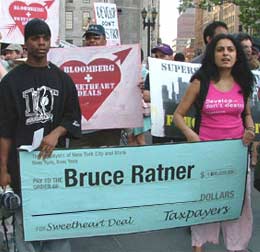
Mayor Bloomberg has signed a blank check for Bruce Ratner.
But now, after his power grab, he won't sign the $400 homeowner tax rebate checks:
"We have no money. This isn't a legal issue; this is a fiscal issue,'' Bloomberg said at a Brooklyn news conference today. "Obviously, we're not going to send out checks, and we'll have to find a way to balance the budget.''
"We have no money," but the blank check to Ratner is still signed?
NoLandGrab: Look, we'd be the first to admit that curtailing the property-tax rebate in tough economic times might be wise, given the need for cash for the MTA, schools and myriad other critical areas. But until the city and state say, "hey, maybe we oughtn't be bailing out a money-hemorrhaging NBA team by subsidizing a billion-dollar basketball arena," we don't feel much like volunteering to play the sucker. So just give us our damned $400.
Posted by eric at 4:17 PM
Times columnist: hard data needed to support benefits of projects
Atlantic Yards Report
David Leonhardt's Economic Scene column in yesterday's New York Times, headlined Piling Up Monuments of Waste, suggested that funding for the nation’s infrastructure was less of a problem than the inability to set credible priorities.
Scattershot system
Leonhardt writes:
It’s hard to exaggerate how scattershot the current system is. Government agencies usually don’t even have to do a rigorous analysis of a project or how it would affect traffic and the environment, relative to its cost and to the alternatives — before deciding whether to proceed. In one recent survey of local officials, almost 80 percent said they had based their decisions largely on politics, while fewer than 20 percent cited a project’s potential benefits.There are monuments to the resulting waste all over the country: the little-traveled Bud Shuster Highway in western Pennsylvania; new highways in suburban St. Louis and suburban Maryland that won’t alleviate traffic; all the fancy government-subsidized sports stadiums that have replaced perfectly good existing stadiums. These are the Bridges to (Almost) Nowhere that actually got built.
Well, the Atlantic Yards arena wouldn't replace a "perfectly good arena," given that the aging Izod Center is in another state and, without public transportation, is not the easiest place to visit. But federal taxpayers would subsidize new construction, even while a new arena in Newark could use a basketball team.
And, while the environmental review process in New York was extensive, was it truly rigorous? After all, the Empire State Development Corporation counted benefits but not costs. And the press punted and never analyzed the study that Forest City Ratner paid for.
Posted by eric at 8:22 AM
November 17, 2008
Recession Is a Relative Term in Baseball
The New York Times
by William C. Rhoden
With much of the nation reeling, with banks failing, workers being laid off and homes being foreclosed, sports owners continue to build castles and pay players by the millions. At least one team, the Knicks, is paying a player millions not to play.
Recession? What recession?
...Sports leagues like the N.B.A., the N.F.L. and Major League Baseball are fairy-tale lands, an otherworld of packed stadiums, charter flights, multimillion-dollar training facilities, multimillion-dollar player contracts paid by multibillionaire owners.
Yet in a time of severe economic crisis, the leagues, at least for now, are holding forth, if not completely thriving.
NoLandGrab: Rhoden goes on to explore several reasons as to why pro leagues appear to be somewhat recession-proof, but he misses the the two most obvious: heaps of public subsidies and anti-trust exemptions.
Posted by eric at 11:13 AM
Why aren’t the Yankees making cuts, too?
amNewYork, Letters to the Editor
Supporters of public funding of local professional sports venues spew the same blah-blah-blah to justify the expense, but when the city is headed towards fiscal straights, pro-sports subsidies never seem to get cut:
I’ve got two questions for the Emperor of City Hall: 1. If “all” of NYC must take the pain of our government’s failures, what “sacrifices” are George Steinbrenner and the Yankees making? 2. If Bloomberg is telling the truth that stadiums are so profitable, why do the Yankees need hundreds of millions of our tax dollars? This has got to be the dumbest lie ever. And, if we taxpayers are paying for half of the new Yankee Stadium, why aren’t we getting half the eventual profits in return? Mike Antoinette better watch his head, because it seems like he’s losing it!
— Tanya O’Langan, Manhattan
Posted by lumi at 5:19 AM
November 15, 2008
NY State Never Sought Piece of Barclays Center Naming Rights Action
Develop Don't Destroy Brooklyn
Ratner's frivolous $950 million arena would supposedly be "privately owned" (it would be leased to Ratner for $1), yet the $400 million naming rights deal with Barclays bank (is it still $400 million?) is solely with the developer. The public gets nothing out of the lucrative naming rights deal on the arena it supposedly owns.Norman Oder did some FOIA searching to find out if NY State ever wisely tried to get any value out of the naming rights deal. What he found was that New York State was not wise. The state sure could have used that money.
Posted by amy at 10:19 AM
November 13, 2008
Did the state try to gain any value from arena naming rights? Apparently not
Atlantic Yards Report
Norman Oder tries to get at whether or not New York State even tried to get a piece of the naming rights for the Atlantic Yards arena, but finds that State and City agencies are not very forthcoming with answers. [Answer redacted]
Yesterday, Gov. David Paterson proposed $5.2 billion in budget cuts over the next 16½ months, with reductions in school aid, increased tuition at city and state universities, and reduced Medicaid reimbursements, among other things.
Perhaps administration officials--many of whom were not in charge at the time, actually--are wondering why exactly their predecessors allowed Forest City Ratner to claim the entire value of naming rights for the Barclays Center arena.
In response to a Freedom of Information Law request, documents received from the Empire State Development Corporation (ESDC) indicated that no effort was made to retain any such value, though at one point, a Forest City Ratner executive indicated anxiety about the developer being "punished" for the naming rights deal.
...Though the documents are scant, in several places they were redacted; the ESDC cited exemptions that allow agencies to deny access to records that are inter-agency or intra-agency materials which are not final agency policy or determinations and instructions to staff that that affect the public, among other things.
NoLandGrab: As far as those budget cuts go, it doesn't appear that Bruce Ratner has yet had to tighten his belt even one notch. What a surprise.
Posted by eric at 9:57 AM
November 11, 2008
And has the Atlantic Yards arena site been assessed? Not that I've been told
Atlantic Yards Report
In order to generate PILOTs (payment in lieu of taxes) sufficient for the Atlantic Yards arena bond, would the land under the arena be assessed in the same questionable way that the land under Yankee Stadium was assessed?
Norman Oder tries to get to the bottom of this question by requesting documents from various government agencies.
NoLandGrab: Regular readers may remember that, just last week, the City of New York refused to hand over documents concerning the Yankees Stadium deal to a US House Subcommittee investigating possible fraud.
Posted by lumi at 5:31 AM
Paterson's Billions in Cuts, As Bruce's Boondoggle Flounders Along
The mantra of "Schools, yes — stadiums, no" was wielded effectively by the Dolan family, owners of Madison Square Garden and Cablevision, in the fight against a Jets stadium on the west side of Manhattan.
Even though Develop Don't Destroy Brooklyn doesn't have the resources to launch a similar media campaign against Bruce Ratner's multi-billion-dollar boondoggle, during these tough economic times, the point still stands:
The New York Times reports:
Paterson Says Schools and Medicaid Face Cuts
Gov. David A. Paterson said in an interview on Sunday that he would almost certainly seek billions of dollars in cuts to Medicaid, as well as midyear reductions in school aid, to address New York’s worsening fiscal condition.
He also said he expected to urge labor unions to reopen the contracts they have struck on behalf of public employees as a way to avoid or decrease layoffs.
Such a step is reminiscent of measures taken by New York City in the financial crisis of the 1970s or moves made more recently by the Big Three domestic automakers to reduce their labor costs after years of granting steady raises and comprehensive health and pension benefits...
Still, New York State and New York City continue to sink hundreds of millions into Bruce Ratner's
frivolous billion dollar arena and parking lots Atlantic Yards projectmoney pit.
Posted by lumi at 5:11 AM
November 9, 2008
For Sports Teams, Mayors Play Ball at the City’s Expense
NY Times
JIM DWYER
The first incarnations of these deals came in the final hours of the administration of Rudolph W. Giuliani, and thus had the faint whiff of idolatry about them. (Mr. Giuliani was such a Yankees fan that he managed to buy four World Series rings from the team “at cost,” which apparently meant thousands of dollars less than their actual value. Somehow, the city’s chief executive can get discount jewelry from a sports company that was being subsidized with public funds, while the Conflict of Interest Board fined a school librarian $500 for displaying a book written by his daughter.)The Giuliani stadium deals were immediately canceled in 2002 when a new mayor took office — the hard-headed, clear-thinking businessman Michael R. Bloomberg. With the city facing a recession and the loss of income from the Sept. 11 attacks, Mr. Bloomberg said New York simply could not afford them. Maybe later, he said.
Over the next few years, Mr. Bloomberg proceeded to slather new layers of icing atop the Giuliani cakes. The stadium plans were reborn, richer than ever. As a result, on Saturday, there will be one of these hokey quasi-religious ceremonies moving home plate from the old stadium across the street to the new one.
This happens the same week that Mr. Bloomberg says he has to close health clinics, shut libraries one day a week, not hire a new class of cops and raise property taxes.
Atlantic Yards Report comments:
Perhaps he could turn his attention to the Atlantic Yards arena, for which Bloomberg claimed in 2004, "This will be done with private money, and any city monies of any meaningful size will be debt issues financed by the extra tax revenues that come from this."That was before the city pledged $100 million in subsidies, then added $105 million more. And the developer wants, at least, another $100 million.
Posted by amy at 11:47 AM
November 8, 2008
U.S. government bails out Bruce Ratner
dailyheights.com
One important piece of news lost in the din of election coverage was the federal government’s decision to free up millions of dollars in tax-exempt bonds for the Forest City Ratner (our old friend Bruce) development project at Atlantic Yards.The ruling gives Ratner access to $800 million in tax-free money to proceed with the construction of a new arena for the New Jersey Nets. The arena is only one part of a controversial $4 billion boondoggle that seeks to transform the yards into a sprawling commercial and residential complex.
But the joke may be on him — not to mention city and state officials that have blown taxpayer money fighting for him — because Ratner still needs to find investors willing to back the bonds. Jay-Z or no Jay-Z, the Nets were a hard sell before the market took a nose dive. With the economy writhing on the table right now, it’s going to be even more difficult to convince people to invest money in a basketball team that went 34-48 last year.
Posted by amy at 7:53 AM
November 7, 2008
City balks over Yankee Stadium documents
MetroNY
By Patrick Arden
Where there's smoke there's fire:
The Bloomberg administration is refusing to hand over documents requested by a Congressional subcommittee investigating how the city secured tax-exempt financing for the new Yankee Stadium. U.S. Rep Dennis Kucinich (D-Ohio) has claimed the probe discovered “substantial evidence of improprieties and possible fraud.”
NoLandGrab: The possible fraud lies in the fact that the City claimed a ridiculously high land value in order to justify the bond financing, but lowballed the land value in order to skimp on the replacement of the park land to the commmunity.
Aside from the fact that the deal may have cheated the federal government of future tax revenue, note that the high land valuation benefits the Yankees and the low land valuation cheats the community.
Is this why we need this Mayor more than ever to steer the City through these tough financial times?
Looking ahead, expect creative justifications for extraordinarily high valuations for the tax-exempt bond financing for Bruce Ratner's arena.
Posted by lumi at 4:23 AM
November 6, 2008
Higher Taxes for All...Except Ratner
Develop Don't Destroy Brooklyn presents a brief study in contrast:
From City Room:
Bloomberg Announces Layoffs and Tax Increase
Delivering a grim prognosis for the city’s economy, Mayor Michael R. Bloomberg announced plans on Wednesday to save $1.5 billion this fiscal year and next, by trimming 3,000 jobs from the city’s workforce, rescinding a popular 7 percent property tax cut and suspending the annual $400 property tax rebate checks that homeowners have come to rely upon...
Meanwhile, Bruce Ratner would pay no taxes on about 7 million square feet of housing and office space and an 18,000-seat arena, and collect hundreds of millions from the City treasury.
Posted by lumi at 5:36 AM
November 4, 2008
The Times takes a skeptical look at stadium construction figures (but not AY)
Atlantic Yards Report
If the Atlantic Yards arena moves closer toward construction, maybe the New York Times will take a skeptical look at the numbers behind it. Meanwhile, in today's article about baseball stadiums, headlined As Stadiums’ Costs Swell, Benefits in Question, there's a lot of skepticism.
NoLandGrab: While The Times's Charles Bagli didn't address the planned new arena for the Nets, anyone who still thinks that publicly funded sports venues are a swell idea should read the article.
Posted by eric at 12:16 PM
November 2, 2008
Barclays Taps Investors for $11.8 Billion in Capital (Update1)
Bloomberg.com
Barclays Plc, Britain's second-biggest bank, will raise 7.3 billion pounds ($11.8 billion) from a group that includes investors in Abu Dhabi and Qatar as credit-market writedowns deplete capital.Chief Executive Officer John Varley tapped sovereign wealth funds in the Mideast to avoid a U.K. government bailout plan that calls for overhauling management boards, capping executive salaries and banning dividend payouts. Barclays fell 12 percent in London trading today.
Posted by amy at 10:02 AM
October 28, 2008
Is "adoption" really "approval"? Looking more closely at ESDC board action in July 2006
Atlantic Yards Report
"Adopted?" "Approved?" "Accepted?" "Supercalafragilisticexpealedocious?" In ESDC World, the line between the real and the made-up seems a little fuzzy.
Norman Oder tries to ferret out the facts.
In the Atlantic Yards chronology, the meaning of one action by the Empire State Development Corporation (ESDC) is a key to whether tax-exempt bonds for the project would be grandfathered in under new Internal Revenue Service (IRS) rules.
Last week, I (like others) concluded that the ESDC's vote to adopt of the Atlantic Yards General Project Plan (GPP) at its 7/18/06 meeting likely constituted what the Treasury Department requires as "official action evidencing its preliminary approval of the project before October 19, 2006."
The issue may be more ambiguous. "Adoption" might also be seen merely as an agreement to release a "proposed" plan for public comment. On the other hand, "adoption" of a plan that receives no comment means it will go into effect, which does indicate approval.
Posted by eric at 8:16 PM
Jobs, housing, and (not) hoops: the city's justification for arena bonds
Atlantic Yards Report
Before a Congressional subcommittee hearing Friday regarding tax-exempt bonds for Yankee Stadium (and other projects), the New York City Economic Development Corporation, whose affiliate New York City Industrial Development Authority issues such bonds, produced a document called Yankee Stadium, Fact v. Fiction (PDF).
While the document only glancingly mentioned Atlantic Yards, the framework was quite curious. The tax-exempt bonds at issue would be used only to build the AY arena, not any other components of the project.
But what's the justification for the arena? Affordable housing and job creation. Most of the latter would be related to office, retail, and building services, not the arena. And affordable housing could be built without the arena.
Posted by eric at 7:40 PM
October 27, 2008
My Arena Bonds $1 billion's-Worth
Gumby Fresh
It's one thing for the IRS to give the nod to Bruce Ratner to seek triple tax-exempt bond financing for a new arena, but where is an overdeveloper supposed get these bonds and what are his prospects in a marketplace where investors are sitting on their hands?
Here are excerpts from Gumby's menu options for Bruce:
Let's look at the appetite for the arena's debt.... Here the omens are still fairly horrible. Broadly speaking, Ratner and his dudes at Goldman Sachs have four financing options:
1) Borrow the money directly from a bank. Tricky. We're mostly talking about foreign banks that would be lending him money, the same ones that are still on their knees and trying not to keel over, and such an option would not involve the use of a tax exemption, which Ratner's pretty much got in the bag now.
...
2) Go to a bond insurer to insure a tax-exempt bond issue. Things have been a wee bit quieter here.
...
3) Get a bank to insure the bonds. The Beekman Tower option. See above. You would get the tax exemption in this instance, but the capacity of the banks to support such a foolhardy venture as moving a second-tier franchise to a horrendously expensive arena in a crowded market in the middle of a downturn would be limited.4) Issue the bonds without any kind of enhancement. Or, could Goldman Sachs threaten enough of their municipal bond salesmen with firing to get the bonds to clear? Again, tricky. The universe of buyers for highly illiquid, low-investment grade infrastructure bonds is small and incestuous.
Posted by lumi at 5:52 AM
October 23, 2008
Bad Call: N.Y. Fans Are Getting Ripped Off
WNBC.com
by Gabe Pressman
The IRS has given the New York Yankees, Mets and New Jersey Nets the go-ahead to use tax-free bonds to pay for their new homes.
The new Yankee Stadium, the new Mets Citi Field and the Nets arena in Brooklyn will all benefit from this ruling and the taxpayers of New York will be ripped off. In baseball terms, it's a foul deal and the taxpayers are the victims of a bad call.
...Ultimately, of course, as ticket prices soar and the sale of luxury suites roll up millions of dollars in revenue for the teams, the citizens of New York will be deprived of money. We are a city of rabid sports fans, but New Yorkers will never be enthusiastic about money being taken out of their pockets.
It's a steal -- and not the kind to cheer about.
NoLandGrab: While the IRS's extension of this tax "loophole" will cost New York's taxpayers several million dollars, it'll cost the citizens of the nation's other 49 states hundreds of millions of dollars. And to think people are angry about bailing out banks.
Posted by eric at 2:20 PM
When AY GPP was "released" in July 2006, was that preliminary approval?
Atlantic Yards Report
Last we checked, words do matter. So what are we supposed to make of Norman Oder's latest discovery?
THE RULE
To grandfather in a project [for eligibility for triple tax exempt bonds], the [IRS] rule requires a governmental entity to have taken "official action evidencing its preliminary approval of the project before October 19, 2006."
"APPROVED" VS. "ADOPTED"
While the Modified General Project Plan for Atlantic Yards was formally approved in December 2006 by the Empire State Development Corporation (ESDC), a slightly different version, the General Project Plan (GPP), had been "adopted" (according to an agency press release) by the ESDC on July 18, 2006.
"PRELIMINARY APPROVAL"
Though that ESDC board action in July was likely cursory, the IRS rule still seems tailored to comments filed by the city and state regarding the definition of "preliminary approval." Thus I (and most others) concluded that the ESDC's "adoption" of the GPP qualifies as "preliminary approval" under the regulation.
"RELEASED"
Developer Forest City Ratner's Atlantic Yards web site does not use the term "approval" to describe the action at that July ESDC board meeting.
It does not use the term "adopted."
It uses the term "released," adding that the ESDC's action "formally started the public review process."
...
The New York Times's coverage that day used "release":The report’s release sets into motion a public comment period. The project faces a final vote by the development corporation’s board this fall, and if it is approved, it will face a vote by the state Public Authorities Control Board.
The IRS may well consider that "preliminary approval." But the public sure didn't know it.
NoLandGrab: Bruce Ratner and his political backers are having it both ways.
To satisfy legal requirements for NY State land-use review, the plan had to be "released", "approved" and "adopted," according to a timetable set by the State Environmental Quality Review Act (SEQRA).
On the other hand, to satisfy the recent federal ruling that grandfathered the project under old IRS rules for Payments in Lieu of Taxes (PILOTs), the project needed "preliminary approval" at some point before the IRS closed the loophole in October, 2006.
Swap "release" for "preliminary approval" and you've got a loophole in a loophole.
Posted by lumi at 7:14 AM
Did DePlasco really mean what he said?
Develop Don't Destroy Brooklyn highlighted the following from Forest City Ratner spokesperson Joe DePlasco's recently released statement on the IRS ruling on triple tax-exempt bonds:
The tax exempt financing was always part of the plan for the development of the arena and the regulation released today acknowledges that.
Atlantic Yards Report points out the IRS regulation says no such thing and the Associated Press noted that the IRS regulation specifically said nothing about Atlantic Yards.
Since no one can figure out exactly what DePlasco is talking about, might we assume that "the plan" "the regulation released... acknowledges" was something agreed upon behind closed doors?
Posted by lumi at 6:05 AM
IRS OKs Tax-Exempt Bonds For Barclays Center, Other NY Venues
SportsBusiness Daily (subscription only)
IRS officials this week ruled that Nets Owner and Forest City Ratner CEO Bruce Ratner for his planned $950M Barclays Center in Brooklyn "can use tax-exempt bonds to pay for the building, providing some rare good news for the delay-plagued project," ...
Posted by lumi at 4:51 AM
October 22, 2008
Tax-Exempt Bonds: The Evening Wrap
Here's the rundown on today's coverage of the IRS's decision to tighten a "loophole" on the use of PILOTs to finance arenas and stadia — only the Yankees, Mets and, maybe, the Nets, have slipped the knot.

Gothamist, Atlantic Yards Project Gets Big Bond Break from IRS
These New York teams may be hard-pressed to find investors who will buy the bonds, given the current Wall Street turbulence. Not so incidentally, the ruling comes four days before Yankees president Randy Levine and city officials are expected to testify at a Congressional hearing investigating the tax-exempt financing of the new $1.3 billion Yankee Stadium. Representative Dennis Kucinich, who is holding the hearing Friday, has threatened to prosecute officials if they lied about the value of the land the new stadium occupies.
State Assemblyman Richard Brodsky, a Westchester Democrat, slammed the IRS decision, telling the Times and the AP, "This is the same kind of socialism for the rich, and capitalism for the rest of us that’s gotten us into the current economic mess...The rules don't apply if you've got enough juice."
Curbed, Atlantic Yards Crap Tossing V.3.5: Financing Edition
The IRS issued a ruling yesterday that has monstrously huge implications for anyone that will ever want to build a stadium or arena ever again (don't go to sleep yet...this is big). You wouldn't know it in NYC, though, because even though it impacts the new Yankee Stadium and Citi Field, it's playing out as an Atlantic Yards story. At issue is whether tax-free financing can be used to build Frank Gehry's $950 million arena. (Leaving aside the issue as to anyone will ever finance a facility that is sure to go above $1 billion given traditional Gehry cost overruns in the middle of one of the most massive credit meltdowns in history.) The ruling creates a loophole for projects that are "substantially in progress," while banning it for new ones.
The Angry New Yorker, Tax Free Stadiums
Hey if I want to build myself a new house, think I can get me some tax free bonds to pay for it?
Brownstoner, Treasury Dept. Hooks Up Ratner Big-Time
One potential snag for FCR: The new regs require that the bonds be issued by December 31, 2009.
Gowanus Lounge, So, Does Mr. Ratner Get Tax-Free Bonds for Atlantic Yards?
The key phrase is that it grandfathers in projects “substantially in progress.” We can see lawyers and bureaucrats arguing this point about Atlantic Yards until we live in Green-Wood Cemetery.
Be sure to check out Gowanus Lounge's reflections on the ethics of subsidizing arenas.
Develop Don't Destroy Brooklyn, Ratner Spokesman Vs. Treasury Department Spokesman on IRS Regulation
Bloomberg News, New York Yankees, Mets Get Approval for Tax-Exempt Bond Funding
Village Voice [Runnin' Scared blog], Atlantic Yards Gets Tax Break, Or Not
The Times spoke to Daniel Goldstein of DDDB, who "said it appeared to him that federal tax officials went out of their way to help the developer," the paper writes, "which he said 'makes no sense' when the federal government is in the midst of a costly bailout of the banking industry." Actually it does make sense: the bailout is an attempt by the powerful to restore a failed, obviously unsustainable confidence scheme to viability; this tax break (if it is a tax break), ditto.
Posted by eric at 9:18 PM
Treasury Gets Tough On PILOTs
Tighter Regs Issued As House Panel Opens
The Bond Buyer
by Peter Schroeder
Some industry insight into yesterday's IRS ruling, including the news that said ruling increases the risk for buyers, which might in turn make the bonds tougher to sell — unless you're George Steinbrenner, Fred Wilpon, or Bruce Ratner.
The Treasury Department yesterday issued more restrictive final regulations for bonds issued by payments in lieu of taxes, just three days before a House panel is scheduled to hold a hearing questioning the use of PILOTs to finance the new New York Yankees stadium.
But the rules contain a transitional provision that appears to enable the New York Yankees, Mets and Nets to continue to issue PILOT bonds as planned without having to comply with the new rules.
...David Caprera, a partner at Kutak Rock LLP in Denver, said the new regulations will require a shift in how many market participants view PILOTs.
...Since the PILOTs must be tied to taxes, Caprera said the new regulations shift a small amount of risk to the bondholder, who cannot be guaranteed a fixed payment, and unexpectedly low tax revenues could jeopardize a timely payment.
Posted by eric at 1:39 PM
Bailout! Feds save Ratner millions with new ruling
The Brooklyn Paper
by Sarah Portlock
"Joe the Plumber" has been all the rage for the past week. Now, courtesy of the U.S. Treasury Department, we bring you "Bruce the Plunderer."

The Treasury Department has bailed out Bruce Ratner.
In a much-anticipated ruling issued late Monday, the federal agency exempted Ratner’s Atlantic Yards project from a ruling that bars the use tax-free bonds to finance stadium projects.
Atlantic Yards was apparently exempted because it is “substantially in progress” — a term defined as having received “preliminary approval of the government” and involved “significant expenditures” before Oct. 19, 2006; and having a finance plan in place that contemplated the use of tax-free bonds.
...“It’s a slight of hand that allows the city to stick it to taxpayers on behalf of developers,” said Neil DeMause, author of “Field of Schemes,” which focuses on the massive public cost of stadium financing.
Posted by eric at 1:11 PM
IRS to give Bruce Ratner a huge federal tax break to build arena
 There's a lot of coverage of the IRS's ruling to grandfather in federal tax breaks for Bruce Ratner's Nets arena and a new round of bond financing for the Yankees and Mets ballparks.
Atlantic Yards Report, In IRS regulations allowing tax-exempt bonds, no need for messy democracy like an elective body
In short, the IRS decided that Payments in Lieu of Taxes would no longer be allowed for sports stadiums after October 2006. For the old rules to apply to the planned Nets arena, the project had to be underway before that. How is that possible when the project wasn't approved until the following January? Norman Oder explains the IRS's twisted logic:
Anyone watching 12/8/06 meeting of the unelected Empire State Development Corporation (ESDC), with all of four board members (of seven, with one vacancy) in attendance could conclude that the project was rubber-stamped. Moreover, some board members had but a vague notion of project details.
But that wasn't the key decision made by the ESDC board. The key decision was made July 18, 2006, when the ESDC announced that it had "adopted" the General Project Plan (GPP) and "accepted" the Draft Environmental Impact Statement (EIS).
...
In between, in October, the Internal Revenue Service (IRS) proposed new regulations to tighten tax-exempt bonds for sports facilities.
...
Apparently, the regulations don't require action by an elective body.A "governmental person (as defined in §1.141-1)" of the Treasury Regulations is "a state or local governmental unit as defined in §1.103–1 or any instrumentality thereof."
And what's §1.103–1? "[A]ny division of any State or local governmental unit which is a municipal corporation or which has been delegated the right to exercise part of the sovereign power of the unit."
In other words, a handful of appointees of Gov. George Pataki showed up at a meeting on July 18, 2006 and gave their OK to stacks of documents they hardly read--or didn't read at all. And that meant the project was on its way, even if the chronology sent by the city and state to the IRS was bogus.
The Associated Press, via International Herald Tribune, New tax rules would allow NYC teams to float bonds
Updated tax rules issued Tuesday limit the way tax-exempt bonds can be used to pay for sports facilities but don't block the New Jersey Nets, New York Yankees and New York Mets from using billions of dollars in bonds to help pay for their new homes, state and city officials said.
The NY Times, Developer of Nets’ Arena Can Use Tax-Exempt Bonds
Lead real estate reporter Charles V. Bagli filed a story today:
Under the new ruling, federal officials essentially gave a green light for the three sports arenas, among the world’s most expensive, to use tax-exempt bonds. But tax experts said that the ruling would not allow other governments to issue such bonds on behalf of professional sports teams. The rule was adopted on Monday by the Treasury Department and the Internal Revenue Service.
Still, the New York teams may have difficulty finding investors who will buy the bonds, given the current turmoil on Wall Street and in the credit markets.
...
[Develop Don't Destroy Brooklyn spokesperson Daniel] Goldstein said it appeared to him that federal tax officials went out of their way to help the developer, which he said “makes no sense” when the federal government is in the midst of a costly bailout of the banking industry.
The Real Estate Observer, IRS Gives Thumbs Up to Tax-Free Bonds for Yankees, Mets, Nets [Updated]
The new IRS regulations are here [Word doc]. They grandfather in any projects that had "preliminary approval" before October 19, 2006. The baseball stadiums were approved prior to then, though Atlantic Yards did not get a final approval until the end of 2006. Still, officials seemed to be under the impression that ruling cleared all three teams to qualify for tax-free bonds.
Also, here's Forest City Ratner pr guru Joe DePlasco's statement:
“We are of course very pleased with the Treasury Department regulation. The tax exempt financing was always part of the plan for the development of the arena and the regulation released today acknowledges that. The regulation will help us move forward with a project that is critical to the on-going economic vitality of Brooklyn and the City.”
NY Daily News, IRS clears way for tax dollars to help new stadiums, arenas
Critics blasted the taxpayer subsidy as a waste of money at a time when the city and state are cutting costs in schools, mass transit and more.
"We can't fund the MTA and we're cutting back on city hospitals," said Assemblyman Richard Brodsky (D-Westchester), whose committee is investigating the Yankees deal.
"This is more socialism for the wealthy, where taxpayers are asked to fund a stadium they can't afford to go to."
NY Daily News, Just call the new Yankee Stadium the House That Tax Subsidies Built
Columnist Juan Gonzalez examines the chicanery behind the Yankee Stadium financing, which just got a boost from the same IRS ruling that made Bruce Ratner happy.
The Star-Ledger, Nets get favorable ruling from IRS
The Empire State Development Corp. expects to issue an unspecified amount of tax-free bonds to fund the arena early next year, Warner Johnston, a spokesman for the agency, said.
...
Nets owner Bruce Ratner is seeking up to $800 million in tax-free financing. The IRS ruling means New York state can issue the bonds, Johnston said.The Brooklyn plans are being closely watched in New Jersey, where some elected officials have hoped the Nets will scrap their Brooklyn arena plans and move to the year-old Prudential Center in Newark or stay at the Izod Center in the Meadowlands.
Curbed, IRS Decides Tax-Free Financing for Atlantic Yards Okay
[The IRS ruling] may or may not help the Atlantic Yards project get financed if the credit market isn't interested, but the project has won a big victory today.
Nets Daily, IRS Approves Tax-Free Bonds for Barclays Center
The blog that tracks all things Nets calls it a "big win for Bruce Ratner."
Two blogs posted Develop Don't Destroy Brooklyn's press release, denouncing the IRS ruling on the basis that the project wasn't approved until after the October 2006 rules change:
Yonkers Tribune, IRS Today Rules Bruce Ratner's Barclays Center Arena Not Qualified for Tax-exempt Bonds
Daily Gotham, IRS to Bruce Ratner: No Way!
Posted by lumi at 6:34 AM
October 21, 2008
New IRS rules stoke Atlantic Yards fight
The Internal Revenue Service issued rules Tuesday on whether the Nets basketball arena planned for Brooklyn can access $800 million in triple tax-free bonds.
Crain's NY Business
by Erik Engquist
The Internal Revenue Service issued rules Tuesday that dictate whether the Nets basketball arena planned for Brooklyn can use $800 million in triple tax-free bonds. The developer, Forest City Ratner, says it can; arena opponents say it cannot.
A layman’s reading of the IRS rules seems to support the position of the developer and its partner in state government, the Empire State Development Corp.
The issue—which like everything else concerning Forest City’s Atlantic Yards project will probably be decided in a courtroom—could determine whether the arena gets built. Forest City has said it could get private financing to build the $950 million venue, but that might not be possible in the current credit market.
The IRS rules say one condition that the arena must have met is that “a governmental person took official action evidencing its preliminary approval of the project before October 19, 2006.” The board of ESDC, the state’s development agency, approved the general project plan of Atlantic Yards in July 2006.
But the arena’s opponents will likely challenge that stipulation.
“The general project plan wasn’t legally binding, and it wasn’t anything that [Forest City Chief Executive Bruce] Ratner could legally rely on to do his project,” said Daniel Goldstein, a spokesman for project opponents.
NoLandGrab: So if Atlantic Yards already had "preliminary approval" in July of 2006, why did we all stand in line for hours for the public hearing for the Draft Environmental Impact Statement on August 23, 2006, endure a fractious, mismanaged hearing, and submit volumes of written testimony?
We knew the whole process was bogus, but this takes the cake.
Posted by eric at 9:41 PM
October 16, 2008
If You Build It, Will They Pay?
Luxury stadiums are on the rise. A top seat can cost $150,000. Beer costs extra.
Newsweek
By Johnnie L. Roberts and Andrew Murr
[T]he Yankees are hardly alone in finding new ways to gouge fans; their premium seats are a bargain when compared with prices in Dallas just for the right to buy a season ticket: as much as $150,000. In the latest sign of hyperinflation in the sports business, a slew of ultraexpensive venues are rising, or have been built recently, across the country from Dallas to Washington to New York—where not only the Yankees, but also the Mets, Jets, Giants and New Jersey Nets will all be getting new digs (the New Jersey Devils got a new arena last year). The total price tag for the New York-area building boom alone: more than $5 billion.
Of course, with the nation's financial system teetering, all this construction couldn't be coming at a worse time. Many of the sports industry's most golden gooses, including financial-services giants and automakers—might have a tough time scrounging up thousands of dollars for a seat these days, and might have to slum it with the hard-pressed masses in the cheap seats (meaning under $100 each at Yankee Stadium). These new sports palaces were conceived in a more conspicuous era, and as such they're replete with luxury suites, upscale club seating, catered food and any number of high-tech distractions. Each stadium has an economically stratified seating scheme that will have fans scraping their pocket bottoms or, in a few cases, even mortgaging their homes (if anyone can get a loan these days).
Of course, Norman Oder has already posted this comment:
Though the article states that "not only the Yankees, but also the Mets, Jets, Giants and New Jersey Nets will all be getting new digs," construction has not begun on the new Nets arena in the Atlantic Yards project in Brooklyn, which faces various challenges (lawsuits, credit crisis, availability of tax-exempt bonds).
Posted by lumi at 7:37 PM
Kucinich schedules hearing October 24 on Yankee Stadium and future of PILOTs
Atlantic Yards Report
Rep. Dennis Kucinich (D-OH), Chairman of the Domestic Policy Subcommittee of the House Committee on Oversight and Government Reform, yesterday announced a hearing October 24 during which Seth Pinsky, President of the New York City Economic Development Corporation, and Randy Levine, President of the New York Yankees, are expected to answer tough questions about the deal to use PILOTs (payments in lieu of taxes) to repay bonds for the new Yankee Stadium. The hearing also may cast doubt on a similar plan for the Atlantic Yards arena.
...
The hearing will examine not only whether the [Yankees] stadium valuation was "gamed" but also "whether the City’s efforts to stop finalization of proposed U.S. Department of Treasury regulations that would effectively prohibit the use of PILOTs in this context serve the public interest."That larger issue points directly to the city's effort to get tax-exempt bonds for the Atlantic Yards arena grandfathered in under the same loose 2006 ruling--which the chief counsel of the IRS called a "loophole" the agency immediately proposed to close--that enabled PILOTs for the new Yankee Stadium and Mets stadium.
The difference, as I've written, is worth perhaps $165 million to Forest City Ratner on $800 million worth of tax-exempt bonds. And this issue, more than any other, may be the biggest hurdle facing the arena.
Posted by lumi at 6:01 AM
Stadiums and the Economy
The Washington Times, "Sports Biz" (blog)
By Tim Lemke
If there's one area that truly will impact the world of sports, its the credit markets, where lending has practically halted and no one is handing out tons of free cash like in the past. Any team looking to build a new arena or refinance is probably going to find themselves in a pinch.
The good news is that most of the teams entering new facilities in the next year or two had already nailed down funding before the big problems on Wall Street. The Cowboys, Giants, Jets, Yankees and Mets were well on their way to building their stadiums and should be in OK shape when their facilities open in 2009 or 2010.
The NBA's New Jersey Nets, on the other hand, are facing some problems in getting their new arena in Brooklyn.
Bruce Ratner's stalled Nets arena is the only example cited in the article, which reviews all of the recent roadblocks, from the credit crisis, to IRS rules governing tax-exempt bonds.
Posted by lumi at 5:52 AM
October 15, 2008
Kucinich Steps Up Pressure on NYC Officials
Develop Don't Destroy Brooklyn
Congressman Dennis Kucinich (D-OH) sent a 16-page letter to New York City Mayor Michael Bloomberg yesterday (with 12 additional pages of attachments), raising "serious questions" about Yankee Stadium land assessments, PILOTs and tax-exempt financing. Can similar questions about the still-known-as Barclays Center arena be far behind?
DDDB has the press release, along with a link to the Congressman's letter, which also includes a reminder to the Mayor:
I request that the City promptly fully comply with the Subcommittee's requests for documents that should have been produced on August 6, 2008 — over two months ago — and provide two witnesses for the upcoming Subcommittee hearing.
Posted by eric at 8:00 PM
Your Name Here?
What happens to a stadium name when the company goes bust?
ABC News
Remember Enron Field, the MCI Center and the Adelphia Coliseum? All three professional sports venues had to be renamed after the companies that owned the naming rights went bust or got mired in scandals. ABC New reports on what effect the current global financial crisis might have on stadium monikers (bonus points if you can guess the current names of the facilities above; answers below).
Enron Field = Minute Maid Park (Houston)
MCI Center = Verizon Center (Washington, DC)
Adelphia Coliseum = LP Field (Nashville)
Barclays Center = ?
Posted by eric at 12:46 PM
October 2, 2008
Safety in the Numbers You Pull Out of Hat: Club’s Number is 103
 Noticing New York
You gotta love a blogger who has a bunny for a sidekick.
For today's magic trick, NNY and Bunny explain how to pull numbers out of a hat to get tax payers to help finance a new stadium for every team that wants one.
Who among us would consider it safe to come up with fictional numbers to present to the IRS?
I am thinking about this because I was reading another attorney’s anonymously offered justifications for the transcendently artificial stratagems currently being used to divert public moneys to the financing of sports venues like Yankee Stadium. In connection with this it seems that some rather fictional numbers were submitted to the IRS. It is doubtful that the numbers are any more substantiated than if they were simply pulled out of hat.
...
The Yankee Stadium financing presents an excellent example of what is wrong with sports stadium and arena financing in the country in general and in New York in particular. The proposed Atlantic Yards Nets arena is on obvious analog and cousin to the Yankee Stadium financing.
Posted by lumi at 4:45 AM
September 24, 2008
It's Time for all New Yorkers to Sacrifice, Unless You Happen to Own a Pro Sports Team
The headlines this week have been full of stories about the tough times facing New York, and how we're all going to have to tighten our belts, cut back, and suffer for the greater good. Unless, of course, your name happens to be Steinbrenner, Wilpon or Ratner.
The New York Times, New York City Wants Cuts by Agencies Across Board
With an eye on Wall Street’s turmoil and New York City’s fragile economy, Mayor Michael R. Bloomberg ordered city agencies on Tuesday to cut spending by about $500 million this year and $1 billion next year.
The cuts are to be made across the board, affecting agencies including the Police Department, which must cut costs by $95 million this year, and the school system, which needs to trim $185 million.
Over all, the reductions represent 2.5 percent of the agencies’ budgets this year and 5 percent next year.
The midyear budget cuts are intended to provide a financial cushion should the city’s tax revenue, which is heavily dependent on Wall Street’s profits, drop further, as many expect.
The timing of the announcement suggests that Mr. Bloomberg may be seeking to soften the political fallout of a possible 7 percent property tax increase, which he disclosed on Monday. The spending cuts, aides said, showed that everyone, including government, will feel the pain from a slowing economy. [emphasis added]
NoLandGrab: Actually, not everyone, since the Bloomberg administration is still doing everything in its power to help the the Yankees, Mets and Nets secure tax-exempt financing for their new palaces, a scheme that will place an added burden on the same taxpayers already in the cross-hairs.
The New York Times, In Fiscal Crisis, Mayor Considers Raising Property Tax 7 Percent
Unless your property happens to be a stadium or arena, in which case, of course, the land beneath it would be conveniently tax-exempt.
As if to underscore the seriousness of the situation, Mr. Bloomberg said that while he sat next to Christine C. Quinn, the City Council speaker, for a full inning at the final game at Yankee Stadium on Sunday night, “The economy was the only thing we talked about.”
NoLandGrab: Who wants to bet that the Mayor and the Speaker never once said, "hey, what if we eliminated the tax exemption on the land right beneath our arses?" Wonder how they scored those great seats?
And in related news...
The New York Times, Transit Agency Requests Review of How Contract for Special Bus Fuel Was Awarded
The MTA is launching an investigation into "a highly unusual contract that has added millions of dollars to the cost of buying diesel fuel for city buses."
NoLandGrab: Like us, you might still be waiting for the investigation into the MTA's agreement to sell the Vanderbilt Yard to developer Forest City Ratner for less than half the amount of its own appraisal — and $50 million less than rival bidder Extell Development Company was willing to pay.
Posted by eric at 12:51 PM
September 22, 2008
Foul Ball: Congressional Committee Criticizes New Yankee Stadium Deal
The AM Law Daily
by Brian Baxter
Ohio congressman and former Democratic presidential candidate Dennis Kucinich is not a fan of the New York Yankees.
Before the historic baseball franchise closed out its last game at Yankee Stadium on Sunday night with a 7-3 victory over the Baltimore Orioles, North America's most successful professional sports team was the target of political vitriol during a Capitol Hill hearing on Thursday.
Kucinich, chairman of the House Oversight and Government Reform Committee, claimed that the Yankees and New York City officials had conspired to misrepresent the value of city land to the IRS for purposes of obtaining sweetheart tax deals from the federal government for the construction of a new stadium in the South Bronx.
NoLandGrab: The article cites unidentified "lawyers with experience in stadium financings" who defend the Yankees and the practice of tossing subsidies at sports teams, but many years of experience have shown that doing so has little economic benefit — except, of course, for "lawyers with experience in stadium financings."
Posted by eric at 3:38 PM
(*)(*)(*)(*) Yankees
PoliticalForum.com
Bruce Ratner sneaks into a lengthy post regarding the Yankees, owner George Steinbrenner's sordid past, their current stadium swindle, and how it all ties in with the current Wall Street tumult.
Almost all Yankees games are broadcast in New York on the YES Network, a cable station formed after the Yankees and the NBA’s New Jersey Nets got into a pissing match with their previous television home and some of that station’s owners. The Nets have since landed in the pocket of wealthy real estate mogul Bruce Ratner, but the Yankees restructured the company with a new partner and kept YES a growing concern. Today, the television network is believed to be worth $1.5 billion (about $200 million more than the Yankees themselves).
Posted by eric at 3:22 PM
At Kucinich hearing, the question arises: why do cities give away naming rights?
Atlantic Yards Report
Though the Congressional hearing Thursday, “Gaming the Tax Code: Public Subsidies, Private Profits, and Big League Sports in New York,” (video) focused on Yankee Stadium, the issues raised do apply the planned Atlantic Yards arena, as I wrote.
Atlantic Yards came up exactly once, near the end of the hearing, when Rep. Dennis Kucinich (D-OH), asked a basic but important question about naming rights--and got back an answer that actually underestimated the value of the Barclays Center deal.
..."Can you explain how cities who build stadiums for teams typically deal with stadium naming rights?" Kucinich asked. "I’ve always been mystified at how cities can make a rather enormous investment of tax dollars, whether it’s local, state or federal, into these facilities, and then have somebody else come along and put their name on it."
Good question. You'll have to read the article if you want to know the answer.
Posted by eric at 9:51 AM
An architect of the Yankee Stadium deal was an IRS insider
Atlantic Yards Report
The AmLaw Daily blog explains that the one architect of the Yankee Stadium financing deal was a real insider:
Nixon Peabody public finance partners Bruce Serchuk and Mitchell Rapaport were retained by the Yankees and the New York City Industrial Development Agency (NYCIDA), an arm of the New York City Economic Development Corporation (NYCEDC). Serchuk, who worked in the office of tax policy at the Treasury Department and in the IRS's chief counsel office, is considered one of the primary architects of the Yankees's strategy to obtain over $940 million in tax-exempt bonds to help finance construction for the team's new stadium, set to open on April 16 of next year.
Posted by eric at 9:42 AM
September 21, 2008
Brodsky Slides in Front of City's Stadium Plans
 |
The New York Observer
Eliot Brown
The focus of the two men [Brodsky and Kucinich] - one a loud and often relentless critic of many Bloomberg administration policies; the other a mousy, twice-failed far-left presidential candidate—is on a complicated mechanism the city used to win tax-free financing for the new Mets and Yankees stadiums (and plans to use to finance the new Nets arena). The Mets and Yankees already have obtained their financing, but both teams want more to cover additional costs. The Nets have yet to gain approval for the financing, with plans to break ground on a new arena before the end of the year. The I.R.S. has criticized the mechanism as a loophole and has yet to rule on whether the teams can get any additional financing through the city’s structure.Without the mechanism, for which the teams give fixed payments in lieu of taxes that pay off hundreds of millions of dollars in bonds, costs would rise substantially for each of the three teams, and in the case of the Nets, perhaps further upset an already troubled project.
At issue is the tax-exempt aspect of the financing. Under the Bloomberg administration’s arrangement, once the city-controlled Industrial Development Authority approves the financing plan, the teams are eligible to issue hundreds of millions in bonds that are free from city, state and federal taxes. Such savings can lower the cost to the teams by perhaps 15 or 20 percent.
...
For their part, Bloomberg administration officials are proud of their work and say they have nothing to hide in the deal, which uses a tax-free structure with a relatively minor amount of city and state investment to leverage a major federal subsidy for city projects. The financing allowed for billions in private investment, officials contend, making Mr. Brodsky’s crusade a frustrating one, especially as the financing mechanism for the Nets is up in the air.
Posted by amy at 11:04 AM
September 20, 2008
Fact vs. Fiction vs. Fact: City statement on Yankees vs. Brodsky statement
Atlantic Yards Report presents Assemblyman Richard Brodsky's response to the city's response to his report. The discrepancy highlights include jobs, land assessment, luxury boxes, process and cost to taxpayers. From Brodsky's response:
“FACT V. FICTION”, New York City’s non-denial denial response to the facts in Assemblyman Brodsky’s Yankee Stadium Report requires only a re-statement of the City’s own sworn statements to reveal the truth.JOBS
Now: “Yankees currently project 1,000 new, permanent jobs.”
Then: Page 7 of the Yankees sworn March 2008 Core Application to the IDA.
Number of existing permanent jobs: 125
Number of jobs after completion of new Stadium: 140
Then we did the math……………………net increase: 15
Now they scramble to change what the documents reveal. Nice pivot. What did you expect them to say once the sworn data was made public?
Posted by amy at 10:05 PM
A second look at the Kucinich hearing, the Yankee Stadium controversy, and the future of the Atlantic Yards arena

Atlantic Yards Report
It's worth a second look at some of the charges and countercharges that emerged Thursday in response to Assemblyman Richard Brodsky’s report on the new Yankee Stadium and the hearing held by Rep. Dennis Kucinich (D-OH), chair of the Domestic Policy Subcommittee of the Oversight and Government Reform Committee, called “Gaming the Tax Code: Public Subsidies, Private Profits, and Big League Sports in New York”. (Hearing video is now available.)What are the hurdles for Atlantic Yards?
1) Investigators from the committees headed by both Brodsky and Kucinich have concluded, at least on an interim basis, that city officials "gamed" the tax assessment for the new Yankee Stadium so it would be high enough to justify the amount of tax-exempt bonds requested by the team. If similar shenanigans were found regarding the Atlantic Yards arena, tax-exempt bonds might be scotched, costing the developer perhaps $165 million.
2) Even if no such subterfuge is found, the arena is still jeopardized by a proposed Internal Revenue Service (IRS) rule that would require that PILOTs (payments in lieu of taxes) fluctuate so they look like generally applicable taxes, rather than fixed so they look like bond payments. The city and state have lobbied hard to get the arena--as well as additional financing for the Yankees and Mets--grandfathered in. Develop Don't Destroy Brooklyn disagrees.
article
NoLandGrab: AYR goes on to answer 17 more of your burning questions about the hearing and Atlantic Yards such as "Can Atlantic Yards developers get arena bonds?" and "What exactly is Atlantic Yards?" Well, we do have an answer to the second question.
Posted by amy at 2:50 PM
September 19, 2008
The More Things Change..., Yankees Edition
The New York Times
by Richard Sandomir
This morsel comes from a story in today's Times about the coming auction of many of the original hand-drawn blueprints for the first Yankee Stadium, designed and built by the Osborn Engineering Company of Cleveland, Ohio, leading stadium architects of the early days of Major League baseball.
[Memorabilia dealer Mitch] Baker is also selling letters between the [Yankees] and Osborn, including one to Frank Osborn in which [then-Yankees' owner Jacob] Ruppert wrote, “Enclosed is a check for $3,332, minus the $88.20 you charged for taxes we don’t feel we have to pay you.” [Emphasis added]
Posted by eric at 1:58 PM
At Congressional hearing, criticism of Yankees deal and stadium funding; IRS says final regulation coming soon
Atlantic Yards Report
Norman Oder reports on what happened at yesterday's Congressional hearing on federal support for NY sports venues:
Piling on to Assemblyman Richard Brodsky’s report on the new Yankee Stadium, Rep. Dennis Kucinich (D-OH) said yesterday that his Subcommittee’s “still ongoing investigation has uncovered substantial evidence of improprieties and possible fraud” by the stadium’s financial architects.
Kucinich chairs the Domestic Policy Subcommittee of the Oversight and Government Reform Committee, which yesterday held a hearing to which representatives of the Yankees and the city of New York were conspicuously absent, though they are expected to appear in the future.
Though the hearing, “Gaming the Tax Code: Public Subsidies, Private Profits, and Big League Sports in New York,” focused on Yankee Stadium, the issues raised have direct applicability to the planned Atlantic Yards arena.
PILOTs (payments in lieu of taxes) can’t exceed the amount of foregone taxes, but PILOTs for the Yankee Stadium were based on an assessment inflated aimed to justify a certain quantity of bonds, Brodsky and Kucinich charged. The same tactic might be in store for Brooklyn, given that the expected arena PILOTs far exceed the foregone taxes for the comparable Madison Square Garden.
Moreover, the new ballparks for the Yankees and Mets rely on special Internal Revenue Service rulings that allowed fixed PILOTs that conform to bond payments, while the IRS has proposed changing the rule to make sure that PILOTs fluctuate with taxes--anathema to the bond market.
That rule, expected to be finalized soon, has city officials nervous. Indeed, according to Metro, the city yesterday issued a statement that “complained of the new hurdles” to financing other projects similarly, such as Atlantic Yards. Whether Atlantic Yards might be grandfathered in under the old rules, as the city and state have sought, remains unclear, but the benefit to Forest City Ratner would be significant; I’ve estimated $165 million on $800 million of tax-exempt bonds.
More coverage...
MetroNY, D.C. grilling for stadium
Associated Press, via amNY, Congress rips new Yankee Stadium deal
Posted by lumi at 5:58 AM
September 18, 2008
Yankees didn't blink when lawmakers swung
A congressional panel found the new Yankee Stadium to be a "waste and abuse of public dollars," but baseball executives and city officials stood by the project.
AP via Crain's NY Business
Crain's slapped the hugely misleading headline above onto this report from the AP, misleading because the reason the Yankees didn't blink was because they weren't even in the ballpark! No one from the Yankees was on hand to testify (it's reported that someone from the team may appear in front of the House Oversight and Government Reform subcommittee on October 7th), and city officials, as was reported yesterday, couldn't be bothered.
The original AP headline, which you can see here, was "Yankee Stadium deal criticized by lawmakers."
Rep. Dennis Kucinich said Thursday he found "waste and abuse of public dollars" in the financing of the new stadium under construction in the South Bronx.
Mr. Kucinich is an Ohio Democrat who heads a House Oversight and Government Reform subcommittee. He charged that city officials misrepresented to the IRS the value of the property, helping them to get special tax deals from the federal government and in effect dumping the cost of construction onto taxpayers. No one from the either the city or the Yankees spoke at the hearing.
..."In the case of the new Yankee Stadium, not only have we found waste and abuse of public dollars subsidizing a project that is for the exclusive benefit of a private entity, the Yankees, but also we have discovered serious questions about the accuracy of certain representations made by the City of New York to the federal government," Mr. Kucinich said.
The panel's investigation found "substantial evidence of improprieties and possible fraud by the financial architects of the new Yankee Stadium," he added.
The criticism highlights tensions felt nationwide as governments increasingly support stadiums for profitable pro sports teams with multimillion dollar payrolls.
Rep. Laura Watson, D-Calif., said her hometown of Los Angeles has gone without a professional football team for decades because city officials are unwilling to pay for a new stadium.
Given the current financial crisis gripping the U.S. economy, she said it made no sense for taxpayers to pay for construction of buildings for the benefit of sports owner tycoons.
"In this country we have allowed the upper class to destroy the middle class," Ms. Watson charged.
NoLandGrab: While Yankees and City officials may be standing by the project, it's not surprising that they wouldn't want to testify in front of a Congressional subcommittee, since if they did so under oath, their "standing by the project" would likely result in perjury charges.
And shame on Crain's for such naked boosterism of the Yankees, and projects like Bruce Ratner's Atlantic Yards. They may call themselves the most trusted name in New York business, but preaching socialism for big corporations and sports teams and capitalism for taxpayers and small businesses is intellectually, and morally, bankrupt.
Posted by eric at 4:29 PM
September 17, 2008
Events, Dear Boy
Gumby Fresh
The Atlantic Yards blogosphere's resident debt-finance expert owns up to the fact that even experts make mistakes.
It's interesting that no matter how infrequently I post, it's still possible for me to drop a decent-sized clanger with pretty decent regularity. I refer, of course, to the post below, where I confidently predicted that Barclays had lost interest in the idea of building up a US brokerage business, and that financing conditions for the Atlantic Yards arena were still benign.
So, that was about 1.5 clangers. Barclays, of course, has decided to double down its bet on a presence in the US capital markets by tearing a few strips off the Lehman Brothers corpse, although how the Lehman* purchase helps it build up a retail business in the US escapes me. It's clear that John Varley and Bob Diamond have decided to fling the money of the good depositors in the banks' UK operations at empire-building in New York.
...The .5 clanger is that financing conditions have headed south again. Now right now, investors love them bonds, and the "Barclays Center" (that dare not speak its name) would probably be financed using bonds. But the bonds that they love are mostly low-risk stuff, and highly-leveraged construction financings for speculative team moves don't count.
NoLandGrab: One interesting news item that popped up over the weekend was the explanation that Barclays backed out of a full takeover of Lehman because the U.S. government wouldn't cover the losses — like their naming-rights partner Bruce Ratner, they apparently know it's better to risk the taxpayers' money than their own.
Posted by eric at 6:46 PM
Blogs Note Yankee Stadium Report, Taxpayer Rip-Off
Runnin' Scared [Village Voice blog]
In addition to citing Atlantic Yards Report and yours truly, Runnin' Scared offers this tidbit by way of the Windy City:
From Chicago, B12 Solipsism comments, "The swindle works so well because there is always a second-string city somewhere who can be used as leverage (like when the Seattle Sonics got moved to BFE Oklahoma ). If city governments stood strong, the owners of the teams would end up financing the stadiums... Mayor Bloomberg (and Rudy 9-11 before him) and the Yankees made all sorts of grandiose claims that the stadium would be a boon to the economy, and of course, it isn't, and won't be much different than the previous stadium, other than making more money for the owners."
Posted by eric at 6:38 PM
At Congressional hearing tomorrow, Brodsky will be the sole New Yorker
Atlantic Yards Report
Dennis Kucinich (D-OH), Chairman of the Subcommittee on Domestic Policy of the Oversight and Government Reform Committee, has released the witness list for the hearing tomorrow called “Gaming the Tax Code: Public Subsidies, Private Profits, and Big League Sports in New York,” and the only New Yorker is Assemblyman Richard Brodsky, whose committee yesterday released a scathing report on the new Yankee Stadium.
The president of the New York City Economic Development Corporation, Seth Pinsky, was scheduled to testify, but withdrew. Discussions with New York City officials about their appearance before the subcommittee are ongoing, according to Kucinich's office. Representatives from the New York Yankees will testify at hearing on October 7.
NoLandGrab: With the Brodsky report tossing around terms like "may have violated legal requirements" and "manipulated and evaded State law requirements," it's just possible that City attorneys advised Pinsky that it might not be such a good idea for him to testify under oath. Time will tell if the Kucinich committee decides to compel that testimony with a subpoena.
Posted by eric at 5:40 PM
Yankee Stadium & Atlantic Yards Follies Update
Curbed
Two of the city's big three stadium and arena projects are in the news again this week (sorry Citifield, you're getting a pass, except for the Shea Stadium foul pole being up for sale). The Yankee Stadium woes and Atlantic Yards woes are different, yet similar.
Posted by eric at 12:35 PM
In Brodsky’s report slamming Yankee Stadium deal, major questions implied about Atlantic Yards arena plan
Atlantic Yards Report
Watergate gave us "it's not the crime, it's the cover-up," but in the case of New York City's manipulation of assessed land values to help the Yankees stick taxpayers with a large bill for their new stadium, it appears to be that it is the crime, and the cover-up.
AYR's Norman Oder has the goods on the damning report issued this week by Assemblyman Richard Brodsky, and what it may mean for Bruce Ratner, who's trying to pull the same scam for his planned Nets arena.
Westchester Assemblyman Richard Brodsky yesterday released a report, The House That You Built (PDF), slamming the city on multiple grounds for its management of the Yankee Stadium deal, suggesting the willingness to grant tax-exempt bonds was based on an empty threat--a vague report, backed up without direct evidence, that the Yankees would leave the media capital of New York City for a stadium elsewhere.
Brodsky’s charges drew a fierce rebuttal from the city, which not coincidentally, was followed by an announcement that Seth Pinsky, president of the New York City Economic Development Corporation and the only witness at a contentious July 2 Assembly hearing called by Brodsky’s Committee on Corporations, Commissions and Authorities, had withdrawn from a planned appearance at a Congressional hearing tomorrow on the Yankees deal.
No other city official will take his place. "We have informed the congressman [Dennis Kucinich] that it will not work for us," Pinsky said, according to the New York Sun. "But we remain happy to speak to him about this subject." (Doesn’t Congress have subpoena power?) Nor will the Yankees testify.
AY implications
The absence of any city representative suggests that Kucinich’s committee will have trouble publicly exploring the parallels between the Yankees deal and that planned for the Atlantic Yards arena. While Brodsky’s report doesn’t mention Atlantic Yards, it raises significant questions about the arena deal, notably whether taxpayers are paying for construction and whether the city is willing to manipulate the arena tax assessment to meet requirements for tax-exempt bonds.
NoLandGrab: We have a feeling that Mr. Pinsky's unwillingness to be inconvenienced by an Acela trip to the nation's capital isn't going to bring Congressman Kucinich's investigation to a halt.
And we do find it interesting that Pinsky and the City feel the hearing won't work for them, since we're pretty damned sure that the ripping off of taxpayers doesn't work for us.
Posted by eric at 8:54 AM
Yankees’ Deal May Have Violated Law, Report Says
The NY Times
By Charles V. Bagli
New York City and the Yankees may have violated federal tax regulations and state laws in using $943 million in tax-exempt bonds to build the baseball team’s new stadium, according to a report issued on Tuesday by Assemblyman Richard L. Brodsky.
Saying the taxpayers are footing the bill for the $1.3 billion Yankee Stadium in the Bronx and are getting little in return other than higher ticket prices and the loss of parkland, Mr. Brodsky, a frequent critic of the deal, said that the report stems from a review of thousands of pages of previously unreleased documents.
...
Mr. Brodsky and other critics have argued that the city violated federal tax regulations by manipulating the assessed value of the land beneath the stadium so that the team’s annual payment in lieu of taxes would effectively equal the annual payments to bondholders, or debt service, of $56.7 million beginning in 2010.Mr. Brodsky’s 34-page report previews testimony he plans to give on Thursday at a Congressional subcommittee hearing sponsored by Representative Dennis J. Kucinich of Ohio that is looking into public financing for sports complexes. The Yankees plan to testify next month, while the Bloomberg administration is negotiating a date.
...
The Bloomberg administration successfully lobbied the Internal Revenue Service to approve the use of the tax-exempt bonds for the stadium, which did not initially qualify. But the I.R.S. later issued a proposal that would tighten the rules governing such bonds so it would be nearly impossible for this kind of financing to be used again by a profitable sports franchise.The Yankees are awaiting a ruling on whether they can issue a second bond offering of about $250 million.
“We do things for professional sports we wouldn’t do for any other business,” Mr. Brodsky said. “When it comes to professional sports, we become socialists; for everyone else, we’re capitalists.”
NoLandGrab: Atlantic Yards developer Bruce Ratner is seeking favorable treatment by the same loophole to finance a new Brooklyn arena for his New Jersey Nets basketball team. How the IRS rules on the second bond offering for the Yankees might affect Ratner's request for a handout.
Associated Press, via amNY, Pol: Taxpayers cheated in Yankees Stadium deal
[Brodsky] said the concerns about subsidies for private businesses without direct benefit to the public could also apply to proposals to help the New York Mets build a new stadium and for a Nets basketball arena in Brooklyn.
Brodsky's criticisms, based on city, IRS and Yankees documents, include:
- The city manipulated the assessed value of the stadium to meet requirements for an IRS tax exemption. That included using comparable land values in Manhattan rather than the Bronx to come up with the value for the new property.
NoLandGrab: Norman Oder of Atlantic Yards Report has explained how Ratner will likely seek to manipulate the assessed property value to maximize the potential for tax-exempt bond financing [link].
The Yankees plan to increase ticket prices, but won't offer more moderately priced tickets to New Yorkers whose taxes will help pay for the stadium.
City officials didn't disclose their purchase of a luxury box and extra game tickets and apparently there is no city policy on their use.
The $366 million in additional funding sought by the Yankees to complete the stadium would be for a large video screen, not structural costs.
The NY Sun, City Declines To Participate In Hearing on Stadium Financing
The Sun is reporting that amidst all of the scrutiny and turmoil, City officials have decided that they won't be going to D.C. for a turn in the hot seat:
The Bloomberg administration is scrapping plans to send one of its top economic officials to testify before a congressional panel that is investigating how sports stadiums and arenas receive public financing.
The president of the Economic Development Corp., Seth Pinsky, confirmed yesterday that he would not be testifying at a congressional hearing in Washington tomorrow called by Rep. Dennis Kucinich of Ohio.
Mr. Pinsky said no other representative from the city will be attending in his place.
"We have informed the congressman that it will not work for us," Mr. Pinsky said. "But we remain happy to speak to him about this subject."
MetroNY, City, Yanks no-shows in Congress
News about City officials ducking Congress focuses on the land-valuation discrepancy as documented in the Brodsky report.
The NY Times, For Stadium Seating, City Officials Demand Luxe
And if all the above hasn't pissed you off enough, here's an aside that will make your head spin:
Rank has its privileges everywhere else — so why not here?
That was the thinking, to hear city officials tell it, that drove them to demand free luxury suites and first dibs on the best available seats at the stadiums being built for the Yankees and the Mets.
...
Mr. Brodsky said that the perks were negotiated in secret and that the city had yet to explain, despite repeated inquiries, why they were necessary and how they will be paid for.
Posted by lumi at 6:34 AM
September 16, 2008
Brodsky: city manipulated assessed value for Yankee Stadium (and a lot more)
Atlantic Yards Report
A not-so-understated press release issued [Monday] by Assemblyman Richard Brodsky about the Yankee Stadium deal indicates
1) an interim report from Brodsky's Assembly committee is coming [Tuesday];
2) Brodsky will be testifying Thursday in the Congressional hearing, which will look into not just the Yankee Stadium deal but also that contemplated for the planned Atlantic Yards arena; and
3) the city, according to the report, manipulated the assessed value of the stadium to meet the need for an IRS tax exemption.
That latter tactic, already the subject of columns by Juan Gonzalez of the Daily News, has potential parallels in the case of Atlantic Yards. Why? Only a high assessed value--likely much higher than that faced by Madison Square Garden--would be necessary to ensure that the PILOTs (payments in lieu of taxes) are sufficient to repay the tax-exempt bonds planned. (A lower assessed value means lower foregone taxes; the bond payments can't be higher than the foregone taxes.)
Update: The AP has responses from city officials and the Yankees.
[full press release after the jump]
“THE HOUSE THAT YOU BUILT”: BRODSKY RELEASES REPORT ON PUBLIC SUBSIDIES FOR NEW YANKEE STADIUM
Interim Report “The House That You Built” Reveals Massive Subsidies, Inflated Tax Assessment, Lack of Job Creation, Questionable Actions by NYCIDA, Luxury Suite Acquisition, Violation of IRS Requirements, Excessive Ticket Prices And Other Issues
What: Press conference to release the Brodsky Report “The House That You Built”
When: Tuesday, September 16, 2008 at 12:00 p.m.
Where: Corner of 164th Street and Jerome Avenue (directly behind the new Yankee Stadium), Bronx, New York
Assemblyman Richard Brodsky (D-Greenburgh), Chairman of the Assembly Committee on Corporations, Commissions and Authorities, will release tomorrow, Tuesday, September 16, 2008 at a press conference being held on the corner of 164th Street and Jerome Avenue (directly behind the new Yankee Stadium) in the Bronx, THE HOUSE THAT YOU BUILT: An Interim Report Into Public Financial Assistance for The New Yankee Stadium.
The 30-page document is based on a five-month investigation into the decision by the New York City Industrial Development Agency and others to provide hundreds of millions of public dollars for the construction of the new Stadium. The findings of this investigation are detailed in the Report and include:
$550 - $850 million dollars in taxpayer investment resulted in the creation of only 15 new permanent jobs
The public, not the Yankees, is paying the costs of constructing the new stadium
A luxury suite was secretly acquired by NYCIDA and the Mayor’s Office with the proceeds from stadium bonds
The City manipulated the assessed value of the Stadium to meet the need for an IRS tax exemption
Sworn commitments to the IRS, the National Park Service, and state officials were not kept
NYCIDA may have violated existing law in its creation of massive amounts of public debt, and its failure to assure public benefits from the massive taxpayer investment
The City refused to protect the public from excessive ticket price increases by the Yankees
Independent investigations of the actions of DOF, NYCIDA, and other public and private parties must be undertaken immediately
The Report is based on a review of thousands of pages of documents, sworn testimony by City officials, and meetings with City officials. It uncovers in depth the actions and decisions that led to the Yankees receipt of cash contributions from the City and State of about $350 million, and additional subsidies of between $200 and $500 million in interest savings on IRS approved tax-exempt bonds, for a total taxpayer investment of between $550 and $850 million and how in exchange the Stadium project will create 15 new permanent jobs, and little in private investment. The Report will be presented to the United States Congress in testimony to be given by Chairman Brodsky this Thursday in Washington.
Posted by lumi at 5:20 AM
September 15, 2008
More details emerge on Yankees lobbying efforts re tax-free bonds
Atlantic Yards Report
Norman Oder wonders if Forest City Ratner's fingerprints may be on the Charles Rangel letter uncovered today by the Daily News.
Yes, the Atlantic Yards arena is part of this controversy. The article concludes:
In 2006, Akin Gump - a bipartisan firm that for years has donated thousands to both Democrats and Republicans - reported that the Yankees hired the firm to lobby the U.S. Department of Interior for "federal approval required to complete stadium relocation."That job ended Jan. 1, 2007. Levine said the Yankees hired the law firm again three months ago - this time to represent the team in a congressional probe on the use of public funds for sports arenas. Hearings are set for this week.
Levine said the firm had nothing to do with the Rangel letter and insisted the letter was meant to serve the interests of the Yankees and other projects, such as the Mets' new stadium and developer Bruce Ratner's proposed Nets' arena in Brooklyn.
Mets officials said they had nothing to do with the letter.
A spokesman for Ratner did not return calls.
So one of the lingering questions is whether Forest City Ratner had anything to do with the letter.
Posted by eric at 9:55 AM
Rep. Charles Rangel lobbied IRS for tax breaks on behalf of Yankees
NY Daily News
by Greg B. Smith
Sure, unemployment is at its highest level in five years, the global financial system is falling apart, millions are without power along the Gulf Coast, and that knock at your door is probably someone serving you with a foreclosure notice. But don't worry — your elected officials are hard at work making sure that you and me and our fellow taxpayers are picking up a big chunk of the tab for billionaire team owners.
This must-read article shows just how deeply entwined city and state officials and sports and development interests really are — and how the system is rigged for the benefit of the wealthy and powerful.
The city and the Yankees secretly crafted a letter Rep. Charles Rangel used to lobby the IRS for tax changes that would save the team $66 million, the Daily News has learned.
They did this at the same time Yankees owner George Steinbrenner and the team's law firm, Akin Gump Strauss Hauer & Feld, raised almost $25,000 for Rangel, records show.
The law firm's political action committee also donated an additional $30,000 to the Democratic Congressional Campaign Committee in this election cycle. Rangel is chairman of the DCCC's board of directors and a key fund-raiser for House Democrats. Yankees President Randy Levine is senior counsel at Akin Gump.
The Rangel letter was just one weapon in the Yankees' ongoing battle to get more tax-exempt financing for the new stadium rising in the Bronx. Last year, the team got $942 million in tax-free bonds through a city agency, but the team wants $350 million more.
If the new bonds go through, the Yankees would lower their borrowing costs by $66 million on top of the $181 million they're already set to save from the first round of tax-free bonds, the Independent Budget Office estimates.
...Levine said the firm had nothing to do with the Rangel letter and insisted the letter was meant to serve the interests of the Yankees and other projects, such as the Mets' new stadium and developer Bruce Ratner's proposed Nets' arena in Brooklyn.
Mets officials said they had nothing to do with the letter.
A spokesman for Ratner did not return calls.
Posted by eric at 9:29 AM
September 14, 2008
Flashback January 2004: where's the team store in the "privately financed" arena?
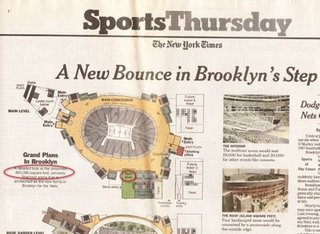
Atlantic Yards Report
Along with the extreme hype, two interesting aspects emerge in a second look at the cover of the 1/22/04 New York Times Sports section.First, the caption at left declares that the arena would be "privately financed," though that phrase didn't appear in the overview article. While no direct public subsidy had been announced--a 2/18/05 Memorandum of Understanding set out $200 million in subsidies, $100 million each from the city and the state--the Times could have been more skeptical.
After all, the 12/11/03 article announcing the Atlantic Yards plan stated:
Mr. Ratner said that the project "will be almost exclusively privately financed," although taxes derived from elements of the project will be diverted to help pay for it. (Emphasis added)
Posted by amy at 3:17 PM
September 13, 2008
As busy week approaches, Yankees' deal gets more scrutiny; will AY arena be included?

Atlantic Yards Report
Next week is going to be very interesting. On Wednesday will be the State Senate's eminent domain public hearing and the oral argument in the appeal of a judge's dismissal of the lawsuit challenging the Atlantic Yards environmental impact statement. On Thursday, a Congressional subcommittee will look into whether city officials "gamed" valuations of Yankee Stadium to ensure that the assessment was enough to fit with bond payments used for PILOTs (payment in lieu of taxes).And in a column yesterday headlined Yanks land deal ain't fair ball, Daily News columnist Juan Gonzalez revealed that Assemblyman Richard Brodsky, who on July 2 held a hearing on the Yankees deal, will next week release an "interim report" on the Yankees probe.
Surely Brodsky will do so before the Congressional hearing called by Rep. Dennis Kucinich (D-OH).
The PILOTs problem
The Yankees deal is understandably the focus, given that, as Gonzalez wrote, in January 2007, the city assessed land under the new Yankee Stadium at ten times the market value of its neighbors--an assessment justified, city officials said, by comparing it to other stadiums around the country.
The PILOTs can't exceed the value of foregone property taxes, hence the need for a high valuation. The same situation applies to the Atlantic Yards arena.
Posted by amy at 10:07 AM
Ratner Says He Can Do Taxable Bond, So Why Not?
Develop Don't Destroy Brooklyn asks more questions in the wake of Tuesday's New York Times article and the desired $800 million tax-exempt arena bond:
There is a very enlightening comment from Ratner spokesman Joe DePlasco:...that financing plan for the arena, known as Barclays Center, is dependent on a favorable ruling by the Treasury Department in the coming weeks that would allow Mr. Ratner to use tax-exempt bonds and a final victory over court challenges. If he is barred from using tax-exempt bonds, his costs will increase substantially for what would already be the most expensive arena in the world.
...
Joseph DePlasco, a spokesman for Bruce Ratner, said his company had drawn up documents for a tax-exempt bond offering that would enable them to move quickly after the Treasury Department issued its ruling. But, he said, Forest City and Goldman Sachs were also confident that they could obtain taxable financing, if needed. (Emphasis added)We've asked this before, and we'll ask again: If Forest City Ratner admits it can build its arena with taxable bonds and can obtain taxable bonds, then why, exactly, are they pursing the triple-tax free bond? The answer is, of course, that the developer will take advantage of every government tax break or handout even as they admit they don't need to. This is because their project is about making a super profit rather than the public good, despite the PR campaign that tries to tell you otherwise.
Posted by amy at 9:52 AM
September 12, 2008
Something is Rotten in (Macombs) Dam Park
Did NYC Officials Deliberately Inflate Land Value of New Yankee Stadium to Turn Public Money into Private Profit?
Democracy Now
Democracy Now co-hosts Amy Goodman and Juan Gonzalez discuss Gonzalez's column in today's Daily News about the shenanigans surrounding the City of New York's over-valuation of the land under the new Yankee Stadium.
And, of course, this is a major issue all around the country, because local governments are spending enormous sums in public subsidies and federally backed—federal tax-exempt bonds to create these huge stadium complexes. Here in New York alone, the Yankees have a stadium, a new stadium; the Mets are building a new stadium; the developer Bruce Ratner wants to build a new Nets arena. Across the river in New Jersey, the Giants and the Jets are building new stadiums. Minnesota, Washington—you go to any major city in America, they’re building new stadiums using huge amounts of public subsidies, and there are questionable practices, I think, in many of these cities as to how government officials are aiding these efforts.
article/video/audio/download MP3
NoLandGrab: Rep. Dennis Kucinich (D-OH) will chair a Congressional hearing next week probing the financing of the new Yankee Stadium and the Mets' Citifield — and Bruce Ratner's planned Barclays Center arena.
Posted by eric at 2:39 PM
Yanks land deal ain't fair ball
NY Daily News
by Juan Gonzalez
Q. How can it be that the land under the new Yankee Stadium is worth 17 times as much as the land under the old Yankee Stadium, which sits just a infield pop-up away?
A. Because the city appears to be colluding with the Yankees to hand the nation's taxpayers the bill for tax-exempt bonds!
In January 2007, the city assessed land under the new Yankee Stadium at 10 times the market value of virtually all other land in the South Bronx neighborhood.
The assessment - not including the new ballpark - worked out to a fair market value of $275 per square foot. But a Daily News analysis of city property records shows that city assessors said land on a dozen blocks around the site was worth an average of less than $25 a square foot.
...Lawmakers in Washington and Albany are investigating whether city officials inflated the new stadium's land value to make it possible for the Yankees to pay back nearly $1 billion in tax-free bonds for the project.
The Yankees deal calls for the team to begin paying back its original bonds once the new stadium opens in April through the use of something called Payments in Lieu of Taxes. IRS rules say such payments can't be higher than the official tax on the property that is being financed.
In other words, the Yankees need the highest possible assessment to be able to make their huge debt payments.
NoLandGrab: If the Yankees, or the Nets, for that matter, are permitted to issue tax-exempt bonds rather than taxable bonds, it can save them hundreds of millions of dollars in interest payments. Supporters say that most of the tax burden falls on the Federal goverment — but we're all federal taxpayers. And if the onus for funding our city's new sports venues is being spread around the nation, you can bet that we, in turn, are being handed a bill to help fund stadiums and arenas in other states, too.
Posted by eric at 1:49 PM
Down to the Wire for Ratner
Brooklyn Daily Eagle
The New York Times reported yesterday that Forest City Ratner plans to break ground in December on its long-delayed, $4 million Atlantic Yards arena-housing-office project. Skeptics, however, say the worsening economy and a host of lawsuits against the project will make it more difficult to begin. The giant real estate firm has applied for the use of tax-exempt bonds to finance its project. At the centerpiece would be the sports arena, designed for the basketball Nets and now named the Barclays Arena. Atlantic Yards is supported by high-ranking public officials, but a lively opposition movement of neighborhood residents and artists continues to be active.
NoLandGrab: The Eagle failed to mention that the Times reported that Ratner is seeking another $100 million in direct cash subsidies from the City and that Barclays Bank has an option to walk away from the naming-rights deal for the arena if the financing for the arena doesn't close by November.
Posted by lumi at 4:17 AM
September 11, 2008
Karma Burns
Gumby Fresh
The one blogger who has insight to bond financing and the like gives his personal assessment of the news from yesterday's NY Times article. Below are a few excerpts, but if you're interested, you may want to check out the entire post.
"Freshie" on the Barclays naming-rights deal:
It certainly explains why FCR and its underwriter are insisting the deal goes down in November. Because, according to the Times' Mr. Bagli, the arena's sponsor, Barclays, can walk if the arena doesn't reach financial close in November.
Barclays must be thinking they dodged a bullet on this one. Let's assume they really thought a speculative move by a basketball team was a good way to market exchange-traded funds. The advantages right now of trying to build a retail brokerage presence in the US are pretty limited.
And while Barclays hasn't had the poor run of form of its peers, but its balance sheet is still in need of a little TLC. $20 million is the amount that Barclays could earn from a single rights issue that isn't a massive cock-up, but it's still probably mutliples of the amount that it squanders on the entire New York financial publishing industry in a year.
...on the bond financing:
And then there's the financing. I reckon, leaving the litigation to one side, that FCR could get the financing done right now. Goldman Sachs closed a pretty solid, if somewhat subsidy-larded financing for the Louisville Arena the other day. The bond insurers seem to have stablised, and right now its easier to persuade bondholders of the utility of a new basketball arena in Kentucky than of the US housing system.
...on the death knell of Atlantic Yards:
No, the Atlantic Yards project won't ever get the decisive stake to the heart. There will be a dozen cuts instead, not least among them higher financing costs, discounted naming rights, restrictions on tax-exemption, Brooklyn pols refusing to chuck any more subsidies at it, and mounting losses at the Nets. At some point, FCR's stock analysts are going to start suggesting that it goes back to nickel-and-diming government agencies on a smaller scale than through gargantuan sports-related boondoggles.
Atlantic Yards Report, The picture clouds for FCR; what might the spreadsheet say?
Norman Oder responds to Gumby Fresh's assessment of how Atlantic Yards might finally bleed to death:
You have to believe that the spreadsheet folks inside Forest City Enterprises and Forest City Ratner have done the numbers, and that the developer can incur Nets losses and the carrying costs of the land as long as the upside--including tax-exempt bonds and naming rights--is available.
If that upside changes--and there's no proof that it will, just the possibility--then the numbers change and the deal changes. Then things might get even more interesting.
Posted by lumi at 5:48 AM
Atlantic Yards Groundbreaking In December
The NY Sun recapped yesterday's NY Times article with this blurb for the Real Estate Week in Review:
The developer Bruce Ratner has told state and city officials that he plans to break ground in December on his long-delayed $4 billion Atlantic Yards project in Brooklyn, which will include apartments and offices in 16 towers built around a basketball arena for the Nets, the New York Times reported. Mr. Ratner, chairman of Forest City Ratner; his bankers at Goldman Sachs, and the commissioner of the National Basketball Association, David Stern, also met last week with bond-rating agencies to discuss the proposed financing for the $950 million arena. The financing plan for the arena, to be known as Barclays Center, is dependent on winning court challenges and a favorable ruling by the Treasury Department that would allow Mr. Ratner to use tax-exempt bonds. If he is barred from using tax-exempt bonds, his costs would increase substantially for what would already be the most expensive arena in the world. Mr. Ratner has asked government officials recently for as much as $100 million in additional cash for the project, citing rising costs and problems in the bond markets.
Posted by lumi at 4:20 AM
September 10, 2008
It came from the Blogosphere... (Atlantic Yards bedside vigil edition?)

Not surprisingly, the Blogosphere is abuzz in the wake of this morning's New York Times article.
Gothamist, Ratner Vows to Break Ground on Atlantic Yards in December
Gothamist doesn't quite share Bruce Ratner's "mission accomplished" optimism.
That plucky developer Bruce Ratner is still rallying for his $4 billion plan to turn the MTA rail yards in downtown Brooklyn* into a sports arena, office and residential complex designed by Frank Gehry!
...All in all, the article is a study in contrasts, with the obstacles facing Ratner seemingly more insurmountable than ever, especially given the tanking economy. Yet the developer seems to be projecting Rumsfeldian confidence.
* The rail yard is not in downtown Brooklyn — it lies between Prospect Heights and Fort Greene; additionally, the rail yard only represents about 38% of the project footprint.
Curbed, Atlantic Yards Volcano Rumbles in Time for the Fall Season
Brownstoner, Plans to Break Ground on Yards, But What About Phase II?
Bavatuesdays, I heard the news today, oh boy…
This eulogy for Coney Island's Astroland finds a little solace in the increasingly murky future of Atlantic Yards.
Gowanus Lounge, Atlantic Yards Project Needs $100M More in Public Subsidy, Etc.
Yonkers Tribune, The Atlantic Yards Deal Is Coming Undone
The Neighborhood Retail Alliance, Net Gains Coming
Lobbyist Richard Lipsky must've read the Times article this morning while sporting his rose-colored glasses, though we do detect a softening in his tone.
But instead of sinking hundreds of millions of public dollars into a pro basketball arena to inspire "the thousands of young people that are playing ball in Brooklyn harboring the dream of playing professionally," dare we say it would make more sense to spend that money on schools, so the 99.9% of those young people who won't end up in the NBA at least have a fighting chance?
Nets Daily, Optimism Mixes with Doubt on Arena Ground-Breaking
Posted by eric at 10:31 AM
Brooklyn Arena Builder Plans to Break Ground in December After Delay
The NY Times
By Charles V. Bagli
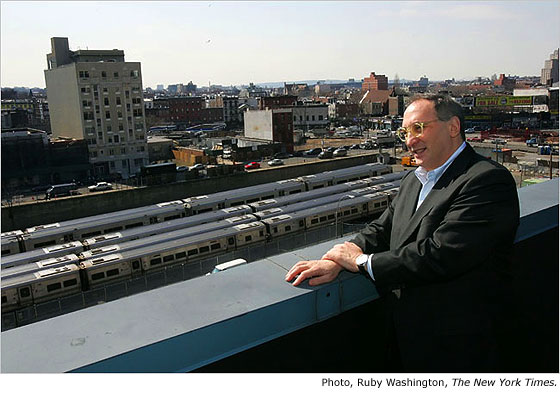
This must-read update on Bruce Ratner's controversial Atlantic Yards arena-'n'-high-rise megaproject contains two breaking-news bombshells:
Ratner has been trying to close on the deal and has been telling the press all year long that the company plans to break ground in November because "the naming rights contract [with Barclays Bank] requires Forest City to close on the land and the financing by the end of November."
[Ratner is now telling the Times's lead real estate reporter that groundbreaking will be in December.]Bruce Ratner is asking for MORE OF YOUR MONEY TO BUILD THE ARENA.
Mr. Ratner has asked government officials recently for as much as $100 million in additional cash for the project, citing rising costs and problems in the bond markets, according to two officials who would speak only on the condition of anonymity because they were not authorized to discuss the negotiations. The city and the state have already agreed to provide $300 million in subsidies and tens of millions in tax breaks.
[More specifically, the tally is $305 million ($100 million from the state and $205 million from the city).]
NoLandGrab: For the online version of the article, the photo is captioned, "Bruce C. Ratner in Brooklyn at the Atlantic Yards, which he has hopes to transform." Technically, he is overlooking "the Vanderbilt Yards."
"Atlantic Yards" is the brand name Ratner made up for the project he hopes to build, which, as you can tell by the photo, hasn't been built.
From Develop Don't Destroy Brooklyn (DDDB), Atlantic Yards: The Deal is Coming Un-done
The group spearheading the legal fight against Ratner's landgrabbing megaproject highlights three important points from the Times article, the two listed above and the issue of whether or not the IRS will reopen the tax loophole to allow for tax-exempt bond financing.
Citing Ratner's troubles, the group calls for a time-out on demolitions so that alternative plans can be considered:
The Atlantic Yards project is hanging by a thread, yet Ratner continues to demolish a whole section of Prospect Heights and spend taxpayer dollars on project-specific infrastructure work. It's time for that to stop. It's time to move forward with a new feasible and superior vision to develop the rail yards.
DDDB thought that Joe DePlasco was "spun by his own spin for too long," when the Ratner pr flack sounded a little punch-drunk in the Times, calling Atlantic Yards "the most exciting project in the country and the most exciting arena in the world."
Atlantic Yards Report, Times: Barclays naming deal has November deadline; FCR seeks $100M in subsidies
Some analysis of the Times article from Atlantic Yards watchdog Norman Oder:
It's doubtful that [November] deadline will be met; while it doesn't mean that the Barclays Center deal is on death row, it could lead Barclays to reconsider and/or renegotiate the deal. (FCR wouldn't comment.)
The article also states that CEO Bruce Ratner "has asked government officials recently for as much as $100 million in additional cash for the project, citing rising costs and problems in the bond markets," according to anonymous sources. (Remember, Chuck Ratner of parent Forest City Enterprises told investment analysts in April that "we still need more" subsidies.)
NoLandGrab: Regular readers will remember that the Chuck Ratner quote was excavated out of a transcript and reported on by Oder.
Despite the article's fairly critical view, Oder suggests that Bagli should have been more skeptical:
The article doesn't define "break ground." While the developer obviously could hold a ribbon-cutting ceremony, it's hardly guaranteed that pending legal cases would be dismissed, or that additional appeals or legal challenges wouldn't emerge.
The article quotes Daniel Goldstein of Develop Don't Destroy Brooklyn: “There’s no way they’ll get control of the land they need, get the financing, end the litigation and break ground by December." Indeed, even in the event the two lawsuits are cleared this year, it would still take additional time to acquire properties via eminent domain.
Note that the Times's phrase "will feature" suggests that the current plan for 16 towers is a go; evidence suggests the project is seriously in flux.
Oder fills in some blanks in response to DePlasco's confidence-building quote:
The FCR spokesman Joe DePlasco offers some spin:
While it is a tough market, we have secured more than $1.5 billion in construction loans this year so far,” Mr. DePlasco said. “And this is the most exciting project in the country and the most exciting arena in the world.”*
Well, part of that total is Liberty Bonds; another part is state housing bonds. Such tax-exempt bonds are a much better deal than taxable bonds.
NoLandGrab: In other words, the "construction loans" cited by DePlasco come from government programs and were NOT secured in the actual marketplace, which presumably will take a less sanguine view of the project.
Posted by lumi at 5:40 AM
Kucinich's Subcommittee to look at stadium and AY arena deals
Atlantic Yards Report
Apparently the July 2 State Assembly hearing on financing the new Yankee Stadium was just a warm-up, since some tough questions about the deals for Yankee Stadium, the Mets' Citifield, and yes, the planned Atlantic Yards arena will be raised next week in Congress.
Rep. Dennis Kucinich (D-OH), who chairs Domestic Policy Subcommittee of the Oversight and Government Reform Committee, yesterday announced a hearing to be held September 18. It follows up on two public hearings the subcommittee held last year (3/29/07 and 10/10/07) that looked more broadly at some of the policy issues.
No witness list has been announced, but I assume someone from the New York City Industrial Development Authority, whose Seth Pinsky was on the hot seat July 2, will be among those present.
While no legislation has been proposed yet, the Subcommittee's concern may put pressure on the Internal Revenue Service (IRS) to clarify and finalize a proposed rule regarding PILOTs (payments in lieu of taxes) to finance sports facilities. That rule could stymie tax-exempt funding for the Atlantic Yards arena--or the city and state could succeed in getting the arena grandfathered in under the ruling that allowed funding for the two baseball stadiums.
The Yankees and Mets, with the assistance of New York City and State, gained "private letter rulings" (PLRs) from the IRS in October 2006 allowing an aggressive plan for tax-exempt financing. After financing for those stadiums was approved, the IRS issued a revised regulation that would eliminate what its chief counsel called a "loophole."
New York City and State would like to see the loophole extended for additional financing for the two stadiums, as well as for the Atlantic Yards arena, which officials contend should be grandfathered in under those old rules, given that it was proposed and proceeded long before October 2006. However, the project was not approved until December 2006.
Posted by lumi at 5:05 AM
September 9, 2008
“Gaming the Tax Code: Public Subsidies, Private Profits, and Big League Sports in New York"
No, that's not the name of a new book by Neil deMause and Joanna Cagan. Even better, it's the title that the U.S. House of Representatives' Domestic Policy Subcommittee, chaired by Rep. Dennis Kucinich (Dem-OH), has given to a hearing it will hold next week on efforts by the Yankees, Mets and, yes, the Nets, to fund their new playplaces at the expense of the taxpayers.
And that can't be too comforting to the Steinbrenners, the Wilpons or Bruce Ratner.
Specifically, the hearing will address whether efforts to finance new stadiums for the New York Yankees and New York Mets and a new arena for the New Jersey Nets by issuing federally tax-exempt bonds advance the public interest; whether the U.S. Department of Treasury’s rulemaking has been consistent with the Tax Reform Act of 1986; and the legal, policy, and economic implications of the existing and proposed IRS rules regulating the structure of payments of lieu of taxes (PILOTs) permitted to finance projects funded by the issuance of federally tax-exempt bonds (i.e., the PILOT rule).
The hearing will also address alleged misrepresentations made to the IRS and investors related to the assessment of the new Yankee Stadium, whether these alleged misrepresentations affect the tax-exempt status of the bonds issued to finance construction of the stadium, and whether these alleged misrepresentations are an outgrowth of the incentives provided to state and municipal stakeholders by the PILOT rule.
Read the complete Media Advisory after the jump.
For Immediate Release:
Contact: Nathan White (202) 225-5871
Media Advisory: Hearing on Financing of New York Stadiums
Washington D.C. (September 8, 2008) – The Domestic Policy Subcommittee of the Oversight and Government Reform Committee will hold a hearing, “Gaming the Tax Code: Public Subsidies, Private Profits, and Big League Sports in New York,” on Thursday, September 18, 2008, at 10:00 a.m. in 2154 Rayburn House Office Building.
This will be the third hearing held by the Domestic Policy Subcommittee examining whether the use of the federal tax code to subsidize the construction of professional sports stadiums and arenas furthers the public interest, and the first to examine alleged improprieties in the financing process.
Specifically, the hearing will address whether efforts to finance new stadiums for the New York Yankees and New York Mets and a new arena for the New Jersey Nets by issuing federally tax-exempt bonds advance the public interest; whether the U.S. Department of Treasury’s rulemaking has been consistent with the Tax Reform Act of 1986; and the legal, policy, and economic implications of the existing and proposed IRS rules regulating the structure of payments of lieu of taxes (PILOTs) permitted to finance projects funded by the issuance of federally tax-exempt bonds (i.e., the PILOT rule).
The hearing will also address alleged misrepresentations made to the IRS and investors related to the assessment of the new Yankee Stadium, whether these alleged misrepresentations affect the tax-exempt status of the bonds issued to finance construction of the stadium, and whether these alleged misrepresentations are an outgrowth of the incentives provided to state and municipal stakeholders by the PILOT rule.
Posted by eric at 6:23 PM
September 8, 2008
Payments in Lieu of Taxes: An Animated Explanation
This animated explanation of PILOTs and TIFs, both creative ways that tax revenue is diverted towards paying for government-sponsored projects, was brought to our attention by the folks at Develop Don't Destroy Brooklyn, who posed the question, "Wouldn't it be nice if you too could use your taxes to pay your mortgage or rent?!"
NoLandGrab: Bruce Ratner is hoping to use PILOTs to finance a new Frank Gehry-designed arena for his NJ Nets basketball team.
That means that, if he gets the go-ahead on PILOTs, the money that would normally be collected as property tax and flow to the State coffers, would instead be used to pay off the loan that financed the construction of the arena.
PILOTs and TIFs are a convoluted response to the taxpayer backlash against direct funding of controversial projects or simple hand-outs of subsidies.
Posted by lumi at 5:26 AM
It came from the Blogosphere...
POLITICS
Brooklynian, News flash: We have a primary Tues. 9/9
"Raulism" updates Prospect Heights netizens about tomorrow's primary election, including the skinny on Atlantic Yards:
We don't have many races in our district, but most of Prospect Heights is in the 57th AD. The one contested race we do have is for District Leader (male). This is a Democratic Party position, and it doesn't have much power, but it is our voice in the official Democratic Party decision making process.
As most people should know, most of the decisions in New York State are done behind closed doors, so this position is our choice for who to put in those hidden negotiations. Believe it or not, our incumbent, Bill Saunders, has been a strong independent voice. He is active in the African-American community in Fort Greene, and he has been a consistent, strong voice for our community and against the Ratner Atlantic Yards proposal.
FINANCE
Nets Daily, Nets Arena Bonds to Launch in November
Goldman Sachs is close to launching an $800 million bond issue for the Barclays Center, says Project Finance magazine. Quoting ”sources close to the financing”, the magazine reports Goldman is in the process of having the bonds rated, and expects financing to be in place by the end of November 2008. The new arena will be part of Atlantic Yards. The Nets say they intend to break ground on the arena in November.
Commenters, like Norman Oder, are skeptical, including "brooklyn bob" who sez:
Anonymous sources … yeah, that’s REAL reliable.
Probably the same sources that spouted a thousand previous lies for ratner.
EVENT
NY Protest Calendar, 10/18 SAT: "Stop Ratnerville" walkathon Atlantic Yards
POSTER PROJECT!
Noticing New York, “Yeah, sure. Bad for the glass.” (Inartful Clues to New York City Government?)
Since many trees along the Brooklyn waterfront are suffering from "salt-shock," Noticing New York asks an important question. The answer will sound familiar to many Atlantic Yards watchdogs:
Could the damaging effect of the art-concept salt-waterfalls have been foreseen? The Brooklyn Eagle tells us that an environmental impact assessment preceded the art project: "‘An Environmental Assessment Study was done, and it was concluded that there would be no lasting impact from the project,” said Rochelle Steiner, director of the Public Art Fund.
...
City Hall issued a June 15, 2008 press release of the Mayor’s statements about the coming art project on WINS 1010: Mayor Bloomberg Discusses the Waterfalls Project in Weekly Radio Address. The Mayor promised “the Waterfalls will have little impact on the environment.”
...
Whether you want to view them as a large scale project or a small one, the Waterfalls are temporary. They might even be viewed as just an experiment and as we see, when they failed environmentally and fell short of expectations they can be turned off early. But we have much more major projects like the Atlantic Yards megdevelopments being propelled along by similar impulses and much less competence. Though the Gehry-branded megadevelopment is being treated cavalierly by the Bloomberg administration almost as if it were just another piece of concept art (Building #1 is currently to take the shape of a stack of discarded pizza boxes), it won’t be temporary and remediation won’t be as simple as turning off a spigot.
Sullivan County CBA Blog, Concord Secures Equity Financing
Though this post is off-topic, the ability to secure financing for large projects is being compared to the region's poster-project:
Even the long-heralded Atlantic Yards mega-project in Brooklyn has been delayed.
Curbed, Columbia's Manhattanville Show, Day 2: 'Diabolical Plan'
And the award for poster-project tied up in years of litigation goes to Bruce Ratner's controversial Atlantic Yards megaproject, though West Harlem property owner Nick Sprayragen vows to take his fight against eminent domain all the way to the top:
The storage facility owner says he will fight the use of eminent domain to take his property all the way to the Supreme Court, a process that could hold up the Manhattanville expansion--not unlike the litigation that has tied up the Atlantic Yards plan in Brooklyn--for years.
Posted by lumi at 4:10 AM
September 2, 2008
City finally responds to FOIL request, but doesn't answer "how and why" extra $105 million was provided
Atlantic Yards Report
Did it really take the Mayor's office three months to release numbers that they point out have already been made public, or was that how long it took to figure out how to NOT give Norman Oder the documents he was really looking for?
I finally got a response to the Freedom of Information Law (FOIL) request that the mayor's office seemed inclined to ignore, but the answer wasn't exactly informative. So we still don't know exactly how Forest City Ratner managed to get the city to more than double its direct subsidy of $100 million for Atlantic Yards.
...
I got a response August 5 to my request for "documents, including but not limited communication between and among government agencies, developer Forest City Ratner, and lobbyists, that explain how and why the $105 million request was made and how and why the City agreed to it."
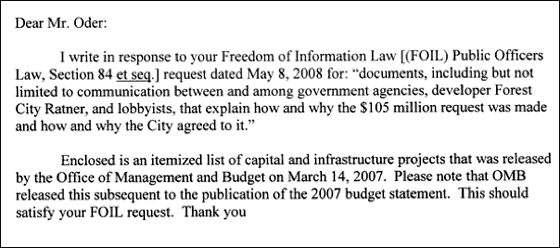
...
In its belated response to me, the city provided an itemized list of capital and infrastructure projects released by the Office and Management and Budget (OMB). That was it--no further explanation.The city stated that the additional $105 "represents capital projects to support infrastructure and other capital needs in the are, some of which are independent of, but in the area of the planned Atlantic Yards project."
As far as I can tell, most of those capital project are not independent of the Atlantic Yards project. For example, the two bridge overpasses are clearly not independent. The MTA infrastructure almost certainly isn't independent, and the "transportation infrastructure" likely is not independent. The "water main improvements" most likely are related to the size of the AY project. As for "Atlantic Ave. Corridor," that's vague.
The fact remains that the city didn't answer "how and why" the request was made, and that Chuck Ratner thinks that entire $105 million goes to the Atlantic Yards project.
Posted by lumi at 5:15 AM
August 27, 2008
As new stadiums spring up, grumbling over ticket prices (but is that the real issue?)
Atlantic Yards Report
There's been some vigorous discussion on the New York Times web site in response to yesterday's front page article, headlined New Stadiums: Prices, and Outrage Escalate, about how four new stadiums coming online in the next few years have raised ticket prices and also added revenue-raising elements like personal seat licenses--both of which are likely for the Atlantic Yards arena, which goes unmentioned in the article.
The article is sympathetic to the elite of sports fans who have season tickets, while some online commenters suggest that fans should be paying for new stadiums. Others point out that the stadiums receive public financing and tax breaks, and that "professional sports leagues are government sanctioned cartels" with competition limited. Moreover, season tickets are often a tax deduction.
And what about the Nets? As I wrote last year: "Thanks significantly to 170 new high-priced suites, the “blended average ticket price” for Nets games would go up dramatically, 73% for regular-season games and 64% for playoff games, upon the team's move." The number of suites has been reduced to 130, but you can bet the average ticket price would skyrocket.
Posted by eric at 10:39 AM
August 26, 2008
New Stadium or Old, Seats Cost a Fortune
The New York Times, New Stadiums: Prices, and Outrage, Escalate
No American market has witnessed anything like it: two baseball teams and two football teams will open three new stadiums within 17 months and 20 miles of one another, with everything set to be in place by the fall of 2010.
But even as fans of the Mets, the Yankees, the Giants and the Jets look forward to state-of-the-art stadium architecture, better sightlines, wider concourses and more bathrooms, some of them are also facing startling increases in ticket costs during a serious economic downturn.
The teams are confident market research supports the increases, but season-ticket holders say the price they are being asked to pay in the new stadiums — the Mets’ $800 million Citi Field, the $1.3 billion Yankee Stadium and the $1.6 billion (and climbing) Jets-Giants stadium — is turning them into something other than fans. Instead, interviews with two dozen fans indicated, they are starting to feel like unwitting bankers.
“You’re asking me for money and giving me nothing in return,” said Steve Kern, a construction executive from Boonton Township, N.J., who owns two Jets season tickets. “I won’t be sharing in the revenues or get any perks.”
NoLandGrab: At least Mr. Kern will get to see a Jets game or two, should he decide to keep his season tickets. Millions of taxpayers will have nothing to show for the massive public investment in these projects.
One has to wonder, too, with all these new stadiums coming online, and a head-to-toe makeover of Madison Square Garden soon getting underway, what demand will remain for seats and suites in the Barclays Center?
amNY, Shea Stadium seats selling like hotcakes
Not the right to sit in the seats in the new Citi Field, but the actual physical seats from the soon-to-torn-down Shea Stadium, 6,000 of which sold in the first two hours of online sales yesterday morning.
The Mets struck a deal to sell the pairs of seats, complete with an armrest in between, priced at the hefty sum of $869 in honor of the team's champion years of 1986 and 1969.
The club will split the proceeds from the sale, which is expected to gross more than $14 million, with the city.
As of Monday morning, all of the orange-colored field level seats were sold out, but seats in the loge, mezzanine and upper deck remained.
Other bits of Shea lore, such as clubhouse lockers, are expected to go on sale shortly, as are pieces of Yankee Stadium, which is also closing this year, but final details have yet to be worked out.
NoLandGrab: And why exactly is the City of New York splitting the proceeds with the Mets, when the stadium is ostensibly publicly owned? Too bad we taxpayers don't get to negotiate our tax rates with local government, which appears to be an exceptionally easy mark.
Posted by eric at 2:16 PM
August 25, 2008
Is Kucinich looking at the issue of naming rights?
Atlantic Yards Report
From a New York Times Magazine Q&A yesterday with Rep. Dennis Kucinich:
I see you are scheduled to speak at the convention on Tuesday, at the Pepsi Center, which sounds like the name of a soda plant. Why is it called that?
My guess is that Pepsi probably bought the naming rights. Naming rights are another thing my subcommittee — the Domestic Policy Subcommittee — is looking into.
We know that the subcommittee has been looking into the tax-exempt bond deals for Yankee Stadium and other sports facilities, as well as the rules behind tax-exempt bonds. But the naming rights inquiry is news to me.
NoLandGrab: If Bruce Ratner's new basketball arena in Prospect Heights is technically publicly owned, how come he gets to keep all the money made from selling the naming rights?
Posted by lumi at 5:09 AM
August 23, 2008
Gov. appoints head of Empire State Development
Crain's
Erik Engquist
Marisa Lago was introduced at a midtown press conference as president and CEO of the Empire State Development Corp. Upstate and downstate ESDC presidents will report to her, unlike in the Spitzer administration, when the agency was bifurcated with two chairmen reporting to the governor. Mr. Paterson had frowned on that arrangement, saying it diluted authority at the agency and led to confusion about who was in charge.Ms. Lago, the former head of development for the city of Boston and a veteran of two mayoral administrations here, has spent the last seven years in international finance as global head of compliance for Citi Markets & Banking. She will be based in New York City and work under unpaid ESDC Chairman Robert Wilmers, who described his role today as “largely strategic” rather than operational. Mr. Wilmers, who was appointed by Mr. Paterson in June, runs Buffalo, N.Y.-based M&T Bank.
...
Mr. Wilmers said that when he accepted his post, “my first thought was to find out how much we spend on economic development.” More than two months later, he admitted, “I still don’t know the answer.”The agency has also been trying to hold businesses accountable for the job creation they promise in exchange for receiving grants and tax breaks from ESDC. Spitzer administration officials complained that the rationale behind the agency’s handouts was often questionable and follow-up was virtually nonexistent.
Develop Don't Destroy comments:
Remember that Forest City Ratner promised 10,000 office jobs when it announced its project in 2003. Today, if the thing ever gets built, it is likely to only produce about 375 office jobs.Since the Atlantic Yards project is stalled, lacking in finance and has numerous contracts remaining to be signed prior to the project moving forward, now is the time when the ESDC can examine—really for the first time—its handouts to Forest City Ratner. There is no need to wait for follow-up.
Posted by amy at 8:57 AM
August 22, 2008
The lesson of Field of Schemes: political reform needed
 Atlantic Yards Report
This is the eighth and final part of a multi-part interview (conducted May 28) with Neil deMause, the Brooklyn-based co-author of the book Field of Schemes: How the Great Stadium Swindle Turns Public Money Into Private Profit, and writer of the companion web site. He testified at a 3/29/07 Congressional hearing that questioned taxpayer financing of stadiums, convention centers, and hotels.
Q. What’s the lesson of the book? Do you have general reform advice--what should cities, states, or the federal government do?
A. It’s easy if you’re the city or the state or the federal government: you stop giving money… It’s within federal government’s power to stop tax-exempt bonds from being used for stadiums right now. You just pass a law telling the IRS don’t do that anymore. The federal government could shut down subsidies for sports stadiums and for other ridiculous deals, luring companies from one state to another.
There’s this thing I mentioned in the book. [Rep.] David Minge’s proposal, why don’t you just pass an excise tax on corporate subsidies, so if Ratner gets, say, a billion in subsidies for this project, then he has to pay federal taxes on this project, that would suddenly make it a lot less lucrative. Congress could do that in a second. They are not.
Cities could say No, it’s not worth it to us, that it would be nice to have a basketball team in Brooklyn, but not that nice. All this is within the power--it’s not that hard to do. The problem is, what do we as private citizens do when the government is not making decisions based on the public interest but making decisions based on the private interest.
Posted by lumi at 4:13 AM
August 21, 2008
Mayor, rich friends need to conserve money, too!
amNY, Letter to the Editor
Hey, it's only one person's opinion, but Tanya O'Langan from Manhattan has a point:
How can Mayor Bloomberg say we have a budget problem when he only pays cops $25k? Maybe our only budget problem is that we have a mayor who gives billions of our tax dollars to his fellow billionaires in corporate welfare?
If 'times are tough' and 'we must all bite the bullet,' then perhaps he should get our money back from the well connected crooks like Steinbrenner and the Mets!
NoLandGrab: And while we're belt tightening, throw in fat-cat Bruce Ratner.
Posted by lumi at 4:32 AM
August 8, 2008
Yet again, sports economist Zimbalist stumbles in court
Atlantic Yards Repot
The sports economist who penned the oft-cited economic study that comes to the dubious conclusion that a new Nets arena in Brooklyn would be a net benifit to taxpayers screwed up on the witness stand, again:
It’s been a tough seven months for sports economist and professional witness Andrew Zimbalist, who has been beaten up in court three times, not to mention the court of opinion. I recently chronicled a case involving the Seattle SuperSonics, during which Zimbalist’s credibility was shredded during cross-examination, an antitrust case involving NASCAR in which a judge cast doubt upon Zimbalist's report, and Zimbalist’s dubious and defensive appearance on the Brian Lehrer Show.
In the past two weeks, Zimbalist’s credibility further suffered during a federal antitrust trip involving a challenge to the ATP (Association of Tennis Professionals), the men's professional tennis players' association, by organizers of the tour in Hamburg, Germany, upset that their tournament had been demoted from the top tier and changing its schedule.
(All coverage is from SportsBusiness Journal, reposted in this tennis blog.)
According to SportsBusiness Journal, Zimbalist’s testimony “caused an uproar,” leading the defense to request a mistrial and the judge to dismiss the jury early, because he brought notes to the stand, in contravention of court procedures.
In fact, at one point, Zimbalist corrected the lawyer questioning him, asking if the right question had been asked. “Well, I have seen it all,” federal judge Gregory Sleet said.
Posted by lumi at 4:16 AM
Kucinich looks into questionable ticket deals for the Yankees and Mets stadiums
Atlantic Yards Report
Norman Oder reports that Representative Dennis Kucinich "has asked the Internal Revenue Service and Treasury Department to hold off from approving any deal allowing PILOTs for a Nets arena until his investigations of tax-exempt financing are concluded."
Kucinich's investigation now includes perks for NYC government officials in the Yankees and Mets Stadium deals.
Posted by lumi at 3:46 AM
Atlantic Yards IS Too Costly
The folks at Develop Don't Destroy Brooklyn (www.dddb.net) agree with Governor Paterson, who recently stated in an interview on WCBS, "if [Atlantic Yards] starts to become too costly, a lot of these projects that we were for, we might have to change our mind."
However, after a quick tally, the group argues "that we are there with Atlantic Yards and have been for quite a while":
Though the NY Post's $2 billion in government back financing is debatable, the developer claimed three years ago that the public investment in the project would be $1.1 billion. Either figure is too costly considering neither the city or state have shown that there would be a meaningful financial return for the taxpayers—especially seeing as how Ratner has provided the public and government with no confidence whatsoever that the project can be built.
Posted by lumi at 3:36 AM
August 6, 2008
Flashback 2005: sports economist Zimbalist on the AY exception
Atlantic Yards Report
Norman Oder pokes more holes in the increasingly shaky reputation of one-time hole-poker sports economist Andrew Zimbalist.
In the June 2005 issue of the Brooklyn-based 'zine Stay Free, an interview (headlined Hoop Schemes) shows sports economist Andrew Zimbalist poking holes in sports facility studies, but insisting his study for developer Forest City Ratner was an exception.
However, a paired interview with Zimbalist's intellectual foil, Neil deMause of Field of Schemes, shows some contradiction in the professor's calculations.
...Yet Zimbalist on the Brian Lehrer Show recently insisted incorrectly that Forest City Ratner was merely relying on as-of-right benefits. And, of course, he ignored costs for additional security and incorrectly speculated there would be no additional public contribution.
Posted by eric at 8:03 AM
July 30, 2008
Field of Schemes: Congress Probes How New Sports Stadiums Turn Public Money into Private Profit
A congressional committee is investigating whether New York City and the New York Yankees wildly inflated the value of the site for the team’s new stadium to float nearly $1 billion in tax-free bonds.
Democracy Now
Congressman Dennis Kucinich, Good Jobs New York's Bettina Damani and Field of Schemes author Neil deMause join host Juan Gonzalez to discuss subsidies, funny stadium math — and Atlantic Yards.

REP. DENNIS KUCINICH: I think that it’s very important to understand that we’re looking at a public policy matter here that relates not only to New York and not only to the Nets and the Atlantic Yard project, but it also relates to the whole country, as your other guests have said, because it’s quite possible that there are billions of dollars in tax benefits that should be going to municipalities for the purposes of repairing their infrastructure and for schools and other things and that are instead being diverted for these private sports complexes.
And the question is one of public policy, one of the IRS, and in the case of the New York Yankees, questions of securities law, because of the various amounts of the appraisal, $45 a square foot versus $275 a square foot, which have a bearing on the overall cost of the project. And if the cost of the project is inflated, that’s going to be of interest to the SEC, as well as the IRS.
...JUAN GONZALEZ: Right. And then, of course, the final irony with—because most of these stadiums have luxury boxes that are for corporations that go from $500,000 to $800,000, in the case of the Yankees, per year to rent these boxes, and of course, my newspaper, the Daily News, reported yesterday that in this deal, the City of New York arranged to have its own luxury box at Yankee Stadium available, presumably to city officials, as part of the deal for the financing. Bettina, your response to that?
BETTINA DAMIANI: It’s aptly coined the landlord suite. And it’s just another example of how local elected officials almost seem to be void of feeling that they have responsibility to the public, because they’re going to get nice seats, in the long run.
article/video/audio/download MP3
NoLandGrab: "The landlord suite." Nice. If we taxpayers are funding the lion's share of the costs, doesn't that make us the landlords? That being the case, NLG's got dibs on the first Mets-Yankees inter-league game next season.
Posted by eric at 7:12 PM
Typo? City/state letter on tax-exempt bonds backdates MTA RFP by three years
Atlantic Yards Report
Maybe it's just a typo. Maybe it's a calculated slip. But there's another misleading element in a letter that, as I and Develop Don't Destroy Brooklyn have contended, deserves serious scrutiny.
The 5/8/08 letter to the Internal Revenue Service and U.S. Treasury Department from the New York City Industrial Development Authority and the Empire State Development Corporation backdates the issuance of the Metropolitan Transportation Authority's request for proposals (RFP) for the Vanderbilt Yard by three years, to 5/24/02.

The MTA's RFP was issued on 5/24/05.
...What's the value of the 2002 date, compared to 2005? Well, maybe it's none, given that 2005 still would fall well before the October 2006 cutoff.
Then again, a 2002 date suggests that momentum for the project--which the letter says commenced in 2003--reached back even earlier.
Also, the 2002 date avoids potential consternation should regulators wonder why, if the project began in 2003 and the MOU was signed in February 2005, the Vanderbilt Yard was put out for bid only in May 2005.
That sequencing issue has been at the heart of the AY federal eminent domain case, which was dismissed by a district and appellate court and refused a Supreme Court hearing--but was never really addressed by the courts.
NoLandGrab: Typo or obfuscation? We don't know, but we do know that once the tale-telling starts, it gets easier to do it again and again, and it's been going on with Atlantic Yards since about "May 24, 2002."
Posted by eric at 8:12 AM
Questions Raised Over Financing Deals of New Yankees Stadium
WNYC News Radio
By Matthew Schuerman
Details about the Congressional inquiry into the Yankee Stadium financing might seem a little off-topic, but keep in mind that the Yankees have requested additional bond financing and that Bruce Ratner hopes to take advantage of the same in order to finance the Nets arena.
The story about the Yankees deal took an interesting turn yesterday when WNYC reported the following scoop (full transcript):
The new Yankee Stadium is receiving more than $600 million in city, state and federal subsidies. Almost half of that money came in the form of tax exempt bonds issued by the city's Industrial Development Agency, or IDA. Under the bonding agreement, the IDA would have permanent access to a luxury suite at the new stadium. Westchester Assemblyman Richard Brodsky says the agreement is another reason to question what public interest the new ballpark is serving to deserve such a high level of taxpayer support.
Though a spokesman for the Mayor has said the City hasn't decided whether or not to accept this gift, our guess would be NOT, now that WNYC has blown their cover.
Develop Don't Destroy Brooklyn explores the possibility of thank-you gifts from Bruce Ratner (link):
If Bruce Ratner ever builds his Barclays Boondoggle Arena (fat chance) one can presume that he'll make a gift of free luxury skyboxes to numerous officials, either because:
1. He owes a lot of people in government for his boondoggle land grab, and/or 2. He can't seem to find buyers for his luxury suites, so why not give them away.
Good Jobs First's blog Clawback is reporting that Bettina Damiani, journalist Neil deMause, columnist Juan Gonzalez and Rep. Kucinich are scheduled to appear this morning to discuss the controversy on Democracy Now (9 a.m. on BCAT channel 34/67.).
Additional Coverage:
AP via amNY
NY assemblyman queries Yankees on stadium subsidy
State Assemblyman Richard Brodsky wants the New York Yankees to explain why the proposed value for land under Yankee Stadium appears inflated in an Internal Revenue Service tax estimate.
He also wants to know if the city agencies considering the team's request for public funds will get a luxury suite in the new stadium.
The Westchester Democrat raised the questions in a letter to Yankees' President Randy Levine released Monday. Brodsky has questioned the Yankees' request to subsidize the new stadium using $336 million in public funds issued by the city's Industrial Development Agency.
...
"This goes to the heart of whether it is a public project or a private project," Brodsky said in an interview. He said his review of documents concerning the project differ from public comments about the deal that would use public support to help the Yankees build their new stadium in the Bronx.
Newsday via amNY
Panel to probe land appraisals for Yankee Stadium
A congressional subcommittee hearing centered on the use of public financing to build sports complexes like the new Yankee Stadium was postponed, allowing the panel to probe deeper into why the value of land under the Bronx stadium appeared inflated on tax reports, an official said Tuesday.
The Domestic Policy Subcommittee of the House Oversight and Government Reform Committee -- chaired by Rep. Dennis Kucinich (D-Ohio) -- had scheduled the hearing Wednesday. It's now planned for sometime in September.
On Friday, Kucinich sent letters to Yankee officials, the Internal Revenue Service and various city agencies inquiring about the accuracy of land appraisals reported to the IRS. In the letter, he requested documentation detailing land value estimates and how they were calculated. He wanted the documents no later than Aug. 6.
But Assemb. Richard Brodsky (D-Westchester) had already obtained some of the information Kucinich had sought and on Monday released land value estimates he said bared discrepancies.
...
Kucinich, a longtime skeptic of public subsidies for sports complexes, and Brodsky, a critic of public authorities, have questioned the Yankees' request for an additional $336 million in tax-free bonds to help complete the new $1.3-billion stadium. The Mets are also seeking about $52 million more in tax-exempt-bond financing for its new stadium. Brodsky, who earlier this month held a hearing in Manhattan on tax-free-bond financing, said he was invited to testify in the September hearing.
Posted by lumi at 4:38 AM
July 28, 2008
THAT '70S WOE IN RERUN
GOV WARNING OF WORST ECONOMY IN DECADES
NY Post
by Fredric U. Dicker
The Post's political maven claims an exclusive on the news that Governor Paterson is going to toss a bucketful of cold water on New York's already-ailing economic psyche.
Gov. Paterson, convinced the state faces its worst fiscal crisis since the mid-1970s, will deliver the grim news in an unprecedented special address to New Yorkers as soon as tomorrow night, The Post has learned.
The governor's address - which his aides hope will be televised by public and cable news stations - will say that plunging state revenues will force painful cuts in state services, necessitate a reduction in the state work force, possibly through layoffs, and require other difficult economic measures, source said.
Paterson is also expected to announce that he's ordered state agencies to slash spending beyond the relatively modest 3.3 percent cuts he ordered in late spring.
NoLandGrab: So, what'll it be? We need this luxury-suite-filled arena more than ever in these tough economic times? Or, Atlantic Yards, an unsupportable commitment of public funds at a time when we all need to be tightening our belts? You can bet that Forest City Ratner's lobbying machine is going all out to convince the Gov that the Net's net is positive for state coffers.
Posted by eric at 12:38 PM
Congress probing whether city wildly inflated value of land for new stadium
NY Daily News
by Juan Gonzalez
The News columnist probes two divergent opinions of the value of the land underlying the new Yankee Stadium — both emanating from New York City officials!
A Congressional committee has launched a probe into whether the city and Yankees wildly inflated the value of the site for the team's new stadium to float nearly $1 billion in tax-free bonds.
Rep. Dennis Kucinich (D-Ohio) last week demanded "specific documents and reports" that could show the city claimed the land beneath the new Yankee stadium was worth nearly seven times its true value.
The massive switcheroo allowed the city to sell $941 million in bonds for the stadium, which must by law be linked to a site's actual value.
...Kucinich, who heads the House Committee on Oversight and Government Reform, is zeroing in on dramatically different estimates the city offered for the stadium land - one of $275 per square foot and another of just $45. A hearing is set for September.
...Why such wildly different values for the same property?
"Our assessors jacked up the numbers and the comparables for the Council to justify the stadium bonds," said a Finance Department official familiar with the project.
NoLandGrab: Vacant land in the Bronx? $275 per square foot.
Vacant land in the Bronx? $45 per square foot.
The possibility of the United States Congress denying tax-exempt financing to the Yankees, Mets and Atlantic Yards developer and Nets owner Bruce Ratner? Priceless.
Posted by eric at 11:43 AM
Kucinich probes PILOTS for sports venues
Representative Dennis Kucinich is looking into whether or not the Yankees tailored the valuation of the team's new stadium in order to justify the amount of tax-free bond financing.
This additional scrutiny of Payment in Lieu of Taxes (PILOTS) could affect Bruce Ratner's Atlantic Yards arena, since he's seeking the same type of bond financing, which could save him perhaps as much as $165 million.
Reuters (via Yahoo), Rep. Kucinich probes Yankee Stadium debt data
Dennis Kucinich, the Democratic Chairman of the House Committee on Oversight and Government Reform, said in a statement that he "has broadened the Subcommittee's investigation of tax-exempt public financing of professional sports stadiums to include specific document requests relating to the valuation of the new Yankee Stadium."
The Yankees, which have won 26 World Series titles and are one of the world's richest professional sports teams, want a city agency to sell $350 million of extra bonds to help finance their new home.
But the Internal Revenue Service must approve the new debt. It stiffened its rules after $941 million of stadium bonds were sold for the Yankees in 2006.
The Yankees repay the bonds that were sold by making so-called payments in lieu of taxes. If the land and buildings are overvalued, the city agency can sell more debt because the payments in lieu of taxes can be higher.
...
The bond issue has gained new currency because the New Jersey Nets basketball team, who plan to move to a new stadium in Brooklyn, New York, also want the IRS to let a city agency sell more than $800 million of tax-free bonds for them. The new arena for the Nets would anchor a big development now struggling in a cooling real estate market.
MetroNY, Yankee Stadium’s worth?
To get the financing, the Yankees needed to pay off the debt with payments in lieu of property taxes, though the team has never paid property taxes. If the Yankees did pay property taxes, the IBO said, the amount would fall $29 million short of what the team needed to satisfy the debt. The city disagreed: The stadium would be valued at $1 billion, and the land underneath it was worth $200 million.
But a much lower number was offered when the city got that land appraised to satisfy a federal requirement to replace parkland with property of equal value. In a second set of appraisals obtained by NYC Park Advocates, the value of Macombs Dam Park was put at $21 million, just below the $25 million total of the replacement parcels.
...
The probe likely won’t affect the $943 million in tax-exempt bonds the Yankees have already sold, but it could stop the team — and the Mets and Nets — from getting similar financing.
Atlantic Yards Report covers the Metro coverage.
Posted by lumi at 4:44 AM
July 26, 2008
Was Yankee Stadium value "gamed" to issue PILOTs? Congressional probe could affect AY
Atlantic Yards Report
Was the valuation of the new Yankee Stadium "gamed" so that the foregone taxes exceeded the expected bond payments, thus allowing a PILOT (payment in lieu of taxes) financing deal?That's the subtext of the inquiry launched yesterday by the Domestic Policy Subcommittee of the House Oversight and Government Reform Committee, which in March 2007 and October 2007 held hearings regarding tax-exempt financing for sports facilities.
And should the subcommittee, chaired by Rep. Dennis Kucinich (D-OH), find the procedures sketchy, that could cast doubt on similar financing plans for Atlantic Yards arena and the new Mets stadium.
Posted by amy at 12:58 PM
July 25, 2008
On further review, O'Malley got bum rap
Case can be made that Dodgers owner was pushed
Albany Times-Union
by Brian Ettkin
In a lengthy and interesting piece on Walter O'Malley on the cusp of the former Brooklyn (and L.A.) Dodgers' owner's enshrinement in baseball's Hall of Fame, reporter Brian Ettkin repeats the too-often repeated error about the precise location of the Ebbets Field successor that never came to be, with a twist.
O'Malley continued asking for help to acquire the Atlantic and Flatbush site (where Bruce Ratner would build Atlantic Yards five decades later).

Ettkin is actually right about the location for Atlantic Yards, but he's wrong about O'Malley, who actually wanted to build on the spot that's now home to Ratner's Atlantic Center mall. He's also off on his phraseology — "would build" is different than "wants to build."
The article does offer up a number of good tidbits, including:
O'Malley offered to build a 100-percent privately financed Major League Baseball stadium, the first since Yankee Stadium had been constructed in 1923, and the land once the city acquired it.
While O'Malley's willingness to privately finance the ballpark was much different than Ratner's dependence on subsidies, O'Malley's plan, like Ratner's, relied on the use of eminent domain.
Moses considered big-league sports of minimal value to a city.
In that respect, Moses and many economists would agree.
[T]he Chavez Ravine stadium deal wasn't valid until a vote of the people narrowly passed it on June 3, 1958, and even then O'Malley had to win several court appeals filed by stadium opponents.
Unlike residents of New York City, Angelenos actually got to vote on the Dodgers' stadium plan.
Posted by eric at 12:30 PM
July 23, 2008
IN THE FRAY: If You Build It, the Jobs Won't Come
The Wall Street Journal
by Mark Yost
More evidence that publicly financed stadiums and arenas are a poor investment for taxpayers, and it's no different in the nation's Capitol.
Just a few years ago, the corner of M Street and New Jersey Avenue was not somewhere you wanted to be after dark. It was part of Washington's notorious Southeast neighborhood, rife with drugs, crime and poverty. But today, about 30,000 baseball fans flock here 80 nights a year to watch the Washington Nationals play in their new $611 million stadium.

While the neighborhood is certainly undergoing a renaissance, what's uncertain is how much credit should go to the ballpark. It's a question that has been debated countless times before, over other stadiums, but the historical evidence is pretty clear.
Sports economists have long argued that publicly financed stadiums are a waste of taxpayer money. And they have the data to prove it.
Yes, stadiums do create high-paying construction jobs for a year or two. But the vast majority of long-term employment is low-wage concession jobs. A Congressional Research Service study of the Baltimore Ravens stadium found that each job created cost the state $127,000. By comparison, Maryland's Sunny Day Fund created jobs for about $6,000 each.
...[U]nder terms of the deal, the city expects to see about $40 million a year in revenue. The smallest portion will come from the team, which is supposed to pay $5.5 million a year in rent. But just this week the Nationals began withholding payments, saying the city had failed to "complete" the stadium.
The vast majority of income is expected to come from the same people who financed the stadium: the taxpayers. An estimated $14 million a year is projected from taxes on tickets, concessions and merchandise. Another $24 million will come from a new stadium tax on D.C. businesses with gross revenues of $3 million or more. Indeed, with the exception of some housing and small businesses that have moved into the neighborhood, the vast majority of the "development" in Southeast is nothing more than taxpayer-funded public works projects.
So in the end, what did the taxpayers get other than a bill for $611 million? The Washington National's Web site advertises jobs for elevator operators, fan ambassadors and security guards. The pay is $7.50-$8.50 an hour.
Posted by eric at 10:03 AM
July 21, 2008
Asking feds not to approve tax-exempt bonds for AY arena, DDDB criticizes city/state letter
Atlantic Yards Report
Norman Oder posted the highlights from Develop Don't Destroy Brooklyn's (DDDB) letter to the IRS, in which the group made the case against reopening a federal tax loophole for Bruce Ratner's Atlantic Yards project.
Some of [DDDB's] criticisms were first reported in this blog: the letter overstates how much land Atlantic Yards developer Forest City Ratner actually controls and it fails to point out that, at least according to available evidence, the foregone property tax might be much less than the anticipated PILOT payment. Also, DDDB points out that the city and state overstate the amount of progress achieved on the project.
...
At stake is a benefit --the difference between tax-exempt and taxable bonds--to arena developer Forest City Ratner worth an estimated $165 million on $800 million worth of bonds for a $950 million arena. The burden would fall mainly on federal taxpayers--hence the interest of the city and state in getting it passed. Should the “loophole” not be preserved for the arena, there might be increasing pressure on the city and state to increase local subsidies for the facility.While DDDB’s concerns may be seen as more parochial than concerns about tax-exempt financing for sports facilities expressed by Rep. Dennis Kucinich (D-OH) and Assemblyman Richard Brodsky, the specific criticisms in the letter likely had not been raised previously in direct communication to IRS and the Department of the Treasury.
Posted by lumi at 5:29 AM
July 20, 2008
On the new Yankee Stadium, two very different calculations in the NY Times (Zimbalist vs. deMause)
Atlantic Yards Report
From a 1/22/06 op-ed in the New York Times by sports economist Andrew Zimbalist, headlined Fair Ball:
The Yankees are proposing a fair financial deal to the city. Nationally, during the last 15 years, the public share in stadium development costs (that is, the stadium plus roads, utilities and so forth) for professional sports has averaged around 75 percent. The Yankees are planning to spend $800 million of their own money on the new stadium (no major league baseball team has spent more than $300 million on their own playing field). The city and state together will spend about $210 million for improvements in the neighborhood. By this reckoning, the public share is only about 21 percent.A different view
From a 7/17/08 essay by Tommy Craggs, headlined Goodbye Ghosts, Hello Hefty Tax Bill:
As the excellent book "Field of Schemes" by Neil DeMause puts it, Steinbrenner’s tenure has been "little more than one long plea for a new city-financed ballpark," a wish that will be fulfilled when the new stadium next door opens in 2009, at a public cost that DeMause estimates will be just south of a billion dollars.Many of those public costs are not direct subsidies, as deMause explains. But the distinction sure is worth sorting out.
Why? If Zimbalist's narrow view, which excludes many benefits to the team owners, is incorrect, well, not only is his defense of Yankee Stadium untenable, so is his (easily-criticized) analysis of the impact of Atlantic Yards.
Posted by amy at 11:58 AM
July 18, 2008
Two Local Stadium Projects Face Different Futures
The NY Sun
By Evan Weiner
Mayor Bloomberg on Bruce Ratner's controversial Atlantic Yards megaproject:
"The development in Brooklyn is going ahead," Bloomberg said in an interview Monday. "I think, given the economy, some of the construction will be a little bit slower. But the arena is going to get done on time, and the New Jersey team is going to move over there.
"I think it is going to be great for Brooklyn," he continued. "Brooklyn is a sports borough if there ever was one. If you take a look at the new Shea Stadium, the design is based on Ebbets Field. It is really a continuation of the sports legacy that New York has had."
Either Mayor Bloomberg actually believes that local team owners are footing the bill for new venues or he doesn't know when to stop lying, to a reporter who covers the business side of sports no less! Amazing.
Bloomberg said he thinks sports "should stand on its own" and "can stand on its owner" when it comes to owners such as the Steinbrenner family in the Bronx footing the bill for a new Yankee Stadium, Ratner in Brooklyn, and the Wilpon family in Queens picking up the tab for a new Mets ballpark. But the city (and state) is still heavily subsidizing the two new baseball parks and the Brooklyn arena with significant tax breaks, tax incentives, and funding for infrastructure (Bloomberg declined to comment on city subsidies).
NoLandGrab: Is it possible that the Mayor doesn't know that NYC's direct contribution to the Atlantic Yards project can be spent on land acquisition?
Posted by lumi at 5:38 AM
July 17, 2008
In court, the not-so-credible Professor Zimbalist gets shredded twice
Atlantic Yards Report
Professor Andrew Zimbalist's interview with Brain Lehrer this week marks the second time in as many months that the well known sports economist has faced tough questioning.
[Zimbalist's] credibility was further undermined last month when he testified as an expert witness in a trial in Seattle over the departure of the Sonics for Oklahoma City.
...
One spur to the settlement, surely, was the poor performance of expert witness Zimbalist, whose stint on the stand provoked headlines like "Sonics defense shreds professor's report" and "Sonics lawyer stymies sports economist."
The Sonics' lawyer rubs Zimbalist's face in the professor's own boilerplate report:
Zimbalist was there to describe the tangible and intangible values of the team, but, as the 6/17/08 Post-Intelligencer reported, in a blog headlined "Defense rebounds with ugly flurry against plaintiff's economist," the going was tough:
Sonics lawyer Paul Taylor then tore into Zimbalist, basically accusing the author of taking the same report he wrote for the Los Angeles Angels of Anaheim in 2005 and using it for the Sonics, showing Zimbalist several passages from both reports and revealing striking similarities, almost to the word, nearly destroying Zimbalist's credibility.
Taylor, who lost out on many exchanges with former Seattle Center director Virginia Anderson on Monday, pounded away at Zimbalist, an embarrassing conclusion to a shaky day for the city.
Apparently the lack of peer review of Zimbalist's work has been an issue before:
Taylor even pointed to another legal proceeding in which Zimbalist lost credibility. In an opinion issued 1/7/08 in the antitrust case Kentucky Speedway vs. NASCAR and International Speedway Corporation, Kentucky-based federal judge William Bertelsman wrote:
Zimbalist’s approach… has not been tested; has not been subjected to peer review and publication; there are no standards controlling it; and there is no showing that it enjoys general acceptance within the scientific community. Further, it was produced solely for this litigation.
...
Still, the judge's criticism of Zimbalist’s novel approach sounds a lot like... Zimbalist’s not-peer-reviewed study for Forest City Ratner, produced solely to get the project passed.
Posted by lumi at 4:57 AM
Sports Economist Battered in Blogosphere
From Develop Don't Destroy Brooklyn (dddb.net):
[T]he interesting news event over the past two days has been watching the multimedia dust-up between Smith College sports economist Andrew Zimbalist (one-time sports arena critic and author of the laudatory FCR report on Atlantic Yards) and Norman Oder from Atlantic Yards Report, who needs no introduction in this space. The exchange has also been enlightening for students of the changing dynamics of the media landscape.
For Prof. Zimbalist it started innocently enough, with an appearance on the Brian Lehrer show in this All-Star week ostensibly to discuss the economics of baseball. But early on host Lehrer began to home in on Zimbalist's apparent new enthusiasm for the tax-exempt financing that the Yankees (and the Nets) are seeking, finally saying with some surprise "So you’re really a defender of the Steinbrenners, on these various controversies?"
Zimbalist began a quick verbal tap dance but it was too late.
Click here for a the highlight reel.
Posted by lumi at 4:51 AM
July 16, 2008
Author deMause on Zimbalist: "a lot of people don't take him as seriously"
Atlantic Yards Report
Journalist Neil deMause's thoughts on the impact of Professor Andrew Zimbalist's Atlantic Yards economic impact analysis:
I don’t think it's destroyed his reputation by any means, but I think there are a lot of people who don’t take him as seriously as they used to. I certainly don’t. I used to think he was somebody who you could go to and would give you a straight answer based on his years and decades of study. I’ve just seen too much work by him that seems to be bending over backwards to make a project look good. His response, when I ask him about it, is What do you know, you’re not an economist.
I’m like, Yeah, I know I’m a journalist. That’s why my job is to question the economists. So, if the numbers don’t add up, I’ve got a calculator. So it’s been very difficult. Andy has always been a prickly guy in the best of times and he’s never taken kindly to people disagreeing with him on stuff.
NoLandGrab: Yesterday, the prickly professor sent a follow-up note to Brian Lehrer, after facing tough questioning on the local weekday radio talk show.
Posted by lumi at 5:47 AM
Deconstructing Professor Zimbalist's dubious defenses of his radio appearance
Atlantic Yards Report
Apparently Professor Andrew Zimbalist got pretty rattled during an on-air interview with Brian Lehrer, who had done some homework and referenced Norman Oder's Atlantic Yards Report blog — rattled enough to send in a follow-up email trying to explain himself.
Norman Oder posted a rebuttal of Zimbalist's analysis in a running commentary.
AZ: Clearly, a group of people are angry about the economic impact report I wrote for FCRC. I stand by that report. It does not contradict anything in the scholarly literature and it does not contradict anything that I have written. I explain this clearly in my report. While it is true that I was paid for writing this report, it is also true that I voiced support for the project before I talked to anyone at FCRC. (Incidentally, the Mets are also using the same tax exempt/PILOT scheme to finance their new field and the team is also paying for the lion's share of development expenses.)
He stands by the report? That's an empty statement, given that he claimed that "Forest City Ratner was simply taking advantage" of existing tax exemptions rather than the special benefits noted by the Independent Budget Office's September 2005 report on Atlantic Yards.
NoLandGrab: "It does not contradict anything in the scholarly literature?" Yeah, and "mission accomplished" in Iraq, oil prices are at historical highs because of shadowy faceless "speculators" and jackalopes are real if you want them to be.
Posted by lumi at 4:35 AM
July 15, 2008
Sports economist Zimbalist criticizes "bogus" economic impact studies, fails to look in mirror
Atlantic Yards Report
Norman Oder follows up on yesterday's appearance by sports economist Andrew Zimbalist on WNYC's Brian Lehrer Show, and all we can say is that for the sake of his professional reputation, the Professor is lucky that Brian didn't open the phones to the speed-dialing AYR blogger.
So there he was, sports economist Andrew Zimbalist, on the Brian Lehrer Show yesterday to talk about the All-Star Game, and suddenly he had to defend his public statements supporting the Yankee Stadium deal and his not-peer-reviewed study endorsing Atlantic Yards.
Had there been an equal debate, Zimbalist would have been flattened. He continued to insist that the Yankees deserved praise for paying for their stadium, without acknowledging the host of special benefits to the team. He continued to insist that Forest City Ratner was using only as-of-right benefits for Atlantic Yards, despite ironclad evidence to the contrary.
And when challenged to resolve the inconsistency between his criticism of the West Side Stadium deal and his support for Atlantic Yards, he became defensive and suggested that the former might have emerged a decade ago, when it was actually several months after he issued his report for Forest City Ratner.
NoLandGrab: Like "jumbo shrimp" and "military intelligence," "sports economist" is obviously an oxymoron.
Posted by eric at 10:33 AM
July 14, 2008
The Future of Baseball
The Brian Lehrer Show
WNYC Radio
Atlantic Yards Report's Norman Oder dominates the comments section — and scores an on-air mention — during Brian Lehrer's interview with the author of the Forest City Ratner-commissioned "economic analysis" of the Atlantic Yards project.
Should taxpayers’ money fund gleaming new stadiums in a time of economic downturn? On the eve of the All-Star Game in Yankee Stadium, sports business expert Andrew Zimbalist gives his take on the future of America’s favorite pastime.
NoLandGrab: Zimbalist's claim that "the Yankees are paying the full freight" of the $1.3 billion cost of their new stadium is pure fantasy, and calls into question "the Ol' Professor's" credentials as an economist. Field of Schemes author Neil deMause has a far more realistic estimate, updated in June, which shows that it's the taxpayers, not the Yankees, who are carrying the load.
Posted by eric at 12:24 PM
Newark watching the finances as arena finishes its emergency system
The Newark Star-Ledger
by Maura McDermott

Next month, the Newark Downtown Core Redevelopment Corp. will launch a national search for a firm specializing in financial performance and maintenance of arenas, said William Crawley, the agency's chief operating officer. The agency oversaw construction of the arena and now must make sure it lives up to its promises.
The goal is to make sure the Devils pay the city what they owe, maintain the arena properly and stay competitive, Crawley said.
...Hiring an expert to analyze the arena's performance is a wise decision, said Howard Bloom, publisher of SportsBusinessNews.com.
"It's the responsible thing to do to make sure the taxpayers get as much of a return on their investment," Bloom said. "It's a matter of checks and balances."
The agency also aims to have the management firm measure how the venue stacks up against its competitors, Crawley said.
...The trouble would come if the Nets build their planned arena in Brooklyn, adding to the competition from the Izod Center in the Meadowlands and other nearby venues, Bloom said.
New Jersey officials have sought to attract the Nets to Newark, but owner Bruce Ratner insists he will break ground on a Brooklyn arena by the end of the year.
NoLandGrab: Should Bruce Ratner actually succeed in building Atlantic Yards, close monitoring of the revenue due taxpayers would certainly be wise. But if history is any guide, his elected and appointed enablers in City government would likely just take his word for it.
Posted by eric at 10:50 AM
FCR consultant Zimbalist (in 2003): "no rationale" for federal subsidy of projects like AY arena
Atlantic Yards Report
Ever wonder why Forest City Ratner consultant Andrew Zimbalist, the esteemed sports economist, titled his report (first issued in May 2004) on the developer's project Estimated Fiscal Impact of the Atlantic Yards Project on the New York City and New York State Treasuries?
Well, the report was aimed at getting city and state officials to back the project. And they did, like lemmings--as did editorialists.
But this was no "solid and verifiable analysis," as Frank Rashid of the Tiger Stadium Fan Club at a 3/29/07 hearing told Congress should be required for publicly funded projects.
After all, had Zimbalist calculated the impact on the federal treasury, well, he would've had to tell the truth and call it a loss from that angle, given that the subsidy for tax-exempt bonds--now worth perhaps $165 million to FCR--falls largely on federal taxpayers. (The arena has more than doubled in cost since Zimbalist issued his report in 2004, so the federal tax exemption has grown significantly.)
Posted by lumi at 4:51 AM
July 8, 2008
Our "by-the-numbers" mayor and his not-so-free-market approach to Atlantic Yards
Atlantic Yards Report

So yesterday, in an article headlined Titans Seek New York Mayor in Bloomberg’s Mold, the New York Times reported that leading business executives, including Jerry Speyer (#1 on the Observer’s list of most powerful people in real estate), hope for a mayor who has the luxury of “financial independence, his lack of party affiliation and his corporate, by-the-numbers approach to management,” and, in the words of one interviewee, “not beholden to special interests.”
Amid a general shower of praise for Bloomberg, the Times allowed that his “administration is considered an ally to many corporations, especially developers.”
What the newspaper didn’t do is examine how a by-the-numbers approach to management might be contradicted by a look at Bloomberg’s treatment of developments like Atlantic Yards, where he’s broken promises, failed to scrutinze the development closely, and falsely claimed the free market was at work, even as sports teams benefit enormously from monopoly rules that enforce franchise scarcity and provoke cities and states to bid against each other by offering subsidies, an issue to be discussed in detail below.
Meanwhile, his administration is busy lobbying in Washington to ensure that a “loophole” (in the words of the chief counsel of the Internal Revenue Service) remains to allow tax-exempt financing for the Yankees and Mets stadiums, both under construction, and the Atlantic Yards arena.
In other words, the Bloomberg who imposed the once-politically unpopular smoking ban and pushed for congestion pricing loses track of his principles when it’s time to construct monumental sports structures where, not coincidentally, there are ribbons to cut.
Posted by lumi at 4:07 AM
July 6, 2008
Kiss my grass, Mayor Bloomberg
NY Daily News
by Michael O'Keeffe
News sports columnist Michael O'Keeffe wonders why the City of New York refused to grant a permit for a 2004 Iraq War protest on Central Park's Great Lawn, but is more than happy to accommodate a Bon Jovi concert sponsored by Major League Baseball.
But given how Bloomberg has consistently put the greed of the sports teams - especially the Yankees, Mets and Nets - over the needs of ordinary citizens, you don't need a weatherman to know which way the wind blows.
As Daily News columnist Juan Gonzalez pointed out last week, City Hall is backing a Yankee request for $366 million in additional tax-exempt financing to complete the new Yankee Stadium - a very expensive handout for a private business that employs a tiny number of New York residents.
Lawyers for Willets Point businesses, meanwhile, say the city has refused to provide even basic services to the neighborhood for years. So is it coincidence or conspiracy that the city has decided to use eminent domain to throw out the junkyards and body shops just as the Mets are putting the finishing touches on their nearby new stadium?
Bloomberg, meanwhile, has been a shameless cheerleader for Bruce Ratner's Atlantic Yards project, which has become an international synonym for a shameless corporate land grab.
Posted by eric at 12:50 PM
July 3, 2008
Lawmakers Debate Public Funding Of New Stadiums' Construction
NY1
The plan to use public money to help build the Bronx’s new Yankee Stadium and the Mets' new CitiField in Queens came under fire at a state Assembly hearing in Downtown Manhattan Wednesday.
The city's Economic Development Corporation wants to use hundreds of millions of city-issued tax-exempt bonds to help finance the projects, but some lawmakers object to such use of the public purse.
...Two years ago, the city issued $920 million in tax-exempt bonds for Yankee Stadium and more than $500 million in tax-free loans to the Mets.
But now, the Bronx Bombers want as much as $360 million dollars more –- preferably through more city-issued tax-free bonds.
City officials defended the practice.
...But while supporters originally touted 1,000 new jobs would be created by the new stadium, the Yankees disclosed in this document that only 15 new permanent jobs would be created.
article/video [dialup/broadband]
Posted by eric at 9:56 PM
At Assembly hearing, Brodsky questions Yankees’ deal; more AY subsidies hinted
Atlantic Yards Report
At a joint hearing yesterday of several state Assembly committees regarding tax-exempt bond financing for the New York Yankees, New York City Economic Development Corporation President Seth Pinsky faced forceful scrutiny from Westchester Assemblyman Richard Brodsky, a vocal foe of “Soviet-style bureaucracies,” his term for the unelected city and state authorities and agencies that have steered such deals.

Though Brodsky said he still hadn’t made up his mind about the legitimacy of the Yankees’ request for additional tax-exempt bonds—under what the Internal Revenue Service describes as a “loophole”--he did offer this statement at the end of the three-hour hearing: “I dislike public benefits for private parties when the public at large is being starved in so many ways.” And if that’s a description of sports facility finance, he added, “so be it.”
The Atlantic Yards arena and the New York Mets stadium both were discussed only glancingly, but yes, there were hints of the additional subsidy request Forest City Ratner is expected to make.
Read the rest of the article to learn more about parallels to Atlantic Yards and how the Public Authorities Control Board approval of the financing of Atlantic Yards "occurred after a regulation was on the table that would effectively shut out tax-exempt financing for the arena."
ADDITIONAL COVERAGE:
amNY, Mets join Yanks in seeking tax-free funds for stadium
MetroNY, Fans forgotten part of Yanks’ new park
The NY Sun, Yankee Stadium Bonds Request Defended as Good for the Bronx
Posted by lumi at 4:29 AM
July 2, 2008
City on Yanks Bond Details: Reply Hazy, Ask Again Later
Runnin' Scared [The Village Voice blog]
by Neil deMause
Once again, we have to ask, if these deals are so good for us taxpayers, then why won't the public officials who orchestrate them just tell us the truth? The Village Voice's Neil deMause filed the following must-read report from today's Assembly hearing on subsidies for the new Yankee Stadium.

As promised, state assemblymember Richard Brodsky held a hearing this morning into the Yankees' latest request for $350 million (or so - see below) in city-backed tax-exempt bonds to help pay for extra doodads for their new stadium. The surprise: On the hot seat for the entire three-hour hearing was a single witness, Economic Development Corporation president Seth Pinsky, who at times struggled to come up with detailed responses to the questions posed by an increasingly impatient Brodsky.
Pinsky did explain one mystery right away: The reason no one can agree whether the additional Yankees bonds would total $350 million or $400 million or what is that the team hasn't submitted a formal request to the city, and won't until the Internal Revenue gives its blessing to the deal. "The Yankees have submitted a partially completed draft application to the [Industrial Development Agency] to put their project into the IDA queue," said Pinsky, and city lawyers have begun drawing up the paperwork, but nothing will go forward unless the IRS rescinds proposed rules that would have the effect of making the bonds more expensive. (Pinsky insisted no bond buyers would touch them at any price, effectively making them unusable for sports projects.) Likewise, a new set of bonds for the Mets (estimated by Pinsky at "tens of millions" of dollars) and promised financing for the Nets' Atlantic Yards project are on hold until the IRS comes to a decision.
Even the rough guesstimates in the Yanks' preliminary application, though, were not revealed at today's hearing - Pinsky's office had redacted them in the documents supplied to Brodsky. (At this point, visible steam all but shot out of the assemblymember's ears.) Pinsky insisted that letting on what the Yanks plan to spend their newfound money on could hurt their bargaining position with suppliers - leading Brodsky to snort that if the team wanted to keep the details a secret, CEO Lonn Trost shouldn't have gone bragging about them to reporters.
...Most of the hearing, though, was spent pressing Pinsky on why exactly the city needed to help finance the Yankees project in the first place. (Though the EDC chief rightly noted that the bulk of the tax-exempt bond costs would hit the federal government, the overall construction project is estimated to cost about $596 million in local subsidies, $419 million of that from the city.) Brodsky noted that in a "deviation letter" issued by the IDA to explain why the Yanks were being let out of the city's Uniform Tax Exemption Policy, the agency claimed that without public aid, the team would leave town:
Brodsky: Who in the IDA was told by the Yankees they would leave?
Pinsky: I don't recall.
Brodsky: Was anybody in the IDA told that?
Pinsky: I don't recall.
Posted by eric at 6:20 PM
Kavanagh to Question New York City Industrial Development Agency on Failure to Control Yankee Ticket Pricing
Kavanagh Will Question Agency Officials at Public Hearing on Yankee's Request for Additional Public Financing
Yonkers Tribune
At a public hearing today Assemblymember Brian Kavanagh (D-Manhattan) will continue his efforts to protect sports fans and taxpayers by questioning the New York City Industrial Development Agency on its failure to control ticket pricing at the new Yankee Stadium—a venue that has so far received $920 million in tax-exempt bonds to aid in construction.
"We're pouring hundreds of millions of dollars of tax-free bonds into a facility that no average New Yorker will be able to afford to get into. It's crazy." said Kavanagh, a member of the State Assembly's Committee on Corporations, Authorities and Commissions and Committee on Cities which are jointly holding the hearing with other Assembly Committees. "We need a law to require affordable tickets at the new Yankee Stadium, the new Shea Stadium, the Atlantic Yards Arena, and other venues around the state that seek public money. We have a responsibility to ensure that public money is used for public benefit."
Kavanagh and 30 of his Assembly colleagues recently introduced legislation (A11692) that would limit ticket price increases by sports franchises that receive public subsidies for their facilities and require that a percentage of tickets at these facilities be sold at prices affordable to people of modest means.
NoLandGrab: Better yet, how about just eliminating the subsidies?
Posted by eric at 4:07 PM
Does Beekman “blackmail” presage AY subsidy push?
Atlantic Yards Report
Even though Forest City Enterprises CEO and Bruce Ratner's cousin Chuck Ratner declared to investors, "We still need more” subsidies for Atlantic Yards, you don't really think that the Ratners would actually threaten and blackmail local government officials to make sure they got their way?
Once upon a time, "Bruce Ratner said that the project 'will be almost exclusively privately financed,'" and consider that the "Atlantic Yards project is not, however, as far ahead as Beekman Tower, which already has financing." Nevertheless, tantalizing clues remain.
Posted by lumi at 5:32 AM
So, why aren't naming rights counted as sports facility subsidies?
Atlantic Yards Report
From part deux of an interview with Neil deMause, the Brooklyn-based author of "Field of Schemes" explains why there's absolutely no good reason why the public shouldn't benefit from lucrative naming-rights deals, and how that relates to the creative financing scheme, dubbed PILOTs:

There’s no reason for this to be private money. If the public is building the stadium, if the public is owning the stadium, why should the team get to slap a name and get the money from it, or consider the money from it that pays off the stadium as paying off their share.
Y’know, I rent; if I decide to put a giant billboard on the roof of my house here--if my landlord lets me do it, I really don’t think he could let me keep all the money from it. If I say, I’d like to move into your apartment, but in order to pay my rent, I have to put a big billboard outside, he’s going to look at me as if I had two heads.
...
It’s very odd that the state will own everything about the arena except the part that makes money.
[Photo: Atlantic Yards developer and NJ Nets owner Bruce Ratner announcing the arena-naming-rights deal with Barclays Bank.]
Posted by lumi at 4:51 AM
Beveridge Fizzy On Future
The New York Observer
By Tom Acitelli
According to Dr. Andrew Beveridge, from an interview on demographic and socio-economic trends in NYC, projects like Atlantic Yards will be a burden to New Yorkers, or not, depending:
How will New York City be remembered from 2001 to the present? Like, the 1950s were extreme growth. The 1970s were a slow decay.
Let’s say we have a real problem. Things like Yankee Stadium, Atlantic Yards, Citi Field—the way in which those things have been financed … you’re looking at gimmicks that are kind of like gimmicks that happened before the last financial crisis, in the 1970s, where all the tax revenue goes to finance development projects and you don’t have any extra spillover. If it turns out we have a downturn, that may be what the Bloomberg years are remembered for: putting up a lot of projects that turned out to be very difficult to finance.
…If you had a real downturn, things could be really bad because you have all of these obligations that have been rolled up and it would be hard, probably, to meet them; so that’s sort of like the dark view.
If, on the other hand, even if we have a fairly short—what’d they call it—adjustment in the real estate market but the long-term growth continues, then this will all probably look like a real good idea.
Posted by lumi at 4:48 AM
July 1, 2008
Author deMause on tax-exempt bonds, PILOTs, & TIFs
Atlantic Yards Report
 Sometimes Norman Oder isn't the brightest guy in the room, as revealed in his interview with journalist and sports-business reporter Neil deMause.
Regarding "the arcane world of tax-exempt bonds:"
Q. I’m flabbergasted that I and a lot of other people looking at Atlantic Yards didn’t really know this.
A. No one understands this. When it started coming up for the Jets project, they were going to use this end run, PILOT [payments in lieu of taxes] payments; instead of calling it rent, they would say, “OK, it’s PILOTs,” even though they claimed it wouldn’t actually be subject to property taxes, because it’s on public land. They said this isn’t rent, it’s tax money, even though it’s a special tax just for them. The Jets thing never happened, the Yankees and Mets used the same structure, got away with it and now the Nets are trying to use the same thing.
Click here to read what is probably the best explanation of the history of payment-in-lieu-of-taxes (or: How I learned to Stop Worrying and Love Building New Venues for Wealthy Team Owners).
Posted by lumi at 5:48 AM
Some questions for the Assembly hearing tomorrow on Yankees' tax-exempt financing (and what about the Nets?)
Atlantic Yards Report
On Wednesday morning, the Assembly Standing Committee On Corporations, Authorities And Commissions, chaired by Assemblyman Richard Brodsky, along with three other committees, will hold a joint hearing in Manhattan in order to look into "the request for increased public financing for construction of a new Yankee Stadium in New York City."
While a focus on the Yankees is understandable, an exclusive focus is curious, given that less than three weeks ago Brodsky issued a press release stating that the hearing would examine the New York City Industrial Development Authority's "practices and procedures for issuance of public debt with respect to sports facilities for the Yankees, Mets and Nets."
I asked Brodsky's office about the narrowing of focus; when I get a response I'll publish it.
Even if the hearing does not specifically address Forest City Ratner's expected request for $800 million in tax-exempt financing (though DDDB assumes it would), any scrutiny of the city agency's effort to get a "loophole" grandfathered in for the Yankees seemingly would apply equally to sports facilities sought by the Mets and the Nets.
Read on for the list of Norman Oder's questions for the hearing.
Posted by lumi at 4:27 AM
June 30, 2008
FCR consultant Zimbalist adds millions to AY subsidy total, calls for ULURP hearings (not quite)
Atlantic Yards Report
Norman Oder points out some glaring inconsistencies in the positions of sports economist Andrew Zimbalist, which seem, not surprisingly, to correlate with the source of his paycheck.
Andrew Zimbalist, the sports economist Forest City Ratner hired to produce a dubious study of Atlantic Yards costs and benefits, mostly dismissed a very big thing: the economic value of the tax-exempt bonds used to build the arena. And when writing about a very similar financing plan for the West Side Stadium, he called such bonds the equivalent of a public contribution.
So, would the $800 million in tax-exempt bonds for AY count as a public subsidy? Not under Zimbalist's logic, given that, in a 1/22/06 New York Times op-ed, he blessed a similar financing plan for the new Yankees Stadium, contrasting it with the West Side Stadium by noting that "the Bronx is already in a tax abatement zone."
But maybe that's not quite right--and it deserves scrutiny as the State Assembly takes up tax-exempt financing for the Yankees, if not the Nets, during a hearing on Wednesday.
There's increasingly less justification for such tax exemptions. Just as the city's longstanding 421-a tax exemption for outer-borough residential construction recently got an overhaul, given that the residential market had long since improved in certain neighborhoods, so have there been recent calls to reform the city's Industrial and Commercial Incentive Program (ICIP), on which the AY arena tax exemption would rely.
Posted by eric at 9:35 AM
Tax-subsidized stadiums vs. early childhood education? An expert's view
Atlantic Yards Report
Unlike so many of his colleagues in the House, Rep. Darrell Issa (R-CA) is not a lawyer, which may explain why he didn't follow the rule of never asking a question to which you don't already know the answer:
During the 10/10/07 hearing, Professional Sport Stadiums: Do They Divert Public Funds From Critical Public Infrastructure?, held by the Subcommittee on Domestic Policy of the Committee on Oversight and Government Reform, Arthur Rolnick, Senior Vice President and Research Director, Federal Reserve Bank of Minneapolis (but speaking for himself only), explained why early childhood education is a much better public investment than sports stadiums.
Ranking minority member Rep. Darrell Issa (R-CA) was a bit skeptical.
Issa: Did you also look at physical fitness, health and welfare, aspirations of young people, everything else that goes when they go to one professional baseball game and they say, "I want to be like that. I'm going to join my Pop Warner and I'm going to do this." Did you look at any of the other -- did you apply those same metrics to that?
Rolnick’s response didn’t mention, uh, steroids, but he still knocked it out of the park.
Rolnick: Yes, we did. Actually, we did. And we do know that baseball is going to exist in this country whether we subsidize it or not. It was interesting when the Minnesota hockey team left Minneapolis for Dallas a number of years ago.
So what happened with those kids who loved hockey? They started to go to the high school games, they started to go to the college games. It isn't that entertainment, sports entertainment disappears. They started to go to some of the minor league games.
Posted by eric at 9:02 AM
June 27, 2008
Gargano flashback: "no taxpayer money will go to build a sports arena"
Atlantic Yards Report
Develop Don't Destroy Brooklyn points to a 8/23/04 interview with Charles Gargano, then chairman of the Empire State Development Corporation, who seemed definitive that there would be no help for Forest City Ratner's Atlantic Yards arena:
The governor and I have made it clear for nine-plus years that no taxpayer money will go to build a sports arena. We will consider helping with infrastructure improvements, like a platform over the rail yards on the West Side or new subway stations, which helps the public at large.
Norman Oder unpacks that damn lie in the rest of the article.
Develop Don't Destroy Brooklyn has more on its web site, including Gargano's yarn about Yankee Stadium, which is turning out to be one of the most successful boondoggles for one of the most successful professional sports franchises in history.
Posted by lumi at 5:12 AM
Congressman offers unskeptical endorsement of Zimbalist's dubious AY study
Atlantic Yards Report

In Congress last year, Andrew Zimbalist's dubious study of Atlantic Yards for Forest City Ratner got a mindless endorsement from the ranking minority member of the Subcommittee on Domestic Policy of the Committee on Oversight and Government Reform of the House of Representatives, even though an expert witness warned that accepting studies that were not peer-reviewed was akin to federal drug regulators embracing reports created by the drug companies themselves.
...
[L]ater in the hearing, some non-peer-reviewed research, albeit with an academic gloss, was promoted by Rep. Darrell Issa (R-CA), the ranking minority member. He declared (see p. 123):Mr. Chairman, I would also like to put into the record an economist's study from the Robert A. Woods professor of economics at Smith College in Massachusetts. It is from May 1, 2004, and it specifically deals with Atlantic Yards, estimating that the total of $2.93 billion over 30 years or a net present value of $1.08 billion would be the advantage for that operation. Although it may not be the one that is going to carry the day, it certainly seems that independent bodies such as university economist very much believe that there can be a net economic benefit, and I ask that be placed in the record.
Except that Zimbalist was a consultant "retained" by the developer, not an "independent body," his study was deeply flawed, and it was never peer-reviewed (nor the subject of journalistic scrutiny).
NoLandGrab: When a report by a paid consultant makes it into the record at a congressional hearing, we'd say Atlantic Yards developer Bruce Ratner got his money's worth.
Posted by lumi at 4:51 AM
June 26, 2008
Who spent $219 million on AY? The city and state obscure the issue
Atlantic Yards Report
In a 5/8/08 letter to the Internal Revenue Service and U.S. Treasury Department, the New York City Industrial Development Authority and the Empire State Development Corporation (ESDC) argue that the PILOTs (payments in lieu of taxes) plan for arena financing should stand, even though the feds want to change the rules for tax-exempt bonds.
Part of the argument is that Atlantic Yards has already proceeded significantly. But on more than one issue, the city and state obfuscate rather than explain.
Posted by lumi at 4:39 AM
June 20, 2008
Given 50% arena cost increase, DDDB asks PACB to reconsider AY approval
Atlantic Yards Report
Develop Don’t Destroy Brooklyn (DDDB) yesterday asked the three-member Public Authorities Control Board (PACB)—comprised of Governor David Paterson, Assembly Speaker Sheldon Silver and Senate Majority Leader Joseph Bruno—to revisit its approval of the Atlantic Yards project, given “the dramatic increase in cost of Forest City Ratner’s Atlantic Yards arena and the development project as a whole.” The effort relies on an untested area of state law.
The PACB, which in 2006 derailed the planned West Side Stadium, is not supposed to evaluate the overall merits of a project, just whether the state’s investment is a sound one. DDDB contends that the nearly 50% increase in the price tag for the arena over 15 months—$637.2 million as approved in December 2006, but $950 million in March 2008—means the PACB should take another look. (The state has pledged $100 million of the project’s cost, estimated at $4 billion at time of approval but certainly significantly higher at this point.)
...I asked DDDB attorney Jeffrey Baker if anyone has successfully made this challenge and, if so, what was the increase in the cost of the project at issue. “As far as I know there is no case law directly on point on this issue with PACB,” he responded.
...Baker noted that the “source of the nearly $320 Million of additional construction costs has not been identified, and it is utterly unclear how the arena PILOT can be paid towards the bond based on assessed property taxes.”
The latter is a reference to a rule that says PILOTs (payments in lieu of taxes) cannot exceed the maximum amount of foregone property taxes. In terms of Atlantic Yards, those taxes may be significantly dwarfed by the potential arena bond.
What if PILOTs curtailed?
Indeed, the PACB’s approval, as with the KPMG study that led to the ESDC’s approval, was predicated on the use of PILOTs to pay off the arena bonds. Should the Internal Revenue Service be successful in curtailing the use of such PILOTs, that would strain the financial model significantly. The cost increase adds another strain.
Posted by eric at 8:28 AM
June 19, 2008
Socialized Sports
The NY Sun
Boston might not be the home of New York's favorite sports franchises, but this city had a reason to cheer as the Celtics claimed the NBA championship over the Lakers on Tuesday night. Boston's victory proves that sports franchises don't need tax subsidies to succeed, and in no city is that lesson more needed than New York, where multimillionaire owners regularly claim that their teams simply cannot compete unless a healthy dose of funding is forcibly taken from taxpaying residents.
TD Banknorth Garden, Gillette Stadium, and Fenway Park are all privately-owned and -funded, while the teams that play in those stadiums — the Celtics, Patriots, and Red Sox, respectively — have, in recent years, all won world championships. That is to say, all the joy generated in Boston sports stadiums hasn't cost taxpayers a dime.
...
[A]ccording to the New York Post, the public will foot the cost of more than half of the Atlantic Yards project in Brooklyn, which will house the New Jersey Nets in a $950 million arena, one the most expensive ever built.
NoLandGrab: Sure, our local teams are not playing by free-market rules, but to call it "Socialized Sports" is a little unfair to socialists.
The Sun is the one paper that has consistently covered the un-capitalistic nature of the Atlantic Yards deal, from massive public subsidies for a highly profitable development company to the abuse of eminent domain. An ardent capitalist recognizes the market-distorting nature of both.
On the other hand, any dyed-in-the-wool socialist would have a problem with allocating private property and public resources to the enrichment of a single developer.
Perhaps "oligarchy" best describes what's going on in Ratnerville, and with our local professional-sports-assistance progam.
Posted by lumi at 4:34 AM
June 18, 2008
Treasury official: Intangible benefits, political constraints fuel stadium deals
Atlantic Yards Report
The only parties who seem to be justifying the use of tax-exempt bonds backed by fixed PILOTs (payments in lieu of taxes) to build sports facilities are sports team owners and their municipal backers. Academic analysts of professional sports and a wide array of civic groups criticize the provision as a wasteful subsidy.
Even the Chief Counsel for the Internal Revenue Service, Donald Korb, called the plan the IRS (seemingly reluctantly) approved for the construction of stadiums for the New York Yankees and New York Mets a "loophole" the IRS tried quickly to close.
Rep. Dennis Kucinich, who chairs the Domestic Policy Subcommittee of the House Committee on Oversight and Reform, doesn't think the IRS should let the stadium deals go through in the first place and has called for a moratorium until the IRS and Treasury Department explain their positions.
After all, as testimony last year showed, the Treasury Department had trouble justifying the deals, suggesting that local decisionmaking was affected by perceived intangible benefits as well as political and fiscal constraints.
That suggests that projects like the Atlantic Yards arena are essentially political projects that require significant scrutiny in the news pages, not cheerleading in the sports pages.
Posted by eric at 9:14 AM
Working Families Party against welfare for new professional sports facilities (except for Ratner's?)
 Atlantic Yards Report, As groups lobby against tax-exempt bonds for sports facilities, is WFP hamstrung by ACORN's AY deal?
One of these letters is not like the other one [hint, the one signed by Atlantic Yards supporter, ACORN NY Director, and Co-Chair of the Working Families Party Bertha Lewis].
There seems to be a consensus among good-government and neighborhood activist groups that tax-exempt bonding for sports facilities, as keyed to the PILOT (payment in lieu of taxes) deals crafted for the new Yankees and Mets stadiums, and planned for the Atlantic Yards arena, is bad public policy. The loss to the federal treasury often benefits sports team owners more than the public at large.
That's why two letters issues yesterday said very much the same thing--but with a curious discrepancy that suggests that the housing group ACORN's role in the Atlantic Yards project may have hamstrung the Working Families Party from explicitly criticizing tax-exempt bonds for the AY arena.
Develop Don't Destroy Brooklyn, Bertha Lewis, WFP Target Steinbrenner's Corporate Welfare With No Mention of Ratner's
The Association of Community Organizations for Reform now, aka ACORN, the key group supporting Forest City Ratner's arena and skyscraper proposal known as Atlantic Yards, is, of course, also a key player in the Working Families Party (WFP). Today the WFP has sent out an email signed by ACORN's Bertha Lewis (with a "take action" link to a letter to Mayor Bloomberg) reprimanding the Administration for going to bat for the Yankees in their attempt to get more triple tax exempt bond financing.
...
Are they suggesting that what is bad for one billionaire—Steinbrenner—is fine for the other billionaire, ACORN's partner Bruce Ratner? It appears so. Or at least they don't want to draw attention to Ratner's corporate sports welfare while shining the light on Steinbrenner's.
Posted by lumi at 5:38 AM
Letter Urges NY Congressional Delegation to End Tax Giveaways to Sports Teams
From Develop Don't Destroy Brooklyn:

Today a co-signed letter was sent to New York's federal representatives urging them to make sure that are no more giveaways for sports facilities, facilities which bring no economic benefit to the public but clear, lucrative benefits to the teams' owners.
The letter concludes: Rather than bending the rules for wealthy private interests, we need to ensure that public dollars are wisely invested in projects that will benefit all New Yorkers.
The letter, sent to Members of the New York City Congressional Delegation and Senators Hillary Rodham Clinton and Charles E. Schumer, was signed by the following groups:
Develop Don’t Destroy Brooklyn
Fifth Avenue Committee
Fiscal Policy Institute
Good Jobs New York
New Yorkers for Parks
New York Public Research Interest Group
NYC Park Advocates
Pratt Center for Community Development
Save Our Parks
Sustainable South Bronx
Posted by lumi at 5:26 AM
June 17, 2008
Another potential snag for AY arena financing: foregone property tax may severely cap tax-exempt bonds
Atlantic Yards Report
Norman Oder explores another probable arena-financing hurdle facing Forest City Ratner — it seems that, legally, Payments in Lieu of Taxes (PILOTs) on arena debt cannot exceed what the equivalent property tax payments on the underlying land would amount to.
Extrapolating from the amount of bonds and the PILOT payments for the Yankees, a similar 6% ratio suggests annual PILOT payments on $800 million in tax-exempt Atlantic Yards arena bonds would be about $48 million.
In 1/7/08 testimony to the City Council Finance Committee, Theresa Devine of the Independent Budget Office stated that owners of Madison Square Garden, who benefit from a full property tax exemption, were saving $11 million in the current fiscal year.
That’s a lot less than $48 million.
In its September 2005 report on Atlantic Yards, the IBO estimated the value of the Atlantic Yards arena at $100 a square foot, compared to Madison Square Garden at $125/sf. Based on the $100 figure, the IBO had calculated the foregone property tax at the Atlantic Yards arena at only $3.85 million.
The value of Madison Square Garden, IBO’s George Sweeting told me in a recent email, is now calculated for tax purposes at $250/sf. So even if doubled to $200/sf, the foregone property tax for the AY arena would be less than $8 million a year--a reasonable ratio if the figure for Madison Square Garden is $11 million.
Sweeting noted that the agency’s 2005 analysis “was based loosely on the Department of Finance’s official market value for MSG at the time, discounting for differences in land value. It is probably true that neither the MSG value assigned by the city, nor the AY arena value estimated by IBO, reflect the actual cost somebody would pay to buy the land and build a new arena. We based our value on an assumption that whatever the Finance Department is doing when valuing MSG, they would do for AY.”
If so, there would have to be a lot more taxable bonds than currently contemplated.
NoLandGrab: The whole PILOT and bond situation presents Ratner and his government enablers with an interesting quandary. On the one hand, Ratner, the ESDC and the City need the assessment of the land to be as padded as possible, in order to maximize the bond cap. On the other hand, such a valuation would theoretically raise — significantly — the "just compensation" paid to property owners whose land would be taken via eminent domain.
Stay tuned to see how the interested parties try to play this one to their benefit — it ought to be entertaining.
Posted by eric at 8:39 PM
June 16, 2008
As IRS moves to close "loophole," ESDC fights for AY funding scheme
Atlantic Yards Report
Norman Oder digs deeper into the background of the controversy over IRS rules and tax-exempt bond financing for stadiums and arenas. Surprised?
The strategy under which the Empire State Development Corporation (ESDC) and developer Forest City Ratner seek tax-exempt bonds for the Atlantic Yards arena has been acknowledged by the chief counsel of the Internal Revenue Service (IRS) as a “loophole” the agency moved quickly to eliminate.
Donald Korb’s testimony came at a 3/29/07 oversight hearing of the Domestic Policy Subcommittee of the House Committee on Oversight and Reform, headed by Rep. Dennis Kucinich (D-OH). The hearing, covering “Taxpayer Financed Stadiums, Convention Centers, and Hotels,” mainly focused on the stadiums, starting from the premise that they do not bring economic development and potentially divert funds from critical infrastructure.
The IRS in July 2006 issued two Private Letter Rulings (PLRs) related to financing for stadiums for the New York Yankees and the New York Mets. (Here's one.) In both cases, the IRS agreed that payments in lieu of taxes (PILOTs) used to pay off the bonds could substitute for property taxes, even though critics warn that they do not seem commensurate with such taxes but simply mirror debt service.
...However, [American Tax Policy Institute Projects Director Dennis] Zimmerman said, "those who benefit most from stadiums (owners of teams, players, fans, some related businesses) learned how to utilize pseudo-economic studies to argue that the economic benefits from stadiums generated sufficient additional tax revenue to pay for the public subsidy, a proposition that runs counter to an extensive economics literature.... Second, the monopolistic structure of professional sports leagues maintains excess demand for franchises, forcing cities to compete for a limited number of franchises with offerings of stadium subsidies. As a result, many stadiums were built for which local taxpayers, who receive limited benefits, paid at least 90 percent of the debt service on the bonds."
Posted by eric at 8:51 AM
School Budget Buster
Courier-Life Publications

|
Develop Don't Destroy Brooklyn posted this clipping (link) from the Park Slope Courier with a reminder:
For years we, and so many others, have been saying that the Atlantic Yards sweetheart deal, funded largely on the backs of taxpayers, exemplifies an Administration that has prioritized the real estate industry and pro sports facilities over necessities, such as public shools.
Develop Don't Destroy Brooklyn started a postcard campaign to Governor Paterson back on March 13 (when it was clear he would become Governor), with that very message. Around 2,000 of the cards have been signed and mailed to the Governor.
Now elected officials from Park Slope to Bay Ridge are saying the same thing.
Posted by lumi at 6:19 AM
June 15, 2008
High End or Low, Ballparks Break Bank
NY Times
JIM DWYER
This week, word came that the Yankees want $250 million to $350 million more in tax-free bonds to complete construction of what is the most expensive stadium ever built in the country. With $943 million already in its bucket, the team is scratching around for additional public financing to bring the Yankees’ part of the project to about $1.2 billion.Add to that at least $500 million that the city is paying to build garages and to replace parkland, a figure that is likely to climb. By the time kids are at last playing in the new parks that will replace the ones handed over to the professional sports team, no one would be surprised if the whole stadium package came to $2 billion.
...
To build the [minor league] stadiums in Brooklyn and Staten Island for 12 weeks a year of minor league baseball, the city borrowed the $120 million over three decades. The debt service on those loans costs the city $6 million annually, or $500,000 for every week of play.And what does $6 million a year mean?
That is about $2 million more than the city pays for sports equipment and uniforms for 400,000 public high school students. And that means $10 a kid.
Posted by amy at 8:01 PM
Bloomberg to Raise Property Taxes on Everyone But Ratner and Steinbrenner

Develop Don't Destroy Brooklyn
Mayor Bloomberg is planning to raise property taxes on everybody but billionaire sports team owners.Bruce Ratner, George Steinbrenner While Mayor Bloomberg's economic development agency lobbies the Treasury Department to open a tax loophole for Bruce Ratner and George Steinbrenner on the one hand, on the other hand the Mayor wants to raise property taxes. Forest City Ratner would pay no property taxes on its 22-acre, 8 million square foot Atlantic Yards project.
If times are tough, shouldn't we all be sharing in the burden?
Posted by amy at 12:04 PM
So Ratner DOESN'T need tax-exempt bonds?
This week, Forest City Ratner performed an incredible high-wire act.
News that Atlantic Yards could further get bogged down if highly coveted triple-tax-exmpt bonds don't come through, undermined the development company's official posture that Atlantic Yards is a done deal.
From the Daily News:
A spokesman for Forest City Ratner, which is building the Nets' Brooklyn arena, said Ratner would break ground on the $950 million arena later this year even without tax-exempt bonds.
This no-worries pr strategy undermines the justification for the lucrative tax-exempt bond financing scheme.
Based on the un-named spokesman's statement, developer Bruce Ratner CAN build Atlantic Yards without the tax-exempt bonds, he's just looking for more free money.
Posted by lumi at 6:34 AM
June 14, 2008
Rep. Kucinich asks IRS, Treasury to hold off on approving financing deal for AY arena, other projects
Atlantic Yards Report
Who loses when triple tax-exempt bonds are used to finance stadiums for the Yankees and Mets, and the planned Atlantic Yards arena? Overwhelmingly the savings come at the expense of federal taxpayers, not state or city ones, which is why city and state officials are so eager to use such a financing mechanism--the costs are just too diffuse.Rep. Dennis Kucinich, a Democrat from Ohio, former maverick presidential candidate, and Chairman of the Domestic Policy Subcommittee of the House Committee on Oversight and Government Reform, yesterday released a letter asking the Internal Revenue Service and the U.S. Treasury Department to desist from approving any more sports facility deals based on PILOTs (payments in lieu of taxes), pending further clarification of their policies.
In other words: don't approve any deal involving the Nets arena just yet.
It's not clear to me whether Kucinich, whose letter was dated May 23, was piling on the recently-surfaced concern about such deals, or whether the original delivery of that letter triggered additional alarm among New York officials whose expectations of smooth sailing for AY arena funding and more bonds for Yankee Stadium had already been dashed.
Posted by amy at 10:22 AM
IRS Rule Coverage
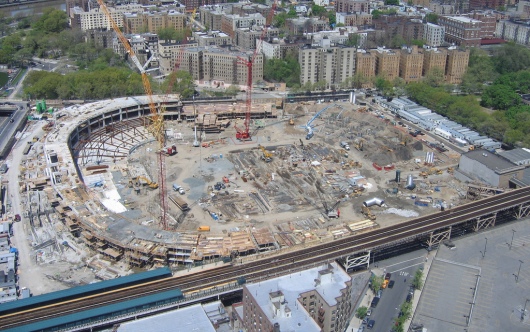
The Real Estate: Cost of Extra Yankees Financing to the City: About $3.6 M.
The most at-risk project appears to be the Nets’ arena in Brooklyn, which is now seeking somewhere between $600 million and $700 million for the more than $900 million cost, though the final amount of financing has not been determined. Should the team and developer Forest City Ratner be unable to finance in the manner initially planned, it seems a new financing plan, likelier at a higher cost, would need to be devised.
Develop Don't Destroy Brooklyn: Ratner's Tax-exempt Atlantic Yards Bonds Worth $165 Million in Savings
We asked here: Why is Bruce Ratner telling NY1 "we don't see really a problem...there's not a problem" with new IRS regulations while his surrogates are in Washington lobbying for an IRS waiver so he can receive triple-tax-free bonds for his arena? Norman Oder provides the answer on his Atlantic Yards Report. Its pretty simple: Ratner was just doing some not very subtle spinning. They do have a problem if they can't get their triple-tax-free bonds—a $165 million problem.
River Ave. Blues: NY pols bemoan stadium subsidies
As Charles Bagli wrote in The Times today, the end game of this debate will probably lead to cost increases across the board for projects of this nature with the potential rule changes impacting the Atlantic Yards development, Citi Field and Yankee Stadium. But somehow I think the sports franchises will worm the money out of the public coffers one way or another.
Develop Don't Destroy Brooklyn: Ratner Says "No Problem" About Atlantic Yards. Twice in One Interview.
All news reports today said that the IRS tax exempt bond regulations may spell doom for Forest City Ratner's Barclays Center arena. So worrying are the regulations for the Ratner team that they, along with the city and state, are lobbying the Treasury Department in Washington to waive the rules for the Nets. But Ratner tells NY1 it's not true, there are no worries.
...
We don't see really sense being made here. If having to use taxable bonds, rather than tax-free bonds because of the IRS regulations, is not a problem for the developer, then why are his surrogates lobbying in DC and why did he go for tax-free bonds in the first place if he doesn't need them?
Atlantic Yards Report: The $165 million difference: why Ratner can't play it cool about IRS rules
The difference is worth many millions. The Yankees would save $189.9 million over the 40-year life of $920 million in tax-exempt bonds, according to the Independent Budget Office. (The Times, quoting the IBO, suggested $190 million savings on $943 million in bonds.)Though the IBO has not calculated the savings on the arena's new $950 million price tag, a similar ratio to the Yankees numbers suggests that those building the Atlantic Yards arena, for which $800 million in tax-exempt bonds are sought, would save $165.1 million.
So Ratner may tell the press that the arena might go forward with taxable bonds. But surely Forest City Ratner's investment plan assumes tax-exempt bonds and the attendant savings.
Posted by amy at 9:53 AM
June 13, 2008
New IRS Rule May Delay Development Of Atlantic Yards Project
NY1

Brooklyn’s Atlantic Yards developer Bruce Ratner downplayed today’s reports that a proposed Internal Revenue Service rule might stall the vast construction project.
..."We don't see really a problem,” said Ratner. “You know if the regulations don't change, do change, whatever the regulations will do, we'll be able to finance this. We've been assured of that. We've been working on it over the last two months, and it will take another three or four months to finish the documentation, but there's not a problem.”
article/video [dialup/broadband]
NoLandGrab: "We've been assured of that?" Assured by whom?
Bruce was apparently tracked down by NY1 while taking part in Forest City Ratner's "Community Day" clean-up of Prospect Park — which is not to be confused with "Brooklyn Day."
Posted by eric at 7:58 PM
Brodsky to hold hearing on bonds for Nets arena and two stadiums
Atlantic Yards Report has the breaking news that the New York State Assembly plans to hold hearings on the issuance of public debt for the new Mets and Yankees stadiums and, most crucially, the planned arena for the Nets.
Assemblyman Richard Brodsky (D-Westchester), Chairman of the NYS Assembly Committee on Corporations, Authorities & Commissions, and Assemblyman Sam Hoyt (D-Buffalo), Chairman of the NYS Assembly Committee on Local Governments, have today invited the New York City Industrial Development Authority (NYCIDA) to testify [before] a Public Hearing to be scheduled on either June 30, July 1 or July 2 in New York City. Final date and location will be announced shortly.
The Hearing will examine the NYCIDA’s practices and procedures for issuance of public debt with respect to sports facilities for the Yankees, Mets and Nets. The Committees have been investigating the facts and actions of the issuance of public debt by state-created entities that operate in secret and without the control of elected officials. Legislation to reform such practices is being considered by the committees.
Posted by eric at 3:57 PM
It came from the Blogosphere... (The Taxman Cometh edition)
More commentary from the blogosphere about those nettlesome IRS rules and their possible effect on Bruce Ratner's Atlantic Yards project.
Curbed, Will the IRS Strangle the Atlantic Yards Arena?
Brownstoner, Key Form of AY Arena Financing Appears Shaky
COMMUNITY BENEFITS AGREEMENTS, Atlantic Yards & Yankee Stadium face difficulties with tax-exempt financing
THE KNICKERBLOGGER, Oh, Now I know Why I have to Pay Tax on Amazon Purchases....
SmartBrief.com, IRS rules threaten future of New York basketball arena
SportsBusiness Daily, IRS Regulations Jeopardizing Construction On N.Y. Projects [Subscription required]
The View from the Bleachers, Politicians Hit Out at New York Stadia Funding
Develop Don't Destroy Brooklyn, IRS Loophole More Important for Nets Than Yankees
Posted by eric at 12:52 PM
Atlantic Yards Doomed If Ratner Can't Get More Corporate Tax Breaks
Develop Don't Destroy Brooklyn
DDDB offers its take on the shocking news that the deep-pocketed owners of local pro sports franchises want more of your money.
The richest team in sports (the Yankees), and the billionaire developer of the most expensive basketball arena ever proposed (Forest City Ratner's arena for his Nets) want more money and the IRS to bend the rules*...for them.
...Forest City Ratner is desperately trying to lobby the Treasury Department in Washington (along with NYC, NY State and the Yankees) to waive an IRS regulation that would make it very difficult for Ratner to get the triple tax-free bond he desires for his billion dollar arena.
This begs the question: If Ratner/Steinbrenner succeed in getting a waiver, opening up an IRS loophole they want for their respective sportsplexes, what then would the IRS do when the next team from, let's say Chicago, wants triple-tax-free bonds for their new sportsplex? Where does the waiving stop? Will the United States government actually break its fiscally prudent regulations just for Bruce Ratner and George Steinbrenner?
*Neil DeMause explains the intricacies of the IRS regulations and what the Yankees and Nets would like to see waived over at the Village Voice.
Posted by eric at 10:37 AM
A Question Mark Looms Over 3 Expensive Projects
The NY Times
By Charles V. Bagli
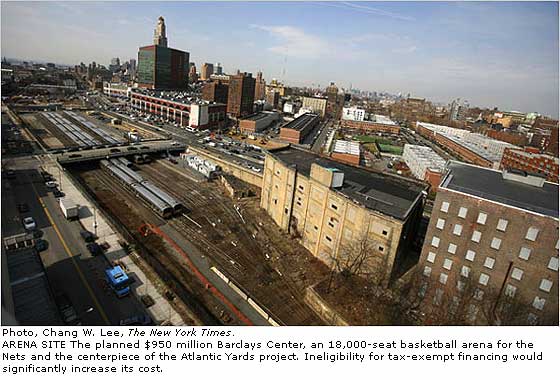
More than two years ago, the Bloomberg administration came up with an aggressively creative way to use tax-exempt bonds to finance two of the most expensive stadiums in the world, one for the Yankees in the Bronx and another for the Mets in Queens.
...The Internal Revenue Service initially approved the use of the bonds for the ballparks, but quickly issued a proposal in 2006 to tighten the rules governing the use of tax-exempt bonds so that it would be more difficult, and perhaps impossible, for this kind of financing to be used again by profitable, private enterprises like professional sports teams.
Much of the financing for the two ballparks, which are both under construction, is already in place. Atlantic Yards developer Bruce Ratner is hoping to score a huge windfall from Washington:
Now state and city officials say the proposed rules are jeopardizing what is planned to be the city’s next big sports palace: the $950 million Barclays Center, an 18,000-seat basketball arena for the Nets that is the centerpiece of the huge residential and commercial complex in Brooklyn known as Atlantic Yards. The project’s developer, Forest City Ratner, says it plans to break ground on the arena this fall and has long expected to use tax-exempt financing to reduce its borrowing costs by tens of millions of dollars.
Barclays Center is expected to be the most expensive arena in the world, and the lack of tax-exempt financing would substantially increase its cost. The $4 billion Atlantic Yards project already faces delays because of litigation, a sluggish economy, the lack of commercial tenants and the reluctance of lenders to finance large real estate developments.
...
In an interview this year, Bruce C. Ratner of Forest City said that he hoped to raise about $800 million through tax-exempt bonds. He acknowledged that “the tax changes would make it more difficult” to do the project, although he was still optimistic that he could break ground for the arena this fall.
...
[T]he proposed changes in the I.R.S. regulations are far more significant for the Nets and Atlantic Yards, which has not yet issued any bonds or started construction.
Some follow up to the story on The Times's City Room blog: I.R.S. Rule Change Could Imperil Atlantic Yards Arena
Posted by lumi at 10:12 AM
Funding the new Yankee ballpark
Behind the News
Eyewitness News (ABC 7)
The old "in for a dime, in for a dollar" theory may be what comes into play in the current flap involving the New York Yankees.
There are many people who expressed skepticism over any public contributions to the construction of the new ballparks for the Yankees or the Mets or the Nets, who want to move from New Jersey to Brooklyn as an anchor tenant of the new Atlantic Yards.
There's the valid argument that the presence of a new facility increases tax revenues, so the City gets money from these teams. But the truth is that these teams are cash cows and the profits redound not to taxpayers -- some of whom double as fans who pay the among highest ticket prices in the nation - but to the owners and highly paid players on the teams.
And so the critics say the teams should dang well fund these facilities themselves.
Posted by eric at 9:24 AM
NYCEDC Confirms: Ratner Wants More Subsidy for Atlantic Yards
Develop Don't Destroy Brooklyn connects the dots in the public discussion on more subsidies for Bruce Ratner's controversial Atlantic Yards project. Here's the gist of it:
Back on April 2nd, Forest City Ratner's parent company CEO Chuck Ratner said on an analysts conference call that "we still need more" subsidy for Atlantic Yards. (Atlantic Yards Report broke that story.) Ever since then, Forest City Ratner spokespeople have flat out denied that they would be seeking more subsidy. But NYC Economic Development Corporation President Seth Pinsky begs to differ, according to the Sun article, he confirms what Chuck Ratner said in April:
...He [Pinsky] also said that the developer Forest City Ratner Co. had expressed interest to the city about seeking additional tax-exempt funding, but that the request was being handled by the state...
...
Two key City Council members—David Yassky, running for City Comptroller and Bill de Blasio, running for Brooklyn Borough President—have already said "no way" to more subsidy for Atlantic Yards.
...
Who will stop this madness? We suggest a hearing before the members of the Assembly Committee on Corporations, Authorities and Commissions would be a good place to start.
Posted by lumi at 5:47 AM
As officials admit lobbying IRS for Nets arena, Lieber says AY groundbreaking by 2009 (at least)
Atlantic Yards Report
Whoopsie! You gotta love when public officials come down with a bout of the truth and go off message:
Deputy Mayor for Economic Development Robert Lieber, speaking at a Crain's New York Business breakfast yesterday, declared that Atlantic Yards would be "under construction by the end of 2009."
[Developer Bruce Ratner still claims it will be fall 2008.]
During the Crain's session, David pointed out that “the opposition which has dogged” Atlantic Yards had been inflamed by reports in March of delays in project construction, the developer’s call in early April for more subsidies, and the general question of what might be done with the site, as exemplified by City Comptroller William Thompson’s April 30 acknowledgement that “I’m not sure what that project is any longer” and his hint that it might be revived by bringing in additional developers.
Lieber said Atlantic Yards “is going through the last stage of litigation” and “we do believe it’s going to get under way.”
As to bringing in other developers, Lieber said the issue hasn’t come up: “Frankly, no, I don’t see any reason to do it.”
What about increased subsidies? “We have not received any kind of request," he said, "but we’re open-minded, and we’ll listen.”
NoLandGrab: We're listening — Forest City CEO Charles Ratner already stated in April 2008 that they'll "still need more" subsidies.
article [updated with extended verbatim responses from Deputy Mayor Robert Lieber]
Posted by lumi at 5:38 AM
'Soviet-Style' Tactics Said To Be Used To Help Yanks
In The NY Sun coverage of Wednesday's revelations that the Yankees, Mets and Nets are hoping for more tax-exempt bonds to finance their stadium and arena projects, reporter Peter Kiefer gives readers a brief history of the latest creative way to publicly finance new sports venues:
Since the 1986 Tax Reform Act was enacted during the Reagan administration, private development companies have faced tight restrictions when attempting to get access to tax-exempt bonds for sports facilities.
In 2006, with the support of the Bloomberg administration, the Yankees and the Mets were able to circumvent the federal regulation by employing a complex accounting technique that allows the bond debt to be paid by the city and state with money received from the private developer, known as payments in lieu of taxes.
Now the IRS is considering closing the loophole for future projects, a move city officials say would hinder development. They say that more private development projects should be able to get the benefits of tax-exempt bonding.
What's in it for NYC?
City officials see the bonds as a relatively inexpensive way to subsidize development, specifically because the federal government picks up a greater share of the tab.
"What is advantageous is that the vast majority is paid for by federal taxes as a result the city loses a small amount of money," Mr. Pinsky said. "We are leveraging a small amount of city and state funds to get a substantial amount of federal assistance."
NoLandGrab: Yeah, that's what sports franchises need, "federal assistance."
Posted by lumi at 5:19 AM
No more stadium tax breaks, pols howl
NY Daily News
By Adam Lisberg
At least somebody remembers that tax breaks and subsidies are supposed to go for people, programs and projects that really need them:
The Yankees, Mets and Nets can complete their new stadiums without more tax-free bonds, officials say - but the city and state are still pushing the IRS to reopen a loophole so they can get them anyway.
"It's a useful tool for economic development," said Seth Pinsky, president of the city Economic Development Corp. "We're constantly having projects brought to us that have a financing gap, and this could be a useful mechanism."
Critics, though, said the city and state economic development corporations have no business lobbying for stadium tax breaks while schools, hospitals and subways are starved for cash.
"We can't fund the MTA capital plan, and yet sports facilities seem to be able to get to the top of the list," said Assemblyman Richard Brodsky (D-Westchester). "Is this the best use of publicly supported debt?"
Local teams plus City and State officials are going to the mat for more tax breaks even though Yankees and Nets execs insist that they'll build without more tax-free bonds??? [Seriously, WTF?]
A spokesman for Forest City Ratner, which is building the Nets' Brooklyn arena, said Ratner would break ground on the $950 million arena later this year even without tax-exempt bonds.
The Mets declined to comment.
There's some big news that made it into the end of the article. Forest City CEO Chuck Ratner said back in April 2008 that the company would be looking for more subsidies for Atlantic Yards. Now City officials are listening:
Meanwhile, the city's deputy mayor for economic development said at the Crain's business breakfast that the city would consider giving more subsidies for Forest City Ratner's Atlantic Yards plan.
"We're open-minded, and we'll listen," Deputy Mayor Robert Lieber said.
Posted by lumi at 5:02 AM
Relief for wealthy teamowners?
 The best quote from yesterday's coverage of local teamowners who are seeking even more tax-free bond financing for their new sports venues came from Janel Patterson of the NYC Economic Development Corp.:
"The city is working with the state in Washington to seek relief from the applicable IRS regulation."
The era when cities openly shelled out for new stadiums and arenas is over, so politicians and owners are now trying to go through the back door.
But the IRS put an end to the scheme, so now team owners are seeking "relief" as if they were victims of some natural disaster, making Steinbrenner, the Wilpons and Ratner just about NYC's whiniest corporate-welfare queens.
Posted by lumi at 3:37 AM
June 12, 2008
After Yankees snag, will IRS regulations slow tax-exempt bonds for Nets arena?
Atlantic Yards Report
Like us, we're pretty sure you've grumbled when writing a check to the IRS, or when looking at your pay stub and seeing how much federal tax is being withheld. But little did we Atlantic Yards critics know that the IRS may be our friend.
Without a waiver, Internal Revenue Service restrictions on tax-exempt bond deals may hamper the construction of Yankee Stadium and, without further waivers or changes in Washington, could snag plans for construction of the Nets arena in Brooklyn and other sports facilities in the city.
...While the Federal Tax Reform Act of 1986 repealed the use of tax-exempt private activity bonds for sports facilities, Congress did not repeal the tax exemption for bonds that are paid off with tax dollars, thus apparently intending to preserve tax-sheltered financing for multi-use, publicly owned arenas, according to GJNY. The bonds, exempt from city, state, and federal taxes, have an interest rate about 25 percent below taxable bonds.
However, city lawyers asked the IRS for a special ruling allowing payments-in-lieu-of taxes (PILOTs) to be considered the legal equivalent of taxes for the purpose of servicing the bond debt. The IRS said yes, “despite language in its own regulations that seemed to contradict the ruling,” according to GJNY.
So now you know why the Atlantic Yards arena would be paid off by PILOTs--it’s the same deal. And now we know that not only pending lawsuits may hinder such tax-exempt bonds, but so might the IRS.
Bettina Damiani of GJNY warned to Metro that the Nets and Mets would likely similarly request such bonding from the city. “This is coming from the mayor who said he’d end corporate welfare as we know it,” she said. “It’s almost comical.”
Posted by eric at 7:51 AM
Yankees want IRS to reverse loophole to allow for more tax-free bond financing
"Allowance" would be boon to Bruce Ratner's Nets arena financing plan
 Associated Press, Yankees may seek more public financing for new stadium
New York City officials confirmed Wednesday that the New York Yankees may be interested in seeking more public financing to build their new stadium, pending a regulation change by the IRS.
The team stressed, however, that its bid to change the Internal Revenue Service regulation wasn't going to affect the completion of the new Bronx stadium.
...
Janel Patterson, of the New York City Economic Development Corp., which is working with the Yankees, said the project isn't threatened. But she said the city is working to relieve an IRS regulation that prohibits more public debt to be incurred for the stadium. State Assemblyman Richard Brodsky, of Westchester, said that IRS change also is being sought to help stadium and arena projects for the New York Mets and New Jersey Nets.
NY Daily News, Can we have 400M more? Yankees ask
About $941 million in tax-exempt public bonds have already been issued for the $1.3 billion stadium, which is to open next year.
Internal Revenue Service regulations prohibit more public debt to be incurred for the stadium.
City officials have been lobbying in Washington for a change in the IRS regulations, which could benefit other local projects, including construction of new homes for the Mets and Nets, [president of the city Economic Development Corporation Seth] Pinsky said.
"The Yankees have informally expressed to us an interest in receiving additional financing for the stadium project. What we've told the Yankees is if [the IRS regulations] were to change, we'd be willing to consider the option."
MetroNY, Yankees ask city for $400M more
Yogi Berra might describe this latest request as déjà vu all over again: In 2006, the team got $943 million in tax-exempt bonds, but the city had to ask the IRS for permission, because Congress had restricted the use of tax-exempt bonds to build sports facilities. A loophole allowed the bonds to be paid off in the form of taxes, and the Yankees claimed the debt would be met with payments in lieu of property taxes, or PILOTs, though the team’s never paid property taxes.
While the IRS eventually gave the go-ahead, it then closed that loophole.
NY Post, MONEY-HUNGRY YANKEES PLAY GALL
Team President Randy Levine said Wednesday night, "At some point, as stated and contemplated in the original transaction, the Yankees will seek additional bonding."
But he insisted, "This issue does not affect completion of the Stadium."
In a worse-case scenario, the Yanks could seek taxable financing, as opposed to tax-free bonds to complete the project.
...
"This isn't the biggest issue for the Yankees and Mets. It's a much bigger issue for the Nets and other development projects that haven't secured any financing yet," said a source.
...
Bettina Damiani, director of Good Jobs New York, said an IRS reversal "would be opening the floodgates. It defies all fiscal common sense to subsidize wealthy sports teams."
Posted by lumi at 4:52 AM
June 1, 2008
In Ebbets Field, regret marks a lost stadium

River Ave. Blues wonders if current Yankees fans will wax nostalgic about the Yankee Stadium in the future, like Dodgers fans have mourned Ebbets Field for the past 48 years. The difference is that the new Yankee Stadium already upset its surroundings, (not that the Dodgers new digs in LA didn't), but hopefully the nostalgia won't come back in another 48 years to be used for nefarious purposes.
A few weeks ago, I finished reading Bob McGee’s The Greatest Ballpark Ever: Ebbets Field And The Story Of The Brooklyn Dodgers. As Brooklyn Dodger histories go, it’s an appropriate companion piece to Michael Shapiro’s The Last Good Season: Brooklyn, the Dodgers, and Their Final Pennant Race Together.In one book — McGee’s — O’Malley is the clear villain in moving the Dodgers; in the other, O’Malley tried to keep the team in New York, but Robert Moses was the man responsible for pushing them out of town. O’Malley wanted to build a new stadium near the current Atlantic Yards site in Brooklyn, but Moses didn’t want to use his Title I powers to build a baseball stadium. While McGee villianizes O’Malley and Shapiro gives him something of a pass, the truth is, of course, in the middle. Both men were responsible for the Dodgers’ flight to Los Angeles.
Posted by amy at 8:36 AM
May 30, 2008
Open space versus parks
Greater Greater Washington
This District of Columbia blog serves up Atlantic Yards as an example of development that is not "good for the area."
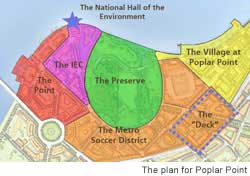
The design for Poplar Point seems to do the best with what it has. Making the stadium stimulate activity in the neighborhood depends upon generating foot traffic to and from games rather than simply a lot of car trips to parking next to the stadium. The deck over the 295 freeway is a key piece, connecting the new neighborhood with the old one and the Metro station. The stadium is near the deck and from the drawing, I don't see any surface parking lots.
If the deck doesn't get cut for cost reasons and the stadium can in fact draw more events beyond the 33 professional soccer games a year, this will be good for the area. If the project morphs into something like NYC's Atlantic Yards, where one building after another gets "postponed" and acres of "temporary" surface parking will last for ten years or more, then we'll prove Fisher right. I hope not.
Posted by eric at 10:19 PM
May 15, 2008
Brodsky calls for "time out" on West Side projects; hearing next Friday
Atlantic Yards Report
A powerful Assemblyman is calling for a "time out" on a major development, but it's not Atlantic Yards, focus of a recent "time out" rally. And that Assemblyman, Richard Brodsky, while calling for a timetable and cost-benefit analysis for megaprojects in the state, said that the focus of an Assembly committee's first hearing next week will be limited to projects on Manhattan's West Side.
The New York Times, in an article Wednesday headlined City Revisits Old Bidders After Railyards Deal Fails, reported:
Assemblyman Richard L. Brodsky and other critics, however, say that the authority should wait for the economy to improve, while working with a master plan to coordinate all the activity on the West Side. “These deals are breaking down because the governance system for authorities doesn’t work and because the public subsidies are out of control,” said Mr. Brodsky, a Democrat from Westchester. “We need a time out before this disaster repeats itself everywhere else.”
Posted by lumi at 5:44 AM
April 27, 2008
Economy, Credit Woes Foil Cities' Big Projects
Wall Street Journal
JENNIFER S. FORSYTH
One project being watched closely is Atlantic Yards, a $4 billion development that Forest City Ratner Cos. is building on 22 acres in Brooklyn, N.Y. After a number of court battles, the developer plans to finally begin construction on a new arena for the New Jersey Nets basketball team by the end of this year.However, the schedule for its planned office tower, called Miss Brooklyn, likely be will pushed back until an anchor tenant is signed given the current market conditions, says Loren Riegelhaupt, a Forest City spokesman. He stresses that the entire project eventually will be built. "It's not a question of if, but when."
Atlantic Yards Report responded:
Well, the plan may be to break ground this year, but how can he be sure? As to whether the entire project will be built, well, there's no guarantee that housing subsidies will be available.More importantly, the governmental authorities don't require the project to be built as approved; the State Funding Agreement includes a City Purpose Covenant that allows for the amendment of the General Project Plan and contemplates its abandonment for a smaller project. Maybe that's why Frank Gehry is laying off architects, as the Los Angeles Times reports on its blog.
Posted by amy at 9:11 AM
April 17, 2008
Atlantic Yards Subsidies Might Total $2 Billion
Runnin' Scared [The Village Voice]
By Duncan Meisel
The Voice's daily blog published a recent-news wrap for Atlantic Yards, covering subsidies, more subsidies and architecture critic Diana Lind's scathing takedown of Bruce Ratner's controversial megaproject.
Posted by lumi at 4:34 AM
April 16, 2008
Reading between the lines: Ratner may seek $163M (or more) in subsidies for the railyard
Atlantic Yards Report
We know that Atlantic Yards developer Forest City Ratner intends on seeking more direct subsidies for the controversial megaproject. But we still don't know how much and what the justification might be.
Norman Oder may have stumbled over a clue:

What did Chuck Ratner, president of Forest City Enterprises (FCE), mean when he told investment analysts two weeks ago that "we still need more" subsidies for Atlantic Yards?
I can't be sure, but documents submitted by FCE's subsidiary Forest City Ratner (FCR) hint that the developer might seek reimbursement for $163 million (likely more) spent on "extraordinary infrastructure costs"--mainly the platform, but also including planned open space--at the Metropolitan Transportation Authority's Vanderbilt Yard.
Why do I draw that conclusion? Because FCR once claimed that it was absorbing those extraordinary infrastructure costs, part of its investment in the project.
In a court document, FCR dropped that claim. Thus it's reasonable to speculate that the developer will seek reimbursement from the public.
Posted by lumi at 5:47 AM
The Bell is Ringing
Supersonic Soul
The very same sound of subsidies being sucked up by NJ Nets team owner Bruce Ratner can be heard in other cities fortunate enough to host an NBA team.

...what is happening to the Sonics in Seattle is happening – on another level – to all NBA teams in all NBA cities.
In New Orleans, where a city bludgeoned by unspeakable tragedy is paying $7.5 million a season in taxpayer money to keep the Hornets from fleeing. You read that right. The Hornets, a team owned by a man, George Shinn, whose net worth of $100 million neglects to include his $275 million basketball team, receives nearly $8 million every year from the people of New Orleans.
...
It is happening in San Antonio, where the model of success for the NBA, the Spurs, turns around and asks the city for more concessions and more money, less than five years after receiving a brand-new building, the same building they received because the brand-new building they received in 1993, the Alamodome, was obsolete within a decade.It is happening in Brooklyn, where the subsidy figure for the Nets’ Atlantic Yards project has now reached the $2 billion mark, and shows no sign of stopping.
All of this has been occurring while America is in on the verge of entering (if it has not already entered) a tremendous recession....
Posted by lumi at 4:31 AM
April 13, 2008
Does Ratner Need More Subsidies Before Proceeding?
NetsDaily
Bruce Ratner’s cousin, Charles, is also CEO of Forest City Enterprises, which owns 21% of the Nets–three times Bruce’s holdings–and is corporate parent of Bruce’s Forest City Ratner. So he caused a storm of criticism last week when he suggested the need for more city and state subsidies for Atlantic Yards–and the Nets’ new arena–on top of the $300 million already approved. He’ll have help. Forest City has some of the city’s top lobbyists.
Posted by amy at 9:35 AM
April 9, 2008
PUBLIC SUBSIDIES: "We still need more!"
Two days ago, Atlantic Yards Report blogger Norman Oder broke the story that Forest City Ratner executive Charles Ratner told investment analysts that they "still need more" public subsidies for the highly controversial Atlantic Yards project.
Here is some reaction from a range of watchdoggies:
Field of Schemes, Ratner: We want more arena subsidies
As [Norman] Oder notes in a phone conversation with FoS, the $305 million Ratner mentions is all direct cash outlays, implying that the Ratners are seeking more up-front money, not tax breaks for affordable housing or the like. Given that the rest of the project is on the brink of collapse and the arena cost is up to a staggering $950 million, it wouldn't be exactly surprising. Stay tuned for further developments.
Ground Report, Greedy In Brooklyn: Well-connected Developer Seeks Still More Subsidies For Brooklyn Arena Scheme
It is not suprising that Forest City Ratner, which was a partner of the New York Times in an eminent domain scheme for the newspaper's new headquarters, should need more money. As I noted in my article "Atlantic Yards Eminent Domain Abuse Scheme Confronts Reality" [http://www.groundreport.com/US/Atlantic-Yards-Eminent-Domain-Abuse-Scheme-Confron] which links eminent domain with the money issue and economy in general, the expansion of the money supply encourages malinvestments. Similarly, the availability of subsidies and eminent domain encourage uneconomic schemes.
The Atlantic Yards real estate scheme is legalized theft. The Empire State Development Corporation is a body whose mission is legalized theft. It should be abolished. The taxpayers must be protected from subsidizing the theft of others.
Save Our Land, if you sound out "FCR" phonetically, what do you get?
A watchdog in Cleveland has seen this all before:
As Roldo predicted, the Ratners--in full FCR mode over at Forest City Ratner--are trying to extort still more from Brooklyn. Did you ever think we'd all be a lot better off without them--FCR, FCE, FCM? They're tanking Cleveland's mass-transit hub at Tower City; Stark's bombing in Crocker Park. I see still another disgusting insider replay coming with this Medical Mart nonsense.
NoLandGrab: The lesson from Forest City in Cleveland is that throwing more money at or reconfiguring a bad project never turns it into good project, never.
Posted by lumi at 5:01 AM
April 7, 2008
DDDB PRESS RELEASE: Forest City Ratner Says They "Still Need More" Subsidy for Heavily Subsidized Atlantic Yards Proposal
NEW YORK, NY— “We still need more” subsidies for the Atlantic Yards project, Forest City Enterprises president Chuck Ratner said during an investment analysts conference call last Wednesday. Forest City Enterprises (FCE) is the publicly traded parent of Bruce Ratner’s Forest City Ratner (FCR). (Journalist Norman Oder broke the news of Ratner’s “need” for more cash subsidies on his Atlantic Yards Report today).
From the conference call transcript it is clear that the Ratner team will seek more public subsidies; it is not clear if they will seek more city and state subsidies or just city subsidies. FCR’s Atlantic Yards $4-plus billion proposal already has been granted $305 million in direct cash from New York City and State. In total, the developer’s project would be the recipient of at least $2 billion in government-backed financing and tax breaks. The city’s direct cash contribution went from $100 million to $205 almost immediately after the project received political approval in December 2006.
During the conference call, FCE president Chuck Ratner said, “Just in these past six or eight months, we got the various governmental agencies, state, city, bureau in New York to increase their commitments to Atlantic Yards by $105 million on top of the $200 they had committed. We still need more.”
(It was actually the city that increased its direct subsidy to Ratner.)
How will local elected officials respond to an impending visit by Ratner back to the public subsidy trough? It doesn’t appear that they will welcome more Atlantic Yards subsidy:
Councilman, and Brooklyn Borough Presidential candidate, Bill de Blasio warned against additional public subsidies for Ratner’s Atlantic Yards in The Brooklyn Paper. “There has already been very generous public investment,” de Blasio told The Brooklyn Paper on March 29th. “I don’t see how we can go any farther.”
“The Atlantic Yards proposal is already subsidized to the hilt. Ratner’s highly profitable development plan should not be bailed out by the taxpayer, especially with budgetary tightening including education cuts,” Develop Don’t Destroy Brooklyn spokesman Daniel Goldstein said. “If Ratner can’t build his project--with over $300 million in direct cash subsidy, over $2 billion in government-backed financing, a blank city check for ‘extraordinary infrastructure costs,’ free land from the city, a below market rail yard purchase price, and the windfall benefits of eminent domain condemnation--he should not be rewarded with yet more taxpayer funds.
Posted by eric at 2:30 PM
March 31, 2008
Sports of The Times: Showing Power, but Weakening a Neighborhood
The New York Times
by Harvey Araton
Times columnist Araton rues the sacrifice of scarce Bronx parkland to a new Yankee Stadium.
With the stadiums side by side, the end of one era blurs with the beginning of another. Baseball’s sights and sounds are always familiarly welcome. But I wonder how many visitors inching their cars through the narrow streets from the northern suburbs or New Jersey this season will notice what has been lost, or taken, from that crowded urban landscape.
How many will mourn the fallen trees, the oasis of green that was Macombs Dam Park, the way Joyce Hogi will?
“A lot of people in the neighborhood really never thought it was going to happen until the trees came down,” she said.
In stages, the park was shuttered, the people of what is often called the poorest Congressional district in America, thrown out at home. Finally, last November, the New York City Department of Parks and Recreation issued a news release announcing the closing of the last remaining section, including the ball fields, the handball and basketball courts, to make way for another sure sign of artistic urban development, Garage A.
NoLandGrab: Sadly, we can't say it's a surprise that the City would try to claim an existing schoolyard or a pedestrian walkway among the "parkland" "replacing" Macombs Dam Park.
Posted by eric at 4:20 PM
March 27, 2008
Subprime Crisis Sends Ripples Through Sports World
The Business of Sport
The NY Sun
by Evan Weiner
The financial crisis has definitely had an affect on Ratner’s Atlantic Yards project in Brooklyn. He still plans to build an arena for his New Jersey Nets franchise, but the scale of the project has been cut down because of financing —or, more specifically, the lack of widely available money for an office tower and three residential buildings on the 22-acre parcel at the corner of Flatbush and Atlantic avenues.
Ratner’s project started in 2004 and gained state approval in 2006. The arena was scheduled to open in 2009, but construction has been delayed by lawsuits. Ratner has signed an open-ended deal to keep the Nets in the Meadowlands until the Brooklyn arena is done.
...The real effect on New York sports teams may not be evident until the opening of the NBA and NHL seasons in the fall. If the financial market loses jobs, and New York officials fully expect a significant loss of positions in that field, that could impact the Knicks’ and Rangers’ high-end seating, along with that of the Devils, Nets, and Islanders.
...The American sports world is keeping an eye on Wall Street and the banking industry. While each league — and each individual team — might have a different immediate reaction to the subprime mortgage crisis, all teams may eventually have to face the full impact of the Bear Stearns meltdown.
Posted by eric at 1:46 PM
March 23, 2008
And Then There Was One
Gumby Fresh is a must-read for those who want to know more about how the credit crisis really affects the project.
The financing picture is beginning to look trickier. First bit of good news for the developer - the bond insurers are still open. The bad news is that they're not that interested right now in the more speculative end of the market (that just above what the agencies describe as speculative grade, and what the rest of us call junk). The ones that are still standing are raking in high premiums for turning silver bonds into gold, rather than bronze into gold, which is a business that is a little more capital intensive.The alternative would be to turn to the banks to finance the arena, rather than the bond market. They've done this before, but interest on bank loans would not, as far as I know, be exempt from tax. The Times article suggests that if the arena loses its allocation of tax exempt bonds this might push up the "cost" of the arena. This is a little misleading. It won't push up the construction cost of the arena (in fact, banks might demand a less expensive set of insurance contracts for the contractors on the arena), and the upfront fees from banks and Goldman Sachs, as bond underwriter, would not be appreciably different.
But it would increase the debt burden on the project hugely, so much that Ratner, as team owner, would see even less of a return on his investment in the team because he's having to devote a higher proportion of team revenues to servicing the arena debt. I'm doubtful that the arena could go ahead with a bond financing without the bond insurers, unless Goldman can scare up a very highly-rated alternative insurer (Buffett?).
Posted by amy at 4:03 PM
March 21, 2008
Taxes Cut and Promises Unkept
The NY Times
By Clyde Haberman
In the midst of a slightly rambling column on the frugal Governor Paterson and corporate welfare, we find what might be Clyde Haberman's first reference to criticism of Bruce Ratner's Atlantic Yards boondoggle:
So with the sudden collapse of the former governor’s political career, taxpayers may be cheered to have a new man in charge who knows how to rein in costs.
...
Over the years, Bear Stearns turned to City Hall repeatedly for handouts, usually with threats to move its operation out of New York.
...
Critics prefer to call the deal-making “corporate welfare.” Some companies got the goodies without even having to threaten to move. Through this routine, hundreds of millions of dollars in tax revenue have been lost to the municipal treasury.Mayor Michael R. Bloomberg, a self-made billionaire, holds no love for the process. Not that he is against giving big business a big hand. He has offered other forms of rich subsidies to well-heeled types like the Yankees and the Mets and developers with eyes on the Far West Side of Manhattan and the Atlantic Yards in Brooklyn.
“It’s still a corporate giveaway, no matter how you dress it up,” said Bettina Damiani, the director of Good Jobs New York, an advocacy group that takes a dim view of the handouts.
Posted by lumi at 5:07 AM
March 19, 2008
Lack of Yankee Funds for South Bronx
WNYC Radio
Is it the lawyer's fault? The accountant's? How 'bout Bronx politicos? At least the Yankees appear to be holding up their end of the bargain.
The new Yankee Stadium in the Bronx is more than halfway finished. It's expected to be ready on schedule by opening day of 2009.
But, the surrounding neighborhood isn't seeing all the benefits that were supposed to come, even while residents are contending with construction noise.
WNYC’s Matthew Schuerman reports.
NoLandGrab: Why are we not surprised that the new stadium will be finished three years before the "replacement" parks will be ready?
Posted by eric at 7:54 PM
March 18, 2008
More Money for the Very Rich: An Unsporting Pursuit?
Huffington Post
Author Michael "Double D" White explains how Bruce Ratner beat George "Double U" Bush at one of the best rackets in town: subsidies, upon subsidies, plus bonus eminent domain, for already-very-rich team owners.
In a nutshell:
New York government officials are committing New York's public to pay subsidies of more than a billion dollars covering all of the escalating costs of a basketball arena that the politically connected Ratner and company will own. The subsidies were awarded on a no-bid basis and the developer is even being promised that after an initial 30-40 year lease term accompanied by tax exemption, Ratner can extend his lease up to a total of 99 years with continued tax exemption.
For you numbers folks, here's how Ratner does it:
The [$692.70 million in municipal] bonds are paid entirely with intercepted tax payments that would otherwise have been going to the public treasury. Other intercepted taxes can defray Ratner's cost of operating the arena, increasing his bottom line. Because the bonds are exempt from federal, state and local income tax an additional estimated subsidy of $129 million goes to the project. Including a $11.7 million exemption from sales tax, donations of public land (and excluding a number of other subsidies that could also be included) it adds up to an arena replacement cost paid for by the public of $905.72 million. From publicly available figures it can be discerned only that Ratner is paying for another $71 million with private money. But beyond this, the public is donating to Ratner the right to name the arena and the neighboring portion of Brooklyn, rights being sold for $20 million a year for 20 years, ($400 million). Just on the arena alone Ratner will clear at least $116.29 million in present value on day one.
And then there's the small feat of taking other people's property:
Bush needed 17 acres to build his Texas stadium. 200 acres were condemned. Ratner has similarly gone after gratuitous condemnations with a peculiar project footprint that would be inexplicable were it not for eminent domain's attractive windfall. The tilted playing field of eminent domain abuse attracts Ratner; the collection of special benefit through below-market acquisition of condemned land is essentially another form of subsidy collection.
NoLandGrab: To address all the apologists who point out that Ratner pays fair- or above-market-value for property in the footprint, consider that the property is valued under the current zoning.
Typically, local governments change the zoning, and original property owners benefit from any apperciation in value — but not in Ratnerville.
The Atlantic Yards project is technically a STATE ZONING OVERRIDE. Ratner purchases the property under current zoning, the State enacts a private rezoning — presto, the property is worth much more — and in effect, Ratner gets the property for a song. Thus the "special benefit" of eminent domain.
Posted by lumi at 5:03 AM
March 6, 2008
In Alberta arena debate, the AY story gets mangled
Atlantic Yards Report
Norman Oder stumbles over quotes from a professor who hasn't been keeping up with the ABCs of Atlantic Yards:

In a March 2 article headlined Stickhandling a hot debate, the Edmonton Journal described the efforts of phys ed professor Dan Mason of the University of Alberta to bring a new hockey arena in Edmonton. Atlantic Yards came up as a positive example, but the facts were mangled.
...
The article almost suggests that Atlantic Yards would be a Jacobsian mixed-use project:It's important that all citizens benefit from the project, Mason says, and the city can ensure this by using its power to push for public spaces and parks to be included in the project, as well as other housing and commercial development.
For instance, in the new $4-billion Atlantic Yards development in Brooklyn for the NBA Nets, half of the 6,000 condo rental units are earmarked for low- and middle-income residents, Mason says. The developer is building an elementary school and day-care centre out of his own pocket as part of the project. The state of New York is helping to subsidize the rental units as part of a broader low-income housing initiative.
Well, half of the 4500 rentals are subsidized; there would be some 1930 on-site condos, of which 200 would be subsidized; the developer says it will built a total of 600 to 1000 for-sale affordable units, but that's not memorialized in any government document.
Only 900 units would be low-income, so AY is not a low-income housing initiative.
And furthermore, Forest City Ratner has already assured the public that the day-care center and elementary school are NOT being paid for out of its own pocket.
Posted by lumi at 5:19 AM
March 3, 2008
Voices: Bloomie's fuzzy math on stadiums
MetroNY, Opinion
Neil deMause doesn't call Mayor Bloomberg a liar (though he could have) in explaining why the Yankee Stadium deal is so lousy for the City.
On his weekly radio show Friday, Mayor Bloomberg was asked why the city was subsidizing stadiums for the Mets and Yankees. His response: “The city and the state, to my recollection, each put in $75 million” for each new stadium — a mere fraction of the total cost. “It was a really good deal,” he added.
For a data-crazed mayor, Bloomberg can be awfully loose with his numbers.
Tally up the cost of replacing the parkland that was sucked up by the deal, lost tax revenue from tax-exempt bonds, a property tax abatement that runs forever, no sales tax on construction materials...
Add in the new Metro-North station, the three new parking garages and other scattered freebies, and the latest tally for the taxpayer tab is $807 million. The Steinbrenner family, meanwhile, even with the extra $300 million in upgrades they announced last month, will be out just $650 million. (For the Mets, the corresponding numbers are $468 million public of public money and $306 million of team money.)
NoLandGrab: Beware, Developer Bruce Ratner and the City are touting the same kind of funny numbers for the Nets arena and Atlantic Yards.
Posted by lumi at 4:53 AM
March 2, 2008
With Recession in the Wind, Local Mega-Projects Scale Back and Slow Down
NY Sun Blogs: Culture of Congestion
Sandy Ikeda
Recent postings in the blog "Atlantic Reports" have noticed an apparent scaling back in the description of the Atlantic Yards development — the proposed future home of the Brooklyn Nets and an enormous Frank Geary-designed mixed-use complex.
...
A related article in the same issue of the Brooklyn Paper reports that federal funding for so-called below-market or below-cost residential units is drying up. It would take $7 billion of federal money to build all of the projects currently proposed in the state of New York, but only $1.33 billion was granted (in bonds) in 2007, with no change expected in 2008. Apparently, if the funding for these units doesn't come through, none of the 2,250 units will get built, and Mr. Ratner will have to pay a $500,000 penalty for going back on his promise. Evidently, the rest of the multi-billion dollar mega-project will go on as planned without further consequences.
link
NoLandGrab: We prefer to get our news directly from the "Atlantic Yards Report" so that we know stuff...like that the $500,000 penalty only applies to job training obligations. That damn "Atlantic Reports" blog is wrong every time.
Posted by amy at 10:46 AM
February 25, 2008
Changing the Way the City Does Business
Gotham Gazette
by David Yassky
Public-policy web site Gotham Gazette offers candidates for City Comptroller the opportunity to tell voters how they would help the city weather an economic downturn.
One idea put forth by David Yassky involves pulling the plug on several hundred million dollars' worth of unjustifiable handouts for Bruce Ratner's Atlantic Yards project.
Of course, the single biggest example of corporate welfare is the proposed Atlantic Yards development. The Bloomberg administration has agreed to give the project's developer at least $100 million in direct subsidies, plus another $400 million to $500 million in tax breaks. In the current financial climate, this handout is impossible to justify.
NoLandGrab: Critics point out that Yassky's stance on Atlantic Yards has gotten tougher now that he's running for Comptroller, but in fairness to the Brooklyn Council Member, he has teamed up with colleague (and staunch AY opponent) Tish James to try to push legislation intended to end the tax breaks.
A quick glance at Bronx Borough President Adolfo Carrion's platform reveals no such criticism of similar giveaways for a new Yankee Stadium. No surprise there.
Posted by eric at 6:55 PM
February 15, 2008
Bronx politicians, Yankees president in a smackdown over stadium
NY Daily News
by Juan Gonzalez
News columnist Juan Gonzalez reports that all is not rosy with the Yankees' CBA:
A breakfast meeting between Yankees President Randy Levine and Bronx lawmakers about the team's new stadium erupted into a heated shouting match, with one assemblywoman so mad she stormed out.
The fireworks began after Assemblyman Ruben Diaz Jr. asked Levine for the number of Bronx residents hired to work on the $1.2 billion stadium.
When the Yankees president could not give precise numbers, Diaz and other lawmakers became visibly upset, several people who attended last week's meeting said.
A few minutes later, Levine became embroiled in a second dispute with Assemblywoman Carmen Arroyo, who wanted to know why a community foundation that was supposed to dispense $800,000 annually in Yankees contributions to Bronx nonprofits had taken more than 18 months to hold its first meeting.
Levine told Arroyo to ask Bronx Borough President Adolfo Carrión about the delay. She then blasted his response and angrily walked out.
A few participants said they were even more angry at Carrión and the borough's City Council delegation than at the Yankees.
NoLandGrab: If construction ever begins on Atlantic Yards, can Brooklynites expect the same degree of efficacy with Ratner's CBA?
The shenanigans in the Bronx are not exactly helping Adolfo Carrión make the case that he's fit to be NYC Comptroller.
Posted by eric at 12:10 PM
Stop feeding Ratner
The Brooklyn Paper, Letter to the Editor
A Brooklyn Heights resident wonders why the NY City Council put the Madison Square Garden owners on a diet, while Atlantic Yards developer Bruce Ratner has the run of the feedlot.
The $700 million in subsidies for Atlantic Yards cited by Councilmembers Yassky and James is an understatement of the subsidies Ratner is being given by the city and state (“James, Yassky: Ax Yards funds,” Feb. 9).
Among other things, Ratner is basically being given the $637.2 million arena for free through an “R-TIFC-PILOT” agreement (pronounced “Artifice PILOT,” or “Return Total Intercepted For Costs PILOT”).
Then there are 139 years of real-estate tax exemptions.
Then there are several-hundred-million more from the state and city in flat-out direct subsidies.
Then there is the Metropolitan Transportation Authority discount on the land that Ratner is being sold at below market.
Then there is the additional subsidy from the tax-exempt bonds on the arena, which includes exemption from state and city taxes in addition to federal.
And Ratner wants more tax-exempt bonds and housing subsidies for the residential portion of his project.
So even before you get to the subsidy he gains because of the state’s use of eminent domain to make properties available to him, the figure is way over $700 million. It clearly exceeds $1 billion and is quite possibly close to $2 billion.
Michael White, Brooklyn Heights
NoLandGrab: Furthermore, Forest City Ratner has stated in the past that it can't and won't reveal the full details of the subsidies that Atlantic Yards will suck up.
Posted by lumi at 5:27 AM
February 11, 2008
New York Times Credulity Friday Edition
Here are a couple we missed from last Friday's New York Times, noteworthy because a) they appeared on the same page of the Sports section, and b) both stories swallow the teams' spin hook, line and sinker.
Sports Business: You Can’t Buy the Naming Rights, but Call It the Billion-Dollar Ballpark
by Richard Sandomir
It was Lonn Trost, the Yankees’ chief operating officer, who noted the new costs Thursday during a news-media tour of the construction site. They will be borne by the team, not the city and the state, which are footing the bill for new parks, new garages and a new Metro-North station, and financed by borrowing beyond the $866 million in tax-exempt bonds and $64 million in taxable bonds that are financing the stadium’s construction.
NoLandGrab: Sandomir fails to mention that estimates by Good Jobs New York and stadium-subsidy expert Neil deMause put the cost to the taxpayers of the new Yankee Stadium at between $663 million and $799 million.
The article is also noteworthy for these tidbits:
Another $60 million is to pay for security improvements that were recommended by the New York Police Department and $50 million was associated with starting construction several months late in August 2006 because of lawsuits.
NLG: OK, Newark close streets for security reasons and the NYPD recommends $60 million worth of security upgrades to Yankee Stadium, but the Atlantic Yards security plan is iron-clad without even the need for bollards? And there goes another pesky community lawsuit stickin' it to the little guy — in this case, over something as trivial as the seizing of public parkland for George Steinbrenner's private benefit.
How is that Community Benefits Agreement coming, anyway?
Face-Lift at the Garden Taps Corporate Money
by David S. Joachim
The Devils have moved into their new arena in Newark, and the Mets, the Yankees, the Giants, the Jets and the Nets are building or designing new homes — all of them with more luxury seating and more space for advertising.
But the Knicks and the Rangers are stuck in limbo as they await approval of a plan to move one block west, across Eighth Avenue, to a newly constructed Madison Square Garden where the James A. Farley Post Office stands.
Until the wrecking ball arrives, Cablevision, which owns the Garden and both teams, is busy remodeling some sections of its dowdy yellowing arena in an effort to squeeze out a few (million) extra dollars from its corporate clients.
NoLandGrab: Poor James Dolan! How can he be expected to make a buck in the "dowdy yellowing" World's Most-Famous Arena, even with his paltry $11.5 million annual property-tax exemption?
So far as we can tell, Madison Square Garden suffers from a mediocre hockey team and a downright dysfunctional basketball squad, not physical obsolescence. With $8 beers, $4 waters and a family of four easily shelling out $500 for a Knicks' or Rangers' game, MSG's revenue stream appears to be neither "dowdy" nor "yellowing."
Posted by eric at 3:38 PM
Prices of Stadium Name Sponsorship Soar
Associated Press, via amNY
By Janet Frankston Lorin
All sports teams want bragging rights, but with the cost of a new stadium now more than $1 billion, it's naming rights they're after.
As several of the most storied franchises in sports replace their stadiums, sports marketing experts expect corporations to pay record amounts for the right to name them.
...
If the [new Giants/Jets] stadium brings in at least $25 million to $30 million annually as predicted, and with the four additional sponsorships, the teams could get more than double or even triple what the highest deal has brought in so far.That belongs to the New York Mets, which will receive $20 million annually from Citigroup to name its new baseball stadium, or about $400 million over a 20-year contract. The New Jersey Nets got a similar deal from Barclays Bank PLC for their proposed new arena in Brooklyn, N.Y.
...
Barclays wanted to expand its brand to the U.S., said Nets CEO and President Brett Yormark. The arena, part of a $4 billion project, has also earned cachet with star architect Frank Gehry and Brooklyn's reputation as an up-and-coming borough, he said."It's not about the team," he said. "It's about the building. This will be landmark building, a destination area."
NoLandGrab: When hundreds of millions of public dollars are going towards building these new sports venues, why do all of the corporate naming-rights proceeds go to the teams?
Posted by lumi at 4:47 AM
February 1, 2008
Bid to cut Ratner’s public subsidies fails
The Brooklyn Paper
The City Council quashed a bid on Wednesday by two Brooklyn politicians to withhold hundreds of millions of dollars in city and state subsidies from the Atlantic Yards mega-development.
Councilman David Yassky (D–Brooklyn Heights) asked the Council’s Finance Committee to take up the matter of those Atlantic Yards subsidies while considering a resolution calling for the state to end property-tax exemptions for Madison Square Garden.
“If we are going to say this about Madison Square Garden, we should say it about Atlantic Yards, too,” said Yassky, who added that he and Councilwoman Letitia James (D–Fort Greene) would soon re-introduce the measure, this time as a freestanding resolution, not an amendment.
According to the councilmembers’ calculations, the proposed arena for the Nets will get close to $700 million in subsidies from the city and state.
The failed resolution comes days after Ratner’s lawyers revealed that ongoing legal challenges to the project are likely to create “significant difficulties and cost increases in concluding the bond financing that is essential to the arena's completion.”
Posted by lumi at 5:35 AM
January 31, 2008
AY vs. MSG: a larger tax break, but not for the arena
Atlantic Yards Report
AYR uses yesterday's unanimous City Council vote on a resolution asking the state to do away with Madison Square Garden's ridiculous property-tax exemption, and the amendment introduced by Council members Letitia James and David Yassky seeking to pull a similar tax break for Atlantic Yards before it starts costing the City even more money (it was tabled in committee), as a jumping off point for a comparison of the two corporate-welfare packages.
"If the Council thinks subsidizing MSG is a bad deal for the City and State, they should take another look at the tax breaks and subsidies being offered to the proposed Atlantic Yards Development: they are even worse," James and Yassky said in a statement. It didn't make it past a council committee, but it may recur in the future.
Such tax breaks and subsidies may indeed be much larger, as MSG pointed out, but they are not quite comparable. In fact, the tax exemption that now saves the Garden some $11 million a year is much larger than the exemption anticipated for the Atlantic Yards arena, mainly because much of the land would be tax exempt for decades whatever was built on the arena site, thanks to an as-of-right tax break. And if MSG builds a new arena, well, some new subsidies likely would be on the table, as Metro reported today.
NoLandGrab: While Oder does his best to shed light on the differences between the two, the net result is still enough to make one's eyes glaze over, which is undoubtedly just what developers and their political patrons want when the taxpayers' money is being dished out.
Posted by eric at 10:09 AM
Council takes a shot at MSG
MetroNY
By Patrick Arden
The City Council unanimously passed a resolution yesterday calling on the state Legislature to end the biggest, longest tax break in New York history. Since 1982, MSG has been exempted from nearly $300 million in property taxes. Now owned by the corporate behemoth Cablevision, MSG will get a 2008 break worth $11.3 million.
...
MSG has justified its open-ended exemption by citing recent subsidies the city has provided to new stadiums for the Yankees, the Mets and the Nets. The Yankees, for example, are receiving almost $700 million in public support.But the Independent Budget Office has pointed out that MSG’s break is much greater than similar tax subsidies granted to the Nets ($140 million) and the Yankees ($162 million). At a hearing of the Council’s Finance Committee this month, IBO senior economist Theresa Devine repeated the “consensus” view that “subsidies for sports facilities are not an effective use of scarce public resources.”
But don't worry, the City Council isn't pulling the plug forever; Council Speaker Christine Quinn added that the corporate welfare could return if and when MSG was ready to rehab the current arena or build a new one.
NoLandGrab: When will politicians get it through their thick heads that spending money on sports venues that NEVER deliver on their promises to the public is a waste of taxpayer money?
Posted by lumi at 4:18 AM
January 30, 2008
Opposition to Taxbreaks for Ratner: Letitia James and David Yassky Team Up
Daily Gotham
Seems Councilmembers Letitia James and David Yassky are teaming up to oppose the massive tax giveaways to developer Bruce Ratner.
From the press release:
Today at the Finance Committee hearing, the committee will review and vote on Proposed Resolution 90, which asks the State of New York to end the twenty-year-old property tax exemption for Madison Square Garden. If the Council thinks subsidizing MSG is a bad deal fort the City and State, they should take another look at the tax breaks and subsidies being offered to the proposed Atlantic Yards Development: they are even worse.
Council Members Yassky and James will introduce an amendment to Res. 90 that includes language condemning public financing of the Atlantic Yards Development, and asking for these breaks and subsidies to be withheld. The arena component alone is slated to receive hundreds of millions in public funds: $100 million from both the City and State, as well as roughly $500 million in effective property tax exemption, and another $100 million saved from the issuance of tax-free bonds to finance the arena. These numbers do not include additional hundreds of millions of dollars that will go towards the residential and commercial components of the project.
NoLandGrab: It's amazing how some City Councilmembers oppose the property tax exemption for Madison Square Garden while shovelling money down Bruce Ratner's gullet.
What's the worst thing that can happen if the City reverses the deal for subsidies and tax exemptions for Bruce Ratner's Nets arena? It's not as if Ratner will threaten to move the team to New Jersey.
Posted by lumi at 8:01 PM
January 19, 2008
The "Free Lunch" for sports team owners and the starving of parks
Atlantic Yards Report
In an interview yesterday on Democracy Now, New York Times writer David Cay Johnston described the country's subsidies for sports teams--though he didn't mention the Nets/Atlantic Yards--that he criticizes in his new book, Free Lunch: How the Wealthiest Americans Enrich Themselves at Government Expense (And Stick You with the Bill).
article
NoLandGrab: AYR offers a transcription as well as descriptions of how other arena subsidies and parkland compare to Atlantic Yards.
Posted by amy at 12:02 PM
January 10, 2008
Pols: Pull Ratner off the trough
The Brooklyn Paper
By Gersh Kuntzman
A City Council effort to reign in a tax break enjoyed by Madison Square Garden should bring about a cutback of the massive public subsidies lavished on Atlantic Yards developer Bruce Ratner, two councilmembers demanded this week.
After the Council’s Finance Committee discussed MSG’s $11-million-per-year property tax abatement on Monday, Councilmembers Letitia James (D–Fort Greene) and David Yassky (D–Brooklyn Heights) demanded that the city and state revisit its subsidies for Ratner’s $4-billion mega-development.
...
Both councilmembers said they would put forward a resolution within days that would “scrutinize the effectiveness all the these tax breaks citywide,” James said.[James] questioned, for example, why Ratner still gets tax breaks for his decades-old Metrotech complex and both his Atlantic Avenue shopping malls.
“He may have needed those subsidies in the past, but Brooklyn is hot right now, so these subsidies are inappropriate,” she added.
Yassky and James have called on Speaker Christine Quinn, who is spearheading the attack on the MSG subsidy yet is also a strong Atlantic Yards supporter, to bring the resolution to a vote.
Posted by lumi at 7:39 PM
January 8, 2008
After criticism of MSG tax break, James, Yassky point to AY
 Atlantic Yards Report
Yesterday Madison Square Garden and its owner, Cablevision, was on the defensive at a City Council Finance Committee hearing where sentiment clearly has shifted—years after good-government advocates began lobbying about it—to lifting the tax exemption that now saves the Garden some $11 million a year.
In response, Cablevision called attention (right; click to enlarge) to the even larger tax breaks and other forms of support the city has handed out for construction of new sports facilities for the Yankees, Mets, and Nets.
And two City Council members—Atlantic Yards opponent Letitia James and sometime critic David Yassky—issued a statement saying the City Council should take a broader look at all subsidies, including much larger ones for Atlantic Yards.
OTHER LOCAL COVERAGE:
MetroNY, Council eyes an end to Garden tax break
The New York Times, A Tax Scare at the Garden, Among Other Worries
AP via Newsday, Council committee hearing considers ending MSG tax break
The New York Sun, Garden Consultant Defends Tax Exemption
NY1, Madison Square Garden's Tax Break Under Microscope
1010 WINS, Madison Square Garden's Tax Exemption Under Fire
Daily News, Quinn Fires Back AT MSG
WNYC, City Council Eyes MSG Tax Break
New York Post, MSG Calls A Foul On Quinn For Tax Probe
Gothamist, Garden Could Lose Its Tax Exempt Status
The New York Times, Madison Square Garden’s ‘Godfather,’ Without the Respect
Posted by lumi at 6:05 AM
December 30, 2007
Private investment, public costs: Fenway Park, Atlantic Yards, and more

Atlantic Yards Report
So how much would the public contribute to the Atlantic Yards arena? At a panel held at the Museum of the City of New York on 9/27/07, titled Take Me Out to the Brand-New Ballpark (here's a report from e-Oculus), well-respected sports economist Andrew Zimbalist, who nonetheless produced a rather skewed Atlantic Yards study for Forest City Ratner, lowballed the figure.Looking at Fenway
Janet Marie Smith, senior VP of planning and development for the Boston Red Sox and architect behind the redesign of Fenway Park, was the most notable speaker on the panel, sketching out the history of ballparks in the country. Fenway Park, dating from 1912, has managed to not just survive but thrive, even as most other facilities from that generation were demolished and supplanted by suburban or semi-suburuban stadiums. And parks like Fenway (and long-gone Ebbets Field, home of the Brooklyn Dodgers) since inspired a new wave of retro urban facilities.
The earlier generation, Smith noted, "fit into neighborhood quite literally, were very civic buildings." New York City power broker Robert Moses, she noted, rejected the plans proposed by Dodgers owner Walter O'Malley for eminent domain and other government support, declaring that this was "in no way a public purpose."
By the 1950s, however, she said, America as a whole began to think of sports facilities as public purpose--the idea of a "civic project" is contested in the Atlantic Yards environmental lawsuit--and multipurpose stadiums, serving baseball and football, obliterated urban areas or were established in suburbia.
Posted by amy at 9:03 AM
December 25, 2007
Forest City Ratner: King of the PILOTs
 Atlantic Yards Report
It's a Christmas story, sort of. Daily News columnist Juan Gonzalez, writing last Thursday in a column headlined, "Deals that lead to lost property taxes," highlighted the city's annual loss of $107 million "in property taxes last year because of privately negotiated deals with some of the world's richest companies." The abatements average "a whopping 60% per company." (Graphic from Daily News)
The report Gonzalez obtained presented Brooklyn's biggest developer as the city's savviest dealmaker. He wrote: The undisputed king of PILOTs is real estate developer Bruce Ratner. His Forest City/Ratner firm paid the city $9.7 million last year for half a dozen commercial buildings the company owns in downtown Brooklyn. That sounds like a lot of money - until you realize it's only one-third of the company's actual $26.3 million property tax bill.
...
Gonzalez's column also included this tantalizing line:That doesn't even count PILOTs that have yet to kick in for Forest City's Atlantic Yards mega-project.
The numbers rgarding AY remain murky, but the September 2005 Atlantic Yards Fiscal Brief issued by the Independent Budget Office provides some clue. Low-cost financing for construction of the arena and its parking garage will come from tax-exempt private activity bonds issued by a not-for-profit local development corporation (LDC). But they wouldn't be repaid the way most bonds are repaid...
Not only is Bruce Ratner's development company, far and away, the City's largest beneficiary of PILOTS, read the rest of the Norman Oder's article to learn about yet another way the Atlantic Yards deal is structured differently than the ordinary megaproject.
Posted by lumi at 8:38 AM
Merry Christmas to Bruce!
 What's wrong with Payments in Lieu of Taxes (PILOTs)?
As this photo illustrates, when a rat eats candy that is supposed to be shared with everyone, then everyone gets nothing and he gets fatter (i.e. when tax revenue is diverted to paying for the tax-exempt bonds on the arena for Bruce Ratner, then these revenues are not going to the general fund where they supposedly benefit everyone).
PILOTs are a sneaky way to get taxpayers to pay for stuff they don't really need.
Back in the day, sports team owners paid their own way. Then they figured out that they could threaten to move their teams if taxpayers didn't sweeten the deal by paying for new arenas or stadiums. After taxpayers realized that these deals were only a net gain for the team owners, several municipalities and states voted down ballot resolutions intended to issue bonds for sports venues.
Now politicians and team owners are exploiting some of the murkier ways to get around that problem. PILOTs, like their predecessors, Tax Increment Financing, are one of their favorites, because team owners and their political backers get to claim that they are not using taxpayer money to pay for the venue, which is an overly simple way of saying that they are using future tax revenue from the project to pay for the financing of the venue. Technically, it's not the same thing and most people are too busy to notice how the scheme works.
Posted by lumi at 8:34 AM
December 21, 2007
Real Estate Round-up
Brooklyn Daily Eagle
By Sarah Ryley
Atlantic Yards developer Forest City Ratner is “the undisputed king of [Payments in Lieu of Taxes],” or privately negotiated deals between the city and companies, according to the Daily News.
Of the $100 million in property taxes the city lost last year due to PILOT agreements, Forest City saved $16.6 million from its actual $26.3 million property tax bill on the commercial property the company owns in Downtown Brooklyn. Ratner spokesman Loren Riegelhaupt responded: “A lot of those buildings in MetroTech were constructed when downtown Brooklyn was not what it was today… Many businesses were fleeing to New Jersey in the 1990s, and we were willing to invest in that area when others wouldn’t.”
NoLandGrab: Loren Rigelhaupt's comment conceals the fact that MetroTech, though originally conceived as a high-rise office park to stem the tide of corporations leaving for New Jersey, has not lived up to its promise.
After high vacancy rates required a municipal bailout, the City of NY became MetroTech's largest tenant. So taxpayers lose revenue through PILOTs, and then get to pay MetroTech's landlord Bruce Ratner for the privilege.
Posted by lumi at 5:21 AM
December 20, 2007
Deals that lead to lost property taxes
NY Daily News
By Juan Gonzales
New York City lost more than $100 million in property taxes last year because of privately negotiated deals with some of the world's richest companies.
The companies - including behemoths like JPMorgan Chase, Pfizer and NBC - have paid a fraction of their normal property tax bill for years through these little-known deals, commonly called PILOTs (Payments in Lieu of Taxes).
In case you don't already know, Bruce is #1!
The undisputed king of PILOTs is real estate developer Bruce Ratner. His Forest City/Ratner firm paid the city $9.7 million last year for half a dozen commercial buildings the company owns in downtown Brooklyn. That sounds like a lot of money - until you realize it's only one-third of the company's actual $26.3 million property tax bill.
That doesn't even count PILOTs that have yet to kick in for Forest City's Atlantic Yards mega-project.
Forest City spokesman Loren Riegelhaupt defended the company's success at landing PILOT subsidies.
"A lot of those buildings in MetroTech were constructed when downtown Brooklyn was not what it was today," Riegelhaupt said. "Many businesses were fleeing to New Jersey in the 1990s, and we were willing to invest in that area when others wouldn't."
Develop Don't Destroy Brooklyn notes Ratner's excuse for receiving PILOTS for MetroTech and wonders if the developer can come up with another excuse for Atlantic Yards:
Yes, Ratner's folks should be proud of how great they are at feeding at the public trough. Forest City Ratner's defense of their use of PILOTs for Metrotech is that in the 1990s "downtown Brooklyn was not what it was today." Then what, exactly, is their defense for receiving PILOTS for their Atlantic Yards project near that Downtown Brooklyn which is what it is today -- a booming real estate market where many are willing to invest.
NoLandGrab: Obtaining any form of public subsidy is Ratner's modus operandi projects and is one of the keys to the company's profitability. As Cooper Union professor Fred Siegel told the Cleveland Plain Dealer, Bruce Ratner is "the master of subsidy. No one does it better. That's not a flat-out criticism of him. It's just that he never builds without someone else taking the risk." That special someone would be the taxpayers.
Posted by lumi at 7:40 PM
November 17, 2007
Why does only Ratner benefit from naming rights at a "publicly-owned" arena?
Atlantic Yards Report
Last January, I raised the issue with the Empire State Development Corporation. Given that the arena would be publicly-owned, should the Local Development Corporation (LDC) that would be set up be in charge of naming rights? Can the LDC pass them on to Forest City Ratner?Then-spokeswoman Jessica Copen responded, "Financing for the stadium comes ultimately from the team. The team has the naming rights. It's the same deal as with the Mets - who also sold naming rights to their new stadium."
That leaves out that tax benefits from financing, the significant public contribution ($305 million to infrastructure), the conveyance of city streets for $1, the threat (and use) of eminent domain, and more government assistance. (Here's the Independent Budget Office's September 2005 report that cites various special benefits.)
The naming rights, in fact, would pay for a good portion of construction.
Posted by amy at 9:16 AM
November 14, 2007
Coliseum project may be do or die for Isles
Newsday
NY Islanders owners have filed plans to turn the Nassau Coliseum into a "sports entertainment complex," but what happens if the plan gets shot down?
"Everyone asks me that question," Wang said when asked recently if there is a point at which he would have to move or sell the team. "I've been here on Long Island for 55 years. I don't want to go anywhere else.
"Yes, there is a point. But the last thing I want is for anything to be construed as a threat. If I wanted to, I could have made threats a long time ago. We've got to get it done. Lou Lamoriello got it done in New Jersey, and Bruce Ratner is getting it done in Brooklyn. We've never been this close before."
NoLandGrab: Sure, Charles Wang and his real estate partner Scott Rechler would like to be further down the road like Bruce Ratner, but is facing a bevy of law suits and doing an end-run around the local political process really "getting it done?"
Posted by lumi at 4:17 AM
November 12, 2007
BLOOMBERG'S BRIBES
NY Post, Editorial
It's easy to cheer Mayor Bloomberg when he criticizes the all-too-common practice of "bribing" businesses to operate in New York City.
...
"I've always been opposed to bribing companies to come and to stay [in the city]," he added, echoing earlier statements. In October 2003, Bloomberg boasted, "We've essentially ended corporate welfare as we know it."Unfortunately, that's not entirely accurate.
Consider:
Atlantic Yards. Megadeveloper Forest City Ratner has negotiated more than $550 million from the city - and that's before tax-exempt bonds.
Other boondoggles listed:
East River Science Park
Yankee Stadium
Citi Field
Pfizer
Bank of America
Goldman Sachs
The Post estimates a grand total of corporate subsidies around $688 million a year and in the final analysis has determined that "a lot of these deals make sense," even though they won't make a difference to the funadamental problems with NYC's economy.
NoLandGrab: We're not sure where the Post is getting the $550-million figure. Atlantic Yards watchdogs have the number currently pegged at $205 million with more to come from "known unknowns" (or is it "unknown knowns?").
Posted by lumi at 6:39 AM
November 8, 2007
Real Estate Round-Up: November 8, 2007
 Brooklyn Daily Eagle
Reporter Sarah Ryley catches on:
The New York Mets paid the city $6 million in rent and $5 million for its parking lot during fiscal year 2007; and the New York Yankees paid $2.3 million in rent and $3 million for its parking lot, according to The New York Post. That might irk some opponents of the basketball arena for the Nets planned at the intersection of Flatbush and Atlantic avenues, who have already complained that developer Bruce Ratner inked a deal between the city and state that promised a rent payment to operate the arena of one dollar.
NoLandGrab: And then developer and team owner Bruce Ratner and NY State have the chutzpah to call it a "public use" in order to justify taking people's homes and businesses. The last time we looked, NY State was still part of America (but we could be wrong about that).
Posted by lumi at 4:42 AM
November 1, 2007
Home Field Disadvantage
The Wonkster
You'd think a sports franchise would pay for the privilege of making NY City its home, but not in Bloomberg's New York:
"...in New York City, taxpayers are being forced to shoulder the burdens of new stadiums to subsidize the multimillionaire owners and players of the Yankees and Mets. The Yankee stadium project alone will receive taxpayer subsidies of nearly $800 million, according to Good Jobs New York, a critic of the project.”
If taxpayer subsidies really are the 21st century version of the Curse of the Bambino, things do not for New York sports fans. The Mets, who just experienced probably the worst late season collapse in baseball history, are getting subsidies for their new stadium. Madison Square Garden, home of the Knicks (this explains everything), also gets break on property taxes, according to the Sun. And the future home of the NBA Nets in Atlantic Yards will also benefit from the largesse of the city and state government.
NoLandGrab: Seriously, we'd love to see one, just one team actually make good on the threat to pull up stakes and take an instant hit to the value of the franchise. The Nashville Yankees, the Moblie Mets, San Diego Knickerbockers?? Puh-leeze!
We are witnessing some of the worst kind of corporate welfare, gratis a Bloomberg.
Posted by lumi at 5:02 AM
October 31, 2007
Scholarship vs. a study for Ratner: the contradictions of Professor Zimbalist
Atlantic Yards Report
 Sports economist Andrew Zimbalist explains what a "promotional study" is, and then issues one himself for Bruce Ratner's Atlantic Yards plan.
Zimbalist and Noll wrote that "promotional studies" often introduce faulty assumptions, such as that "a stadium does not impose additional, security, infrastructural, or environmental costs on the city."
...
But consider Estimated Fiscal Impact of the Atlantic Yards Project on the New York City and New York State Treasuries, the updated June 2005 report Zimbalist did (with no peer review) as a paid consultant for Forest City Ratner.
...
Consider this passage:FCRC has made an initial estimate of the city’s operating expenses at Atlantic Yards. Based on conversations with former budget officials, FCRC concludes that the increment in fire and police budgets would be negligible.
That's just one case of what Zimbalist might deem an "unrealistic assumption," that is, if he weren't poking himself in the eye.
Check out the full article for a couple more.
Posted by lumi at 9:18 AM
Fenway's Example
The NY Sun Editorial
One point that we haven't yet seen made is that the Red Sox made their way to their second World Series victory in four years while playing in a ballpark that is 95 years old. The owners of the team considered building a new field, but even the sports-crazed taxpayers of the People's Republic of Massachusetts balked at the subsidies. So the owners decided to invest their actual own money in improving the old ballpark in the fen. They managed to make more space in the park for revenue-producing activities by moving some back-office employees to commercial office space nearby.
...
The owner of the Knicks, Madison Square Garden, enjoy a property tax exemption for its arena, while Atlantic Yards and its developer, who will bring the Nets to play basketball in Brooklyn, will receive at least $300 million in city and state subsidies.
NoLandGrab: The $300-million figure (rounded down from $305 million) represents the direct cash contribution — additional subsidies for affordable housing, extraordinary infrastructure, triple-tax-free bonds, etc. could end up in the billions. Develop Don't Destroy Brooklyn has the number for known direct and indirect subsidies pegged around $1.9 billion (PDF), but there are still the known unknowns that have not yet been accounted for.
Posted by lumi at 8:07 AM
October 11, 2007
Dolan’s Problems May Affect Prospects of New MSG
The NY Sun
By Evan Weiner
The chairman of Madison Square Garden, Jim Dolan, may be the most polarizing owner in sports today, and that could mean big trouble for him in the near future. Dolan wants a new MSG, but he may have tripped himself up by being found guilty of sexual harassment in the Anucha Browne Sanders case; by possibly going to trial in another sexual harassment suit that has been filed by a former captain of the New York Rangers cheerleading squad, and by launching an antitrust lawsuit against the NHL. All of these legal actions could result in Dolan failing to get a new Garden built with funding from taxpayers.
NoLandGrab: Maybe Dolan should hire Bruce Ratner as the developer, because we can't find anything Bruce-built that doesn't have a hefty pricetag for the taxpayer.
The reality is that Dolan doesn’t need a new building, and the city doesn’t need to finance his dream. The city is already paying big bills for minor league baseball parks in Brooklyn and on Staten Island, as well as the infrastructure for the Yankees’ and Mets’ new stadiums. It will also put up a chunk of money for Bruce Ratner’s planned Brooklyn project, which includes a basketball arena for Ratner’s Nets.
The reality is that none of the NY teams need public financing for a new venue:
- The Yankees and Mets set annual attendance records for the 2007 season, at 4,271,083 and 3,853,937 respectively.
- Bruce Ratner's $300-to-400-million naming-rights deal with Barclays Bank would pay for well more than half entire construction cost of a new arena for the NJ Nets.
We're still waiting to hear the compelling argument for public funding of a new arena for the Dolans.
Posted by lumi at 8:32 AM
October 6, 2007
Land is the new currency in sports
Sacramento Bee
Terri Hardy and Mary Lynne Vellinga see that the easiest way to explain tricky financing for arenas is to start with poster boy Bruce Ratner:
The mother of all the new sports/development plans, however, is the proposal for a fleet of 16 high-rises surrounding a new Brooklyn arena for the New Jersey Nets. Designed by star architect Frank Gehry, the towers would contain 6,400 apartments and condominiums.While such development plans hold appeal because they don't raise taxes, they still can stir controversy. They often involve less obvious public subsidies -- such as the donation of land or money for streets and utilities -- that can total many millions of dollars.
The city and state of New York are collectively spending $300 million for infrastructure serving the Brooklyn project by Forest City Ratner, a development firm headed by Nets owner Bruce Ratner. Opponents assert that the true subsidies for the development, including tax breaks for the housing, top $1 billion.
Posted by amy at 10:48 AM
October 4, 2007
NETS' RATNER GETTING INTO NAMING GAME
NY Post
By Holly M. Sanders
Brooklyn Sports and Entertainment - an affiliate of Ratner's ownership group Nets Sports and Entertainment - is launching a naming-rights division to secure sponsors for other sports and entertainment venues.
The move comes after Brooklyn Sports and Entertainment got Barclays Bank to pay $20 million a year to put its name on the new Brooklyn arena, where the Nets hope to play in 2009.
More recently the New Jersey Sports & Exposition Authority asked Brett Yormark, president and chief executive of Nets Sports and Entertainment, to help line up sponsors to rename the Continental Airlines Arena.
"We've sold two naming rights in the same market in the last 10 months, which has never been done before," Yormark said in an interview.
The three bidders in the running - Izod, Rocawear and Southpole - are all apparel companies. Rocawear was founded by hip hop mogul Shawn "Jay-Z" Carter, who is a part owner of the Nets.
The Sports & Exposition Authority is expected to vote today on which of the companies will get to rename the Meadowlands arena.
Yormark said the Nets' marketing muscle has drawn interest from colleges and art centers, among others, that are keen to secure their own naming-rights deals.
NoLandGrab: We hope the public understands that sports teams get subsidies from government (that's YOUR money) and tax breaks, and some even benefit from eminent domain, but the revenue from these naming rights deals goes straight into the teamowners' pockets.
In the case of Bruce Ratner's new Nets arena, the Barclays deal will pay for most of the costs of construction.
Posted by lumi at 8:28 AM
September 22, 2007
IBO calculates more (modest) costs to the city from AY arena
Atlantic Yards Report
One more piece of the Atlantic Yards fiscal puzzle has been filled in. The use of tax exempt bonds for the Atlantic Yards arena would cost the city $5.2 million foregone tax revenue over 30 years, expressed in present value, according to a letter from the New York City Independent Budget Office (IBO), which in a 2005 report on the project had eschewed specific estimates.
...
Cost adds upWhile IBO in 2005 said that the cost of the bonds would pose “relatively little impact on New York City or State,” the additional $5.2 million calculated would appear to put the city further in the hole regarding the arena.
IBO had calculated a modest fiscal gain for the city, $28.5 based on a city contribution of $100 million. Now that the city contribution has grown to $205 million—some portion of which may not go directly to the arena—the city likely was facing a loss, I concluded. Sweeting confirmed to the Brooklyn Paper that such a loss was possible.
Posted by amy at 8:19 PM
September 18, 2007
Exorcising the Dodgers
50 years ago, the Dodgers left Ebbets Field for Los Angeles. Isn’t it time their ghosts left, too?
NY Magazine
By Sam Anderson
 These days, every thorough examination of Brooklyn Dodgers mythology leads to the creation theory of Atlantic Yards (article):
This is the origin myth of modern Brooklyn, a story hammered as deep into the borough’s collective psyche as the Odyssey to the ancient Greeks’: The Dodgers united a multicultural Eden, but O’Money ate Southern California’s forbidden fruit, and the borough fell into darkness.
...
The Dodgers have been so persistently overinvested with meaning—so puffed up on lofty flights of jock metaphysics—that they’re not even a baseball team anymore. They’re every big idea you’ve ever heard of: Equality, Democracy, Community, America.
...
The most obvious (and calculated) candidate to replace Ebbets is the massive Atlantic Yards project, the $4.2 billion, sixteen-tower, 6,400-unit Gehry-designed commercial-residential-office complex that will redefine Fort Greene and Prospect Heights, ramp up gentrification, and (pretty much incidentally) be home to basketball’s Nets. Depending on whom you talk to, this is either Brooklyn’s long-awaited salvation—a Second Temple to atone for the destruction of Ebbets—or the most cynical use of a sports team ever, the worst thing to happen to Brooklyn since the Dodgers left. It’s impossible to say, of course, whether the development will draw the surrounding neighborhoods together, giving modern Brooklyn the civic center it so clearly lacks, or whether it will just act as a gigantic crinkly metal wall. But as a metaphor, it’s the exact opposite of Ebbets. Ebbets was a tiny, neighborhood-uniting orthodox baseball temple that was built, in less than a year, on an old dump crisscrossed by goat paths. Atlantic Yards is a huge, neighborhood-raping megadevelopment, pinned between two of its developer’s own malls, that violates every design principle of the borough’s small-scale, organic history. Construction is scheduled to take ten years. It is pure real estate, with sports as a footnote. The Nets haven’t grown, like the Dodgers did, directly out of the Brooklyn soil—they’ll be transplants, a squad of mercenaries paid to sell the neighborhood’s new regime. It’s hard to envision the natives finally bonding with the gentrifying hordes over $50 seats at a Nets game. (Bruce Ratner has skillfully scrambled the racial politics of the project, enlisting—some say buying—widespread black support and casting opponents as selfish gentrifiers.) Atlantic Yards is Dodgers nostalgia run amok: New Brooklyn getting rich on the dying myth of Old Brooklyn—a supposed tribute to the borough that may well end up defacing the Brooklyn it’s pretending to honor. The Nets are less a karmic reversal of the Dodgers tragedy than its logical conclusion. O’Malley ruined the borough by leaving; Ratner will ruin it by moving in.
Develop Don't Destroy Brooklyn comments:
There's really nothing we can add to that passage; in fact, we can't recall having ever seen a better summary of what "Atlantic Yards" is all about.
We can tell you, though, that the entire article is a must-read, if you have any interest in understanding how the collective memory of the Dodgers has been twisted and exploited for the purpose of selling a giant real estate boondoggle.
The NY Mag article continues:
Ironically, in terms of community building, Atlantic Yards has already been a rousing, unintentional success, even in its infancy—it’s become Brooklyn’s best excuse for daily conversation in decades. It’s the anti-Dodgers, bringing people together in anger. And it looks like it will provide the borough with a basis for outraged chitchat for at least as long as the Dodgers dominated the National League.
NoLandGrab: Honestly, we don't know whether to laugh or cry.
It looks like Ratner might score one old-timer in his new fan base:
I asked [Rabbi] Kushner, after his lament about the soullessness of corporate sports, what he thought about the idea of the Brooklyn Nets—surely one of the more brazenly corporate exploitations of a fan base in the history of corporate exploitation, a second dose of O’Malleyism on his home soil. But very suddenly, I found that I was the only cynic at the table: Kushner’s nationalism trumped his reason.
“It all depends on one thing,” he answered, “and one thing only. If they call themselves the New York Nets, I couldn’t care less. If they call themselves the Brooklyn Nets, I’ll go to their games. Then they’re my team. For the first time in my life, I’ll become a basketball fan.”
Posted by lumi at 10:43 AM
September 12, 2007
Real Estate Round-Up, September 11, 2007
Brooklyn Daily Eagle carried two items in the "Round-Up:"
CBS News (uh, actually it was the Weekly Standard, via CBSNews.com) reports that the financial benefit to taxpayers and the local economy is negligible at best, and perhaps negative.
And you can start holding your breath, because Frank Gehry will be unveiling his redesign of the first phase of Atlantic Yards any day now, according to an architecture column in the New York Times.
Posted by lumi at 7:42 AM
September 9, 2007
Stadium Scams
CBS News (Weekly Standard)
By Duncan Currie
Still, the resistance to "sports welfare" can be fierce. In Brooklyn, for example, local residents have howled about the planned exercise of eminent domain to build the Nets a new basketball arena. This has prompted a messy legal battle, with opponents of the $4 billion Atlantic Yards project angrily denouncing Nets principal owner (and real estate tycoon) Bruce Ratner, whose firm Forest City Ratner is the developer. Several affected property owners have filed a lawsuit challenging the proposed use of eminent domain. A federal district judge ruled against them in June, but the plaintiffs are appealing.Like any good sports mogul, Ratner insists his Atlantic Yards development will provide an economic boon to the city. In time, he may be proved correct. But the historical evidence suggests that new stadiums and arenas rarely deliver the type of revenue gains and job growth that is expected.
Posted by amy at 10:37 AM
August 23, 2007
Harrah's, AEG to build Las Vegas arena to attract NHL, NBA teams
AP, via Yahoo Sports
By Ryan Nakashima
We don't know if the Brucester saw this, but if his dream of moving his NJ Nets to a new arena in Brooklyn is dashed by one of the lawsuits or falters under it's own weight, then here's an idea for a place to move the Nets — AND pursue Forest City Enterprises' facination with casino gambling. And, if the story is to be believed, without use of eminent domain or taxpayer financing.
Casino giant Harrah's Entertainment Inc. announced Wednesday that it will partner with AEG, the company that brought David Beckham to the Los Angeles Galaxy, to build a 20,000-seat arena in Las Vegas capable of housing an NBA or NHL team.
The $500 million arena, behind the Bally's and Paris hotel-casinos on the Las Vegas Strip, is projected to open in 2010. It's a step toward attracting a pro sports franchise to a city that has tried to persuade reluctant league officials to look past its legalized sports betting.
The deal puts a dent in Mayor Oscar Goodman's plans to have an arena built downtown with the help of tax breaks, but he said such plans would go forward. The site for the Harrah's-AEG arena, a block east of the Strip, is in unincorporated Clark County, outside city limits.
Gary Loveman, the chief executive of Harrah's, which is being bought by two private equity firms in a $17.1 billion deal, said the development was "very much a part of our master plan for Las Vegas."
...
The arena to be built on 10 acres of land that Harrah's owns is to be privately financed. Construction is set to begin on the project in the summer of 2008.
LAS VEGAS (AP) -- Casino giant Harrah's Entertainment announced Wednesday it is partnering with AEG, the company that brought David Beckham to the Los Angeles Galaxy, to build a 20,000-seat arena capable of housing an NBA or NHL team.
The arena, behind the Bally's and Paris hotel-casinos on the Las Vegas Strip, is projected to open in 2010. It's a step toward attracting a pro sports franchise to a city that has tried to convince reluctant league officials to look past its legalized sports betting.
The deal puts a major dent in Mayor Oscar Goodman's plans to have an arena built downtown. The site for the arena, a block east of the Strip, is in unincorporated Clark County, outside city limits.
Gary Loveman, the chief executive of Harrah's, which is being bought by two private equity firms in a $17.1 billion deal, said the development was "very much a part of our master plan for Las Vegas," a long-awaited vision that is expected to link or redevelop its nine hotel-casino properties in Las Vegas, including Caesars Palace, Flamingo, Harrah's and the Rio.
"This arena is being developed with the capability of hosting an NHL or NBA franchise from day one," said Timothy Leiweke, the president and chief executive of AEG, which owns the Galaxy and the Staples Center in Los Angeles.
"We continue to have productive conversations with potential owners and are optimistic that either basketball or hockey, or both, will be played in Las Vegas when the venue opens," he said in a statement.
The arena to be built on 10 acres of land that Harrah's owns is to be privately financed. Construction is set to begin on the project in the summer of 2008.
Updated on Wednesday, Aug 22, 2007 3:40 pm, EDT
Posted by lumi at 12:47 PM
August 21, 2007
Flashback, 2000: the borough president criticizes the mayor over a sports facility
Atlantic Yards Report
Norman Oder fills in more of the backstory of Brooklyn's sports complex.
Just seven years ago, the Brooklyn Borough President disagreed with the Mayor over the siting of a baseball stadium in the Coney Island and the no-bid process behind it.
And backers of the original sports facility planned for the site wanted to ensure that public land and public subsidies supported amateur, not professional sports.
...
Developers were interested in the Sportsplex. As I wrote, the Daily News on 11/12/98 (BOROUGH BIGS NEARLY WHIFF ON RUDY'S BALLPARK CURVES) reported that developer Bruce Ratner had "talked with Brooklyn Sports Foundation officials about building the Sportsplex at cost, provided he can build an entertainment complex next door."On 3/22/02, Golden's successor Marty Markowitz issued a press release about the Borough's State Legislative Agenda, citing a goal to "retain funding for the Coney Island Sportsplex and increase the allocation in order to attract an NBA franchise." Even in 2003, on the day of his next State of the Borough address, the New York Daily News reported (Marty’s Minding Our Manners, 1/23/03):
The borough president also goes to sleep dreaming of bringing a National Basketball Association team to Coney Island.
That plan, of course, fell by the wayside later in the year as Forest City Ratner's plan for Atlantic Yards emerged.
Posted by lumi at 9:06 AM
August 17, 2007
Stadtmauer Bailkin, Bruce Ratner, and the web of subsidies
Atlantic Yards Report
Norman Oder finds yet another revolving door, this one connecting Bruce Ratner, MetroTech, the law firm at which Bruce learned the fine art of the questionable subsidy, and that firm's work in securing a hefty chunk of public money for the new Yankee Stadium's parking garages.
The package of subsidies that have been pledged for Atlantic Yards are part of a pattern in large projects. A law firm specializing in wrangling such subsidies was where Forest City Ratner CEO Bruce Ratner got some key experience. And now that firm's behavior in a Yankee Stadium deal has been questioned.
Consider Metro's report July 30 on the questionable deal for parking garages at Yankee Stadium, and the web of insider connections:
At a Community Board 4 meeting last month, attorney Steven Polivy took credit for putting together the “private-public partnership.” Polivy works for Stadtmauer Bailkin LLP, which specializes in securing government subsidies for corporate clients. CIDC’s president, William Lowenstein, has had a long relationship with the firm.That’s one of many backroom connections listed in a new report by watchdog group Good Jobs New York.
Posted by lumi at 9:55 AM
July 23, 2007
It came from the Blogosphere...
 Education Notes Online, The UFT is an Urban Myth; Coogee Beach Will be One Soon
Welcome to our brothers from Down Under:
Dan (native of the Williamsburg houses in Brooklyn) and Robyn (Fremantle native) Scherr have descended on the New York area. They are these activists back home fighting to save their local and beloved Coogee beach from the actions of developers. While here, they should hang out with the gang from "Develop, Don't Destroy" who are fighting Bruce Ratner and his Atlantic Yards. It is funny how developers destroying neighborhoods in Brooklyn or Coogie use the same tactics against even small groups of critics: branding them anti-development, professional protesters, outside agitators, a vocal minority, etc, etc. They monitor every word of criticism, no matter how mild, very closely and use their PR machines to respond instantly.
Queens Crap, Getting 'Yank'ed around
The Villiage Voice reports:
Baseball's New York Yankees will get taxpayer subsidies worth $217 million more than first estimated for a new stadium, a civic group said on Friday, blaming ex-Mayor Rudolph Giuliani and Mayor Michael Bloomberg for the ballooning cost.
Did anyone one not see this coming?
"It's obviously not the first time there were major cost overruns associated with a large development project in the city," Good Jobs research analyst Dan Steinberg tells the Voice—the city's $100 million cost for Brooklyn's Atlantic Yards project, he notes, mysteriously "leaped to $205 million" earlier this year, while the 1970s renovation of Yankee Stadium was initially budgeted at $24 million before ballooning to a final price tag of $101 million.
Fast Hugs, How 'Sex' Ruined New York
"The Atlantic Yards" is mysteriously included in a pantheon of landmarks that symbolize New York City before Manhattan became one giant chain-store mall and was overrun with Sex-in-the-City wannabes.
SupersonicsSoul, Revue Nues
One sports blogger has some observations about Norman Oder's article on the Nets' average-ticket price increase:
Finally, also on the arena front, it turns out that Nets fans in Brooklyn (or whatever they would be called if they moves), would be looking at some pretty hefty ticket price increases with a new stadium, as reported in Atlantic Yards Report. If you read the entire article, you'll see that while there will be plenty of $15ish tickets for the regular folk, personal seat licenses and other faves of ownership will be implemented. Ironically, it will be the season ticket holders and mini-season ticket holders who will bear the brunt of the price increases, not the bleacher crowd.
Why is that ironic? Because it's the bandwagon fans who are against the stadium that would benefit the most. Meanwhile, the season ticket-holders, who take the unpopular view politically in support of the arena, that will pay the most for it. Somewhere in there is a karmaic message, I suppose.
Posted by lumi at 7:34 AM
July 21, 2007
Yanks Reach First Place ... In Stadium Subsidies

Village Voice
Neil deMause
"It's obviously not the first time there were major cost overruns associated with a large development project in the city," Good Jobs research analyst Dan Steinberg tells the Voice—the city's $100 million cost for Brooklyn's Atlantic Yards project, he notes, mysteriously "leaped to $205 million" earlier this year, while the 1970s renovation of Yankee Stadium was initially budgeted at $24 million before ballooning to a final price tag of $101 million.
Posted by amy at 9:02 AM
July 20, 2007
Home field advantage
Report: Pols bat for Yanks
MetroNY
By Patrick Arden
Though Mayor Bloomberg told everyone (and the media believed him) that George Steinbrenner would be "footing the bill” for the new Yankee Stadium, the public pricetag just went up.
But taxpayers are subsidizing the Yankees’ new $1.3 billion stadium project with direct payments and tax breaks worth more than $663.5 million, according to a new report released today by the watchdog group Good Jobs New York. This puts the deal in the same league as former Mayor Rudolph Giuliani’s reviled offer to go “halfsies” on a ballpark in Manhattan.
The new numbers are backed up by the city’s Independent Budget Office, which yesterday increased its estimate for the benefits gleaned from city financing of the stadium with $920 million in tax-exempt bonds, a skirting of a 1986 law that required an IRS waiver.
The report documents how the team hired former public officials — and induced current ones — to work for the project.
NoLandGrab: Though the article isn't specifically about Atlantic Yards, long-time readers will remember that at the official unveiling of Bruce Ratner's controversial project, Bloomberg also claimed that Ratner would have to pay for the arena himself.
In addition, the City's direct cash contribution for Atlantic Yards has already increased two-fold, with no end in site, since the City has agreed to foot the bill for any "extraordinary infrastructure costs."
Between Bloomberg's track record on getting team owners to "foot the bill" and the increasing public costs for Atlantic Yards, it's amazing that anyone takes the original announcements at face value. And if the public tab is nearly $700 million when the team "foots the bill," what might that mean for taxpayers who are on the hook for "extraordinary infrastructure costs?"
Posted by lumi at 9:04 AM
July 15, 2007
City Council member items and the work of the CBA
Atlantic Yards Report
The Atlantic Yards Community Benefits Agreement (CBA) was set up, advocates said, to provide worker training for locals and to support minority-owned businesses.Those may be worthy goals, though CBAs are coming in for criticism, in part because the benefits they provide might better come from a more accountable and transparent source: government.
City Council funds job training
The budget passed this year by the New York City Council includes several items touching on issues raised in the CBA and the City Council, which has not been the most transparent agency in the past, more clearly spells out who's funding what.
The budget includes $1.5 million for the MWBE Leadership Association--an organization I couldn't find on the web--to provide "entrepreneurial training on the process and procedures for doing business with the City and/or on the major public works projects."
Posted by amy at 10:23 AM
July 13, 2007
The Doming of America
CommonDreams.org
By David Zirin
The building of stadiums has become the substitute for anything resembling an urban policy in this country. The stadiums are presented as a microwave-instant solution to the problems of crumbling schools, urban decay and suburban flight.
Read about how cities across the US can always find money for new sports venues, even while low test scores, overcrowded classrooms, crumbling infrastructure and firehouse closings are in the headlines.
Posted by lumi at 11:36 AM
July 9, 2007
Mayor's mixed messages
amNY
One Brooklynite notes that the Mayor's support for Atlantic Yards is at odds with his campaign against congestion:
In addition, why then would we want a stadium in Brooklyn?
It will increase traffic so Brooklynites will have to pay to drive in Brooklyn. Easy answer, cancel the stadium in Brooklyn and stop the congestion pricing in Manhattan.
— Thomas Healy, Brooklyn
NoLandGrab, FYI: The Mayor's POV is that the region would not be able to stomach the historic megaproject called Atlantic Yards without first swallowing what some may call a bitter pill (congestion pricing). [Granted, the Mayor's office wouldn't phrase it in that manner.]
Posted by lumi at 8:36 AM
July 5, 2007
Would the city and state pay for school and community arena use? That was the plan
Atlantic Yards Report
 Ratner's lawyers contend that a new arena for the Nets represents a public use, which made no sense when documents released last December indicated that community groups would have to pay a $100,000 rental fee.
In the documents obtained by State Assemblyman Jim Brennan's office, Norman Oder discovers that:
There was once a plan to guarantee more public use--but it would've cost the city and state $18 million a year. Over 40 events, that would be $450,000 an event. Over 80 events, that would be $225,000 an event.
A 10/22/03 presentation by FCR to the Empire State Development Corporation, unearthed via Assemblyman Jim Brennan's lawsuit, sets out a plan in which the Local Development Corporation running the arena would offer three leases, two to government agencies and one to the developer. The developer would pay just $1. (The nominal rent is a thank you for the increased tax revenues the arena should generate, though it doesn't take into account, say, the developer's $400 million deal with Barclays Capital for naming rights.)
The document states:
One lease will be from the LDC to the City and one to the State (the "Public Party Leases") to use the arena facility at specified times for indoor state-of-the-art amateur sporting events of the Boards of Education and Higher Education, private secondary schools and colleges and community organizations. The term of the leases will be equal to the term of the LDC bonds. The City and the State would each pay $9 Million per year for a total annual rent of $18 Million for the Public Party Leases. It is anticipated that these payments would be offset by the new incremental sales and other taxes generated by the arena.
That, apparently, didn't fly. Government negotiators must have recognized it was not exactly a good deal.
Gratuitous snark alert: The reason it didn't fly is that Ratner usually convinces the City or State to bailout his project AFTER it's built, not before. [NY City is the largest tenant in MetroTech and NY State is the largest tenant in Atlantic Center.]
Why bother splitting hairs over the usage of the arena? Norman explains:
On the other hand, the failure to guarantee use by nonprofit entities would make it harder to argue that the arena, in fact, is a "civic project," an issue in dispute in the pending lawsuit over the Atlantic Yards environmental review.
Posted by lumi at 7:12 AM
July 2, 2007
Tally ho: Atlantic Yards Subsidies!
Lawmakers are throwing around billions of dollars trying to get Bruce Ratner's subsidy-laden Atlantic Yards Trojan Horse off the ground.
 Develop Don't Destroy Brooklyn has been keeping a running tally of known and unknown public subsidies for Bruce Ratner's controversial Atlantic Yards arena-office-housing superblock complex (download the PDF). After adding in $300-million gift via the State's 421-a reform bill*, known subsidies register around $2.11 billion and unknown subsidies will cost taxpayers, um...
A great philosopher once said, "as we know, there are known knowns; there are things we know we know. We also know there are known unknowns; that is to say we know there are some things we do not know. But there are also unknown unknowns -- the ones we don't know we don't know." In Ratnerville, that means, hold on to yer wallets because it's gonna suck up more public subsidies than you can imagine.
Yesterday, Gowanus Lounge noted:
While there are a number of different ways one can count the public cost of the Atlantic Yards development, the total of the taxpayer-back financing and public subsidy is a fair indicator of the level of public support of the $4 billion project... Even in the large scheme of things, the 421-a subsidy is significant.
* Governor Spizter has yet to sign the 421-a reform bill, but you gotta love any "reform" bill that lines the pockets of a single developer!
Posted by lumi at 11:41 AM
July 1, 2007
Atlantic Yards – and the UFT

Education Notes Online
An article on the massive project in Brooklyn in today's NY Times points to the release of documents that were only obtained through a lawsuit."Critics have long suggested that the project is a taxpayer-subsidized bonanza for the developer, the project’s promised jobs and subsidized housing a kind of Trojan horse for the thousands of high-end apartments that come with them. But the developer, Forest City Ratner, and state officials overseeing the project have resisted divulging much information about the project’s financial structure, confining those criticisms to the realm of speculation." [My emphasis.]
From purely an education point of view, though there is no mention of this point in the Times article, Leonie Haimson and other critics has been pointing to the fact that with all this building, there is no provision for schools. Our May 4 post "Bloomberg Vision: A Childless NY" with a link to Leonie's comments addressed that issue.
But I always come to the question: Where is the UFT on the refusal to divulge crucial information or the no-schools issue or on the enormous amount of public money being pumped into the project? Just as the UFT took an initial position supporting the Jets stadium until they jumped on the bandwagon when public sentiment turned against it, the UFT, being part of the power structure, goes along with what the power structure wants. That is the "new unionism" - a partnership, lining up with the real estate and corporate interests – have you heard of any criticism over the enormous tax breaks for corporations while telling the members there is no money for class size reduction or new schools and relying on decades old CFE suits and phony petition drives on class size?
Posted by amy at 11:36 AM
June 30, 2007
AY: Government Backed Financing & the Cost to the Taxpayer
Develop Don't Destroy Brooklyn
Since government has been unwilling to tally the full cost to the taxpayers of the Atlantic Yards project, and with the latest 421-a Ratner Clause added, we've updated our ongoing tally and best estimate.Click here to download the pdf: Atlantic Yards: Government Backed Financing and the Cost to the Taxpayer (as of June 30, 2007).
The known government backed financing and public cost for the taxpayer that we've calculated is $2.119 billion. The unknown public cost and government backed financing could amount to more than that.
Remember, the project, according to Forest City Ratner, costs $4 billion.
Posted by amy at 11:41 AM
June 19, 2007
EDC criticizes Coney developer's demand for "huge" $100M+ subsidy
Atlantic Yards Report
Yesterday, the Times quoted a government official who criticized Thor Equities's Coney Island redevelopment proposal (article), claiming that the developer is "looking for a huge subsidy from the city. North of $100 million."
The "Mad Overkiller" Norman Oder opines:
Would make the $205 million city subsidy for Atlantic Yards "more than huge"?
NoLandGrab: Technically, it's "2.05-times-as-huge." But who's counting, when no one's looking?
Posted by lumi at 9:36 AM
June 3, 2007
Dark Lady: when it comes to a stadium, follow the money
Atlantic Yards Report starts a summer reading list:
It’s subway reading, at best. Richard North Patterson’s 1999 mystery Dark Lady got mixed reviews and, frankly, doesn’t completely hang together. Though the title refers to prosecutor Stella Marz, and there’s a woman’s silhouette on the cover, the book is about a development deal, the construction of a baseball stadium (and more) in Steelton, a lightly fictionalized version of Cleveland.And the lesson, as for Atlantic Yards watchers, is an old one: follow the money.
Steelton, like its model, is a deindustrialized city clawing its way back, with a split in political power between white ethnics and African-Americans. The Steelton 2000 bond deal was sold to voters as a plan based on a baseball stadium, “another Camden Yards or Jacobs Field,” for the Steelton Blues.
Posted by amy at 11:41 AM
May 23, 2007
It came from the Blogosphere...
 Date Hole, Smart Move: Local Documentaries
"Brooklyn Matters" as part of your classic NYC date, dinner and a movie (NLG corrections added):
So normally, a movie would be out of the question. Movies are uninspiring and more generally not a particularly original idea for a date. But when it’s a movie about something that’s happening right now in the city that you live in and you could actually affect change, it can be played as a pretty creative date idea.
This particular documentary is titled “Brooklyn Matters” and is about the pending redevelopment of the Atlantic train yards in
downtown BrooklynProspect Heights, Brooklyn. If you haven’t been paying attention to this at all, Bruce Ratner (a prominent developer) bought up a lot of space indowntown BrooklynProspect Heights (and by a lot of space, we’re talkinghundreds of22 acres) and requested that thecityState use eminent domain to appropriate the property (read: residences) that he couldn’t buy.What: Brooklyn Matters
When: June 3rd, 7pm
How Much: FREE! Donate, you greedy prick.
Where: Union Docs: Take the G or the L to Lorimer/Metropolitan and walk south on Union Street.So, after you go and get your indignation on, there’s really nothing better than to wash your misery down with the some delicious pulled pork and a delicious glass of beer. And I know that this place is the perinial favorite, but Fette Sau is, in fact, good.
Mitchell Langbert's Blog, Bloomberg--Left Wing Independent
The conservative argument against Bloomberg for President includes a large dose of welfare for sports team owners, eminent domain abuse and boondoggles for rapacious "liberal do-gooders" (Atlantic Yards issues in bold):
Bloomberg has avoided reducing government, avoided reducing taxes, presented plans for a wide range of big government boondoggles like a football stadium that no one wanted and a Robert Moses-style master plan, favored gun control, and has supported his fellow billionaires the Ochs-Sulzbergers in their goal of looting small private landlords through private-use eminent domain. At the same time that he has been supporting the ultra-rich, like Bruce Ratner and the Ochs-Sulzbergers, Bloomberg has viciously and repeatedly harassed small businesses in a dozen different ways, insisting on one regulation after another in synch with his left-wing public health compulsions.
Brownstoner, Ratner: 'Fort Greene, I've Got You Surrounded'
Man, it's getting hard to keep up with all the towers that are sprouting up in Downtown Brooklyn. Yesterday, Curbed ran some renderings of Bruce Ratner's latest project at 80 Dekalb Avenue aka 625 Fulton Street.
I Am A Child Of Television, Be Sure To Watch
Be sure to watch... On The Lot on FOX tonight.
Not because it looks like an interesting variation of the American Idol concept, with aspiring film makers being judged by a group of industry people (Carrie Fisher, Bruce Ratner, Gary Marshall, Jon Avnet) with the prize of a million dollar development deal with Dreamworks.
NoLandGrab: Um, that's supposed to be "Brett" Ratner, but it's nice to know that our community's campaign to make "Bruce" some sort of household name seems to be getting some traction.
So let's get it straight:
BRETT = filmmaker
BRUCE = national figurehead for developers-gone-wild
The Knickerblogger, Lies Have Consequences
What is curious is that is seems to be easier to get a lie known [than] the truth. We, opposition to Atlantic Yards have always felt that 'if the people knew' they would be outraged at the massive public outlays, the eminent domain abuse that Ratner is palming off as a 'civic' project. Likewise, leading up to Iraq war, i was bewildered that people actually believed there were "WMD" and Saddam was another 'Hitler'. Why is it so many people are willing to accept a lie instead of the truth?
Posted by lumi at 7:09 AM
May 21, 2007
Pretty Pictures and the Myths they Tell
Fans For Fair Play
We know well how Nets owner and Atlantic Yards developer Bruce Ratner's PR materials exaggerate and deliberately mislead (see, here, here, here, here, here, here, here, here, here, and here) — could Yankee's owner George Steinbrenner be learning from the master?
Like the parent club and Ratner's machine, Jane Rogers and the Staten Island Yankees are fabricating the truth. They're seducing you into paying for the privilege of being lied to.
Compare the view from behind homeplate from a Staten Island Yankees ad and the actual view.

Posted by lumi at 7:00 AM
May 7, 2007
Progressive Democrat Issue 120: NYC FOCUS: Your Tax Money is Going to Support a Rich Developer
Mole's Progressive Democrat
Because the Mayor's budget is coming up for a vote soon (and maybe because we missed it the first time around), "Mole 333" repeated the deep concern over "worst expenditures:"
In particular let's consider $205 million budgeted to support Forest City Ratner’s Atlantic Yards project in Brooklyn. This is money that each and every New York City Taxpayer, including those in Manhattan, Staten Island, Bronx and Queens, is being asked to spend so that a private developer can make gobs and gobs of money. Now SOME of that money will go to infrastructure inprovement, which I will address in a moment. That particular expenditure has problems but is not so bad in principle. But $100 million of it is nothing but a gift to a wealthy developer to get him off the hook of actually PAYING for the land he wants to develop. There are two reasons why the $205 million is problematic and should be rejected.
Here's the summary [click here for the details from the original article]:
Reason 1: Ratner was forced to bid $100 million for the Vanderbilt Railyards, which is coincidentally the amount that the City has added for land acquisition.
Reason 2: Ratner never submitted a business plan, though the MTA bid required him to do so and despite the fact that the Public Authorities Control Board was supposed to scrutinize the financial plan for Atlantic Yards.
Posted by lumi at 9:39 AM
How education -- and schools -- always come last
NYC Public School Parents
Ever since the Dolan family, owners of Madison Square Garden, wrapped up the television- and radio-marketing campaign to kill the West Side Stadium project, the debate about public spending on stadiums and arenas versus schools has virtually disappeared from the headlines. However, the issue hasn't gone away.
And what's the consequence of the double-whammy, Bruce Ratner's Atlantic Yards publicly funded arena and historically dense housing plan?

Nothing reveals the flawed priorities of this administration more than the fact that almost twice as many new seats in sports stadiums will be created over the next five years as new seats in schools. See this chart – with 117,000 new seats projected for the new Yankees, Mets and Nets stadiums, with only 63,000 new seats in our schools.
Take the $360 million the city will give the Yankees in tax subsidies and exemptions for their new stadium – that amount alone could fund 8-10 new elementary schools or 8 new high schools with 5,000 new seats.
The plaintiffs in the [Campaign for Fiscal Equity] case determined that we needed at least 120,000 new seats to eliminate overcrowding and reduce class size in all grades – not even taking into account any population growth. This new capacity, along with libraries, science labs, and other needed improvements was the basis of the $9.2 billion that the state provided the city in capital funding.
Yet the administration plans to create only 63,000 seats. In fact, since they received all this new funding from the state, they cut back the capital plan by 3,000 seats.
Meanwhile, new development is springing up all over the city, and will likely cause even more overcrowding in our schools.
...
And this is why we must ask our elected officials to require that schools be incorporated in all large scale residential and commercial developments – and not just small schools with 500 seats, when the need is more than 1,000 new seats, as generated by the Atlantic yards project. And why we need a better capital plan -- one that provides at least twice as many seats as the one currently proposed by DOE.
Posted by lumi at 8:39 AM
April 26, 2007
Scamming redevelopment
With little oversight, local redevelopment agencies seize private property and spend tax dollars to subsidize developers.
LA Times, Op-Ed
By Doug Kaplan
Everyone does it!
IN CALIFORNIA last year, redevelopment agencies spent more than $5 billion. They consumed almost $3 billion in property taxes. They forced people from their homes and businesses. And what vital service did they provide? They built shopping centers.
And here's the developers' dirty little secret:
Developers don't demand subsidies because they need them; they demand subsidies because they are there for the taking.
What if I'm wrong? Then redevelopment officials should still ask themselves — or better yet, they should ask the voters — how the public expects its tax dollars to be spent. Does it want more fabulous shopping centers and ever grander avenues? Or, for example, would it prefer better neighborhood schools?
Redevelopment is unwise, unjust and unnecessary and should be repealed before billions more dollars are wasted on public subsidies for private developers who — trust me — don't need the money.
He ought to know:
DOUG KAPLAN is a Northern California developer and former school board trustee. He lives in Aptos.
Posted by lumi at 7:33 AM
April 18, 2007
Something to Remember as you Pay Your Taxes
Daily Gotham
On pay-your-taxes day, "Mole333" thanks the little taxpayers on behalf of Bruce Ratner and reminds us:
And remember...the taxpayer funded gift of Atlantic Yards is only the beginning of what the state and city can do for the man with no business plan.
Posted by lumi at 8:29 AM
April 17, 2007
The Taxman Cometh
Develop Don't Destroy Brooklyn posted this little reminder about how the government is spending your taxes.

|
The group has linked it to a PDF that tallies up the known tax subsidies and provides a list of unknown tax subsidies or tax subsidies we know we don't... ugh... to paraphrase a known GOP philosopher:
When it comes to subsidies for Atlantic Yards, there are known subsidies. There are subsidies we know we know. We also know there are unknown subsidies. That is to say, we know there are some subsidies we do not know. But there are also ones we don't know we don't know.
Posted by lumi at 11:17 AM
April 4, 2007
Yanks’ garages in park
MetroNY
By Patrick Arden
The new Yankee Stadium parking garages are turning out to be a raw deal for the taxpayers:
While the Yankees dashed into Macombs Dam Park last August to break ground on a new stadium ahead of a community group’s lawsuit, the team’s plan for four large parking garages has lagged far behind schedule.
An initial request for proposals was pulled in 2005, and when the RFP resurfaced last June its deadline had to be extended. Few believed a private developer could actually make money from a project that would require a $250 million investment and be fully used for just 80 games a year. Now the city has turned to a not-for-profit to complete the deal, minus one garage.
Community Initiatives Development Corp. is a not-for-profit formed in 1992 to help private firms and local governments secure tax-exempt financing. For the Yankees’ garages, CIDC set up a local entity in February to act as the tax-exempt borrower for the city, which could have been liable for the full tab.
...
Dan Steinberg of Good Jobs New York, is raising his initial estimate of public subsidies going to the project, which he had pegged above $400 million. He thinks the garage money would be better spent on the planned Metro-North station, considering the garages were vehemently opposed in the neighborhood, which suffers from a high asthma rate.
NoLandGrab: Could public-subsidy creep happen with Atlantic Yards? With Bruce Ratner at the helm, you can practically guarantee it.
Posted by lumi at 7:54 AM
April 2, 2007
Taxpayers last to benefit from stadiums
AP, via BusinessWeek.com
WASHINGTON
Taxpayers don't benefit from multimillion-dollar publicly subsidized professional sports stadiums, residents from New York, Detroit and Seattle told lawmakers at hearing Thursday.
...
Just last year, the Internal Revenue Service revamped regulations that give stadium developers easier access to tax-exempt financing. But lawmakers continue to get complaints that stadiums built or upgraded with tax-free financing make economic conditions better not worse.The hearing was one in a series focused on the state of urban America. A week earlier, the panel had focused on rising foreclosures on mortgages issued to borrowers with high-risk credit.
Joyce Hogi, a south Bronx widow, detailed conditions in four apartment buildings 100 feet away from four parking garages built for Yankee Stadium.
"The process ... had no standards and was arbitrary and capricious," Hogi said. She blamed stadium owner "greed" for the presence of professional sports team making life worse for people who live nearby.
Some lawmakers defended the IRS' move last year.
Posted by lumi at 7:42 AM
April 1, 2007
Sunday Comix
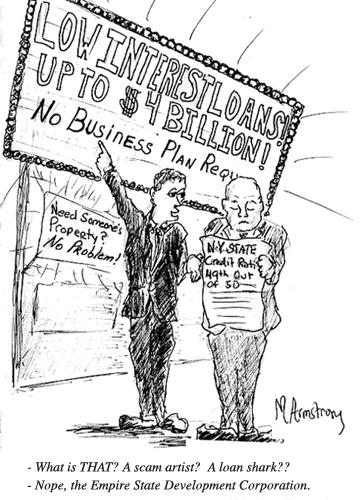
|
Posted by lumi at 10:00 AM
March 31, 2007
Progressive Democrat Issue 115: NYC FOCUS: More Atlantic Yards Insanity
Mole333 is understandably upset over having New York City footing the bill to buy the land for Atlantic Yards.
Did you know that you are buying the land for Bruce Ratner to build his Atlantic Yards' project? Yep. That is what Michael Bloomberg wants, as I have previously reported. Ratner promised to pay $100 million for the land to build his project (the low bid, but being Pataki's friend apparantly compensated for his low bid). Guess how much NYC taxpayers are being asked to pay for land acquisition for Ratner? Yep...$100 million. We are buying the land for him. Feel free to tell your City Council member what you think of that.
Having the State move forward without ever having seen a business plan for the project only makes him madder.
It appears that Pataki and Bloomberg went full speed ahead with their support of Ratner, and the Empire State Development Corp. gave it glowing reviews...even though RATNER NEVER SUBMITTED A BUSINESS PLAN! That's right. The ESDC approved the project and Bloomberg is asking us to foot the bill but Ratner never submitted a business plan. Of course we only know this because Jim Brennan SUED to get access to the business plan.
Mole333 recommends taking action by attending the April 4 Spunk Lads reunion at Southpaw, which will raise funds for the Develop Don’t Destroy Brooklyn Legal Fund.
Posted by steve at 8:36 AM
March 30, 2007
Heads in the Sand
The failure of Atlantic Yards developer Bruce Ratner to submit financial projections for the project leads to several questions.
From Develop Don't Destroy Brooklyn:
Does anyone who approved this project, for which the government intends to use the awesome power of eminent domain, even know if it's financially viable? Does anyone in Albany or in City Hall have any idea how Ratner's potential profit compares to the public's meager return? Does anyone know if Ratner might pull the plug on Phase Two if he makes all his money on Phase One? Apparently not.
Would a bank give you a small business loan (let alone hundreds of millions in taxpayer subsidies) if you didn't show them a business plan?
NoLandGrab: Since the answer to all of the above is an unequivocal "NOT," the next question is "Why?" [And don't say, "Because we like you."]
Posted by lumi at 11:12 AM
Once again, KPMG report on IRR doesn't mean profit
Atlantic Yards Report
If you're as confused as we are about the difference between "profit" and "internal rate of return," join the press corps:
Two published articles this week have inaccurately suggested that the KPMG audit the Empire State Development Corporation (ESDC) commissioned actually estimated Forest City Ratner's profit on the Atlantic Yards project.
First, the New York Sun reported, in an article noting that the state never saw a full business plan for the project:
Cash flow projections and interviews with executives were the basis for the report's conclusion that the developer would stand to make a total return on its investment of about 9.8% on the mixed-use portion of the project.
Then the Brooklyn Paper followed up:
The KPMG report projects that Ratner will walk away with a $400-million profit from his state-backed $4-billion Prospect Heights Xanadu.
So how do we square this with New York magazine's estimate of $1 billion profit? We don't.
As I reported in December, quoting affordable housing expert David A. Smith, internal rate of return (IRR) doesn't mean profit....
Norman Oder explains (link).
Posted by lumi at 8:39 AM
Bloomberg says...
Queen's Crap posted a link to Mayor Bloomberg on the campaign trail, where he tells folks what they want to hear.
Bloomie sez:
"This city cannot build the schools, expand the libraries, fix the potholes and build big sports facilities at this time...Shea and Yankee Stadiums don't make any money for the city...If you counted the infrastructure for Shea and Yankee Stadiums, they are disasters for the city...We are only going to build stadiums if there's private money."
NoLandGrab: Even though Bloomberg eventually got NY City to pony up $205 million for the Ratner arena — for starters — and left us on the hook for "extraordinary infrastructure costs" (read: blank check), in 2004 he sold Atlantic Yards as a private project:
"The new stadium over in Brooklyn for the Nets is private money. Bruce Ratner is going to finance it himself."
Bruce Ratner doesn't build anything exclusively with private money. Anyone who thinks so doesn't have what it takes to be Mayor of anything.
Posted by lumi at 7:15 AM
March 20, 2007
Report: Ratner among state lobby leaders
MetroNY
By Amy Zimmer
Forest City Ratner spent roughly $2.11 million on lobbying efforts last year for its $4 billion Atlantic Yards development plan, making it the state’s third highest spender, trailing a health care lobbyist group and Verizon. The state’s recently released figures prompted outcry yesterday from project foe Develop Don’t Destroy Brooklyn.
The group criticized Forest City Ratner for its spending on lobbyists in light of recent news that rather than having the developer dip into its own pockets to pay the Metropolitan Transportation Authority for the rights to build over the rail yards, the city may cough up an additional $100 million in taxpayer money for the 8.5-acre parcel of the 22-acre site.
The largest single lobbying contract in 2006 was the $656,520 Forest City Ratner paid the Fried Frank Harris Shriver & Jacobson firm. The report also shows that Forest City Ratner employed eight different lobby firms last year.
Also, another development threatening the use of eminent domain coughed up beaucoup bucks to get their point across to state officials:
Columbia University, which is eyeing expansion in West Harlem, paid the second-largest contract — $527,875 — to Kramer Levin Naftalis & Frankel.
Posted by lumi at 7:21 AM
March 19, 2007
PRESS RELEASE: In Buying Albany’s Approval and the City’s Acquiescence
Bruce Ratner Was Number 3 Lobbying Spender During 2006
“Atlantic Yards” Developer Spent $2.11 Million on Lobbying
Without Spending a Cent on Acquiring Vanderbilt Rail Yards
BROOKLYN, NY—It was reported today that Bruce Ratner’s firm Forest City Ratner was the number three lobbying spender in NY State during 2006, spending $2.11 million to push forward his $4 billion “Atlantic Yards” proposal. The development firm trailed only the healthcare industry and Verizon. Forest City Ratner paid the largest single lobbying contract in 2006, $656,520, to Fried Frank Harris Shriver & Jacobson.
Meanwhile it was recently revealed that New York City taxpayers will contribute $100 million in cash for Forest City Ratner’s “Atlantic Yards” related “land acquisition.” Since, in 2005, the Metropolitan Transportation Authority (MTA) agreed to sell Ratner the rights to the 8.5-acre Vanderbilt Railyards for $100 million it has become clear that the City’s taxpayers are paying for the railyards so Ratner can get the yards for free.
“Forest City Ratner had $2.11 million to lobby Albany on ‘Atlantic Yards’ but will not spend a single penny to purchase the rail yards which comprise over one-third of the development site Bruce Ratner desires. Instead NYC taxpayers will pay to buy the yards for Ratner. It's an exquisite shell game,” said Develop Don’t Destroy Brooklyn spokesperson Daniel Goldstein. “Ratner has also left NYC taxpayers holding the entire bag when it comes to the so-called ‘extraordinary infrastructure costs’–or blank check–necessitated by his development experiment in extreme density founded upon eminent domain abuse. The taxpayers are being forced to pay Ratner’s bills without any say in the matter.”
Forest City Ratner employed eight different lobbying firms in an Albany climate that is sure to change under Governor Spitzer’s reforms.
The NY State Lobbying report is available here: http://nylobby.state.ny.us/ann_rept06/index.html
Posted by lumi at 10:52 PM
Money for Ratner and the Railyards for Free
Develop Don't Destroy Brooklyn wants you to know that taxpayers are purchasing the railyard for Bruce Ratner.
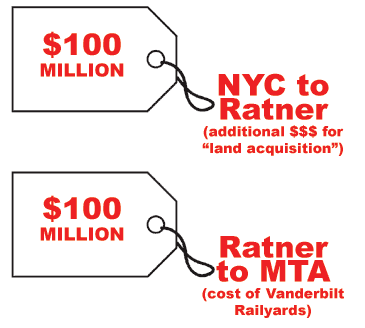
The coalition group opposing Bruce Ratner's Atlantic Yards plan connects THE DOT and crunches THE NUMBER to bring you this explanation:
In September 2005 Bruce Ratner agreed to pay the MTA $100 million for the rights to the 8.5-acre Vanderbilt Railyards, which comprise over one-third of the "Atlantic Yards" project site. The MTA reached that lowball agreement despite the competing bid of $150 million by Extell Development Company and the $214.5 appraisal.
Last week it was revealed that New York City would give $100 million in taxpayer funds to Bruce Ratner for "land acquisition."
No need to connect the dots here, it's one dot.
The City is using taxpayer dollars to buy the railyard rights for Bruce Ratner.
Posted by lumi at 10:10 AM
March 16, 2007
Atlantic Yards: the financial salt mines
 Affordable Housing Institute
David Smith helped Norman Oder of Atlantic Yards Report demystify the three-page Atlantic Yards financial projections released two weeks ago.
This week Smith helps us to demistfy Oder's article along with skads of very helpful visual aids for the verbally and mathematically impaired.
Posted by lumi at 7:18 PM
The Ratner ripoff
The Brooklyn Paper editorial
So why is the city — which has already pledged $105 million towards “infrastructure improvements” around Atlantic Yards — buying $100 million in land?
It’s a reasonable question, given that Ratner has already bought up most of the land — some of it at a reduced price, courtesy of his state lackeys. Those same supposed stewards of our tax dollars have promised to condemn whatever land Ratner was unable to buy and turn it over to him.
...
Now, this newspaper has no problem with the city doing the necessary infrastructure work — laying sewer lines, installing lights, etc. — to encourage private development.But we don’t understand why it is the taxpayers’ job to cut costs for Ratner’s land acquisition.
NoLandGrab: No other NYC editorial board has come close to contemplating this simple question.
Posted by lumi at 11:38 AM
March 14, 2007
People Who Can Help Get a Project Built — Or Help Stop One
City Hall

New York’s reputation as a place resistant to many new buildings has done nothing to discourage more people from trying every year, every day. Among the most important decisions which go into translating a project from concept to blueprint to concrete foundation are those made by people charged with mediating between government and private developers. Of the many who do, here are 10 (in no particular order) who City Hall thinks help bridge public demands and private interests when it comes to getting shovels in the ground in New York.
Familiar names to those who are living in the shadow of Atlantic Yards: Sheldon Silver , Eliot Spitzer, Dan Doctoroff, Amanda Burden, Joseph Bruno, and more recently Patrick Foye.
And here's proof that if you repeat a myth it stays as fresh as a Twinkie™ (emphasis added):
[Amanda] Burden has also played an important role... in reducing the scale of the controversial Atlantic Yards development in Brooklyn.
[For myth-busting, check out Atlantic Yards Report, where Norman Oder revealed that a document "obtained via a Freedom of Information Law request from the Department of City Planning shows that most of the proposed cuts had been on the table since January, 2006, in an option (20B) presented by the developer and architect Frank Gehry."]
Posted by lumi at 6:58 AM
March 9, 2007
Public obligation creep: city will spend $100M for AY land acquisition
Atlantic Yards Report fills in some blanks in the Daily News story on $100 million of taxpayer money to be used to buy land for Ratner.
[The] MOU (p. 4) contemplated a city contribution of $100 million. In January, I reported the city's contribution has been more than doubled, to $205 million; the explanation was murky.
...
The Council Members protest a bit much about the uses of the city subsidy, given that it was announced more than two years ago. However, it was never contemplated that a sum that large--$100 million--would be used for land acquisition.Apparently the really important part of the MOU was the declaration (p. 8) that it was non-binding.
Posted by lumi at 9:27 AM
Cash flow docs mystery: missing revenues, missing subsidies
Atlantic Yards Report compares and combines numbers from the three pages of financial projections, dated 10/06 and released last week, with the 24-page KPMG report obtained, but not released, 12/06.
Using the KPMG report, AYR is able to fill in some of the gaps in the three-page financials, but many details remain wanting.
Neither set of documents provides a clear sense of the project bottom line; for that, we’d need a full accounting of “sources and uses” of the funds. However, the unreleased document—which I and some other reporters have acquired, though not via the ESDC—goes much farther than the document publicly released.
For example, the Nets team and arena might end up being a cash cow:
Regarding the Nets, the document released last week (right) has some gaps. The KPMG document includes $33.5 million in annual TV revenue and $27 million in “other Nets-related revenue,” figures that do not appear explicitly on the document at right.
That suggests more than $60 million annually should be added to the bottom line—a significant gain, given that the developer’s obligation to pay for the arena would be less than $44 million a year. That sum refers to debt service on tax-exempt bonds; it would be higher if the state required Forest City Ratner to pay for the arena directly rather than have it be “publicly-owned” by a state subsidiary.
Oder also looks into figures for condos, rentals, subsidies, rental of retail space and revenue from laundry facilities.
Posted by lumi at 8:21 AM
March 5, 2007
Three Pages of Financials Released On Atlantic Yards ‘Not Enough’
Brooklyn Daily Eagle
By Sarah Ryley
The state agency overseeing the Atlantic Yards arena and high-rise project released a three-page financial projection of the profit developer Bruce Ratner would make off the heavily subsidized, $4 billion development.
“A handful of three faxed pages of a chart or two is insignificant. And we’re not interested in drips and drabs,” said Assemblyman James Brennan, D-Park Slope, who filed a lawsuit Monday with state Sen. Velmanette Montgomery, D-Fort Greene, to force the release of the documents.
The long-awaited Empire State Development Corporation (ESDC) financial analysis, provided by developer Forest City Ratner Companies, projects $571 million in “total investment cash flows” by the year 2015.
The estimate includes the real estate project cash flows, and the team and arena investment cash flows, but has some conspicuous omissions such as the profits from the planned 180-room hotel that would be housed in the project’s centerpiece building, “Miss Brooklyn.”
A representative for the ESDC declined to comment any further on the figures, and a representative for the developer did not return calls by press time.
article (login required)
Posted by lumi at 9:15 AM
March 3, 2007
Moses to O'Malley, 1953: urban renewal won't support "speculation in baseball enterprises"
Atlantic Yards Report
Master builder Robert Moses, vilified for ignoring neighborhoods and prioritizing the automobile, nevertheless was unwilling to be strongarmed by Brooklyn Dodgers owner Walter O'Malley into supporting significant government subsidy for a privately-run sports facility.Indeed, a 6/22/53 letter from Moses to O'Malley on exhibit at Columbia University's Wallach Art Gallery puts it plainly. In the letter, part of the "Slum Clearance and the Superblock Solution" exhibit that's one of three segments in Robert Moses & the Modern City, Moses resists O'Malley's entreaty to locate a new stadium in urban renewal land between DeKalb and Myrtle avenues, just east of Flatbush.
(Note: O'Malley primarily wanted a separate site over the Long Island Rail Road station and including land to the east, site of the Fort Greene Meat Market, both north of Atlantic Avenue. That's not the same as the site south of Atlantic Avenue--including the MTA's Vanderbilt Yard and more--planned for the Atlantic Yards project, though Mayor Mike Bloomberg and others have conflated the two. But Forest City Ratner has malls north of Atlantic Avenue and wants to build Atlantic Yards across the road.)
Posted by amy at 9:09 AM
March 2, 2007
It came from the Blogosphere...
 Gothamist, Atlantic Yards Financials: "Mysterious" and "Insufficient"
A summation of the online coverage and the Sun article on the release of financial info for Atlantic Yards also includes an interesting comment from the Gothamist's previous post.
The Daily Gotham, The Cost of Ratner's Plan: We STILL Don't Really Know
"Mole333" says:
Does sloppy bookkeeping and oversight encourage confidence? Not in my mind. Yet the Empire State Development Corporation (ESDC) continues its shoddy oversight of Bruce Ratner's Atlantic Yard's project. Keep in mind that the ESDC has up to now been nothing but a rubber stamp for everything the Axis of crony capitalism (Ratner and his political pawns) has wanted. Now they file an inadequate and incomplete financial projection for Ratner's overdevelopment plan that basically tells the taxpayers very little about what it will actually cost them in the long run.
Don't Worry It's Just Reality: Brooklyn Edition, Flurry of News On Ratner Brooklyn Bridge to Nowhere......
"Dreadnaught" wonders:
Could simple exposure of financial documents be enough to embarass the ESDC, reform minded Spitzer to put a stop on what is essentially the biggest boondoggle in NY history, with no real public benefit?
Brownstoner, AY Financial Docs: The Morning After
The lack of coverage and analysis of the Atlantic Yards financial documents released yesterday is pretty astounding. Radio silence from the Times and the Daily News, Metro mentioned it at the end of an article about a different aspect of Yards, and The Post wrote a reasonably in-depth article about what the docs revealed but held off from weighing in on their usefulness or credibility. The Sun was the only paper that delved a bit into the response of critics of the project, even editorializing that "there does not seem to be enough information to make an accurate estimate of Forest City Ratner's return."
Only the Blog Knows Brooklyn, WHAT THE READERS OF BROWNSTONER MAY NOT KNOW
This is a blantant instance circular linking, but OTBKB posted a link to our entry about what NY Times reader's don't know about Atlantic Yards.
Reading some comments on Brownstoner, Lumi Rolley, of No Land Grab, noticed that some folks at Brownstoner who read Jennifer Egan's historic Op-Ed didn't believe her assertion that, if built, Atlantic Yards would be the densest residential community in the nation. But then it dawned on Rolley, The New York Times has never published that fact in it's reporting on the project.
Posted by lumi at 10:12 AM
March 1, 2007
Three pages of mystery: FCR's cash flow documents leave questions unanswered
Atlantic Yards Report
Assemblyman Jim Brennan’s effort to get the Empire State Development Corporation (ESDC) to release the Atlantic Yards business plan provided by developer Forest City Ratner reaped some results yesterday, but not nearly enough to evaluate the project.
The ESDC released three pages dated 10/10/06 and 10/11/06, but with no explanation for the assumptions behind the numbers. I showed them to David A. Smith, an affordable housing expert in Boston, who’s paid close attention to the Atlantic Yards plan. "These cash flow schedules are like a Japanese landscape watercolor; fascinating and evocative in their own right but only lightly drawn,” he wrote in response. “They make one hungry for more detail, without which it is impossible to have a properly informed opinion about either the expected profit the developer may make relative to the risk, or whether the public is receiving fair public benefit for the public resources contributed."
Thus, the documents would not help Brennan evaluate whether Atlantic Yards could be downsized without harming the financial viability of the project. ...
The documents fill in some details about the arena:
The documents do offer some tantalizing details, for example pegging revenue from suites in the suite-intensive arena at $38 million a year (beginning in 2009-10), with an annual increase of $1 million, slated within five years to surpass the annual arena debt service of $43.8 million. In other words, the suites alone could, as I’d predicted, pay for the arena, the most expensive ever in the country, at $637.2 million.
They also show that the new arena would easily pay for its operations; as sponsorship revenue, starting at $31.2 million annually, would nearly cover operating expenses. (That revenue would include $20 million a year from the Barclays Center naming rights deal.)
Norman Oder also explains the difference between “investment internal rate of return” and profit and why the later is impossible to calculate without knowning how much of the money the developer would put up."
David Smith explains it this way:
“Knowing the net cash flows without knowing the fees is like learning that the Nets scored 89 points last night, without knowing who they were playing, what the other team's score was, and whether they won or lost."
There are also some discrepancies in the numbers related to the "Affordable Housing" and several unexplained gaps, like lack of numbers for the hotel, retail space or parking.
Posted by lumi at 10:28 AM
RATNER NETS B'KLYN BONU$
 NY Post
By Rich Calder
The Post calls it an "EXCLUSIVE" though Brownstoner and any number of blogs had it first and MetroNY and The NY Sun also had it. [The Post reporter is causing concern in the blogger community for having recently reported stories which originaly appeared on blogs, without attribution or citation.]
Maybe the Post is calling it an "EXCLUSIVE" because the document is marked "confidential?"
The article provides a summation of the three-page financials, but doesn't note any of the things that are missing from the projections. However, they did run this fabulous photo that will probably show up on NoLandGrab from time to time.
And don't forget this:
Forest City Ratner and the Empire State Development Corp, which released the records to The Post, declined comment yesterday.
Posted by lumi at 10:14 AM
February 28, 2007
Press Release: "Atlantic Yards" Financial Projections Fail to Shed Light on Forest City Ratner's Potential Profit
Figures Released By ESDC Under Threat of Legislators' Lawsuit Leave Many Questions Unanswered, Appear to Grossly Understate Profit
BROOKLYN, NY- Financial projections released today by the Empire State Development Corporation (ESDC) purporting to show Forest City Ratner's (FCRC) projected profit for the proposed "Atlantic Yards" project appear to raise more questions than they answer - and to severely understate the developer's profit.
The financial documents, which were released only after State Assemblyman Jim Brennan and State Senator Velmanette Montgomery sued the ESDC for the information, fail to provide sufficient details or underlying assumptions, including information on "sources and uses" typically provided for a project receiving significant amounts of public funding. In some cases, the documents omit information altogether, for example, assigning no projected value to the project's planned hotel. The true value of the assets, once built, would appear to be much higher than the values outlined; several elements of the plan appear to be estimated below market value, let alone future value.
At least one local real estate developer who has reviewed the documents had serious questions about the conclusions contained in the documents. Shahn Andersen, in comments posted to the web site Brownstoner.com, stated that he believed FCRC would earn approximately a billion dollars, and questioned how much money of its own the developer was actually putting up. He also questioned FCRC's purported rate of return as being severely understated.
The documents only project out eight years, to 2015, one year before the project's officially projected completion date. (In comparison, the MTA, in its Request for Proposals for the Vanderbilt rail yards, had required 20-year pro forma projections, although FCRC failed to provide the MTA with the requested information.) Some people with knowledge of the project, including "Atlantic Yards" landscape architect Laurie Olin, have said they expect construction to last 20 years.
The financial projections do reveal some interesting information about the arena, including the fact that the New Jersey Nets are currently losing some $40 million dollars a year. "It appears that the taxpayers are being asked to bail out a professional sports franchise that's currently a complete money loser," said Candace Carponter, spokesperson for Develop Don't Destroy Brooklyn. "While the city and state are bending over backwards to subsidize Bruce Ratner, it seems that it should be the other way around."
According to the documents, the act of relocating the Nets from New Jersey into an arena in Brooklyn will allow Ratner and the Nets' co-owners to essentially double their initial investment by 2013, providing the money-losing team's investors with a publicly subsidized golden parachute.
It's also unclear as to whether the ESDC has analyzed and verified the projections released today, or if they simply rubberstamped this submission, just as they have every other aspect of the "Atlantic Yards" project. Given the vast public subsidies that this project is slated to receive, the public has the right to expect some assurance from the government that the developer's numbers are comprehensive and based upon valid business assumptions," said DDDB's Carponter. "The footnote on these documents says 'For discussion purposes only - actual results may vary.'"
Posted by lumi at 6:40 PM
Skybox muscle slips for stadiums
Suites that aren't paying off get boot
Wall St. Journal, via Myrtle Beach Sun
By Russell Adams
On the eve of the release of financial projections for Bruce Ratner's Atlantic Yards plan, this article revealed that skybox revenue ain't what it used to be.
It was like watching an era of sports history being erased. In early December, construction workers sawed through the multiple layers of drywall and metal studs separating a row of skyboxes at the Seattle Mariners' Safeco Field. They tore up the suites' beech-hardwood floors and carted away their oriental rugs and leather furniture. By the end of the week, the eight skyboxes were gone.
In a reversal that strikes at a cornerstone of pro-sports finances - and of the way corporate America entertains - teams around the country are ripping out luxury suites. These perches have been used to justify billions of dollars in stadium construction over the past two decades. But in many cities, they are losing luster with surprising speed, partly the result of factors that couldn't have been predicted five or 10 years ago, from changes in tax laws to scandal-driven reforms on corporate entertaining.
NoLandGrab: In contrast to this article and current nationwide trends, Ratner estimates, in the documents released today by the ESDC, that "suite and loge box revenue" will nearly pay for the arena's construction.
Posted by lumi at 6:26 PM
February 25, 2007
Youthful mogul sticks to his vision
Salt Lake Tribune
No, the youthful mogul in question here is not Bruce Ratner, but he's certainly on his way to becoming him:
So, he has purchased a franchise in the National Basketball Association's Developmental League. He will announce the team's name next month, and the season begins in the Utah Valley State College gym in Orem this fall.
...
But it's his Lehi project that has gained Andersen the most attention - that and the hiring of a world-renowned architect to create a distinct design at what Andersen calls the "gateway between Utah and Salt Lake counties."Gehry, who designed the Guggenheim Museum in Bilbao, Spain, and the Walt Disney Concert Hall in Los Angeles, also is working with rapper Jay-Z and the New Jersey Nets on a $400 million arena in Brooklyn.
Posted by amy at 11:20 AM
February 12, 2007
Stadium game playing us for fools
An article in MetroNY about cities who have adopted a "build it and they will come" position to arena building, references Bruce Ratner's Atlantic Yards (click image to enlarge):

"The fact is that these communities, just like Detriot, St. Louis, Newark, N.J., Brooklyn and others, have fallen prey to the same sporting facilities shell game that has played out all across this nation. Areas that can't find a nickel to reduce class sizes, help get medication to their poorest residents or even adequately fix pot holes suddenly can hike taxes a percentage point so they can tailgate. Why fix cities, when you can give citizens bread and circus?"
Posted by lumi at 10:02 AM
February 10, 2007
Nazis, slave traders & racists are too much for Clarke - Congresswoman pulls support of Atlantic Yds. citing Barclay’s shadowy past

Courier-Life
Stephen Witt
“Forest City Ratner Companies [FCRC] has fallen short of community expectations in fulfilling certain commitments. I am concerned about this marriage and its ramifications in meeting the expectations of the residents of Central Brooklyn,” said Clarke.
...
“This process must be inclusive, transparent and structured so that community stakeholders are active participants in making key decisions,” she said.“There are a range of issues including tax breaks and eminent domain that can only be addressed by multiple levels of government,” Clarke added.
article
And we are all anxiously awaiting Yvette's participation in making this opaque process transparent.
Posted by amy at 1:19 PM
February 8, 2007
It came from the Blogosphere...
 NY Magazine, Daily Intelligencer, Urban Planners Agree: New York in 2030 Will Suck
The Mayor's NYC2030 brainstorming session backfired when urban planners came to warn about problems on the horizon.
Planning to stick around town for the next 23 years? You might want to reconsider. Apparently the New York of 2030 — the major American city at the second-greatest risk of catastrophic hurricane damage after Miami, by the way — will be facing a homelessness epidemic, more Miss Brooklyn–esque way-out-of-scale enormous buildings over rail yards, a major shortage of engineers qualified to construct such things, and a war between the union and nonunion laborers who build them.
Room Eight, NY Politics, Two To See
The local politics blog excerpts the NY Sun article covering Thursday's hearing.
A little-noticed, jaw-dropping exchange about the appropriate use of eminent domain between a federal judge and a lawyer representing Brooklyn's massive Atlantic Yards projects:
"What I'm hearing is that so long as a defendant can articulate a public use," Judge Levy asked, eminent domain is "per se constitutional?"
"Your honor, I would say yes," Mr. Braun said, adding that "the role of the court really disappears" beyond conducting that initial review.
This answer did not seem to satisfy Judge Levy. Soon thereafter, he put forward a hypothetical: What if developers wanted to seize 22 acres of private property and build luxury housing on 21 acres of it and place a school on the remaining acre?
Hardbeatnews.com, THE EDUCATION OF YVETTE CLARKE PART 19: SO HOW IS SHE DOING SO FAR?
Disappointments over the Bruce Ratner-Barclays Bank naming-rights deal is getting play in the Caribbean-American community and Yvette Clarke's core constituency.
Disappointment #5. Ratner selling the name of the new Brooklyn arena.
Lots of Brooklynites and numerous elected officials have criticized Bruce Ratner for selling the name of Brooklyn’s first ever major indoor facility the state of the art sports, entertainment and convention center that will open in 2009 – selling that name to a very suspect British bank Barclay’s with Ratner pocketing $400 Million in the process. What is Yvette’s position? She could make a big difference. As a strong supporter of the project Yvette is in a position of strength on this issue if she will speak out forcefully.
Note: Just this week, Yvette Clarke issued a statement to the press expressing her concerns.
Field of Schemes, Nets arena court battle begins, Knicks arena next?
Neil DeMause sends readers to Norman Oder's "extensive report" on the hearing for the defendants' motion to dismiss the Atlantic Yards eminent domain lawsuit. Also, there are rumblings across the river over a plan for a new Madison Square Garden where, in what will come as no surprise to the NoLandGrab reader, the public will probably have to pony up some bucks.
Queen's Crap, The King's Decree
The blog tracking real estate controversies and the related political fallout in Queens takes issue with Mayor Bloomberg's recent statement about eminent domain. Bloomberg probably didn't mean to describe a property owner who isn't willing to sell to Bruce Ratner as "one little person," but he did.
This represents the general contempt that King Michael has for any of his subjects who dare stand in the way of his buddies' development proposals.
not another f*cking blog!, my next photography exhibit
A local photographer will be exhibiting photographs "of buildings in and around the 'footprint' of the proposed Atlantic Yards development" at the Oliver Wolcott Library in Litchfield, CT in April.
NoLandGrab: Wonder if the Litchfield library censors their exhibits for politically controversial material.
nyu realty llc, Are these Celebrities looking to Buy Real Estate in Brooklyn?
Why would celebrities like Gisele (Runway SuperModel Star), Tiger Woods (World's Greatest Golf Star) and Joakim Noah (Son of Tennis Great Yanik Noah and maybe The Next New York Knick) buy Real Estate in Brooklyn. Maybe because Bruce Ratner And JayZ are going to Bring the New Net's Stadium to Brooklyn. What do You Think?
Don't Worry It's Just Reality, Brooklyn Edition, The Brooklyn "Public" Library..another instution in the tentacles of Forest City
Are we to believe Forest City had nothing to do with [censorship of the Footprints Exhibit at the Brooklyn Public Library]? Given Ratner's track record, of lying, deceit, underhanded influence, its' to be expected. I would seriously consider asking BAM and other Brooklyn institutions to divest from Forest City - if they continue to accept his money, its clear the arts will not serve Brooklynites, but Bruce Ratner.
Posted by lumi at 8:54 PM
February 6, 2007
BEGGING FOR BILLIONAIRE$
 A Limelight Cinema Group Production
Brooklyn isn't that special when it comes to bending over for billionaires:
Begging for Billionaires is a documentary about a nationwide epidemic happening in cities across America. In the Midwest, in the heart of America, the use of eminent domain has affected thousands of people. This documentary follows those who are fighting to keep the heritage of the American concept of property rights alive.
View the trailer and interviews of property owners standing in the path of progress.
Posted by lumi at 9:46 AM
February 5, 2007
Barclays Denies Alleged Ties To Slave Trade
NY Sun reporter Eliot Brown covers the Barclays brouhaha in Brooklyn:
Amid criticism by black leaders in Brooklyn over the naming rights deal for the Nets stadium, Barclays Bank late last week issued a letter denying allegations that it had links to slave trading in the 18th century.
After staying relatively mum on the issue for two weeks, Barclays failed to pacify many outspoken critics with its letter, though it prompted a correction from the Brooklyn Paper.
Posted by lumi at 10:00 AM
Hello, Neighbor!
Fans For Fair Play stands up to Brooklyn's new "neighbor," Barclays Bank, which sent out a strongly worded defence last week of the banks alleged ties to slavery, apartheid S. Africa and activities during WWII. FFFP lays out more details on the history of Barclays, seeks to clarify the record on one item, and explains the bank's latest hardball tactic:
Of course we're talking about Barclays Bank, who just crawled into a comfy palace four-post bed with Bruce Ratner. Barclays shelled out $400 million or so -- as per the usual secrecy from all things Ratnerian, Bruce and the bank won't exactly say how much.
New neighbors? Hey, let's do what anyone would and walk up the street, say hello, find out a little about them.
Seems that Barclays has a few skeletons in its closets...boney, scrawny evil lookin' things called Slavery, Apartheid, Anti-Semitism, Racism.
Oh...and a quick-trigger forearm to the throat of any newspaper, journalist, blogger, writer or internet site willing to write about their sordid little history.
NoLandGrab: Does anyone else get the feeling that Bruce Ratner's penchant for secrecy goes both ways? Is it possible that Bruce conveniently forgot to tell the British bank that they were about to partner up in one of today's most controversial development projects? Brooklyn's newest "neighbor" can't be happy.
Then again, as cited by Fans For Fair Play, Barclay's spokesperson Peter Truell writes, "As a good neighbor and corporate citizen, we pay close attention to the concerns of any community in which we have a presence...."
Posted by lumi at 8:39 AM
Times, Daily News pass on $205M story; Doctoroff says construction costs could up city contribution
Atlantic Yards Report sums up the media coverage of the Bloomberg administration's more-than-doubling of the direct cash subsidy for Atlantic Yards, and follows up with Deputy Mayor Dan Doctoroff:
On the media:
The New York Sun and New York Post thought it was news. So did the online components of New York magazine, the New York Observer, and the Village Voice, as well as the online Gotham Gazette. The three Brooklyn weeklies--the Brooklyn Paper, the Courier-Life chain, and the Downtown Star (my story)--have covered it.
The New York Times and the New York Daily News have ignored the story so far. That's inconsistent, given their willingness to prominently play stories that were merely speculative. For example, a 9/5/06 Times article on a rumored six to eight percent cut in the size of the Atlantic Yards project ran on the front page--the lead story in the local edition. And a 12/22/06 Daily News story on the still sketchy possibility of a new Brooklyn Technical High School ran on page 2.
The Doctoroff is in:
...after the symposium on Robert Moses last Thursday, I asked Deputy Mayor for Economic Development Dan Doctoroff a couple of Atlantic Yards questions. I already covered the discussion of public dialogue and Community Benefits Agreements, but I also raised the funding issue: "You probably know there's a $205 billion capital plan for Atlantic Yards--
"Much of that," he intervened, "was stuff that was going to be done in the area regardless."
"Then why is it under the rubric of Atlantic Yards?" I asked.
"Because it happens to be in the area surrounding Atlantic Yards," he responded.
Posted by lumi at 8:13 AM
February 3, 2007
City doubles down on Ratner’s Atlantic Yards Project, many cry foul
Courier-Life
Stephen Witt
Call it mystery money.Couched in Mayor Bloomberg’s capital budget, released last week, is $205 million earmarked for the Atlantic Yards project.
The line item more than doubles the $100 million that the city has already given toward the Forest City Ratner Companies (FCRC) project for infrastructure costs.
...
“The public costs keep rising, and yet we have a paltry amount of housing that is affordable to the average Brooklynite, and no agreement with the construction trades union to work with local residents who need jobs,” said City Council member Letitia James.
Posted by amy at 9:04 AM
February 2, 2007
Why they lie
The Brooklyn Paper explains why NoLandGrab can't even squeeze in a vacation, much less retire:
Lately, it seems that no matter which development story we cover — Atlantic Yards, the so-called “Brooklyn Bridge Park,” the redevelopment of Coney Island — one common theme emerges.
Developers don’t tell the truth.
And the simple reason is that they don’t want you — the taxpayers who subsidize most development going on today — to know how much of your money they’re taking.
We write about this subject a lot, but it bears repeating because the lies and subterfuge blinds many of our readers to the hidden costs of some of Brooklyn’s biggest projects.
With Atlantic Yards, developer Bruce Ratner once boasted that his project would generate $100 million in tax revenues for the city every year for 30 years. That figure is now down to $15 million. Fifteen million! That’s coffee money for a city with a $57 billion annual budget.
The city once said it would only spend $100 million on “infrastructure improvements” at the Atlantic Yards site. That figure is now $205 million — and the mayor told our reporter this week that the final figure will be higher.
Posted by lumi at 8:15 AM
What's in a name? Money, that's what
The Journal News
Sports columnist Rick Carpiniello resists becoming a mass-marketing device, but is puzzled by Bruce Ratner's Barclays naming-rights deal:
There are words I'd like to say I'll never use. Like Red Bulls - not because I don't like soccer, but because I'm not going to promote somebody's beverage.
Unfortunately, I have to use Barclays when the golf tournament comes to town, but I'm not going to use it when referring to the Brooklyn Nets' arena, and I'd like to try to avoid the word "Citi" when talking about the Mets' new ballpark. It would be great if newspapers everywhere realized that, hey, these sponsors aren't paying us to use their names; that the arenas aren't actually named for the sponsor, but rather that the sponsor is paying somebody else to have its name sprayed everywhere on the building and to get publicity from us without paying us.
That said, I don't understand a lot of things, but one of them is this: How is it that New York City is coming in $100 million or so over budget on the Brooklyn arena, and Bruce Ratner and his Nets get to cash the $200 million worth of Barclays money for the naming rights? How does that money not go to NYC until all the bills are paid?
NoLandGrab: We don't mean to "Norman Oderize" Rick Carpiniello, but that's $105 million over budget for the NYC direct cash subsidy and more than $300 million (published rumors say closer to $400 million) all for Ratner from Barclays for the naming rights to the arena.
Posted by lumi at 7:32 AM
News Analysis: City's Atlantic Yards Bill Keeps Growing
Brooklyn Downtown Star
By Norman Oder
Since a February 2005 Memorandum of Understanding (MOU), the City of New York committed to spending $100 million on infrastructure and other costs for the Atlantic Yards project in Brooklyn, helping to prepare a complicated site - including a railyard - for an arena and also to help developer Forest City Ratner pay for properties that would be on the arena site footprint.
However, last week, a little more than a month after the project received its final public approval (via the state Public Authorities Control Board, or PACB), Mayor Mike Bloomberg's proposed capital budget included $205 million on the line for Atlantic Yards. ...
However much the $205 million might raise eyebrows, [Kate Suisman, chief of staff for Council Member Letitia James] noted, when it comes to the budget, the Council "can't say no to parts of it; you have to accept or reject the whole thing." She said that the totality of the spending "should have been made public prior to the PACB vote."
Posted by lumi at 7:30 AM
City Yards cost skyrockets; Opponents scream as Bloomy quietly doubles taxpayer subsidy
The Brooklyn Papers
By Ariella Cohen
Mayor Bloomberg explains the soaring costs of new sports venues to the taxpayers:
At a press conference on Wednesday, Bloomberg attributed the higher allocation to the “rising cost of cement and steel.”
“We have a commitment to pay for infrastructure costs and we will meet that commitment,” the mayor said.
Hizzoner dismissed the notion that taxpayers would be stunned to hear that the city was spending more than it anticipated on Atlantic Yards and new stadiums for the Yankees and the Mets, both of which also received multi-million infusions last week.
“We are fundamentally where we thought we would be,” Bloomberg said.
The Atlantic Yards adjustment is the largest of the three hikes in funding. In total, capital funding for the three projects has risen to nearly $600 million — up from the $360 million initially promised.
The Papers puts the figures in context:
A Bloomberg spokesman said the extra spending was a small price to pay for the largest development project in the history of Brooklyn.
“This project will create jobs, provide affordable housing and generate billions of dollars in tax revenue and represents a solid investment of taxpayer resources,” the spokesman said.
Unlike the city contribution, the tax revenue that Atlantic Yards is expected to generate has gone down. Over the summer, state officials said the project would generate $1.5 billion over 30 years. It is now projected to generate $944 million over the same time period — or just $15 million per year for the city and state, whose annual budgets are in the tens of billions.
NoLandGrab: Blooomberg blows off taxpayers with this quote: "We are fundamentally where we thought we would be [just not where we told you we'd be]."
However, the Mayor is right; taxpayers aren't "stunned" because most local media haven't covered the issue. Q: If an activist "screams" in a forest, but hardly anyone covers it, does the activist actually make a sound?
Posted by lumi at 7:19 AM
February 1, 2007
It came from the Blogosphere...
 Nah Right, Jay-Z Supports Slavery
An indy hip-hop blog runs a pretty damned inflammatory headline.
SoundSlam, Jay-Z's New Nets Stadium To Be Funded By Former Slave-Trade Bank
Things are getting pretty silly in the Hip-Hop-o-sphere when Jay-Z is getting credit for the Barclays deal:
Recently, Jay had poured further money into the franchise by securing 400 million in funding from British bank Barclays to build a new stadium for the team, to be called the Barclays Center.
EURweb.com, BEYON-JAY SUBJECT OF BAD PRESS: Beyonce accused of paying dancers chump change; Jay-Z’s Nets accused of taking money from slave owners.
Now we're speechless:
When it rains, it pours for lovebirds Beyonce and Jay-Z, as their latest round of bad press swings from slave wages, to slave money.
The Grammy-winning singer is being accused of paying her tour dancers pennies, while the rap mogul is catching flack because his New Jersey Nets basketball team is taking money from a bank that profited from the slave trade.
Brooklyn Record, The Barclays Center Saga Continues
But what exactly do [Roger Green and Hakeem Jeffries] want from Barclays Bank? Well, Jeffries told The Brooklyn Paper, “All options should be on the table, including payment for past wrongs and termination of the agreement." Green, is a strong supporter of Atlantic Yards, said that the $2.5 million that Barclays will be paying to repair public basketball courts throughout Brooklyn (as part of the $400-million naming-rights deal) is “not enough.” But if we're talking about paying reparations for the slave industry, is it even possible to come up with a dollar amount that would be "enough"?
Majikthise, NYC quietly doubles contribution to Atlantic Yards mega-project
I have no doubt that the infrastructure costs associated with the Atlantic Yards project will be extraordinary in the sense of being huge. On the other hand, I wonder why the city didn't anticipate these costs when it made its initial commitment.
So these "extraordinary" infrastructure costs include things the city would have had to do anyway? Sure.
BarbaraCorcoran.com, Brooklyn Matters
I’ve lived in Brooklyn for nearly 4 years now and ever since I moved into the neighborhood the Atlantic Yards project has filled me with deep ambivalence.
"I am not Barbara, I am Simon" doesn't like eminent domain to take peoples' homes, but feels the neighborhood is "barren," hates basketball (all sports, for that matter), loves Freddy's AND Frank Gehry, doesn't like dark shadows (is there any other kind?), but likes the idea of a lot of affordable housing (for whom?).
It seems all of my reasoning is entirely selfish, just like everyone else’s I suppose. On balance I’d have to be with the ‘no’ camp, for Freddy’s more than anything else. If I were the man in charge I’d make the whole thing much smaller, scrap the sports and not steal anybody’s home. Sadly I am not the man in charge so whatever happens, happens and I remain deeply ambivalent.
Perhaps I need to see this documentary.
Queens Crap, Brooklyn Matters
Brooklyn Matters is a documentary that chronicles the struggle of people to save their neighborhood from the Atlantic Yards project. The film will be screened at several locations over the next month. Crappy encourages you to watch. Hopefully the film will make its way across the border soon. Heck, maybe we'll even sponsor it!
The Gowanus Lounge, Atlantic Yards Property Update: Where the Eminent Domain Hammer Would Fall
What you're looking at above is a map of the Atlantic Yards site, color-coded to show who owns what. While the entire thing makes a pretty, multi-colored map and diagram of the project, what's of particular interest here are the areas in red. Those, according to Develop Don't Destroy, are properties that are still privately owned. In total, more than five acres of the proposed site are still privately owned or controlled.
Daily Intelligencer, Neighborhood Watch
Prospect Heights: Turns out there are still five privately owned acres smack in the path of Atlantic Yards. [Develop Don’t Destroy Brooklyn]
OnNYTurf, Eminent Domain at Atlantic Yards Mapped
Regular readers will know that no one appreciates a good map like OnNYTurf:
DDDB.net has a nice new map showing just how much property Bruce Ratner and the State of New York need to take from people to build the Atlantic Yards project.
5 acres of property are in the hands of private owners. Clearly a victory for property owners, in what is an epic battle with Mr Ratner, would completely scuttle the project and Mr Ratner would need to create a new development plan from scratch.
Posted by lumi at 6:46 AM
January 31, 2007
Atlantic Yards: Now Twice As Expensive (for the City)
New York Magazine political reporter Chris Smith explains how Bloomberg just doubled the City's direct cash subsidy public assistance for his pal Bruce:
Turns out Mayor Mike — in between doling out tax breaks like the Republican he purports to be and money for the arts like the Democrat we know he secretly is — hasn't forgotten his pal Bruce Ratner. He is doubling the city's direct subsidy to the Atlantic Yards megaproject. Yup, City Hall is now set to kick $205 million across the Manhattan Bridge; for context, that's more than 5 percent of New York's overall budget surplus.
...
Here's how: The funding is for "infrastructure improvements" that are supposedly independent of the construction. They just happen to be, um, concurrent with it.
Posted by lumi at 8:49 AM
Hidden Costs For Atlantic Yards
Gotham Gazette
Advocates reading the fine print in Mayor Michael Bloomberg’s budget have unearthed at least one item the mayor probably would have preferred remain unnoticed: a doubling of the city subsidy for the Atlantic Yards megaproject in Brooklyn. The added funding – allegedly for infrastructure improvements (i.e. not the luxury high rises themselves) — “brings the city’s direct contribution to $205 million,” the Sun reports.
Details have been hard to come by, but Doug Turetsky of the Independent Budget Office told the Voice that the money will probably go for items “some of which might have been on the books prior to Atlantic Yards, but some substantial amount of which is likely related to the scale of the project—such as the need for expanding sewer and water capacity.” And, of course, no one knows how much the city will eventually have to ante up because of increased automobile traffic, demands for classroom space, strain on city facilities and so on that could arise from the project.
Posted by lumi at 8:44 AM
January 30, 2007
Mo' Money on the QT?
 The NY Post explained that the amount "has quietly risen from $100 million to $205 million."
Atlantic Yards Report used the word "obfuscatorily" to describe how City Hall went about giving Bruce Ratner mo' money and took their time to come up with a boilerplate explanation.
It's really too bad for City Hall that it has to actually itemize these things because, as Neil DeMause reported in Power Plays, everyone who's building a new sports venue is getting an unexpected(?) windfall. DeMause explains that for the Yankees, Mets and Nets:
Total city capital funding for the projects appears to now be as high as $586 million—a nearly two-thirds hike from the $360 million (not counting tax and lease breaks) that Bloomberg had promised taxpayers would be on the hook for when the projects were first announced.
That part in the parenthesis means that the cash contributions doesn't include the total cost to taxpayers, which is really hard to tally because there's all sorts of math involved.
If not for independent journalists and a community group who has nothing better to do but complain about even more public assistance for rich sports team owners, we'd still have no clue about the bait and switch.
We're not saying that anyone was trying to pull a fast one, but it almost appears that Mayor Bloomberg sold the public on one set of figures, while assuring sports team owners that there would be more money available, and then tried to slip it through "quietly" and deal with it "obfuscatorily."
Posted by lumi at 8:02 AM
City Hall, obfuscatorily, admits doubling AY funding
Atlantic Yards Report
 Here's the latest installment from Norman Oder on the increase in public money for Bruce Ratner's Atlantic Yards plan and the explanation from the Mayor's office:
Mayor Mike Bloomberg's capital budget, released last Thursday, includes $205 million designated for Atlantic Yards, though the city had earlier agreed only to $100 million.
The news didn't generate much scrutiny until I raised the issue on Saturday and Develop Don't Destroy Brooklyn (DDDB) sent out a press release yesterday declaring the increase part of the "blank check" known as “extraordinary infrastructure costs.”
In a nutshell, NYC promised $100 million in the Memorandum of Understanding, but another clause in the same document left the door open to provide more money. How much more? It doesn't say and no one knows.
One thing is clear: with each increase of public money going to Bruce Ratner's Atlantic Yards, the net benefit to the city decreases.
[NYC Deputy Press Secretary John] Gallagher ended his brief message with some boilerplate: "This project will create jobs, provide affordable housing and generate billions of dollars in tax revenue and represents a solid investment of taxpayer resources."

Whatever the tax revenue, the net new revenues, previously estimated at $944 million, apparently just went down more than ten percent.
What about the fact that this story was broken by an independent journalist and, only after Develop Don't Destroy Brooklyn made a big stink in a press release, was picked up by a mere two of four paid-circulation daily papers?
Could you imagine if cities like Houston (fourth-largest) or Philadelphia (fifth-largest) quietly planned to double their contribution to the most ambitious development project in their city's history?
Surely, a reporter at the Houston Chronicle or Philadelphia Inquirer would've noticed the numbers in the mayoral budget. In New York, however, the mayor's office is covered by reporters for the dailies who don't know much about a project in Brooklyn, and the reporters in those dailies' Brooklyn bureaus are often stretched too thin to dig.
Posted by lumi at 7:27 AM
Bloomberg's Budget Doubles Subsidy For Atlantic Yards
The NY Sun
By Eliot Brown
The city has doubled its direct subsidy for the Atlantic Yards project, adding an extra $105 million to the proposed development.
...
Forest City Ratner did not return several calls seeking comment.Council Member Letitia James, whose district includes Atlantic Yards, was upset by the budgeting for additional funds, her chief of staff, Kate Suisman, said. Ms. James has been an outspoken opponent of the project, but Ms. Suisman said she did not think the added $105 million would derail the passage of the mayor’s proposed budget.
A former president of the Boerum Hill Association, Jo Anne Simon, said she opposes many aspects of the project, though infrastructure could be a good thing. “This is part of the problem,” she said. “Of course there are needs for infrastructure, but I don’t know why this amount of money and what it’s going to go for.”
Posted by lumi at 7:12 AM
CITY DOUBLE-COVER$ B'KLYN ARENA
 NY Post
BY Rich Calder
The Bloomberg administration is now kicking in $205 million toward Bruce Ratner's Atlantic Yards project in Brooklyn - more than double the amount anticipated.
The mayor's preliminary 2008 budget revealed that the city's subsidy for the $4 billion project - which includes an NBA arena and 16 skyscrapers filled with residential and commercial space - has quietly risen from $100 million to $205 million.
Posted by lumi at 7:02 AM
January 29, 2007
Nets' city subsidy doubled?
Field of Schemes
New York Mayor Michael Bloomberg released his capital budget on Thursday, and Atlantic Yards Report proprietor Norman Oder noticed something odd about it: The sum allocated for developer Bruce Ratner's Nets-arena-and-condo-towers-and-office-tower plan has more than doubled, from $100 million to $205 million. Oder noted that it's possible this somehow includes the $100 million in state funds that were also promised to the project - or that the extra $105 million is part of the mysterious "additional contributions for extraordinary infrastructure costs" that were noted in the city's original memorandum of understanding with Ratner.
...
As of this morning, the mayor's office still hadn't responded to questions about the inflated city capital costs. Watch this space for further updates.UPDATE: As I just reported over at the Village Voice's Power Plays blog, the extra $105 million really is an extra $105 million...
Posted by lumi at 9:41 PM
Bloomberg Adding $226 Million for Nets, Mets, Yanks?
Power Plays, political blog of The Village Voice
By Neil DeMause
Buried in the nether reaches of the preliminary capital budget that the mayor released last Thursday are some curious details on the three new sports facilities—that's Yanks, Mets, and Nets, for those scoring at home—that the city has in the works. Namely, total city capital funding for the projects appears to now be as high as $586 million—a nearly two-thirds hike from the $360 million (not counting tax and lease breaks) that Bloomberg had promised taxpayers would be on the hook for when the projects were first announced.
...
It's all enough to make one wonder if New Yorkers are really meant to know what our elected officials are spending our money on. "The city budgets, while they have become increasingly transparent, still are not organized in a way to allow the kind of public scrutiny necessary to evaluate these sorts of items," admits Citizens Union director Dick Dadey, though he says the problem may be less "intentional effort to obfuscate" than the fact that " our city budget is far more complex than most states'." Council speaker Christine Quinn, he points out, has pressed for more transparency in the budget process; it will be interesting to see if an unexpected $105 million invoice will be enough to get the speaker to start asking tough questions of her pal the mayor over the project that would eat Brooklyn.
Posted by lumi at 9:35 PM
DDDB Press Release:
Public Cost of 'Atlantic Yards' Continues to Balloon
City Doubles Direct Taxpayer Subsidy for Ratner Plan From $100 Million to $205 Million
 NEW YORK, NY—Ratner gets richer as the public’s burden for 'Atlantic Yards' increases yet again
New York City’s taxpayers have now been forced to double their direct cash subsidy for Bruce Ratner’s “Atlantic Yards.” The subsidy has climbed from $100 million to $205 million as revealed in the new City budget. The ballooning number comes after the project received its only political approval by the State’s Public Authorities Control Board in December, amounting to a bait and switch at taxpayer expense.
The new $205 million taxpayer subsidy is only part of the City’s subsidy package to Ratner, a package which includes tax abatements and credits, housing subsidies, undervalued City-owned land, and a blank check called “extraordinary infrastructure costs.” The total subsidy and public investment from the City and State comes much closer to $2 billion).
“We’ve always known that Bruce Ratner’s ‘Atlantic Yards’ would cost the public much more than we’re being told. This doubling of the City’s taxpayer cash subsidy to $205 million for Ratner’s project is just the first blast of helium into a very large balloon of public money,” said Develop Don’t Destroy Brooklyn spokesperson Daniel Goldstein. “There will be many more installments made to Ratner under a blank public check euphemistically called ‘extraordinary infrastructure costs.’ Who will put a stop to this?”
When the City, Forest City Ratner and the State signed an “Atlantic Yards” Memorandum of Understanding (MOU) in February 2005, there was a blank check agreed to called “extraordinary infrastructure costs.” It appears that that blank check has started growing.
“The Mayor has told us over and over that New York City taxpayers would be forking over $100 million to Ratner, but before seeing if the project can even survive serious federal and state lawsuits, let alone begin construction, the Mayor has increased the Ratner handout to $205 million,” Goldstein concluded.
Posted by lumi at 6:57 PM
January 27, 2007
$205 million for AY seems to double city's pledge
Atlantic Yards Report
Mayor Mike Bloomberg's capital budget, released Thursday, includes $205 million designated for Atlantic Yards--a sum far greater than the $100 million formally pledged.I asked the mayor's press office early yesterday morning for details, but did not get a response by the end of the day.
One explanation may be that the city is relying on a vague clause in a 2005 Memorandum of Understanding to steer more city funds to the project. If so, that opens the door for even more city contributions in the future--a potential Atlantic Yards slush fund.
If not, could the city's capital budget somehow have included the $100 million in state funds also pledged to the project?
Posted by amy at 6:59 PM
January 26, 2007
Bloomberg Cautious Even as City Records $3.9B Surplus
NY Sun
Get out your wallets! The Mayor presents his new budget plan...
On the capital side, it earmarks money for dozens of projects, including $350 million for the Jacob K. Javits Center, $320 million for redevelopment in Coney Island, and $205 million for the Atlantic Yards Project in Brooklyn. It also includes $28.4 billion in school construction spending through 2017, and increases subsidies for the city's public hospital system. It assumes that Governor Spitzer will increase state education spending for the city by $1.9 billion annually.
Posted by amy at 11:00 PM
Barclays pays big bucks for arena name
Courier-Life
Stephen Witt speculates that not only will Barclays' be naming an arena, they are going to move their operations to Brooklyn and make it the financial hub of the Universe! But wait, there's more!
In addition, the agreement calls for the creation of a $2.5 million Nets-Barclays Sports Alliance, a non-profit organization whose goal is to promote athletics, education and mentor young people in Brooklyn.The alliance will, as its first objective, repair and renovate basketball courts and other sports facilities throughout the borough, as well as sponsor amateur athletic tournaments and clinics for Brooklyn’s youth.
The Barclays spokesperson said the alliance will mirror the Barclays Spaces for Sports program in the UK.
The UK program helps local communities transform neglected land into the sporting facilities they want – from skateboard parks to soccer fields or multi-use game areas.
NoLandGrab: Let's just hope that "neglected land" is not British for "your house is next"!
Posted by amy at 10:11 PM
The Barclays Question
The Politicker
Azi Paybarah
Monetary questions aside, is the name of the stadium a relevant point?Daily News man Errol Louis, who is responsible for prompting the most recent mini-debate, says that it isn't. Yesterday, he wrote:
"If the critics are serious about removing the names of slave-linked institutions from public view, they have a lot of work to do. Peter Stuyvesant (as in Stuy-Town, Bed-Stuy and Stuyvesant High) owned 50 slaves. George Washington (Washington Ave., Washington Street, Washington Heights, etc.) owned upward of 200. Chase sponsors dozens of community events in every corner of the city. Where does it end?"It seems like a reasonable question. Does anyone have an answer?
NoLandGrab: We're unsure if Azi is re-asking what Errol is asking, or having a joke on him. Does anyone have an answer? As usual, the peanut gallery does, and most of the answers are pretty well stated.
Posted by amy at 9:49 PM
January 24, 2007
COUNTERPOINT
 WFAN's "Mike and the Mad Dog" give Scott Turner from Fans For Fair Play a chance to air some of those pesky details that reveal that Atlantic Yards isn't such great deal for Brooklyn after all.
Though the ten-minute interview with Atlantic Yards Development Group President Jim Stuckey was posted on the Internet last week, the three-minute Turner interview has just been made available at http://podcast.wfan.com/wfan/99568.mp3.
Turner explains Ratner's affordable housing scheme, eminent domain abuse, Metrotech's myth and public financing of the Nets arena.
Posted by lumi at 8:28 AM
Brooklyn's O'Malley, Others Paved Way for Ratner
The NY Sun
By Evan Weiner
...
O'Malley's wanderlust started with the move in 1953 of the Boston Braves to Milwaukee, where three years earlier Milwaukee city officials had resolved to build a stadium with the hope of landing a major league baseball team.That decision by Milwaukee elected officials is far more significant than the Dodgers and Giants moves. The local government changed the rules for stadium and arena funding and signaled the start of competition between cities for sports franchises. Cities were now willing to put up money for venues — something unheard of until that time.
...
Ratner’s move from New Jersey to Brooklyn will be neither historic nor ground-breaking. It’s just another franchise move in a deal that’s really about the real estate business, not sports. But professional sports have always been about business — the business is just bigger than it was when Walter O’Malley waved good-bye to Brooklyn 50 years ago.
Posted by lumi at 7:39 AM
January 23, 2007
Paying so they can play
NY Newsday, Letter to the Editor
Nothing gets the goat of the region's most prolific letterwriter, Larry Penner, like taxpayers getting stuck with the tab by wealthy sports-team owners:
UK Bank 'Nets' Deal to Name Arena' (Jan. 19) concerning Barclays Bank paying $400 million to Bruce Ratner for naming the Nets Brooklyn basketball arena proves my point why taxpayers should just say no to using public funds for any new major sports stadiums.
...
How sad that New York City taxpayers are continually asked to pay for new stadiums. Public dollars on the city, state and federal level are being used as corporate welfare to subsidize a private-sector business.The only real beneficiaries of these expenditures are team owners and their multimillion-dollar players.
Posted by lumi at 6:04 AM
January 21, 2007
Fleeced
Develop Don't Destroy Brooklyn
WARNING: All of this talk of exorbitant naming-rights and ticket prices is speculation. We'll keep saying this until it becomes clearly understood. Currently private citizens own and rent the land where the arena (and much of the rest of the "Atlantic Yards" project) is proposed. This land amounts to at least 5 acres spred throughout the site. Unless the State of New York and Forest City Ratner can seize title to the properties, all of the hype and hubbub is just that–hype and hubbub. And a Federal court will make this decision.Rich Calder's story in todays NY Post is a small step forward for the mainstream press in trying to ascertain the profit Ratner intends to make off of the public purse, public land and private abuse of eminent domain. According to the article premium ticket holders would have to pay $4,500 just to get the right to buy tickets. And game tickets will range from $51-$970.
Thats some community facility.
...
And if Ratner/Barclays/Yormack/Zimbalist are counting on fans coming from New Jersey, they should take a look at the Bergen Record. The Record asked its NJ readers: Would you go to Nets' games in Brooklyn? Commenters commented here (please disregard the sporadict hateful sentiments on the board.)
Posted by amy at 7:08 PM
January 20, 2007
Big Buts For Brooklyn-Bound Barclays
Gothamist
We wonder how interested American corporations would have been - and how much Ratner was holding out for. Given that there are many lawsuits pending and prickly feelings from the community, anyone considering to be a part of the arena would have to think a few times before committing.While the deal makes Ratner very rich, Barclays history is being questioned. The Brooklyn Paper notes that London-based Barclays' history "is inextricably linked to some of mankind’s lowest moments," such as the 18th century slave trade, the Holocaust (freezing Jewish customers' bank accounts), South African apartheid (doing business with the government), and the civil war in Congo.
Posted by amy at 3:07 PM
Barclays' present to Brooklyn's future?
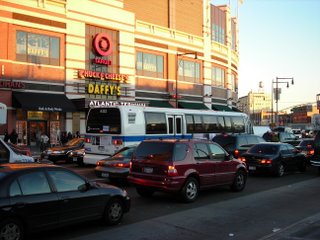
Atlantic Yards Report looks at the imagery of the Barclay's ads:
We see a full frontal of the Urban Room and Frank Gehry's Miss Brooklyn, with the tower at Site 5 (now home to P.C. Richard/Modell's) looming at right. The Urban Room is, notably, ad-free, though we can expect some striking, perhaps overwhelming, advertising.On the left, a piece of the facade of Forest City Ratner's Atlantic Terminal mall (without the Target and Chucke E. Cheese signage--see below), and a wedge of the Bank of New York Tower above it. In the center, the historic and restored (through already overwhelmed) Atlantic Avenue subway kiosk. And a whole bunch of traffic--perhaps a hint that critics' warnings might be worth a listen.
What's missing? The arena. Is that because it's such an innovative design, wrapped in four towers, and thus too tough to portray? Doubtful. Is it because the arena is less dramatic than Miss Brooklyn, from the outside? Who knows.
Is it because some of the buildings around the arena (including Miss Brooklyn) might be branded as part of the Barclays Center? Possibly.
Posted by amy at 2:56 PM
December 17, 2006
We've Got Some Questions
Develop Don't Destroy Brooklyn has a lot of questions and is unable to receive answers, even with Norman Oder's detective work and FOIA requests. Here's a taste:
QUESTION:
The proposed rezoning of the Lower East Side and East Village of Manhattan defines affordable housing with a income band cap at 80% of Area Median Income (AMI), or $56,000 for a household of four. Atlantic Yards has a cap of 160% of AMI, or $113,000 for a household of four. 51% of the “affordable” units in Atlantic Yards would be for households earning above 80% of AMI.-Why is the income cap so high in Brooklyn and so relatively low in Manhattan?...
QUESTION:
What is the total public cost of the project including both as-of-right and extraordinary costs?The ESDC memo summarizing the economic impact analysis of the project is incomplete and lacks a full accounting of the public costs. Without accounting for numerous, significant public costs, the net revenue projection is significantly overstated.
QUESTION:
What is the net revenue return for the city and state of New York (just this week it was disclosed that revenues have been cut by nearly 33% and still doesn't include substantial public costs)?The public has yet to see the developer’s 20-year pro forma financial projections, as required by the MTA’s RFP for the Vanderbilt Rail Yard (the competing bidder, Extell, submitted detailed projections. FCR’s submission to the MTA is here:
www.dddb.net/php/press/budget/proForma.gif

UPDATE! DDDB has found one answer:
Did you know that the public is paying entirely for the construction of the arena?Yes. Instead of paying property taxes, Forest City Ratner (FCR) will pay for the arena construction bond with Payments in Lieu of Taxes (PILOTS). How will FCR cover the costs of those PILOTS? Simple: with things like luxury box suites, concessions, arena advertising and arena naming rights. The developer puts up NO money for the arena construction. This is called a shell game.
Posted by amy at 7:42 PM
Opaque State Development Corporation
Develop Don't Destroy Brooklyn
A new, and unimproved, Empire State Development Corporation revised memo on an unreleased "independent economic impact analysis," was received by Atlantic Yards Report journalist Norman Oder yesterday. Oder found that the memo raises even more questions about the ESDC's transparency, methodology and, though he doesn't say so, their competence.
...
In this new memo, out of fear, the ESDC hides the revenue projects for the project option that includes much more commercial office space. In their first memo from October, that option's projections were included. What is clear is that the commercial heavy option provides a much greater return for the public but not nearly as good a return for the developer. To show those commercial tax revenue projections towering over the residential project option in a side-by-side comparison would glaringly illustrate that the ESDC is going with a project option that provides much less tax revenue for the public.There are so many inconsistencies between the first economic impact memo from October, this new revised memo and the modified General Project Plan approved December 8th. The contradictions are eye-popping and head-spinning. Numbers can often seem dry and complicated. But even so, these numbers are of critical importance when it comes to the PACB vote and the ESDC's credibility. If these memos are all the PACB has to go on, it makes no sense for them to vote on this project.
Posted by amy at 11:39 AM
December 16, 2006
New ESDC fiscal impact memo raises more questions than it answers
Atlantic Yards Report:
In a memorandum dated December 14 but released yesterday, the Empire State Development Corporation purports to offer “a more complete description” of the economic analysis that led to a drastic drop of $456 million in net projected Atlantic Yards revenue, but the agency leaves numerous questions unanswered.Notably, the memo does not explain why the agency changed its methodology in projecting a more than fivefold leap in city tax revenues from construction (even as the total tax revenue plummeted) nor a significant discrepancy between the revenues in the memo and in the General Project Plan (GPP).
Also, it doesn't explain why the ESDC changed the discount rate--the interest rate used in calculating the present value of expected benefits and costs—from 6% to 3%. (Given that a higher discount rate means a smaller present value of future cash flows, lowering the discount rate would increase the present value, perhaps overinflating even the lowered revenue figures the ESDC released this week.)
Nor does the memo explain why the ESDC corrected some apparent errors in the previous memo, issued October 18, including an agency assertion that “25% of visiting team players salaries is earned in New York City.” (There are 30 teams in the National Basketball Association.)
Posted by amy at 12:06 PM
December 15, 2006
Atlantic Yards a losing bet
The Brooklyn Papers
This week's BP editorial is troubled by the missing $435 million from the Atlantic Yards project proposal revenue projections:
If there was any doubt that Bruce Ratner’s Atlantic Yards mega-development would be a bad investment of billions of dollars in taxpayer subsidies, it was wiped away this week by new revelations that the project will generate far less tax revenue than promised just five months ago.
As The Brooklyn Papers reports this week, buried — not announced, but buried! — in a 2,000-page state document is the news that Ratner’s much-touted “economic engine for Downtown Brooklyn” is now projected to create $944 million in city and state tax revenues over the next 30 years.
Do the math: That means that the city and state — whose annual budgets are tens of billions of dollars — will see just $15 million a year in new revenues from Atlantic Yards.
And, they aren't buying Bruce Ratner's excuse:
Ratner has trimmed the commercial component of his project — which means fewer new jobs and, therefore, less tax revenue — but that was his plan all along. From Metrotech to Atlantic Center to Atlantic Terminal, Ratner has a track record of promising lots of new office jobs and then not delivering. His three office complexes are filled with public, taxpayer-funded offices — the ESDC itself is housed in Atlantic Center! — guaranteeing Ratner’s profit.
Bruce Ratner’s goal all along has been to float fantasy revenue projections so that politicians and the public would be wowed. But his shock and awe campaign has failed.
Posted by lumi at 7:40 AM
December 14, 2006
Nets arena to net less in taxes?
Field of Schemes
By Neil deMause
The mystery behind the incredible shrinking tax-revenue estimate got airplay on Field of Schemes yesterday, as Neil deMause tried to track down some answers:
More today on the Brooklyn Nets economic impact mystery from Norman Oder's Atlantic Yards Report: It seems that in the revised Atlantic Yards General Project Plan issued last Friday by the state-run Empire State Development corporation, it revised downwards the projected tax revenues from $1.9 billion to $1.4 billion, while also reducing the projected public cost from $545 million to $453 million. (Neither the new or old figures include costs of schools, sanitation, or other services for the several thousand new residents of the apartment towers that would accompany the Nets arena.)
Posted by lumi at 7:09 AM
December 13, 2006
The missing half-billion: ESDC cuts projected AY tax revenue by nearly one-third
 Atlantic Yards Report tries to figure out the mystery behind the incredible shrinking Atlantic Yards tax revenue figure:
The Empire State Development Corporation (ESDC) didn't shine a light on it, but nearly half a billion dollars in projected public revenues just vanished.
The revised Atlantic Yards General Project Plan (GPP) issued last Friday by the ESDC contains one very significant change from the document released in July. Projected net new tax revenues have plummeted by $456 million. That's almost a one-third decline from the $1.4 billion figure announced five months ago.
That's much more than a rounding error. And it vastly outpaces other changes regarding Atlantic Yards. After all, since July, the project's cost went down 5% (from $4.2 billion to $4 billion), and its size declined 8% (from 8.659 million square feet to 7.961 million sf).
So how could the revenues drop so much? The change calls into question the ESDC's methods, and its candor, since no supporting study has been released.
It may be worse
Even as the agency has modified its revenue projections to $944.2 million over 30 years, it has yet to acknowledge the full impact of subsidies and public costs that could cut deeply into the overall net revenue.
In other words, there are hundreds of millions of dollars in taxpayer costs--for affordable housing, public safety, schools, and sanitation--that further offset the net revenue. And those costs have not been fully disclosed, nor factored into the ESDC's analysis.
Posted by lumi at 9:10 AM
December 10, 2006
Stadiums/Arenas Are Profitable...but to Whom?
Don't Worry It's Just Reality: Brooklyn Edition gets in on the Gehry bashing weekend as well. Gehry must be feeling the heat like he's walking on the sidewalk in front of the Disney Concert Hall.
There are two trends in the sports industry that make building an arena in Brooklyn a bad idea:
a. franchises have little or no loyalty to existing fans - with the exception of places like Green Bay, owners use the threat to leave as a bargaining chip, and they frequently do leave.
b. because of this arenas and stadiums have much shorter life cycles -because those who use them don't have to pay for them. So it's not unlikely, in fact, it might even be expected that an arena over Vanderbilt yards would be an abandoned, ugly, impractical (the definition of a Gehry work) eyesore within ten years...and that will really be blight.
Posted by amy at 8:06 PM
December 7, 2006
City subsidies make little difference with AY?
Atlantic Yards Report
An article in the New York Observer this week, headlined No, No, No. Yes. The Mayor’s Curious Evolution on Public Money for Private Real Estate, sketches how Mayor Mike Bloomberg has come around on the issue of city support for private projects. The paragraphs relevant to Atlantic Yards:
A city economic-development official said that capital subsidies—or, rather, investments—serve another purpose. “It provides the type of upfront capital funding that is needed in the early stages of the project, when it might be hard to get that money from other sources,” the official said.
Thus, the city is pitching in $100 million for Atlantic Yards, even though that project is so gargantuan—$4.2 billion—that it’s hard to believe it will make a difference. Opponents of the project argue that the public could end up paying much more, through indirect subsidies and also because the memorandum of understanding calls on the city and state to “consider making additional contributions for extraordinary infrastructure costs.”
Au contraire mon frère, says Norman Oder, it's not just opponents who are making the point:
Actually, the Independent Budget Office toted up a long list of public costs, and the Empire State Development Corporation acknowledges both city and state costs.
The affordable housing subsidies, among other things, remain unknown. Indeed, three Assemblymembers recently warned “there has been, to date, no public disclosure of the project’s finances, including detailed cost analysis, anticipated public subsidies, and expected financial return."
Posted by lumi at 7:56 AM
November 22, 2006
Yankees Build Giant Dustbowl in Bronx
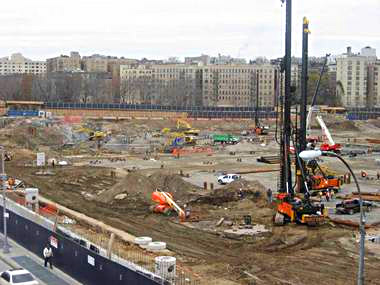 Power Plays (Political blog of The Village Voice)
By Neil deMause
It's four months past the groundbreaking for a new Yankees Stadium in the Bronx — what does the neighborhood have to show for it?
Dust from what used to be a park, traffic and noise from trucks starting at 6AM, pile driving and rats are all environmental impacts that were predicted for this residential community.
And what about those temporary ballfields that the City promised? The City has yet to solicit bids for their construction.
NoLandGrab: Years of adverse environmental impacts and delayed community benefits are some of the things Central Brooklynites, too, can expect if Atlantic Yards is approved.
Posted by lumi at 6:44 AM
November 14, 2006
It came from the Blogosphere...
 Two blogs covered the n+1 case for Atlantic Yards [NLG got in our shots last week.]
Daily Intelligencer, The Highbrow Case for Atlantic Yards
Was it possible, then, to be a pro-Yards guilty intellectual? Yes! Acceptance is just another twist of pretzel logic away, as demonstrated by the contrarian post-ironists at n+1. The stadium, writes Jonathan Liu, is a great idea precisely because it's all wrong for the borough.
Gawker, Literary Magazine Waxes Poetic About Atlantic Yards
"The authenticity of a place as volatile and heterodox as Brooklyn, and New York in general, lies in incongruity, the disorienting juxtaposition of century-old brownstones and Gehry's warped, twisting towers." Purty-soundin', yes, but all the grad-school adjectives in the world won't sell us on the desirability of a massive new development that can't be supported by the neighborhood's infrastructure.
The Real Estate Observer, Voters Pan Arena Subsidies
REO points to Michael O'Keeffe's column in this weekend's Daily News for a good anti-multi-million-dollar-subsidies-for-rich-team-owners-slash-overdevelopers rant.
Brownstoner, Making Atlantic Yards a Black-and-White Issue
The map that ran with the Atlantic Yards article in yesterday's Times was pretty neat. Not that the results were particularly surprising (they were about what you'd expect) but it was particularly interesting for us to see that Fort Greene and Clinton Hill, which get so much press for being so racially mixed are still predominantly black on a pure numbers basis. As for the article, it wasn't much fun being reminded of the appalling amount of race-baiting that's gone on in battle for the hearts and minds of Brooklyn residents over the Atlantic Yards issue.
Gumby Fresh, Welcome To Brooklyn, Ya Limey Fruits
An anti-Markowitz rant gets in some pot shots on Atlantic Yards and offers her Majesty's subjects a real tour of Brooklyn.
Posted by lumi at 6:50 AM
November 12, 2006
We're not going to take it... anymore!

Daily News
Michael O'Keeffe covers this week's public financing of sports teams and eminent domain ballot initiatives smackdown with flair, calling billionaire sports team owners "corporate welfare queens."
Because New York state politics is more banana republic than Jeffersonian republic, New York voters haven't been given the opportunity to approve or deny Ratner public money and infrastructure for his project. Instead, we have Mayor Bloomberg and Brooklyn Borough President Marty Markowitz telling us we're selfish yuppies because we're concerned about the environmental impact of the Atlantic Yards. Instead we have architect Frank Gehry - who elected him? -tell us we're Luddites if we don't embrace his designs. And we've only been given scant opportunity to engage in honest dialogue and ask real questions: How much will Ratner make on this deal? Is there a better site for the Atlantic Yards? Is there a better plan for the Brooklyn rail yards?But Tuesday's election made one thing crystal clear: It's no longer easy to convince Americans to write blank checks - whether for Halliburton or the NBA.
Posted by amy at 10:57 AM
On Election Day, billionaire team owners looking for taxpayer handouts had it just as rough as the GOP.
Salon.com
King Kaufman's Sports Daily covers initiatives across the country that opened a "cannawhoopass" on "billionaire sports team owners looking for welfare to build stadiums and arenas" this week.
Seattle voters overwhelmingly passed Initiative 91, called the anti-Sonics initiative in some circles. It requires that any city tax dollars invested in a stadium or arena yield a profit at least equal to the return on a 30-year U.S. Treasury bond, which at the moment is a little under 5 percent.
...
There's nothing preventing the Sonics and Storm from staying in Seattle other than the desire to soak the taxpayers. Bennett and his partners can finance a new arena themselves, and the new law says nothing about county or state taxes, though Chris Van Dyk, who leads the group Citizens for More Important Things, which spearheaded the I-91 campaign, all but dared the teams to try that route.
...
Meanwhile, Sacramento voters soundly rejected a quarter-cent increase in the sales tax that would have paid for a new arena for the Maloof brothers and their team, the Kings.
Posted by amy at 10:42 AM
November 6, 2006
It came from the Blogosphere...
 Manhattan Real Estate Report, Artists weigh in on Brooklyn's changing real estate
On the two art exhibits covering Atlantic Yards:
They should call it Art-lantic Yards.
Left Behinds, Going to the well once too often
The local-news-and-politics blog posted running commentary on The Brooklyn Papers article on the IRS crackdown on Payments in Lieu of Taxes and what it could mean for Bruce Ratner's Atlantic Yards. (PG-13)
Streets Blog,
Transit-Oriented Development Forum
The transpo- and liveable-city blog dubs the Atlantic Yards Report blogger, "Norman 'The Human Tape Reco’der' Oder," and sends readers to Oder's account of the TOD forum. Almost as interesting as the forum is a point made in the comments section:
They key thing is street-oriented development, designed to blend into the city and be friendly and accessible to pedestrians. But that’s much harder than just putting something next to a train station.
New Market Machines, NMM The Running-Dog Rentier
NMM sends readers to Atlantic Yards Report, which the writer calls, "simply one of the best one-note samba public policy blogs I know of."
After a bit of contemplation about rising rents in his neighborhood, NMM envisions what he would do when locked out of his apartment in a post-Atlantic Yards world:
Sit on my stoop and play Tetris until the batteries run out, I guess. And blog about how miserable I am, and how short-sighted I was to hitch my wagon to Bruce Ratner, billionaire basketball humanist.
Property Grunt, The politics are dancing
One real estate blogger jumps the gun on the effect that Atlantic Yards critics are having on "Visionary" Bruce Ratner, though he makes a good point about local politics:
Bloomberg has displayed how politics can be used to encourage development and Bruce Ratner is an example of how even a man of his stature can be reigned in by those who have only their voices to fight with. Whether you are a developer or a just a homeowner, it is imperative to be aware of the politics of your neighborhood since it will either benefit or destroy your project.
Posted by lumi at 11:54 AM
November 4, 2006
Friday: Chelsea Artworld 'Streetwalkers'! Plus, Redesigning Design
The Real Estate
Max Abelson
The math is a bit complex, but Brooklyn Paper reports that the IRS will be foiling Bruce Ratner's "sweetheart deal" for the Atlantic Yards. Developers have long enjoyed a tax scheme called PILOT--payments in lieu of taxes--in which those "payments" are quite petite. PILOTs were bestowed upon the Mets and the Yanks for their new digs, but will it now be taken from Bruce and the Nets?
Posted by amy at 11:53 AM
November 2, 2006
Bond bombshell
IRS would hike Ratner’s Yards cost
Experts: New rules could scare off investors
The Brooklyn Papers
By Ariella Cohen
Bruce Ratner’s sweetheart deal may be about to turn sour — thanks to the IRS.
Just in time for the final approval of Ratner’s Atlantic Yards project, the Internal Revenue Service has proposed the reform of a development-friendly tax program — a bond-financing scheme that happens to provide a funding foundation for Atlantic Yards.
The program under scrutiny is called “payments in lieu of taxes,” or PILOTs. Using PILOTs, a city can take land off the tax rolls in exchange for fixed rent-like payments — but the payments are typically less than property taxes and, in Ratner’s case, would not even end up in the city’s coffers.
NoLandGrab: PILOTs were created when the IRS outlawed Tax Increment Financing (TIFs), which was created to get around public approval for bond issues. How much you wanna bet that someone has already figured out a new way to publicly finance private projects, along with a new acronym to boot?
Posted by lumi at 11:17 PM
November 1, 2006
In Shift, Newark Mayor Backs Hockey Arena After Team Agrees to Offer Local Aid
The NY Times
By Andrew Jacobs
After months of negotiations with the owner of the Devils, [Newark Mayor Corey Booker] held a news conference to trumpet a series of modest concessions he had wrung from the team, which will move next year from the Meadowlands to the $365 million stadium that is rapidly taking shape a few hundred yards from City Hall.
Basically, Mayor Booker negotiated community benefits even after ground had been broken. He also rolled out the welcome mat for Bruce Ratner's NJ Nets:
The Booker administration would also love to lure the Nets basketball team if plans for a new home in Brooklyn come to naught.
Posted by lumi at 8:16 AM
October 25, 2006
our development subsidy panel - watch and listen online
Drum Major Institute Blog
In case you missed DMI's Marketplace of Ideas panel last month - or if you're doing research for your own brilliant blog post - check out the audio and video we have of the panel now on the DMI website.
Norman Oder already posted on this forum (link). However, if you are interested in learning more about holding companies, like Forest City Ratner, accountable for public subsidies, and the wisdom of using public money for sports venues, you may want to check it out.
Everyone on the panel from good government advocate Assemblyman Brodsky to crusading New York Daily News collumist [sic] and Atlantic Yards supporter Errol Lewis was extremely passionate and pointed in their discussion.
Posted by lumi at 7:53 AM
October 21, 2006
"Gentrification subsidy": proposed 421-a reform seems tentative

Atlantic Yards Report
A city task force has issued recommendations to modify the 421-a tax break in order to generate at least $200 million for affordable housing.
...
Currently, developers who get tax breaks in the 421-a exclusion zone--Manhattan from 14th Street to 96th Street and the Greenpoint-Williamsburg waterfront--must include at least 20 percent affordable housing. The program would expand to parts of Harlem, Lower Manhattan, DUMBO, Brooklyn Heights, and parts of the Brooklyn/Queens waterfront.In other words, there would be no requirement to build affordable housing on the non-railyard blocks of the proposed Atlantic Yards site.
Posted by amy at 8:22 AM
New IRS bond regs could affect Nets arena
Field of Schemes
The Yanks and Mets bonds are long since sold, but the new IRS regs could come into play for the proposed Brooklyn Nets arena, which would use a similar tax-exempt bond plan. Matthew Schuerman of the New York Observer goes so far as to speculate that they may "imperil" the entire Atlantic Yards finance plan, but really, this is just a matter of forcing Ratner (or the public) to pay more to borrow the funds for it. Though it's worth recalling that this same problem - that bond buyers want to know where their money is coming from - is the same one that forced the New York Jets' Manhattan stadium plan to switch from tax-increment financing to fixed PILOT payments back in 2003. At what point might Atlantic Yards be too rich for Ratner's blood? That's between the man and his fleet of accountants.
Posted by amy at 8:13 AM
October 20, 2006
IRS Haunts Stadium Deals
To get around having the public vote on bond debt for sports venues, local governments came up with Tax Incremental Financing (TIFs). The IRS struck down TIFS, so to get around that, local governments came up with Payments in Lieu of Taxes (PILOTS). Now it looks like the IRS isn't buying that one either.
From The Real Estate Observer:
The IRS is planning to revisit the financing scheme behind the new Yankees and Mets stadiums because, according to sources cited by The Bond Buyer, the arrangements looked "too much like a private loan."
What's the big deal? The new regulations will drive to the heart of the question about whether cities should be allowed to use their power to issue tax-exempt bonds for the benefit of privately owned sports franchises (which don't even make it into the World Series, to boot). And the new rules may imperil Forest City Ratner's deal to finance the Nets arena.
Posted by lumi at 7:08 PM
September 25, 2006
No real winners in sport facility fights
Metro NY
By Jason Notte
To some, the facilities are an economic boon that can bring jobs and improved quality of life to their respective areas. For others, the buildings will seem like scars left by the deep, angry wounds opened by their construction.
...
These battles end up being much like the sports themselves — in the end, someone has to lose. For the competing sides in this conflict, however, there is no next season — no “wait ‘til next year.” When the stakes are no less than people’s homes and livelihoods, losing isn’t an option — and the wounds suffered don’t heal in the off-season.
Documentary filmmaker, Jevon Roush, observes:
“Grassroots organizations that sprung up [around the West Side Stadium] were very fortunate to have Cablevision behind them,” Roush said. “That the organizations in Brooklyn don’t have that is surprising... considering that given the state of the Knicks, we’ll all be Nets fans if they move in.”
NoLandGrab: Roush is discounting the likelihood that once the NBA franchise owners voted to approve the Nets' move to Brooklyn, the owners of the Knicks are prohibited by their NBA franchise agreement from fighting the move.
Posted by lumi at 6:17 AM
September 21, 2006
Getting our money’s worth with Atlantic Yards? Few care, and here’s why
Atlantic Yards Report reports from the Drum Major Institute's forum on holding government and corporations accountable for public subsidies:
Who can oppose economic development, projects that bring--as Atlantic Yards proponents say--jobs, housing, and opportunity? But when major governmental subsidies are involved, the question gets more complicated. As former state Comptroller Carl McCall put it on Monday, “Somewhere along the way, someone has to say, ‘Are we getting our money’s worth?’”
The question hasn’t really been answered regarding the AY plan, but it’s not clear that anyone—besides a few civic groups and a journalist or two—is really asking. The panel discussion that McCall introduced, held at the Harvard Club by the Drum Major Institute, described a dysfunctional discourse in New York about such important civic issues. Reforms achieved in Minnesota, thanks to pressure from groups including unions, seem elusive here.
At the discussion, the most prolific journalistic defender of Atlantic Yards, Errol Louis of the Daily News, was chastised by Assemblyman Richard Brodsky for lacking a "principled response" to the general issue of subsidies.
Posted by lumi at 7:16 AM
September 9, 2006
Ratner's Nets arena project is housing-optional
Field of Schemes takes a look at Matthew Schuerman's recent article in the New York Observer:
"Phased construction" has actually been a byword of the project since the very first press conference, but according to Mr. Schuerman, even the "community benefits" package agreed to with the housing group ACORN allows that "the developers may change the development phases in their sole discretion prior to commencement of the first development phase." Brennan is pushing for Ratner to sign a binding lease with the state to guarantee that the housing will be built, while shrinking the overall size of the project by 34% - in exchange for $590 million in additional state subsidies.At least one fence-straddling local pol, famed white guy running for Congress in an African-American district David Yassky, took exception to this, and specifically the possibility that Ratner may have artificially boosted the project's size just to create leverage for more public cash. "It's typical of Forest City Ratner to inflate projections in order to get more public money from of the state," Yassky spokesperson Evan Thies told the Brooklyn Papers. "It's a deceitful way of doing business, and they should be committed to a project that works and can be vetted to the community."
Posted by amy at 10:00 AM
August 19, 2006
Gaps in ESDC's fiscal impact study: another look at unmentioned costs
Atlantic Yards Report looks at ESDC's estimate of $545 million in public contribution to the Atlantic Yards proposal. For starters, there is "no evidence that the ESDC is including public costs for schools, sanitation, and public safety.":
Public cost: over $1 billion?Not including DDDB's numbers or the "green building" credits, the ESDC's calculations still require major adjuetments. Assuming that the other subsidies have been expressed in present value, it's possible that the $292.9 million in tax exemptions and $76 million in housing subsidies should be added to the total of $726.2 million. That would increase the public cost to well over $1 billion.
And the net fiscal impact would not be $1.4 billion but $778 million.
That still sounds like a significant sum, but that's 44 percent less than the ESDC estimate.
Posted by amy at 11:09 AM
August 10, 2006
Bruce Ratner must be stopped
Stellavision says Atlantic Yards critics pretty much have it wrong. Bruce Ratner must be stopped NOT because of lack of a democratic process or because he would ruin the neighborhood.
Conservatives are seeing red because Atlantic Yards would be a terrible use of taxpayer money and eminent domain.
It has to be stopped because it's using taxpayer money. (If Bruce Ratner can't make a profit on his own funds alone, why should I, or anybody else, be forced to help him?) It has to be stopped because people living on 13 acres of the proposed footprint are to be booted out via eminent domain. (Cavalier violation of property rights.)
NoLandGrab: While Ratner has tried to split the community, the project curiously manages to unite progressives and conservatives.
Nationally, the conservative-progressive split over property rights is slowly being bridged, as bleeding-heart liberals are beginning to realize that low-income/inner-city neighborhoods are most vulnerable to eminent domain abuse.
The affordable-housing debate is also an interesting one, and it's temporarily bringing together both sides over Atlantic Yards. Conservatives favor free markets and believe that the market can provide housing for all income levels; progressives are concerned that a majority of the available subsidies for affordable housing will be going to a single privately owned project that stands to make over a billion dollars in profit for a company in Cleveland.
There's more, but I'll leave it at that. Suffice it to say, NoLandGrab.org isn't promoting one side over the other, but regardless of your worldview, the upside primarily goes to the developer, Bruce Ratner.
Posted by lumi at 7:13 AM
July 26, 2006
Yankee Lobbyists on Taxpayers' Tab
The Village Voice
By Neil deMause
File this under "unbelievable, but true," in the category "Public Funding of Stadiums:"
City documents newly uncovered by the Voice reveal that the New York Yankees billed city tax-payers hundreds of thousands of dollars for the salaries of team execs and high-powered consultants to lobby the city and state, thanks to the team's sweetheart lease deal engineered by the Giuliani administration.
...
The Yankees are apparently taking advantage of a clause in their lease with the city that allows "planning costs" of their new $1.3 billion stadium—groundbreaking for which could take place as soon as next week—to be deducted from the team's rent.
Amazingly, one of these taxpayer-funded lobbyist has also worked for Ratner:
The city even apparently paid the Yankees to lobby the city itself. Another recipient of city money, via the Yankees, was the law firm Fried, Frank, Harris, Shriver & Jacobson, which, according to the New York City clerk's lobbyist database, has served as a registered lobbyist for both Tishman Speyer, the Yankees' project managers for the stadium, and the Yankees themselves. (Tishman's $1.9 million in 2004 was the number one billable item in the stadium planning account.) Working on the Yankee account, the documents show, was land-use lawyer and lobbyist Stephen Lefkowitz: The son of longtime state attorney general Louis Lefkowitz, he has been involved with nearly every major development project in recent city history, including Battery Park City, the Time Warner Center, the attempts to build a new New York Stock Exchange and a Manhattan Jets stadium, and Bruce Ratner's Metrotech and Atlantic Yards projects.
...
Skeezy as all this may be, lobbying experts say it's unlikely that any of it is illegal.
Posted by lumi at 8:15 AM
July 25, 2006
Letter to the editor: Taxpayers shouldn’t pay for Nets arena
Metro NY
LARRY PENNER • Great Neck
Aside from placing the proposed Nets arena in "downtown Brooklyn" (if built, the arena would be near "downtown" in Prospect Heights), our region's most prolific letter-to-the-editor writer Larry Penner, makes some good points and asks some serious questions about taxpayer-funding of Ratner's Atlantic Yards plan.
Regarding “Protesters: Arena on slippery slope” (July 17): The article concerning developer Bruce Ratner’s plans to build a new stadium for the Nets in downtown Brooklyn was most informative.
In too many cases, projects like this one have been heavily subsidized by taxpayers, commonly known as corporate welfare. Between direct government funding, indirect infrastructure improvements, low interest loans and long-term tax exemptions — the bill to taxpayers ends up being greater than the benefits. There also is a relationship between pay-to-play campaign contributions from developers to elected officials looking for favorable legislation, permits, subsidies and support. Is there any relationship between these donations to elected officials and their reciprocal endorsement of this project?
If the Atlantic Yards project is so worthwhile, shouldn’t major developers such as Ratner be able to finance it using his own funds, obtain loans from banks, issue stocks or bonds? Why the need to pick the pockets of taxpayers to pay a significant portion of the bill? Real business people who believe in capitalism build their companies on their own. How sad that some don’t want to do it the old-fashioned way: sweat and hard work. They are looking for shortcuts in the form of huge subsidies at taxpayers’ expense and favors from elected officials.
Posted by lumi at 12:16 PM
July 4, 2006
Eminent Domination Without Representation
Eleven score and ten years ago today (230 yrs.), 57 property/business owners declared that they were fed up with King George III of England and his failure to act in the best interests of his citizen-subjects.
At the risk of being labeled "screamers" and "kooks," these 57 men volunteered to represent their communities and publicly executed a radical and politically risky move. They pledged their lives and fortunes to fight against what was essentially a "done deal:" the arbitrary rule of law and the manipulation of legislatures to serve the purposes of a despotic power.
On this anniversary of the signing of the Declaration of Independence, we offer you a transcript of the document (after the jump), so that you may ponder the contemporary significance of the usurpations of a despot who refused to allow local citizens to determine issues that directly affected their lives, liberty and pursuit of happiness.
As you consider the "Declaration of the thirteen united States of America," your thoughts may drift towards more recent events concerning a major land-use headache in Central Brooklyn (where, coincidentally, the first major battle of the War for Independence was fought): * NY State's takeover, with Mayor Bloomberg's consent, of local zoning, land use and environmental review (in other words, putting an arena and 16 towers at an already congested intersection — economic, health and quality-of-life concerns be damned), * Eminent domain seizures without legislative oversight (no legislators get to vote if the project is under NY State jurisdiction), * Manipulations of the rule of law to serve the purpose of the politically connected (i.e. "emergency" demolitions, the inevitable finding of "blight" to justify private property condemnation), * Approval of the largest single-source development project in the history of NYC placed in the hands of un-elected representatives of the three most powerful men in Albany, * The spending of our tax dollars on Bruce Ratner's private development, with taxes generated by the project earmarked to the servicing of Bruce Ratner's mortgage on the property, * Government officials ignoring the petitions of redress by their subjects/citizens.
The Declaration of Independence: A Transcription
IN CONGRESS, July 4, 1776.
The unanimous Declaration of the thirteen united States of America,
When in the Course of human events, it becomes necessary for one people to dissolve the political bands which have connected them with another, and to assume among the powers of the earth, the separate and equal station to which the Laws of Nature and of Nature's God entitle them, a decent respect to the opinions of mankind requires that they should declare the causes which impel them to the separation.
We hold these truths to be self-evident, that all men are created equal, that they are endowed by their Creator with certain unalienable Rights, that among these are Life, Liberty and the pursuit of Happiness.--That to secure these rights, Governments are instituted among Men, deriving their just powers from the consent of the governed, --That whenever any Form of Government becomes destructive of these ends, it is the Right of the People to alter or to abolish it, and to institute new Government, laying its foundation on such principles and organizing its powers in such form, as to them shall seem most likely to effect their Safety and Happiness. Prudence, indeed, will dictate that Governments long established should not be changed for light and transient causes; and accordingly all experience hath shewn, that mankind are more disposed to suffer, while evils are sufferable, than to right themselves by abolishing the forms to which they are accustomed. But when a long train of abuses and usurpations, pursuing invariably the same Object evinces a design to reduce them under absolute Despotism, it is their right, it is their duty, to throw off such Government, and to provide new Guards for their future security.--Such has been the patient sufferance of these Colonies; and such is now the necessity which constrains them to alter their former Systems of Government. The history of the present King of Great Britain is a history of repeated injuries and usurpations, all having in direct object the establishment of an absolute Tyranny over these States. To prove this, let Facts be submitted to a candid world.
He has refused his Assent to Laws, the most wholesome and necessary for the public good.
He has forbidden his Governors to pass Laws of immediate and pressing importance, unless suspended in their operation till his Assent should be obtained; and when so suspended, he has utterly neglected to attend to them.
He has refused to pass other Laws for the accommodation of large districts of people, unless those people would relinquish the right of Representation in the Legislature, a right inestimable to them and formidable to tyrants only.
He has called together legislative bodies at places unusual, uncomfortable, and distant from the depository of their public Records, for the sole purpose of fatiguing them into compliance with his measures.
He has dissolved Representative Houses repeatedly, for opposing with manly firmness his invasions on the rights of the people.
He has refused for a long time, after such dissolutions, to cause others to be elected; whereby the Legislative powers, incapable of Annihilation, have returned to the People at large for their exercise; the State remaining in the mean time exposed to all the dangers of invasion from without, and convulsions within.
He has endeavoured to prevent the population of these States; for that purpose obstructing the Laws for Naturalization of Foreigners; refusing to pass others to encourage their migrations hither, and raising the conditions of new Appropriations of Lands.
He has obstructed the Administration of Justice, by refusing his Assent to Laws for establishing Judiciary powers.
He has made Judges dependent on his Will alone, for the tenure of their offices, and the amount and payment of their salaries.
He has erected a multitude of New Offices, and sent hither swarms of Officers to harrass our people, and eat out their substance.
He has kept among us, in times of peace, Standing Armies without the Consent of our legislatures.
He has affected to render the Military independent of and superior to the Civil power.
He has combined with others to subject us to a jurisdiction foreign to our constitution, and unacknowledged by our laws; giving his Assent to their Acts of pretended Legislation: For Quartering large bodies of armed troops among us:
For protecting them, by a mock Trial, from punishment for any Murders which they should commit on the Inhabitants of these States:
For cutting off our Trade with all parts of the world:
For imposing Taxes on us without our Consent:
For depriving us in many cases, of the benefits of Trial by Jury:
For transporting us beyond Seas to be tried for pretended offences
For abolishing the free System of English Laws in a neighbouring Province, establishing therein an Arbitrary government, and enlarging its Boundaries so as to render it at once an example and fit instrument for introducing the same absolute rule into these Colonies:
For taking away our Charters, abolishing our most valuable Laws, and altering fundamentally the Forms of our Governments:
For suspending our own Legislatures, and declaring themselves invested with power to legislate for us in all cases whatsoever.
He has abdicated Government here, by declaring us out of his Protection and waging War against us.
He has plundered our seas, ravaged our Coasts, burnt our towns, and destroyed the lives of our people.
He is at this time transporting large Armies of foreign Mercenaries to compleat the works of death, desolation and tyranny, already begun with circumstances of Cruelty & perfidy scarcely paralleled in the most barbarous ages, and totally unworthy the Head of a civilized nation.
He has constrained our fellow Citizens taken Captive on the high Seas to bear Arms against their Country, to become the executioners of their friends and Brethren, or to fall themselves by their Hands.
He has excited domestic insurrections amongst us, and has endeavoured to bring on the inhabitants of our frontiers, the merciless Indian Savages, whose known rule of warfare, is an undistinguished destruction of all ages, sexes and conditions.
In every stage of these Oppressions We have Petitioned for Redress in the most humble terms: Our repeated Petitions have been answered only by repeated injury. A Prince whose character is thus marked by every act which may define a Tyrant, is unfit to be the ruler of a free people.
Nor have We been wanting in attentions to our Brittish brethren. We have warned them from time to time of attempts by their legislature to extend an unwarrantable jurisdiction over us. We have reminded them of the circumstances of our emigration and settlement here. We have appealed to their native justice and magnanimity, and we have conjured them by the ties of our common kindred to disavow these usurpations, which, would inevitably interrupt our connections and correspondence. They too have been deaf to the voice of justice and of consanguinity. We must, therefore, acquiesce in the necessity, which denounces our Separation, and hold them, as we hold the rest of mankind, Enemies in War, in Peace Friends.
We, therefore, the Representatives of the united States of America, in General Congress, Assembled, appealing to the Supreme Judge of the world for the rectitude of our intentions, do, in the Name, and by Authority of the good People of these Colonies, solemnly publish and declare, That these United Colonies are, and of Right ought to be Free and Independent States; that they are Absolved from all Allegiance to the British Crown, and that all political connection between them and the State of Great Britain, is and ought to be totally dissolved; and that as Free and Independent States, they have full Power to levy War, conclude Peace, contract Alliances, establish Commerce, and to do all other Acts and Things which Independent States may of right do. And for the support of this Declaration, with a firm reliance on the protection of divine Providence, we mutually pledge to each other our Lives, our Fortunes and our sacred Honor.
The 56 signatures on the Declaration appear in the positions indicated:
Column 1
Georgia:
Button Gwinnett
Lyman Hall
George Walton
Column 2
North Carolina:
William Hooper
Joseph Hewes
John Penn
South Carolina:
Edward Rutledge
Thomas Heyward, Jr.
Thomas Lynch, Jr.
Arthur Middleton
Column 3
Massachusetts:
John Hancock
Maryland:
Samuel Chase
William Paca
Thomas Stone
Charles Carroll of Carrollton
Virginia:
George Wythe
Richard Henry Lee
Thomas Jefferson
Benjamin Harrison
Thomas Nelson, Jr.
Francis Lightfoot Lee
Carter Braxton
Column 4
Pennsylvania:
Robert Morris
Benjamin Rush
Benjamin Franklin
John Morton
George Clymer
James Smith
George Taylor
James Wilson
George Ross
Delaware:
Caesar Rodney
George Read
Thomas McKean
Column 5
New York:
William Floyd
Philip Livingston
Francis Lewis
Lewis Morris
New Jersey:
Richard Stockton
John Witherspoon
Francis Hopkinson
John Hart
Abraham Clark
Column 6
New Hampshire:
Josiah Bartlett
William Whipple
Massachusetts:
Samuel Adams
John Adams
Robert Treat Paine
Elbridge Gerry
Rhode Island:
Stephen Hopkins
William Ellery
Connecticut:
Roger Sherman
Samuel Huntington
William Williams
Oliver Wolcott
New Hampshire:
Matthew Thornton
Source: http://www.archives.gov/national-archives-experience/charters/declaration_transcript.html
Posted by lumi at 8:01 AM
June 26, 2006
Newark Takes a Hard Lesson In the Pro Stadium Game
New York Sun
By EVAN WEINER
James finally signed a deal with the Devils last fall after years of negotiating with New Jersey Nets ownership to move the NBA team to Newark. When Bruce Ratner decided to move his Nets to a proposed arena in Brooklyn, James turned to Vanderbeek, who still expects the building to open its doors in the fall of 2007. It’s unknown what would happen to the Devils if Booker terminates the deal.
...
You might think a city as rich with business opportunities as New York would be immune to this sort of predicament. But at the height of the West Side Stadium battle last year, Mayor Bloomberg said that if the city failed to build the stadium, it would deter businesspeople who want to invest with the city. The West Side stadium was killed by Assemblyman Sheldon Silver about a year ago, but life went on, and Bloomberg quickly announced that the city would partner with George Steinbrenner to build a new stadium for the Yankees and with Fred Wilpon to construct a new Mets facility.It would not be surprising to see Bloomberg and New Jersey Nets owner Bruce Ratner use the same mantra in boosting the Ratner-proposed Brooklyn Arena project at the Atlantic Yards. If Ratner’s plans to build an arena for his Nets is eventually shot down, it will send out a bad message to those who want to do business in New York: You can’t trust New York to follow through.
Posted by amy at 7:57 AM
June 25, 2006
Phantom Project Pork
Develop-
don't destroy
BROOKLYN
For Immediate Release
State Finalizes $100 Million Appropriation for Highly Speculative Ratner "Atlantic Yards" ProposalBROOKLYN, NY—The New York Post reported today that the Governor, Assembly and Senate have finalized an agreement to appropriate $100 million for Forest City Ratner's proposed "Atlantic Yards" development in Prospect Heights and Park Slope, Brooklyn. The 8.7 million square foot development proposalincluding 16 skyscrapers and a 20,000 arena in a low-rise residential communityis the largest single-source development proposed in the history of New York City.
The city has already approved $100 million for the proposal but the $200 million city and state total is just the tip of the iceberg. The developer claims the project would cost the public $1.1 billion while a study done by project opponents, Develop Don't Destroy Brooklyn (DDDB), shows that the total public cost could reach $2 billion or more.
The appropriation has come before the public and elected officials even know what exactly the project is, what its total public cost would be, what its return would be, what the environmental impact would be and if those impacts could be mitigated. The appropriation also comes without any public disclosure by Forest City Ratner of its profit-loss statement, and before the state mandated environmental review has even begun.
Posted by amy at 8:49 PM
Nets arena taps $100m, sun's life-giving rays
Field of Schemes
The state of New York has approved $100 million in subsidies for developer Bruce Ratner's Atlantic Yards project, which would include a Brooklyn basketball arena for the New Jersey Nets, according to the New York Post. The money, said the Post, was included in a last-day-of-session budget agreement - the New York legislature loves to vote on controversial bills then skip town before anyone notices - by which "Gov. Pataki set aside $34 million of economic-development pork money he controls, while the Assembly and Senate committed $33 million each." Presumably this means that the money is coming out of various discretionary funds, instead of via the normal budget process - I'll see what I can find out once legislators are back in their offices tomorrow.
Posted by amy at 8:44 PM
June 24, 2006
TEAM 'NETS' $100M IN AID
New York Post
The New Jersey Nets got an assist yesterday from the state in their bid to move across the river to Brooklyn.A budget agreement approved yesterday contains $100 million in capital funds for the controversial $3.5 billion Atlantic Yards project.
Gov. Pataki set aside $34 million of economic-development pork money he controls, while the Assembly and Senate committed $33 million each.
Posted by amy at 7:49 AM
June 19, 2006
REFORMING PUBLIC AUTHORITIES
Gotham Gazette
Two NY State agencies are involved in Bruce Ratner's Atlantic Yards proposal: the MTA, which agreed to sell the railyards to Ratner, despite the developer's low bid; and the Empire State Development Corporation, the "collaborating" agency that's handling the environmental review and approval process.
NY State's quasi-governmental corporations have long been the subject of scrutiny. These agencies act independently of the State Legislature, creating boondoggles for the politically connected, taking on additional debt and being held accountable to no one but the politicians who appoint the board members.
In 2005, the state enacted some measures to reform the authorities. But a report issued last month by the Commission on Public Authority Reform, known as the Millstein Commission after its chair Ira Millstein, said much more remained to be done. And some critics say even that panel did not go far enough. At a recent panel discussion, several experts discussed the problems with authorities and what could be done to fix them.
Posted by lumi at 2:52 PM
June 18, 2006
More Taxpayer Funded Boondoggles
from Develop Don't Destroy:
Forest City Ratner is not the only developer building luxury condos off the taxpayer's back. Magic is in Fort Greene, the Clarett Group is in Fort Greene; developers all over the city are taking advantage of the misguided and abused 421a tax break, while Forest City takes advantage of nearly every tax break and subsidy known to all of developer-kind.
Posted by amy at 9:45 AM
June 15, 2006
Booker to reevaluate Newark arena deal
Incoming Newark Mayor Corey Booker is fulfilling his campaign pledge to reevaluate the NJ Devils arena deal for Downtown Newark.
Home News Tribune [Central Jersey], Newark's Booker 1, arena 0
AP via Myrtle Beach Sun News, Booker reevaluating new downtown arena with eye on costs
Posted by lumi at 7:08 AM
June 10, 2006
Payback? Yassky asks City Council to give BUILD $3M to fulfill Ratner's CBA
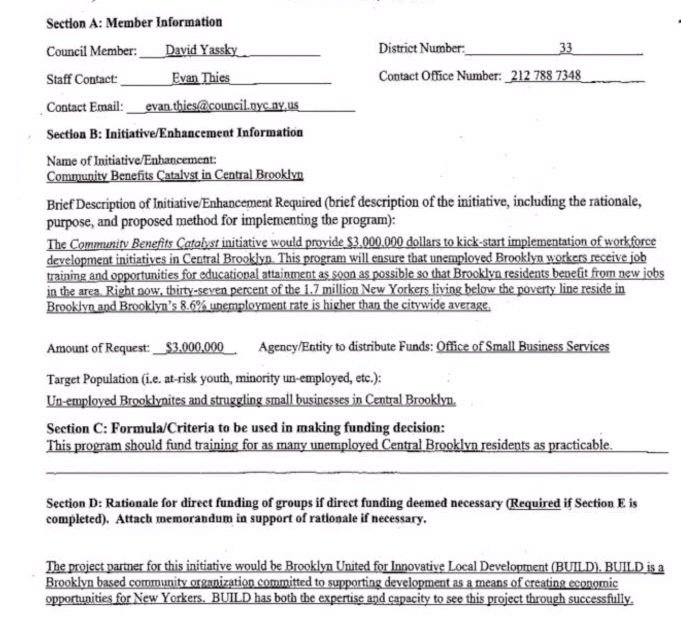
Atlantic Yards Report:
It looks a lot like payback. Council Member David Yassky, the only white candidate (of four Democrats) in a heated campaign to win the open seat in the black majority 11th Congressional District, on May 7 announced the support of several community activists, including three signatories to the controversial Atlantic Yards Community Benefits Agreement, or CBA. (None of the three, who are black, were identified in Yassky’s press release as associated with the organizations that signed the CBA.) Within ten days, Yassky filed a City Council Priorities Request asking taxpayers to send $3 million for job training to Brooklyn United for Innovative Local Development (BUILD), the most controversial of the CBA signatories, which is headed by James Caldwell, one of those supporters at Yassky’s press conference.
This information should provide some interesting fodder for Al Vann's Stop Yassky meeting.
Posted by amy at 9:39 AM
June 7, 2006
Brownfield bucks for Vanderbilt Yards?
 Today’s Crain's reports (emphasis added):
On May 12, the EPA gave the city a portion of its $69.9 million Brownfield grants, which are used to restore contaminated sites around the country. New York City is using a $750,000 loan fund grant to leverage private investment in the New York Metro Brownfields Redevelopment Fund; $400,000 for the Broadway Triangle in Williamsburg and the Atlantic Terminal Urban Renewal area in Brooklyn.
NoLandGrab: Is this money going towards brownfield cleanup of portions of Bruce Ratner's Atlantic Yards plan that fall within the boundaries of the Atlantic Terminal Urban Renewal Area (ATURA)? [See map, Atlantic Yards/ATURA overlap in orange and blue.]
Local activists note that the project has yet to be approved.
Posted by lumi at 8:31 AM
May 20, 2006
Bill: State should pay Bruce to build less at A’Yards site
Brooklyn Papers Gersh Kuntzman
To compensate Ratner for the smaller project, Brennan’s bill would give the developer the Atlantic Yards site for free, rather than charging him $100 million for it. The MTA had appraised the site at $214 million.In addition, Brennan’s bill would relieve Ratner of his obligation to renovate the Long Island Rail Road yard, saving him another $200 million, the assemblyman said.
Brennan’s bill would also require the state — rather than Ratner himself — to subsidize the 50-percent of the project that Ratner agreed to set aside as affordable housing.
“This bill is like negotiating with a hijacker,” said Daniel Goldstein, spokesman for the anti-Atlantic Yards group, Develop Don’t Destroy Brooklyn.
Posted by amy at 11:39 AM
May 18, 2006
Hevesi Weighs in on Subsidy Reform Debate
DMI Blog
By Adrianne Shropshire
Here's something to think about the next time Forest City Ratner claims that its Atlantic Yards proposal would "create" or "provide" 18,000 "new" or not-so-new jobs:
An audit released yesterday by the office of the state comptroller found that 2/3 of Industrial Development Agencies across the state did not meet job creation goals. While this news is not a shocker (NY Jobs with Justice issued a report last week showing that 63% of IDAs give subsidies to companies that cut jobs once they receive tax breaks) it does add a new dimension to the growing calls for subsidy accountability in the state.
Hevesi's report was accompanied by draft legislation that reinforces the kinds of reform measures being pushed by the NY Initiative for Development Accountability.
Posted by lumi at 8:29 AM
May 15, 2006
NY Loves Business?
Here's more evidence that Bruce Ratner's Atlantic Yards proposal is becoming synonymous with Big-Business Boondoggles.
 Vertebrae, an upstate economic-development property-rights policital-watchdog blog, considers the claims on the NYLovesbiz.com website, the official site of the Empire State Development Corporation, the lead agency for the Atlantic Yards proposal (emphasis added):
The fact is, offering shovel-ready sites and providing subsidies to a very small number of pet projects--many of which are dubious in nature (see the Atlantic Yards fiasco in Brooklyn)--does not imply or equate to a business friendly environment. New York City is successful for reasons other than the State's "business friendliness," and the biggest flops and fiascos going on in NYC (Ground Zero development, Atlantic Yards) have the State's hand firmly implanted in the project. Upstate is self explanatory.
The Times Ratner Report posted an analysis on NYLovesBiz and the ESDC's chairman, Charles Gargano, in February, 2006.
Posted by lumi at 8:31 AM
May 11, 2006
Olympic Sites Become Topic Of Hot Debate
NY Sun
By David Lombino
Nearly a year since the Bloomberg administration’s Olympic dreams died, the legacy of its elaborate citywide development plan is a subject of debate. Advocates say the plans laid the groundwork for future growth, while critics charge the mayor was overeager and cost taxpayers.
The New York 2012 Olympics plan called for more than 20 venues to be built across the five boroughs, pairing sports like beach volleyball with the Brooklyn waterfront and whitewater kayaking with Flushing. Mayor Bloomberg’s announcement last week that the city would not pursue a 2016 Olympics bid signals that most of those planned venues will never come to fruition. Still, the administration is touting the Olympic legacy as a spur for some of the broad economic development that is occurring across the city.
...
The author of the Web site newyorkgames.org, Brian Hatch, an advocate of the Olympics who has been critical of the Bloomberg administration’s bid, said most of the development on or near the planned Olympics venues would have happened anyway in today’s booming development environment. Instead, he said, the administration’s rabid interest in the Olympic sites had a negative effect for taxpayers.“The deals got better for the developer in most instances,” Mr. Hatch said.
...
[Julia] Vitullo-Martin pointed to Forest City Ratner’s Atlantic Yards project as an example of where Olympic dreams may have clouded [Deputy Mayor Dan] Doctoroff’s judgment. She called the project, which would have housed the gymnastics competition, “way too big, and way too subsidized.”
Posted by lumi at 6:13 AM
April 28, 2006
Bloomberg on Stadium Bonds: It Depends What You Mean By 'Taxes'
Power Plays
Neil DeMause explains why Payment In Lieu of Taxes (PILOTs) have become au courant in NYC's arena-and-stadium-building boom and why the hidden tax break "might well be illegal":
At issue is the use of city-issued tax-exempt bonds, which are cheaper than traditional bonds: The city Independent Budget Office has estimated that the two teams would save a combined $216 million thanks to this device, mostly at the expense of the federal treasury. The U.S. Congress, worried that it would end up subsidizing every local development deal that came down the pike, specifically outlawed using tax-exempt bonds on privately funded projects, including sports stadiums, in the 1986 Tax Reform Act. But the Bloomberg administration has argued that by having the teams repay the bonds with "payments in lieu of property taxes"--PILOTs--it's met the IRS requirement that the bonds be repaid by general tax revenue.
The controversy takes an interesting plot twist when DeMause recalls how, just a year ago, Mayor Bloomberg was arguing that PILOTs weren't repaid by general tax revenues and therefore didn't require City Council oversight.
Posted by lumi at 8:47 AM
April 27, 2006
Charles Barron, Taxpayer Watchdog
The Daily Politics
By Ben Smith
One City Councilmember didn't vote to force taxpayers to pay for ballparks they aren't even sure they even want, for multimillionaire team owners.
New Yankee and Mets stadium deals passed the City Council today by votes of 46-3 and 48-1 respectively, with the only member to vote against both the black radical from Brooklyn, Charles Barron.
Posted by lumi at 7:09 AM
April 24, 2006
Now you see it, now you don't
Last Thursday, Governor Pataki vetoed Senate bill S.7264-A, a Senate budget bill which included the $33 million line item earmarked for Ratner's Atlantic Yards proposal. Only the State Assembly can override the veto, though the horsetrading to subtract items from the bill is undoubtedly underway.
Posted by lumi at 7:02 PM
April 22, 2006
Saturday Morning Special
Field of Schemes:
One of the competing bidders for a Pittsburgh casino slots license lashed out at the Penguins for refusing to commit to the state's "Plan B" arena plan. if the team's preferred arena partner isn't awarded the license: Forest City Enterprises co-chair Albert Ratner accused the Pens of refusing to chip in more for the arena in order "to sell the hockey team at a higher price." The irony: Albert Ratner's cousin Bruce is currently seeking public subsidies to build a new Nets arena in Brooklyn, to help justify the inflated price he and his partners paid for the team.
Posted by amy at 4:44 PM
RATNER’S RICHES
Brooklyn Papers:
In the wake of $66 million in public subsidies approved by the state legislature for Atlantic Yards developer Bruce Ratner, Gov. Pataki promised this week to make it a cool $100 million — even if he doesn’t know how.“We don’t exactly know where the funds will come from, but an appropriate funding stream will be found,” said state budget spokesman John Sweeney.
Wild guess to where the funds will come from - bake sales?
Posted by amy at 3:54 PM
April 17, 2006
The Phantom Vetoes
The Real Estate Observer
By Matthew Schuerman
Pataki vetoed subsidies for the Mets and Yankee stadiums when the money was appropriated twice in the current budget under review. That's two line items and only one veto. Meanwhile regarding taxpayer financing for the Nets arena:
The Governor is also committed to seeing that Atlantic Yards get the full $100 million coming from the state, the aide said. That means that, in addition to the $66 million budget appropriation, Pataki will make up the difference by applying some of his discretionary funds to the arena-and-housing complex or through other means.
So much for fiscal belt-tightening.
Posted by lumi at 8:21 PM
April 14, 2006
Report: Yanks gave funds to key pols
Metro NY
The New York Yankees spent $1,049,621 lobbying for a new stadium in Albany and the city since 2003, according to a report released yesterday by Common Cause/NY. Executives from the team and the YES Network also contributed $25,600 to the campaigns of city and state politicians, including $2,000 for City Council Land Use Committee Chair Melinda Katz, $500 for Finance Committee Chair David Weprin, and $9,850 for Bronx Borough President Adolfo Carrion.
Megan Quattlebaum compares the Yankee Stadium lobbying effort to the failed West Side development which also rings true for the Nets arena fight:
“On the West Side, it was Goliath versus Goliath. The Yankee Stadium debate was more of the classic David versus Goliath.”
Posted by lumi at 9:52 AM
April 13, 2006
DDDb Press Release: State Legislators and Governor Grant $100 Million
"Atlantic Yards" Developer Receives Subsidy While Project Remains a Financial, Planning and Environmental Mystery
ALBANY, NY - State legislators in the Senate and Assembly, and Governor Pataki have proposed to grant $100 million for Forest City Ratner's "Atlantic Yards" development proposal in Brooklyn.
Developer Forest City Ratner (FCR) requested $100 million for its 17 tower and arena proposal. Last week the Assembly appropriated $33 million, and reports today say that the Senate has appropriated $33 million and that the Governor will add $34 million.
Develop Don't Destroy spokesman Daniel Goldstein said, "It appears that Albany has put a mystery development proposal and potential white elephant in the state budget. This giveaway has been made without any knowledge of the proposed development’s: cost-benefit analysis, scale, density, design, environmental impact, cost of mitigation, financial viability, and security measures — to name just a few of the unknowns about the development plan.
Goldstein continued, "Granting a single cent to Ratner at this point is grossly premature. We'd like to know what other backroom politics were at play 150 miles from the people of Brooklyn who would have a front row seat to Ratner's destructive, publicly-subsidized, sweetheart, backroom deal."
Brooklyn assembly members, such as Roger Green who represents the district where the development is proposed and is an avid Ratner booster, lost their one chance at using the Ratner request for $100 million as legislative leverage to gain any meaningful concessions or mitigations from the developer. In November, Mr. Green said, “"I didn't sign the C.B.A. and that was intentional, because my position was that my ultimate endorsement on behalf of this project would be the state legislation, the legislation that would authorize the resources that they would need to complete this project."
The lone Senate vote against the $33 million appropriation came from Senator Velmanette Montgomery who represents the district where the development plan has been proposed.
"We want an explanation about this thoughtless and reckless giveaway from Assemblyman Green, his colleagues in both houses, Mr. Silver, as well as Mr. Bruno and Governor Pataki," Goldstein added.
The Daily News report on the budget item has this comment from Brooklyn state Senator Martin Golden (R-Bay Ridge): "I support it because of economic development," said. In a DDDB meeting with Senator Golden last year the Senator stated that he supported "Atlantic Yards" but would never want to see it in his district or neighborhood.
DDDB sent a letter earlier this week to Governor Pataki, Speaker Silver, and Majority Leader Bruno explaining to them why their appropriation for Forest City Ratner's proposal is premature and irresponsible and at this early stage relinquishes any leverage the state legislature would have over the proposed development plan. That letter can be found here: www.dddb.net//budget/patakiletter.pdf.
The state has granted this giveaway despite the fact that Forest City Ratner has only provided this indecipherable, meaningless 20-year profit/loss financial projection to Albany and the MTA (a real 20-year projection was required in the Metropolitan Transportation Authority's Request For Proposals for Vanderbilt rail yards.).
Posted by lumi at 8:55 AM
April 12, 2006
$66 Million and counting...
 The NY State Senate appropriated another $33 million for Ratner's arena, which brings the tally to $66 million served.
While Governor Pataki is vetoing funding for Medicaid and secondary education, look for Bruce Ratner's Columbia University Law School chum to hand over more bucks to bring the tally to the grand total of $100,000,000.
Here's the coverage:
The Daily News, Senate OKs 33M for Yards Net arena
The State Senate approves Ratner arena funding over the objections of State Senator Velmanette Montgomery, who represents the district where the Atlantic Yards proposal is sited.
The Real Estate Observer, Atlantic Yards Total: $66M
The $66 million still needs to pass muster with the Governor. But something tells us that despite his slashing and burning the rest of the legislature's budget, this part will stay in. In fact, Pataki may even add to the pot from his discretionary funds.
Crain's, Atlantic Yards Cash
Posted by lumi at 5:36 PM
Taxpayers shouldn't pay for stadiums
NY Newsday columnist Raymond Keating outlines the lucrative deals that our state and local governments are cutting with sports teams for the privilege of building them new stadiums.
Keating gets into details about the financing of the Yankees, Mets, and Islanders deals, but leaves out the Nets, though back in March, 2004 he wrote:
"Hold onto your wallets; it gets worse. The Nets' new owner, developer Bruce Ratner, also is looking for handouts, including related infrastructure costs, the donation of air rights to build over the Long Island Rail Road yards in the borough, and special tax breaks to pay for the project. The Nets arena tab for the taxpayers could reach $1 billion."
Posted by lumi at 8:51 AM
April 11, 2006
Letter to the Editor: "Local communities"
NY Metro
LUCY KOTEEN
Fort Greene
April 11, 2006
Why is the mayor giving away our land to build new sports centers? There is a massive land transference taking place in the city right now. Our homes, our local businesses and our parks are all vulnerable under the Bloomberg/Doctoroff doctrine that supports the rich and well-connected by using our precious tax dollars along with huge tax incentives to aid these land takeovers. It doesn't seem to matter that the local communities are locked out of the process and no matter how many neighborhood people protest, they are written off as a few naysayers. Imagine if these public relations efforts and money were put into solving the problems of homelessness, hunger, asthma and education.
Posted by lumi at 7:38 AM
April 9, 2006
Brooklyn & Bronx Blighted By Billionaire Boondoggles
Save Our Parks takes on Ratner vs. Steinbrenner:
Ratner wants to seize 22 acres of residential buildings to build several 20-sory and 60-story buildings thereby destroying the community.
Steinbrenner wants to seize 22 acres of our centralized Macombs Dam and Mullaly Park to build the Steinbrenner Stadium thereby destroying the community.Ratner proposed project costs $3.5 Billion of which about 40% ($1.5 Billion) is to be taxpayer subsidized.
Steinbrenner proposed project costs $1.2 Billion of which about 40% ($480 million) is to be taxpayer subsidized.Ratner talks about 400 jobs for the Nets Arena but doesn’t reveal that the workers currently in the Meadowlands would get first dibs on the new proposed stadium.
Steinbrenner talks about 900 jobs for the Steinbrenner Stadium but doesn’t reveal that the workers currently in the House That Ruth Built would get first dibs on the Steinbrenner Stadium.
Posted by amy at 9:10 AM
April 7, 2006
Free parking for Forest City Ratner crew
Brooklyn Papers:
Several of the company’s development parcels east of the proposed Nets arena, between Sixth and Vanderbilt avenues, can be used for “interim parking” during construction of the Atlantic Yards project, according to new documents released by the project’s lead agency, the Empire State Development Corporation.“One little line gives Forest City the ability to park cars wherever there isn’t construction,” said architect Jonathan Cohn, whose Brooklynviews blog broke the story. “You’ll be seeing a parking lot for about a decade.”
NoLandGrab: HMMMM...Atlantic Avenue, Free Parking...add a top hat and a 'get out of jail free card' and you might be on to something...
Posted by amy at 8:51 PM
Ratner’s assembly buddies
Brooklyn Papers rounds up comments from assembly members regarding "$33-million subsidy for Bruce Ratner’s still-unapproved Atlantic Yards project":
Roger Green (D-Prospect Heights) “Ratner gave a good presentation. The questions are the same — scale, size and traffic — but we have to think about the community benefits.”Joan Millman (D-Brooklyn Heights) “They were kind of between a rock and hard place,” a spokesman said. “This is funding that she and a lot of residents have been fighting for a long time ... I don’t know why the Ratner money was put there ... [Millman] was the only person who spoke out on the floor against the appropriation.”
Posted by amy at 8:42 PM
STADIAMANIA!
 |
Area sports teams are getting a free pass and lots of loot to boot to build new arenas and stadiums.
The NY Sun, All Area Teams Angle for Arenas
The NY Sun, Editorial Big Idea for the Little League
Some thoughts on the Yankee's Community-Benefits-Agreement-cum-slush-fund and the patronage that goes with all these local sports venue deals.
The NY Sun, Fans Welcome New Stadiums; Will Stadiums Welcome Fans?
Fans better become accustomed to higher prices, because the Yankees, Mets, Giants, Jets, Knicks, Rangers, Liberty, Devils, Nets, Islanders, and Red Bulls will all be playing in new or renovated facilities within the next five years with all the requisite “fan amenities” that teams tout.
“Fan amenities” is code for raising prices and weeding out poorer fans and replacing them with customers who have the means to buy higher-priced tickets, beer, soda, hot dogs, team apparel, parking, and will order off the menus at in-facility restaurants.
In a carefully choreographed move, The Mets unveiled their plans for a new ballpark one day after the new Yankee Stadium passed final approval by the NY City Council.
MLB.com, Mets unveil model of new stadium
NY Newsday, Mets release details of new stadium plans
The NY Times, Wilpon Is Walking Again Through Ebbets Rotunda
NY Post, HEY, EBBETS!
NY Daily News, Home Run!
NewYorkGames.org, Mets & Yanks Plans Lack Olympic Stadium Deal
Posted by lumi at 8:26 AM
April 6, 2006
NY Loves Bizness, it's just not sure where to mind it
The Scoping documents for the Environmental Impact Statement are posted on the Empire State Development Corporation's web site, although the latest "Final" edition can be found in the "PennStation" directory.
Draft scope URL:
http://www.nylovesbiz.com/pdf/FCRCArenaSCOPE_Final.pdf
Final scope URL:
http://www.nylovesbiz.com/pdf/PennStation/ArenaFinalScope3-31-06SC.pdf
ADDENDUM
So much for making fun of the Empire State Development Corporation — after tweaking the quasi-governmental corporation about putting the Atlantic Yards Final Scope of Analysis of Environmental Impact in the "PennStation" directory on the NYLovesBiz.com web site, they've moved the document to http://www.nylovesbiz.com/pdf/AtlanticYards/ArenaFinalScope3-31-06SC.pdf.
Posted by lumi at 7:23 AM
April 5, 2006
NYC’S EDIFICE COMPLEX
The city stands by stadium giveaways
NY Press
By John DeSio
There was nothing organic about any of the four stadium plans put forth to the city. The community did not rise up to offer their input and demand new stadiums. These franchises, in cooperation with their partners in city government, have delivered these stadium proposals in a top-down, ham-fisted manner. Sure, community input is nice to have. But what they say doesn’t really matter.
Posted by lumi at 11:01 PM
The Yankees’ $700,000 Play: ‘It Is Not A Shakedown.’
The Observer
By Matthew Schuerman
A report about the Yankees Community Benefit Agreements in NYC and how it may affect the legitimacy and support for other such agreements:
Back in the late 1980’s, developers of controversial projects were so desperate to get into the good graces of the locals they bought off local chambers of commerce, senior centers and neighborhood groups, writing out fat checks to get their endorsements.
...
Condemned as shakedowns, those practices largely died out when they were hauled before the public in the press.
Posted by lumi at 10:25 PM
NoParklandGrab: City Council Vote TODAY on Yankee Ballpark Deal
Public funding and public land for sports venues, community benefits agreements brokered by handpicked groups, politicians lining up declaring it's a done deal -- New York has it in spades.
Today the City Council is set to vote on the Yankee Stadium deal.
The coalition fighting Bruce Ratner's Atlantic Yards plan has expressed support for the community opposition.
NY1 is fielding an online poll and Brooklyn Fights For Bronx put their petition online.
WYNC reported on a last-minute attempt by the Governor and Mayor to get the MTA to agree to building a Metro North train station for the new stadium to assuage transportation advocates and community groups.
Meanwhile, check out Google News for all the latest coverage and commentary.
Posted by lumi at 9:34 AM
April 4, 2006
Ex-Yank Bouton cries foul
Ex-Yankee pitcher Jim Bouton calls a foul over the Yankee Stadium plan and makes a larger point about taxpayer-financing of sports venues:
“I don’t know how a businessman can walk into a community with overcrowded schools and ask that city for a dime,” he said. “That’s what’s happening in New York City. In Pittsfield they were turning out streetlights; in New York City they’re closing firehouses. The city’s in this huge debt mode, and they’re going to spend hundreds of millions on a stadium?”
Posted by lumi at 7:50 AM
April 3, 2006
Develop Don't Destroy Brooklyn Sends Public Letter Calling on City Council to Oppose Yankee Stadium Plan
Steinbrenner Plan, Like Ratner Plan, is an Affront to Communities and a Rip-off of Taxpayers Around the City and State
BROOKLYN, BRONX, MANHATTAN, QUEENS, STATEN ISLAND–Develop Don't Destroy Brooklyn sent the following letter today to the City Council in opposition to George Steinbrenner's Yankee Stadium development plan. The letter, in its entirety, follows below.
Dear Honorable Speaker Quinn; Planning, Dispositions & Concessions Committee Members, and all Council Members:
I am writing on behalf of Develop Don't Destroy Brooklyn, which represents over 5,000 people, to say very clearly that you must vote NO on the Yankee Stadium Plan.
In Brooklyn, we are not only watching this issue closely, but we are actively involved in opposing the Yankee plan to take up and break up that Bronx community's parks, and overwhelm the neighborhood with a massive sports/shopping complex. This is a citywide and statewide issue, despite Bronx Borough President Carrion's offensive suggestion that anyone concerned with the Stadium plan is an "outside agitator."
In Brooklyn, the thousands that are opposed to the Forest City Ratner "Atlantic Yards" proposal are acutely aware of the issues at stake in the Bronx, because they are so similar to the issues at stake with Ratner's proposal, and the development issues at stake in nearly every neighborhood throughout the city. In the Bronx you have the chance to do right by the people; unfortunately, without any protestation from the Council, the city gave up its chartered right to oversight of the Ratner proposal so you will have absolutely no say in the largest single-source development proposal in the history of New York City.
Most of the citizens of this city are becoming more and more disturbed at the willingness of the Bloomberg Administration, in partnership with the Council, to give away our dollars, our air, our light, our parks, our streets, our land, our homes, our businesses, our neighborhoods, and our communities to billionaires or anybody else while locking our communities out from any genuine input or say in our future. We are at a tipping point with the Yankee proposal and the Ratner proposal.
There is great gravity to the decision you make during this lead up to the scheduled vote on Yankee Stadium on April 5th. Your choice is between representing the people or representing George Steinbrenner's need for luxury boxes and minimizing construction time. Your choice is to defend smart, fair, and sustainable urban planning or promote profit-driven, destructive non-planning which would repeat the terrible mistakes of the past.
It is simple, in the end: Your choice is between standing with the people or standing against them with wealthy developers and sports barons.
The eyes of New Yorkers will be focused on you on April 5th to see where you stand. We fully expect you to stand with the people and vote NO on the Yankee Stadium plan. Then we can work together to improve the parks in the Bronx, where they need improvement, and renovate the great House that Ruth Built.
Sincerely,
Daniel Goldstein On behalf of Develop--Don't Destroy (BROOKLYN)
Posted by lumi at 10:10 AM
April 2, 2006
Opponents of Ratner's Atlantic Yards Plan Gain, Reducing Size of Project and Re-shaping Scoping Process
Big Cities Big Boxes:
The document on which State environmental review focuses is called an Environmental Impact Statement (EIS). For every project, the developer and the state, with limited opportunity for public comment, determine what questions--the "scope" of review--this environmental study must answer. Thus, ESDC's concessions in the scoping process are, as The Times says, "significant victory" for critics. Up until now, the ESDC has refused to consider alternative proposals, and it has maintained that study of the project's effects should be limited to its immediate area. The three alternative proposals the ESDC will now consider, however, will include the proposal from the rival developer, Extell Corporation, that project critics in the coalition Develop Don't Destroy Brooklyn themselves brought into the bidding process for the Atlantic Yards site with the Metropolitan Transit Authority. The ESDC has also agreed now to expand the main geographic area of the study to half a mile from the project site, from a quarter mile, and to increase from 65 to 93 the number of intersections where traffic impact will be studied.The Ratner project remains far too large for Brooklyn, too tall, too dense, and too wide, even after yesterday's five-per-cent reduction in bulk. As DDDB spokesman Dan Goldstein told The Times, it is larger than when Ratner first announced his plans. In addition, the scope of the environmental review, as a vice-president of the Regional Plan Association, Christopher Jones, noted, fails to consider the project's impact beyond its expected completion date, 2016.
Posted by amy at 9:36 PM
Albany Priorities: Money for Private Developers, Not Enough Money for Schools
Daily Gotham:
Albany has repeatly been ordered by our courts to give more money to NYC schools. Yet Pataki and the Republican dominated State Senate repeatedly short change our schools. Pataki refuses to give us the money the courts have ordered him to give. NYC education is not an Albany priority.But what is? Bruce Ratner's Atlantic Yards Project. Ratner has been lobbying for Albany to give him $100 million for his Atlantic Yards project. This is a private developer asking for money from the government to build his dream project. Albany just eagerly gave him his first installment: $33 million dollars. That's our money, folks. While our schools suffer, our subways decline, our subway fares climb, and Pataki and the Republican dominated State Senate tell NYC schools to go to hell, they give our tax money to Bruce Ratner so he can build 17 skyscrapers and an arena in the heart of Brooklyn.
Posted by amy at 9:32 PM
Ratner's Rubberstampers
Brooklyn Papers editorial criticizes Albany's approval of $33 million for Atlantic Yards project in the Education budget.
Posted by amy at 3:18 PM
April 1, 2006
State gives Ratner $33M
Brooklyn Papers:
Legislators in Albany have handed developer Bruce Ratner his first public subsidy for his Atlantic Yards project, allocating $33 million for the still-unapproved mega-development.Three weeks after Ratner dispatched his troops to Albany to lobby for a $100-million handout, state officials this week earmarked one-third that amount for his $3.5-billion project in Prospect Heights.
...
By Assembly tradition, lawmakers often defer to local elected officials before signing big checks. But even though two of the four Assemblymembers who represent areas in or surrounding the Yards’ 24-acre footprint oppose the project, the initial Ratner subsidy was expected to pass handily.
Objection from local lawmakers - CHECK. Monies for unapproved project - CHECK. Ratner, here's your CHECK!
Posted by amy at 10:03 AM
March 31, 2006
Arena and Stadium Money Flows Freely
The Wonkster (political blog for the Gotham Gazette)
Money can't buy you love, but it can buy you sports!
The Wonkster on the State money for the Nets arena:
The $33 million is less than the $100 million developer Bruce Ratner is seeking, but state lawmakers may have to explain why they included it as an amendment to the Education, Labor and Family Assistance section of the budget. [emphasis added]
When the Yankees couldn't earn the community's support for the Stadium, they decided to buy it:
The [Joyce Purnick NY Times] article (available only to subscribers) discusses an overlooked issue in the plan - how $700,000 in cash grants to community organizations and 15,000 Yankee tickets will be distributed and how that will affect the City Council’s vote on the project on April 5.
Posted by lumi at 1:53 PM
Yanks support shaky?
Bronx delegation split, says community’s Council member
Metro NY
By Patrick Arden
Here's one article about this week's Yankee Stadium City Council hearing that points out that the approval isn't a done deal, despite the lack of media coverage of the opposition to the project:
“Many Council members have concerns, many more than the media realizes,” said Foster, who represents the Highbridge neighborhood and opposes the project. “The Bronx delegation isn’t completely on board yet. I don’t see how between now and Wednesday the issues that we have can be resolved.”
OnNYTurf has taken the point and compiled a list of key City Councilmembers to contact to make your opinion heard on this very important vote.
Railyards, city parks -- these are public assets that Mayor Bloomberg has been hell-bent to hand over to sports teams despite inflated claims of economic benefit.
Posted by lumi at 9:45 AM
Ballpark figures
 Sports economists agree that cities--and taxpayers--get close to nothing from spending public money on sports teams. What they haven't figured out is why we're still doing it.
The Boston Globe
By Drake Bennett
Cities continue to spend millions of dollars to build new sports venues, though the economic impact is dubious. This is a must-read article for those who are trying to understand how these sports venue deals are sold to the public.
Posted by lumi at 9:07 AM
March 27, 2006
KO aid to Ratner until school is built, pol sez
The NY Daily News
By Hugh Son
The controversial Atlantic Yards project shouldn't get $100 million in state funds until a desperately needed Sunset Park high school is built, a Brooklyn elected official said.
The stalled high school project - promised and then scrapped three times in 37 years - is more deserving of state funding than developer Bruce Ratner's $3.5 billion arena, office and residential tower project, said state Sen. Velmanette Montgomery (D-Fort Greene).
Posted by lumi at 10:57 AM
March 25, 2006
RATNER SEEKS $100M
Crain's:
Forest City Ratner is lobbying the State Legislature to include $100 million in the next state budget - due April 1 - for its Brooklyn Atlantic Yards project. The developer was promised the money for infrastructure improvements in a memorandum of understanding signed last year. But the request has outraged opponents because the project has not been approved, lacks completed environmental reviews, and doesn't have a final design yet. Atlantic Yards is also expected to face a court challenge on several fronts, including its use of eminent domain.
Posted by amy at 6:31 AM
March 23, 2006
Yankees Stadium Plan Mapped
OnNYTurf brought you the Google Map hack of Atlantic Yards to show just how incredibly big the project is.
Just released today, the new Yankee Stadium Plan Google Map.

The Bronx's land shuffle is as mind-boggling as Atlantic Yards is BIG. Details of the Yankee Stadium plan have caused the eyes of the local press corps to glaze over, and now you can see why.
Click here to see how the City plans to drop the Bombers on the Bronx.
Included:
Several different plan views
Locations of schools and senior centers
Neighborhood pics
And parking, parking, parking!
Posted by lumi at 7:17 AM
March 16, 2006
Are Tax Breaks for Builders Still Needed in Hot Market?
The NY Times
By Janny Scott
The headline says it all. With a residential development boom, should the city be missing out on millions of dollars of revenue by subsidizing the construction of luxury housing through the 421-a tax-incentive program?
ACORN has issued a report and proposals to improve the program by requiring more affordable housing.
The group's report comes less than a month after Mayor Michael A. [sic] Bloomberg appointed a task force of developers, housing advocates and others to rethink the program, which city housing officials say has fueled the construction of more than 110,000 units since 1971 but has also cost the city hundreds of millions of dollars in lost taxes a year.
Posted by lumi at 8:04 AM
March 15, 2006
They Gotta Have Park
In the spirit of NoLandGrabbing and for our readers who have been following the push to build private sports venues on public land, here are two articles covering the hasty end-run around the community as city parks are being given over to the Yankees and Mets.
Metro NY, How the South Bronx lost its parks to Yanks
The Village Voice, Two Stadiums. No Waiting.
Posted by lumi at 6:28 AM
March 12, 2006
No Evidence of Threat, F.B.I. Says
New York Times:
The F.B.I. said Friday that there was no specific, credible threat of a terror attack aimed at college basketball arenas or other sports stadiums, but acknowledged alerting law enforcement to a recent Internet posting discussing such attacks.The F.B.I. and the Homeland Security Department distributed an intelligence bulletin Friday to state and local law enforcement nationwide describing the online threat against sporting sites.
Posted by amy at 10:35 AM
February 9, 2006
Stadium news
The big new-sports-venue news yesterday was the release of the Good Jobs NY analysis and report on the Yankee Stadium deal.
Here are a bunch of links for readers who want to learn more about how such deals are structured these days. Team owners pay for the venue while taxpayers get to foot the bill for all the extras:
The NY Post, $TRIKING OUT AT STADIUM
The NY Daily News, New stadium report: Thee Yankees win!
The NY Sun, Watchdog Group Gives Proposed Yankee Stadium a Bronx Cheer
GlobeSt.com, Group Cries Foul Over Yankee Stadium Proposal
Field of Schemes, Yankees stadium cost to taxpayers nears $500M
Field of Schemes, The empire strikes back
[WARNING: Gratuitous weekly pot shot at the "paper of record."]
The NY Times, OOPS... must have missed something. It's got to be here somewhere. Hmm, the only items that turned up in the Times on the Yankees' deal are two letters (one from a Good Jobs NY research analyst), published in response to last month's op-ed piece supporting the project by Andrew Zimbalist.
Posted by lumi at 6:56 AM
February 4, 2006
City official Andrew Alper: "not up to us to find a better deal"
TimesRatnerReport:
It's old news, but the question still gets asked: did the city ask any other developers if they were interested in bringing basketball to Brooklyn? The answer: no.
See what Andrew Alper, the president of the New York City Economic Development Corporation, had to say here.
Posted by amy at 11:28 AM
January 25, 2006
Zimbalist vs. Zimbalist
 For those of you following the debate over public funding of sports venues, Field of Schemes has posted a point-counterpoint between Andrew Zimbalist and Andrew Zimbalist, the authors of last weekend's startling NY Times op-ed in support of a new Yankee Stadium and the Ratner-sponsored economic analysis of the Nets arena proposal.
Posted by lumi at 8:35 AM
January 23, 2006
Zimbalist, critic turned enthusiast
 Andrew Zimbalist made his name exposing the downside of building new sports venues. Now Zimbalist is staking his reputation on supporting them.
After coming out with his Ratner-commissioned report, touting the public benefits for a new Nets arena in Brooklyn, Zimbalist has reappeared, this time on the NY Times Op-Ed pages, with his glowing assesment of the public benefits of the Yankee Stadium deal.
Too good to be true? Field of Schemes explains why.
Zimbalist's past work has forced sports team owners and government officials to play "hide the subsidy." Since then, the eminent economist can't seem to "follow the money."
Posted by lumi at 8:43 AM
January 22, 2006
Fair Ball
The NY Times
By ANDREW ZIMBALIST (NYT) 738 words
PLANS to build a new Yankee Stadium in the South Bronx have kicked up a small storm of local protest. Many people who live near Mullaly and Macombs Dam Parks, where the new stadium will be built, are concerned about what it will mean for their neighborhood, and rightfully so. But the crucial public policy question here is whether there will be a net benefit for residents of the Bronx and the other boroughs. The answer is yes.
Those who want no disruption and the maintenance of the status quo need to think again. The existing stadium was built in 1923 and grows more unsafe and expensive to maintain with each year. The Yankees have been spending nearly $10 million a year on maintenance at Yankee Stadium -- money that their lease allows them to deduct from the rent they pay the city. Engineering studies say it's time to build a new stadium.
The Yankees are proposing a fair financial deal to the city. Nationally, during the last 15 years, the public share in stadium development costs (that is, the stadium plus roads, utilities and so forth) for professional sports has averaged around 75 percent. The Yankees are planning to spend $800 million of their own money on the new stadium (no major league baseball team has spent more than $300 million on their own playing field). The city and state together will spend about $210 million for improvements in the neighborhood. By this reckoning, the public share is only about 21 percent.
Yet most of this public spending will be of direct benefit to the community, and a significant share will come back to the state and city. As part of the $210 million, the city will spend a projected $130 million to replace and upgrade the parks and their athletic facilities. According to the plan, there will be 10 percent more park space, more ball fields, an upgrade to the existing running track and soccer field and the addition of basketball, handball and tennis courts.
Contrary to some reports, these fields will be at ground level. Other than the new tennis center, which will be on the river (part of a 5.5-acre riverfront park with esplanade and bubble for winter use), the fields and open space are linked, and adjacent to the new stadium. Together with the development of surrounding commercial space and the prospect for a new Metro-North platform, the project will be a major facelift for the area and help gentrify the South Bronx.
Also part of the $210 million is the state's investment of $70 million into new parking garages. Under the proposal, all parking revenue would go back to the state and more than pay off the investment. The city and state would each contribute $5 million toward other improvements.
Further, the city will be able to sell off all the seats and other memorabilia from the present Yankee Stadium, lowering its net cost on the project. The Yankees are also agreeing to cover any cost overruns on the new stadium.
Naysayers will object that the Yankees contemplate getting a substantial part of the construction financing from tax-exempt bonds issued by a new local development corporation. Debt service on these bonds will be covered by the Yankees via payments in lieu of taxes to the corporation. The critics will argue that if the Yankees cover the debt service instead of paying taxes, then, in effect, the public treasury is paying for the bonds and the stadium through forfeited tax collections.
This objection was valid in the case of the vetoed West Side stadium for the Jets, but it applies only to a small degree to the Yankees project. The Bronx is already in a tax abatement zone -- commercial developers in the borough don't pay real estate taxes on new projects for 15 years.
So while it could be argued that in net terms, the Yankees are contributing only $756 million to the new stadium and not $800 million, the team is still paying 75 percent of the total project costs.
All major investment projects, no matter how positive they may be for a community, disrupt the life of somebody. Undoubtedly, some residents will be made worse off. But as an investment, the Yankees' stadium plan is a winner for the Bronx and all of New York.
Posted by lumi at 7:50 AM
January 17, 2006
Bloomberg Boots Yankee Stats
Village Voice
By Neil DeMause
This article wasn't posted yesterday because it's about the Bloomberg administration's extraordinary efforts to fudge the numbers to make the deal for a new Yankee Stadium look good.
However, several avid readers sent the link to us, so we offer it to you as another example of why the public no longer believes politicians and team owners when they claim that the benefits of new sports venues outweigh their costs.
Here's an astonishing example of fuzzy math from the economic analysis commissioned by the city's Economic Development Corporation:
To generate the report's projected $74 million a year in added ticket revenues solely from out-of-towners, the Yankees would have to average 63,000 fans a night—a neat trick in what would be a 53,000-seat stadium.
Posted by lumi at 9:57 PM
January 12, 2006
Arguments Heard For And Against A New Yankee Stadium
NY1
The City Planning Commission held hearings yesterday on a new Yankee Stadium under NYC's Uniform Land Use Review Procedure (ULURP). Bronx residents are fighting against the loss of parkland, increased traffic and support of the political machine and unions.
But things got heated between opponents prior to a public hearing on the project Wednesday.
Even before the hearing got underway, a shoving match broke out between advocates and opponents of the plan.
Construction workers were there, saying they want the new stadium because that means jobs for them.
Opponents say the last time a hearing was held, they didn't get a chance to air their complaints. This time around, the commission assures them they will.
Posted by lumi at 7:01 AM
January 7, 2006
The Top Ten Dumbest Reasons to Build a Stadium of 2005
From Field of Schemes:
1. ON A MISSION FROM GOD
James Caldwell of Brooklyn United for Innovative Local Development, a new community group that has backed developer Bruce Ratner's plan for a Nets basketball arena, called Ratner "like an angel sent from God" and said, "If this thing doesn't come out in favor of Ratner, it would be a conspiracy against blacks." It was later revealed that BUILD's entire $5 million budget for 2005 and 2006 was to be supplied by Forest City Ratner, the Nets owner's development company.
Posted by amy at 11:28 AM
Throw another $500M on the fire
Field of Schemes reveals the newly adjusted post-Katrina cost of building stadiums (emphasis added):
Anyone remember that $1.2 billion expansion of the Javits Convention Center that was supposed to go along with the now-defunct Manhattan stadium for the New York Jets. Turns out the cost will now be $1.7 billion, and the state is considering selling land adjacent to the rejected stadium site to help pay for the difference. The reason for the half-billion-dollar cost overrun, reports Newsday: "[State development chief Charles] Gargano and [Javits development czar Michael] Petralia said the spike in projected construction costs for the center stems in part from the rebuilding along the Gulf Coast following Hurricane Katrina, which has cut into the availability of labor and materials." **That sets the Katrina Effect factor at a new high of 30%; adjust your stadium cost projections accordingly.**
Posted by amy at 11:24 AM
January 6, 2006
Jets vs. Nets
The Real Estate Observer
by Matthew Schuerman
In the Jets v. Nets pissing contest, it looks like the Nets come out way ahead on contracting with women- and minority-owned firms, according to a copy of the Jets' minority hiring plan, recently obtained by The Real Estate Observer.
What are the numbers? Well, the Jets have been touting around 5% of total project cost, "but the plan doesn’t even mention that figure as a goal, let alone guarantee it."
Q: Who knew that Reverend Al Sharpton's support came so cheap?
The Observer does point out one weakness in the FCRC Community Benefits Agreement that hasn't been discussed by the media:
Yet one element that the Jets included that Forest City did not was a conflict-of-interest clause: the politicians, association heads and consultants who were on the minority advisory board for the stadium and were to continue on as supervisors of the agreement “will be precluded from entering into any service contract work with the NY Jets and its consultants on the [New York Sports and Convention Center] project.”
Posted by lumi at 9:01 AM
January 3, 2006
Giving Away the Store to Get a Store
Tax increment financing is no bargain for taxpayers.
It's been a while since Tax Increment Financing (TIF) has been discussed on this page — in NYC the program has been assigned a more bullish moniker, PILOTs (Payment In Lieu of Taxes).
Here's commentary by Daniel McGraw from Black Enterprise magazine about how TIFs have been added to local goverments' bag of tricks to promote the welfare of politically connected corporations.
At a time when local governments' efforts to foster development, from direct subsidies to the use of eminent domain to seize property for private development, are already out of control, TIFs only add to the problem.
Originally used to help revive blighted or depressed areas, TIFs now appear in affluent neighborhoods, subsidizing high-end housing developments, big-box retailers, and shopping malls.
Posted by lumi at 7:53 AM
December 15, 2005
Adolfo the Beep has a posse
Field of Schemes
In the latest installment of democracy Bronx-style, about 200 people who showed up at the alloted 6 pm start time for last night's Yankees stadium hearing found the doors barred, with staffers for Borough President Adolfo Carrion claiming the room was filled to capacity.
Read Neil DeMause's account of the "not-so-public process" and then check out the entry below for the Yankee President Randy Levine's catty response.
Posted by lumi at 6:37 AM
YANK PREZ HITS FOES OF STADIUM
Yankee President Randy Levine, spins this yarn about the opposition to the new Yankee Stadium plans:
"As the process goes forward, it will become more and more clear that the people who speak in opposition are professional protesters."
NoLandGrab: When the professional politicians stop asking questions, professional taxpayers will be footing the bill, and professional residents are losing their park, who you gonna call...
Posted by lumi at 6:26 AM
November 27, 2005
Forest City Ratner day in the NY Times regional editorial sections
The NY Times
Two Ratner projects were covered in the corresponding regional editorial sections of the Sunday Times.
Atlantic Yards
The City
A Matter of Scale in Brooklyn
The NY Times editorial board still holds that the project should go forward, but not before laying out many of the problems: traffic congestion, expansion of the project, fewer jobs, less affordable housing, modest returns, and public subsidies.
Ridge Hill
Westchester
The Shame of Palookaville
You could have cast a half-dozen Frank Capra movies from the roomful of regular folks - moms and pops, tweedy types, old ladies in wool coats, a lawyer or two - who stepped up to deplore an impending vote to rewrite city zoning law to help a rich developer. Their words were hot but their demeanors cool. They spoke civilly and played by the rules, something the Council majority assuredly did not do on that chilly, depressing, inspiring night.
The Times's Westchester editorial lauds the Yonkers citizens who showed up at a meeting of their City Council, intent on saving democracy. Brooklynites, however, can note that the same paper's Atlantic Yards editorial left out one key point from its litany of concerns with the project: the subversion of the local city planning process.
The NY Times loves democracy; maybe it can look into getting some more of it in Brooklyn.
Posted by lumi at 5:55 PM
November 17, 2005
TODAY: Bronx Town Hall Meeting
Hey, Brooklyn isn't the only Borough being run over by a useless, public-cash-guzzling sports stadium.
WHAT: Joint Town Hall Meeting (hosted by Bronx BP & Bronx CB#4)
WHEN: Thursday, November 17, 6:00-8:00pm
WHERE: Bronx School for Law, Government and Justice gymnasium
244 East 163rd Street
Bronx, NY
MORE INFO: 718-590-3500
Save Our Parks is a Bronx community group fighting the New York Yankees' plans to build a new Yankee Stadium next to the current one -- and in the process destroying the surrounding communities' two green spaces, Macombs Dam Park and Mullaly Park. In addition, the new stadium would soak taxpayers for $573 million dollars.
Develop Don't Destroy Brooklyn and Fans For Fair Play are working with Save Our Parks in a coalition linked by wealthy sports team owners bent on uprooting communities for new stadium projects. The coalition urges you to hop the train to the Bronx and support SOP as they represent their angry neighborhoods against the Yankees/Bronx Borough President/Parks Dept./EDC juggernaut.
Posted by lumi at 5:55 PM
November 15, 2005
Bloomberg's Gift Horse
The Village Voice
Neil deMause gets to the bottom of the Yankees and Mets stadium deals. Both deals were rolled out to great fanfare because they are "self-financed," or are they?
The truth about stadium deals is in the fine print, and nowhere has the print been finer than in the deals concocted by Bloomberg and his sidekick for economic development, Dan Doctoroff. An analysis by the Voice of public documents reveals that when all is said and done, the Mets' and Yanks' "privately financed" stadiums would stick taxpayers with a bill of at least $800 million—and possibly hundreds of millions of dollars more.
Read about PILOTS, state giveaways, rent subsidies, property tax abatements, all "cut from the same cloth as Doctoroff's now defunct Jets plan."
NoLandGrab: Has Ratner stopped bragging about how is arena is "self-financed" yet?
Posted by lumi at 6:38 AM
The rich get all the breaks with Mike
NY Daily News
Juan Gonzalez
An alert reader brought this recent column on one of the myriad of ancillary topics in the Fight for the Heart of Brooklyn, Payments in Lieu of Taxes (PILOTS). Mayor Bloomberg and Gifford Miller quietly landed a deal at the end of last month to award property tax breaks to developers who build in the Hudson Yards.
But those new tax breaks are "unwarranted and fiscally irresponsible," according to a report last week by the nonprofit Fiscal Policy Institute.
Tax breaks to major businesses have exploded under Bloomberg and are bound to get worse with the Hudson Yards project, said economist James Parrot.
Why we care: * PILOTS are planned for Ratner's Atlantic Yards program. * Bloomberg's corporate giveaway program shifts the tax burden to middle- and lower-income property owners for decades to come.
The bottom line is well-connected developers and large corporations get big breaks for the privelege of not moving to NJ, and the rest of us are shouldered with the burden through increased property taxes and rents.
Posted by lumi at 6:19 AM
November 11, 2005
Bronx Group Fighting New Yankee Stadium
Curbed.com mistook media silence for acceptance by Bronx communities of the new Yankees Stadium project.
Unfortunately, in this city, if the media hasn't covered it, it didn't happen. Like NLG and DDDb.net in Brooklyn, the Bronx has its own blogs and web sites, trying to get the word out:
There is outrage over the new stadium, and it lives on Save Our Parks, a site whose tagline reads, "We are local residents who are opposed to the taking of Macombs Dam and Mullaly parks by the Yankees for a new stadium."
Posted by lumi at 5:54 AM
November 3, 2005
In ballpark figures, every dollar counts
Philadelphia Inquirer, via San Louis Obispo Tribune
by Don Steinberg
Sports team owners are turning into real estate moguls, as the push for new venues now includes large-scale commercial and residential development. [Ratner is the exception of the group, being a real estate mogul first, he bought the Nets as "the centerpiece" (or red herring, whichever your POV) of the Atlantic Yards proposal.]
Ticket sales are important, but they're only part of the modern team owner's local revenue, as the game on the field is becoming a shrinking piece of the contemporary sports venue. [Oakland A's owner Lewis] Wolff's plan has luxury apartments built into the outfield wall, an attached outlet-store mall, restaurants, and maybe a hotel. Rental revenues for these would go toward his construction debts and maybe help the A's be able to afford their starting pitchers longer.
WARNING: The article uses the old $2.5 billion figure for the Ratner complex. The most recent figure puts the Ratner proposal that includes the most expensive arena EVER at $3.5 BILLION.
Posted by lumi at 7:45 AM
October 13, 2005
Battle for Nassau Coliseum Shakes Sports Landscape
The NY Sun
by Even Weiner
It's a bidding war between titans over the fate of a sports franchise, an arena and development of surrounding property. What a novel idea!
Unless the Nassau County Legislature goes with Charles Wang's bid, the possibilities of what may happen with the Islanders and the headaches that it will create for broadcasters and the NHL are endless, including one scenario where Ratner would try to bring the Islanders to Brooklyn.
Posted by lumi at 8:46 AM
October 6, 2005
The headline we haven't seen: Brooklyn Arena Would Be Most Expensive Ever
TimesRatner Report
 The price tag of Ratner's arena has ballooned from $435 to $555.3 million, which would make it the MOST EXPENSIVE ARENA IN THE HISTORY OF THE WORLD .
But imagine a standalone arena. Wouldn't the cost generate some news coverage? Wouldn't reporters be asking Ratner and public officials why the arena would cost so much?
Norman Oder makes a good point in his follow-up blog to the report on the Times's coverage, that under normal circumstances this would be a big story. But Ratner's supersized megablockolis is anything but normal.
Posted by lumi at 8:00 AM
Work Starts on New $310M Arena
GlobeSt.com
by Eric Peterson
Newark city officials have broken ground on a new arena for the NJ Devils that was originally supposed to be home of the three-time Stanley Cup winners and the NJ Nets before Ratner bought the Nets and made the lives of Brooklynites so interesting.
Posted by lumi at 7:32 AM
October 1, 2005
Ratner to bar public from promised park
From the Brooklyn Papers:
Plans for a glorious, 52,000-square-foot publicly accessible recreational space on the roof of Bruce Ratner’s proposed Frank Gehry-designed basketball arena will not be open to the public, according to a document released last week by the state authority acting as lead agent for the project.The elevated parkland, described as “1+” acres in earlier promotional material distributed by the developer’s Forest City Ratner Companies, which hopes to develop the site with the help of at least $200 million in public funds, is now going to be for private access only, according to the “Draft Scope of Analysis for an Environmental Impact” on the Atlantic Yards plan.
Posted by amy at 9:21 AM
September 12, 2005
"Ridiculous:" The Brooklyn Nets look like they are about to have a home...
FoxSports.com calls Ratner's arena scheme "ridiculous" in the daily dispatch from Dime Magazine:
The Brooklyn Nets look like they are about to have a home, and it looks like it is going to be ridiculous. Nets owner Bruce Ratner has reached an agreement to buy the nine-acre rail yard in downtown Brooklyn for the Nets' proposed arena. Ratner is planning a $550 million arena, the most expensive building of its kind in the country. The current plan is for the Nets to be in their new home by the '08-'09 season ...
Posted by lumi at 8:42 AM
Let them build stadiums
The Daily News
by Michael O'Keefe
 Bush matriarch, fondly known as "Babs," spoke volumes about political reality in the States last week as she expressed her concern that the "underpriviledged" would take advanatage of Texan hospitality and decide to stay. While her boy genius, fondly known as "W," cut back programs that could have mitigated the extent of the disaster wrought by Katrina, the government has continued to find funding for stadiums and arenas, like the Texas Rangers deal that put W on the map and launches his political career. The Daily News sports writer, Michael O'Keefe connects the dots:
Meanwhile, here in New York, Nets owner Bruce Ratner wants $200 million in public subsidies, tax-exempt financing, tax breaks and other perks to build a $3.5 billion development that would include an arena for his NBA team, 6,000 apartments, stores and offices.
Ratner and his political allies - including Mayor Bloomberg, Gov. Pataki and Brooklyn Borough President Marty Markowitz - tell us this will be great for New York, even if they haven't figured out how they'll take care of the traffic congestion, polluted air and crowded schools that will follow.
In return for throwing people out of their homes and businesses, according to the Independent Budget Office, the city gets a whopping $28.5 million for its investment over the next 30 years - or less than $1 million year
NoLandGrab: If we had a dollar for every time we asked this question, we'd have two dollars (see "Mike Lupica, Shooting from the Lip"). *Why does it take a Daily News sports writer to scrutinize the Ratner proposal and point out its profound effects on public policy and life in our city? Stepping out of their ordinary beat, these writers have become the boy who isn't afraid to say that the emperor has no clothes.*
Posted by lumi at 7:58 AM
September 8, 2005
Net loss or Net gain?
Field of Schemes
by Neil DeMause
DeMause gives his take on recent news that the MTA is set to accept the new lowball bid from Ratner and the Independent Budget Office's report. He identifies two "potential gaps" in the IBO report, the subsidy figures and the fantasy that Nets fans from Jersey will schlep to Brooklyn.
Finally, while the IBO deducts the $224 million in direct cash subsidies (plus sales- and property-tax deductions) that the arena would get from the city and state, the actual public subsidy would be significantly greater - more like $451 million according to my estimates, though that could go down a bit once Ratner's increased bid is taken into account. Needless to say, tacking on an extra $227 million in costs would turn a $107 million windfall into a whole mess of red ink - so don't enter that "slam dunk" in your scorecard just yet
Posted by lumi at 6:23 PM
September 7, 2005
$107M IN 'NET' WORTH
The NY Post
by Rich Calder
The Post emphasizes the total return for City and State. However, the article points out that Ratner and public officials are banking on New Jersey fans to continue coming to games in order to post a net financial gain for the City and State.
Also, NY Sun, REPORT: RATNER DEVELOPMENT TO GENERATE SURPLUS FOR CITY
Posted by lumi at 7:15 AM
September 6, 2005
$1 Million a Year
The Real Estate Observer
by Matthew Schuermann
A report today by the city’s Independent Budget Office found that the proposed Atlantic Yards basketball arena would net (hee-hee) the city about $1 million a year. The upshot: a little political cover for project supporters, though its opponents are claiming victory, too.
In other words, what the city loses from its $100 million donation—plus some other goodies—it would make up over 30 years in sales and incomes taxes. (Those are taxes from all the players, team execs and spectators, mind you, not the developer, Forest City Ratner.)
Also, Crain's New York Business, City releases forecast for Brooklyn arena
Posted by lumi at 6:53 PM
Independent Budget Office releases analysis of Atlantic Yards and solicits comments
NOTICE FROM Independent Budget Office (IBO)
The IBO has done an analysis of the fiscal returns from proposed city and state subsidies for the Atlantic Yards project. Our findings: a modest fiscal surplus for the city over 30 years, and somewhat more for the state.
This new fiscal brief is available on IBO's Web site at www.ibo.nyc.ny.us/iboreports/atlyards_fbsept2005.pdf. To receive printed versions of this or any other IBO publication, e-mail ibo@ibo.nyc.ny.us or call (212) 442-0632. IBO also encourages you to forward this e-mail to friends or colleagues who may be interested in its contents.
IBO welcomes your comments and questions about this report. To send us your thoughts, send an e-mail to us at ibo@ibo.nyc.ny.us.
Doug Turetsky
Chief of Staff/Communications Director
NYC Independent Budget Office
110 William Street, New York, NY 10038
Phone: 212-442-0629/Cell: 917-513-7488
Posted by lumi at 6:41 PM
DDDb Press Release: Sweet Deal for Ratner, Raw Deal for Taxpayers
In Incomplete Analysis, Independent Budget Office Projects Meager Return for the Taxpayer on Ratner Arena
NEW YORK, NY—Today the City's Independent Budget Office (IBO) released an analysis of Forest City Ratner's (FCR) proposed 8-million square foot mixed-use development in Prospect Heights, Brooklyn. The IBO projects a meager return on taxpayer investment–a return of less than $1 million per year for New York City. The IBO report only analyzes the proposed Nets' arena but fails to analyze the bulk of FCR's proposal—7.2 million square feet of approximately 7,300, mostly luxury, residential units. In their analysis the IBO fails to consider numerous public costs and economic impacts such as traffic, pollution, rezoning, security, police, fire, sanitation, and schools. The report also overestimates some key revenue streams.
FCR's commissioned economic analysis, by Dr. Andrew Zimbalist, wildly exaggerates the projected benefits from the arena to the taxpayer. Zimbalist, who the Mayor, Governor and other elected officials have relied on for the project's economic benefit projections, predicted a surplus for the city and state that is four times that projected by the IBO.
The public also does not know what the estimated profit is for Ratner. FCR's profit estimate, or pro forma, was part of their proposal document submitted to the MTA. But the FCR profit estimate has not been released to the public by the MTA.
"Ratner's projected profits for the city and state are exponentially greater than any independent study has shown, and Ratner has hidden his own projected corporate profits. How sweet a deal is Ratner getting and how raw a deal is the public getting? Very sweet and very raw," said Develop Don't Destroy Brooklyn spokesman Daniel Goldstein. "Less than $1 million a year is an unacceptably small return on a huge public investment. It is incumbent upon the MTA to publicly release Ratner's projected profits, as they did for his competitor, Extell. We need to know what kind of profit Ratner will make on his project, because the IBO report shows that the public will barely get a return on its investment."
The MTA reaches its self-imposed 45-day exclusive Atlantic Yards negotiation deadline with FCR this Saturday, September 10th.
Goldstein concluded, "How can the MTA reach an agreement with FCR before they have publicly announced Ratner's profit projections? The IBO report shows that there is nothing unique about the Ratner proposal that would justify what has effectively been a closed bidding process by the MTA."
Posted by lumi at 6:20 PM
August 30, 2005
EMINENTLY ODD
NY Post columnist Robert A. George covers Public Advocate Betsy Gotbaum's bizarre squirms during the two Public Advocate debates as she was questioned on her support of Ratner's Atlantic Yards proposal, despite the use of eminent domain.
Her official spokeswoman told [George], "The public advocate believes Ratner to be a very respected and very responsible developer [who] will negotiate with all the tenants. [She has been] consistent on this. The public advocate supports the project, but will not if eminent domain is used."
George's conclusion:
In short, whether the issue is eminent domain or just plain transparency — Gotbaum refuses to give this project the same critical assessment as similar ones in the city.
Simply because she trusts the developer.
Also: NY Daily News columnist Juan Gonzalez makes the case for supporting Norman Siegel over the incumbent Gotbaum ("Let's hire a true people's lawyer").
Posted by lumi at 7:17 PM
August 23, 2005
Corruption in the Republic
 Alter.net
by Joshua Holland
Pork sausage, pork chops and pork rinds -- pork is on everyone's mind these days. And what could be porkier than spending public money on stadium projects? Before you bash your local pols, consider that you could be the one to blame.
Start by reading this article about sports venues, fat cats and the lard-assed electorate.
Though NLG recently linked this other article (Bergen Record, "The sport of stadium building"), we thought you might like to ponder the recent changes in sports venue deals, packaged to make pork look less like bologna.
Posted by lumi at 8:01 AM
August 16, 2005
The sport of stadium-building
The Bergen Record by Evan Weiner
A keen look at the change in how sports team owners are structuring their deals with cities and states for new venues.
Politicians and sports owners are no longer using the argument that a football stadium or an indoor arena will serve as an economic engine and will be the linchpin of financial development.
An individual owner will build a new stadium or arena, paying for the facility out of his or her own pocket. The owner also wants acres upon acres of land complete with tax breaks and incentives such as making payments in lieu of taxes to build what sports owners now term an "urban village."
Sports used to be all about games, but the simple truth is that sports ownership looks at actual games as just a byproduct of a growing industry that includes media and real estate.
How does Ratner figure in this new trend?
The New Jersey Nets are moving to Brooklyn in a real estate deal. Bruce Ratner will build an arena and then an urban village complete with skyscrapers surrounding the new Brooklyn Arena. All Ratner wants is the land and tax breaks and incentives.
And if Ratner doesn't get all the land he needs he can always get New York City to seize land through eminent domain - and the Supreme Court has given its blessing to eminent domain seizures - to make sure he gets everything he needs to build his urban village.
NoLandGrab: What seems to be unique about the Ratner plan is that he's a real estate mogul exploiting the benefits of sports team ownership, instead of the other way around.
Posted by lumi at 8:25 AM
August 13, 2005
Tax plan is said to be used as mayor’s own slush fund
From the Brooklyn Papers:
The Bloomberg administration illegally diverted more than $22 million in city funds, using the money as a slush fund to further the agenda of Mayor Michael Bloomberg, city Comptroller William Thompson charged this week.This was possible because of the lack of accountability in a financing scheme known as PILOTs — payments in lieu of taxes — meant to assist so-called economic development projects.
Two big Brooklyn developments — Atlantic Yards and Brooklyn Bridge Park — are each largely dependent on PILOTs like the one that Thompson’s audit says are roiled with a lack of accountability.
Posted by amy at 10:18 AM
August 1, 2005
Mike Lupica: Shooting from the Lip
NY Daily News
Mike Lupica is either a super genius or the only columnist in a local daily paper that has the credentials and guts to make the following point:
And, oh by the way, the deal that Caring Bruce Ratner is getting on that land in Brooklyn is the same kind of sweetheart deal the Jets were trying to get from their friends in city and state politics.
Posted by lumi at 10:16 AM
July 16, 2005
Ten Better Places for a Football Stadium
"The Mets, the Jets, the Nets, the Yanks — new stadia all around! But where to put them? Architect and urbanist Michael Sorkin surveyed the five boroughs for sites to consider." |

|
Posted by amy at 9:10 PM
July 2, 2005
It’s all about money
Brooklyn Papers
Ed Weintrob
Paper founder
The issue is that taxpayers are being asked to pay for Ratner’s game. An honest discussion will put the public price tag at $1 billion or more, not $100 million (a token down payment referenced by the Manhattan news media). Tax breaks associated with the New Jersey Nets component of the project — a very small part of the overall plan — alone amount to $300 million; the gifting of the MTA’s rail yards (yes, they will be “sold” — but in an essentially non-competitive 11th-hour bidding process); hundreds of millions of dollars in infrastructure costs (some will be masked as railroad improvements if the MTA moves its tracks to make way for an arena) — incredibly lavish subsidies to pay Ratner for the so-called “affordable” housing component of his project (no, Ratner is not paying for the “affordable” housing — you are), and more, lots more — all amount to virtually a blank check.
Posted by amy at 9:23 AM
June 30, 2005
NYC stadium subsidies hit $1.3 billion and rising
Field of Schemes
by Neil deMause
Neil deMause shatters Andrew Zimbalist's lowball calculations and misunderestimassumptions that appeared in Zimbalist's column in the Sports Business Journal.
NoLandGrab: DeMause looks at the arena portion of the Nets deal for his comparison of stadium deals. This doesn't even include the housing subsidies that Bruce Ratner is seeking for the residential towers portion of the project.
Posted by lumi at 9:01 AM
June 28, 2005
Big Apple can take a shine to this new threesome of sports facilities
Sports Business Journal
by Andrew Zimbalist
Zimbalist touts the Mets, Nets and Yankees stadium deals:
Compared with the typical deal in the sports industry and previous proposals in New York, the new facility plans for the Yanks, Mets and Nets are good news indeed.
Zimbalist never discloses in the column that he was paid by Forest City Ratner to author an economic analysis of Atlantic Yards. Then he reveals that he has no understanding of the financial structure of Ratner's proposal:
[T]he Ratner project includes not only $500 million of private funds for the arena but also an additional $3 billion in private funds for residential and commercial development.
CORRECTION: By Zimbalist's account the $3.5 billion project will be entirely privately funded. He is forgetting the $1.1 BILLION in public subsidies that Forest City Ratner Executive VP Jim Stuckey claimed the company would seek in hearings before the NYC Council.
Either Zimbalist is still shilling for the man or this leading analyst of sports venue deals doesn't know his facts.
Posted by lumi at 8:37 PM
June 21, 2005
Are stadiums worth it?
This NY Newsday article by Liam Pleven looks at the plans for local sports teams to spend their own money to build new facilities.
Forest City Ratner scores a publicity coup -- the article considers the $100-million subsidy from the City and State to be "relatively small," in comparison to the Jets Stadium deal. Pair that with the additional taxes generated by relocating a team from out of state and the "roughly 6,000 housing units" and "it looks like it would be a positive flow to the city," according to Independent Budget Office Spokesperson Doug Turetsky,
NoLandGrab: Seriously, if you add in the 17-19 high-rise towers (the 6,000-7,300 housing units) to the financial equation, then you must consider the additional subsidies that apply.
The total subsidy is $1.1 BILLION by Forest City Ratner's accounting and $1.6 BILLION according to Develop Don't Destroy Brooklyn. Since details of these additional subsidies have yet to be provided, how is Doug Turetsky making his assesment?
TODAY'S ESSAY QUESTION:
Considering the billion-dollar-plus subsidy for Atlantic Yards, does Bruce Ratner's plan really square with the analysis made by Newsday staff reporter Liam Pleven?
Hand in your assigment to letters@newsday.com.
Posted by lumi at 7:31 AM
June 16, 2005
PILOTS for Dummies
(or those who are kinda smart but can hardly believe it's true)
Here's how PILOT financing works in a nutshell: * Ratner's project is declared exempt from property taxes. * A local development corporation (LDC) is set up to issue bonds to finance the construction of Ratner's project. * Property taxes Ratner's project would have generated (if they weren't exempt) go to the PILOT fund instead. * PILOT fund pays back bonds.
An analogy for property owners
Imagine not having to pay property taxes and using that money to pay off your mortgage instead.
PUBLIC SUBSIDY?
NO WAY: Developers and politicians who support their plans emphasize that the bond repayment does not come from the general fund. Furthermore, this investment in the future of the City will generate additional sales and income taxes that will eventually flow into the general fund coffers.
HELL YEAH: Detractors and many good-government watchdogs point out that it's a great deal for the developer (who assumes no risk, unlike regular property-owning folks) that diverts revenue from the general fund. So what if the bucks comes from one account or another? If this project goes forward, it will still means less money for schools, while the City is financing Ratner's plan.
More info:
NY Observer, The Jets vs. Nets: Brooklyn Arena Deal Template for Stadium
Local coverage, City Council legislation to restrict Mayor's control over PILOTs
NY Sun, Flying Solo With PILOTS
Field of Schemes, Nets arena questions and answers (and more questions)
NY Newsday, Scrutiny for stadium funding
The Bond Trader, N.Y. Jets out, PILOTS in?
Pay your property taxes online
While we're on the topic, you can now conveniently pay your property taxes online (http://nycserv.nyc.gov/NYCServInquiry/NYCSERVMain).
Posted by lumi at 9:23 AM
N.Y. Jets Out, PILOTs In?
New Type of Debt May Outlive Stadium Deal
The Bond Buyer
June 10, 2005
By Elizabeth O'Brien
What the hell are Payment In Lieu of Taxes (PILOTs), why does the City Council care and what does the Jets stadium financing have to do with Ratner's arena and 17 (or is it 19?) high-rise tower proposal?
Mayor Michael R. Bloomberg's proposal to pay for New York's portion of the stadium costs called for a type of debt that officials and market participants say has not been used before in the city. The plan involved the creation of a local development corporation to issue bonds backed by PILOTs - payments in lieu of taxes - which are offered as incentives for companies to stay in the city and generally are lower than property taxes. While PILOT-backed deals have occurred in other parts of the country, such transactions remain rare, market participants say.
Regardless of whether the stadium is ultimately built - the Jets and the city have both said they are weighing alternate funding - this new type of PILOT-backed debt will likely find other uses in New York City for city- and state-financed projects.
(complete article)
N.Y. Jets Out, PILOTs In?
New Type of Debt May Outlive Stadium Deal
An unusual approach to debt involving payments in lieu of taxes might become the public finance legacy of New York City's thwarted attempt to build a stadium in Manhattan for the Jets football team.
The city's plan to construct the stadium on the far West Side suffered a serious and perhaps fatal blow last week when a state panel quashed the $2.2 billion project. The stadium proposal also served as the centerpiece of New York's bid to host the 2012 Olympics, and many believe last week's setback effectively killed the city's candidacy. The International Olympic Committee is scheduled to choose from among New York, Paris, London, Madrid, and Moscow on July 6.
Mayor Michael R. Bloomberg's proposal to pay for New York's portion of the stadium costs called for a type of debt that officials and market participants say has not been used before in the city. The plan involved the creation of a local development corporation to issue bonds backed by PILOTs - payments in lieu of taxes - which are offered as incentives for companies to stay in the city and generally are lower than property taxes. While PILOT-backed deals have occurred in other parts of the country, such transactions remain rare, market participants say.
Regardless of whether the stadium is ultimately built - the Jets and the city have both said they are weighing alternate funding - this new type of PILOT-backed debt will likely find other uses in New York City for city- and state-financed projects.
Critics charge that PILOT-backed debt is a potentially risky financing mechanism that gives the mayor too much control over the revenue as well as the ability to shape development without legislative oversight.
 The proposed West Side stadium is only one of many development projects the Bloomberg administration has proposed for the city and its waterfront, and deputy mayor Daniel L. Doctoroff told The Bond Buyer last week that PILOT-backed bonds may be used to finance some of these other projects.
Dedicated PILOTs are the main source of backing for $3 billion of bonds to be issued by the Hudson Yards Infrastructure Corp., another local development corporation, to finance redevelopment of rail yards just east of the stadium site. The project involves the extension of a subway line and the creation of as much as 24 million square feet of office space and will continue even though the stadium's future remains uncertain, Doctoroff said.
"We're moving full steam ahead," Doctoroff said of the development on what's known as the eastern rail yards parcel controlled by the state's Metropolitan Transportation Authority.
In addition, PILOT-backed debt has been proposed to finance a new basketball arena in Brooklyn for the New Jersey Nets and a new baseball stadium for the Yankees in the Bronx. A PILOT-backed financing proposal for the Nets project has already been made public, and a banker familiar with the less-advanced Yankees plan said it would also involve PILOTs.
Moody's Investors Service analyst Robert Kurtter said that while he talked to city officials about this new type of PILOT-backed debt, Moody's hadn't received a formal presentation on it because neither the Hudson Yards agency nor the local development corporation for the West Side stadium bonds had been close to going to market.
"We didn't develop an approach to it," Kurtter said, adding that PILOT-backed debt will be rated on a transaction-by-transaction basis.
"It would be a brand-new security type," said Standard & Poor's analyst Robin Prunty. She said her rating agency also had not yet developed criteria for such financings.
Potential credit concerns involving PILOT-backed debt include whether the entities making the PILOT payments are creditworthy, Kurtter said. Depending on its structure, a particular PILOT-backed deal may be assigned a corporate credit instead of a public finance one, he added, since most of the entities paying the PILOTs are companies.
Under the stadium-financing plan, debt issued by the unnamed local development corporation to fund the city's $300 million contribution would have been backed by broad PILOT payments that the city collects, as opposed to dedicated revenue from the site.
Roughly $40 million in PILOT payments goes into the city's general fund annually, and this revenue stream is expected to grow to $70 million by 2009, according to city officials. The $30 million of incremental growth was to go towards debt service on the city's $300 million of bonds, said Raymond Orlando, spokesman for the city's budget office.
The Bloomberg administration has argued that state and city law empower the mayor to receive and dispense PILOTs. The city has termed PILOTs "non-surplus personal property" instead of "revenue," a legal distinction that allows the aggregate payments to be absent from the budget's accounting of revenue and expenses.
This interpretation has serious implications, attorney Eugene W. Harper Jr. said in an opinion piece last month in the New York Sun. Say "the mayor has a pet project," he wrote. "... He has no money in the capital budget. Borrowing has exceeded the city's debt limit. He needs over $100 million to finance the project. Annual debt service exceeds $5 million for 30 years. Simple: He identifies property producing the requisite level of debt service in taxes, instructs an agency to negotiate a PILOT arrangement (or allocates existing PILOTs), and then 'assigns' the PILOTs to bondholders willing to finance the project."
Under this system, mayors can set their own development agenda for the next 30 years while depriving the city of a revenue source, Harper argued.
Some critics have derided PILOTs as the mayor's "slush fund," saying he should not be allowed to divert this revenue stream from the city's general fund. The first person to use that term was City Council Speaker Gifford Miller, a Democrat who is expected to challenge Bloomberg when he runs for re-election this November.
Budget watchdogs also have bemoaned the lack of a central, public accounting of PILOT payments that the city bills and receives. They say that while the city's general fund takes in $40 million of PILOTs per year, the total that the city collects remains unclear.
"We have a big transparency concern," said Stephanie Greenwood, research analyst at Good Jobs New York, a nonprofit organization that promotes accountability in the use of government subsidies.
Doctoroff countered that PILOTs are a valuable resource.
"We've used PILOTs to finance projects for a long time," Doctoroff said, even if they weren't previously securitized. "People have benefited from that use."
The City Council passed legislation last month requiring that PILOTs go through the normal budget process. Another part of the legislation would require the mayor to provide the council a monthly report detailing the amount of PILOTs received, the source of the payments, the amount of the real property or other tax for which the entity paying the PILOTs would have been responsible, and other information.
The administration's proposed use of PILOTs is expected to wind up in court. Yet even if the City Council's legislation stands, the law would not preclude the use of such payments to back debt, according to council Finance Committee chairman David I. Weprin. A majority of city lawmakers support the stadium, he said, and if the city gets another shot at building it, they would likely support the use of PILOT-backed debt to fund part of it.
Weprin disputed the view that PILOTs, which are set by the city's Industrial Development Agency, constitute a risky revenue stream.
"Once the City of New York enters into a contract with a developer, these are long-term contracts, and to me, that's a very good backing for bonds," Weprin said.
Posted by lumi at 7:45 AM
June 3, 2005
After Cheering Stops, Arenas Would Endure
The NY Times
by Charles Bagli
If the city succeeds in winning the Olympics, it will mean changes in many neighborhoods around the city, where Olympic planners envision many of the sporting events taking place.
Posted by lumi at 6:50 AM
May 31, 2005
Scrutiny for stadium funding
State leaders are questioning whether plan for Jets to borrow more than $1B violates New York City law
NY Newsday
The most expensive stadium ever proposed, the West Side Stadium, is being scrutinized in Albany on several fronts. These same maneuvers are being attempted in Bruce Ratner's Atlantic Yards proposal.
CURCUMVENTION OF LEGISLATIVE APPROVAL
"Everything that they've done was designed to stay away from legislative approval on a city and state basis," said one state legislative staffer who did not want to be identified.
FINANCING FUNDED BY DIVERTING PROPERTY TAXES (PILOTs)
Instead of paying real estate taxes, the Jets would use their own PILOTs to pay back the city and state, which are borrowing $450 million at reduced interest on the team's behalf.
LOCAL DEVELOPMENT CORPORATION (LDC) EVADES OVERSIGHT WHILE COMMITTING $$$
Critics say that, in an attempt to evade votes by the State Legislature and the City Council, Pataki and Bloomberg agreed to create one or more local development corporations, run jointly by the city and state, that would borrow $1.05 billion on the football team's behalf.
MTA SWEETHEART DEAL
The stadium is also jeopardized by lawsuits that claim the Metropolitan Transportation Authority, which owns the site on which the facility would be built, gave a sweetheart deal to the team when it approved the Jets' $250 million bid although the authority had appraised the property at $900 million.
Posted by lumi at 8:36 AM
May 26, 2005
Nets arena questions and answers (and more questions)
Field of Schemes
Neil deMause attended today's hearings to learn more about the true costs to the public of Ratner's 17 high rises and basketball arena. "The list of unanswered questions about the Nets project keeps growing:"
- Who gets the Nets PILOTs?
- Should the Nets PILOT payments be considered a public subsidy?
- What will the Nets pay the MTA for the land?
- Are there any additional public costs to the project?
DeMause explains why these questions are so hard to answer.
Posted by lumi at 11:45 PM
New York City Lobbyists Take in $33.6 Million
Not-for-Profits and Corporations Driving Industry to New Heights
The NY Sun
Records of lobbyists' activities in NYC from 2004 shows that both Bruce Ratner and the Jets have spread around cash to more than one PR firm to lobby local government:
The Jets were not, however, the only entity with business before the city spreading money around to firms with ties to government entities.
Forest City Ratner, which has development projects all over the city and is trying to win approval to build a basketball arena for the Nets in Brooklyn, also hired several firms. An initial review of the report shows that Ratner shelled out at least $196,000 to three different lobbyists.
Posted by lumi at 7:56 AM
May 19, 2005
Land Doesn't Pay
The city's $7 billion-a-year property tax gap -- no wonder we're broke
The Village Voice
Neil deMause demistifies property tax exemtions, who gets them and why the city is always broke. Find out why favored developers like Ratner, like New York City.
Posted by lumi at 8:19 AM
May 18, 2005
Jets: Stadium caught in turbulence
The Newark Star-Ledger
by Matthew Futterman
The West Side stadium has grabbed most of the headlines, but it is just one of nine stadium proposals in the region waiting for government approvals or financing deals.
Brooklyn arena: Nets owner Bruce Ratner has spent tens of millions of dollars in the past year buying private property at the site where he wants to build his arena. He still must negotiate the deal that will give him the rights to the publicly owned land -- a rail yard at Flatbush and Atlantic avenues.
Ratner will pay for his $500 million building, but he has to negotiate a lease for the rail yards, assuming there are no other bidders for the site, and then figure out with the MTA who pays the costs of moving the yards across Flatbush Avenue. Together, the lease and the rail yards could cost Ratner more than $200 million.
NoLandGrab: Futterman's analysis of the Ratner deal assumes a lo,t since many important details have yet to be revealed. The cost projection of the arena itself could easily rise.
Posted by lumi at 7:06 AM
May 13, 2005
Economists: Stadiums Are Bad Investments
LA Times
"There are only two things you do not want on a valuable piece of real estate. One is a cemetery, and the other is a football stadium," University of Chicago sports economist Allen Sanderson said Tuesday.
While American cities have traditionally assumed sports facilities would trigger urban development, local governments are increasingly wary of such assumptions — and of using public money on the basis of them.
Posted by lumi at 8:44 PM
City Council passes Speakers PILOT legislation
Wednesday, the NY City Council passed Speaker Gifford Miller's PILOT legislation (Intro 584-A), which would bar the Mayor from spending City money without the City Council approval, including money disbursed from the Payment In Lieu of Taxes (PILOT) fund. This legislation is targeting Mayor Bloomberg's proposal that the City contribute $300 million to the building of the West Side Stadium.
This legislation could have bearing on the Mayor's proposal to spend $100 million on the Nets Arena proposal, though New Yorkers can expect that the Mayor will veto the legislation, the Council will overide the veto and the whole ball of wax will end up in the courts.
The Daily News, Council bars mayor from stadium aid
Gotham Gazette, City Council Slated Meeting Notes: West Side Stadium Financing
City Council Press Release
Posted by lumi at 7:17 AM
May 11, 2005
10 teams tenaciously pursuing palaces
The Philadelphia Inquirer's "Stadium Scorecard, a ranking of the top 10 sports stadium projects," lists Ratner's Nets arena as "Probable" and the West Side Stadium as "Questionable." The list doesn't contain in-depth info, but is a good gauge of who's winning the PR battle for the sports reporters.
#8 New Jersey Nets
Highlights: Bruce Ratner, property developer and Nets owner, wants to build an office and residential complex in Brooklyn that just happens to have a basketball team playing there.
Status: Probable. The big league returns to Brooklyn. It's like Welcome Back, Kotter, but with basketball. Call it Welcome Backcourt, Carter.
Posted by lumi at 7:54 AM
May 10, 2005
DEMOLISHING SPORTS WELFARE
Two court cases could mean the end of publicly funded stadiums
Reason.com
Kelo v. New London, which the Supreme Court is scheduled to rule on by summer, could decide once and for all when or even whether governments have the right to use eminent domain to acquire private property for the benefit of private businesses. Meanwhile, Hamilton County v. Cincinnati Bengals Inc., which is being heard in federal court in Cincinnati, is challenging football’s federal anti-trust exemption, forcing all NFL teams to open their closely guarded books, and arguing that the Bengals’ demand of build-it-or-we-can’t-compete is tantamount to fraud.
...sports business specialists around the country say these two cases could bring the taxpayer-financed stadium-building boom of the last 15 years to a merciful halt.
Posted by lumi at 9:40 AM
May 7, 2005
Tish to Gif: Look here!
From the Brooklyn Papers:
Prospect Heights Councilwoman Letitia James wants Speaker Gifford Miller to stop paying so much attention to the New York Jets stadium plan championed by Mayor Michael Bloomberg and get serious about the Atlantic Yards basketball arena, office skyscraper and housing development being planned in her district.“This project is the largest that this borough has seen in over three decades,” said James, “a project that is going to fundamentally reshape the borough of Brooklyn and its landscape.”
Posted by amy at 10:56 AM
May 3, 2005
New York’s Proposed Stadiums and Arenas
 Gotham Gazette
An overview of how NYC's three proposed sports venues compare to others across the nation.
[W]hen comparing New York’s proposed stadiums and arenas to others across the country, some things are clear:
- New York’s sports venues would be by far the most expensive ever built
- They depend on large subsidies by the taxpaying public
- The city may be repeating mistakes that have been made elsewhere in the country.
Posted by lumi at 8:04 AM
April 23, 2005
Experts: Arena will burden Brooklyn
From the Brooklyn Papers:
Planning, transportation and budget experts say developer Bruce Ratner’s proposed Atlantic Yards basketball arena, housing and office skyscraper project could overburden transit lines, clog streets with traffic and reduce pedestrian access.George Sweeting, deputy director of the Independent Budget Office (IBO), noted early on that, along with the $200 million that has been offered to the developer by the city and state for the project, Ratner’s Forest City Ratner Companies would also be eligible for tax exemptions by the city.
“Depending on what he’s eligible for, he won’t pay taxes for anywhere from 16 to 24 years,” said Sweeting, who clarified that any other developer would be eligible for the same breaks.
He also pointed out the sale of city land to Forest City Ratner for $1.
Posted by amy at 1:35 AM
April 17, 2005
Mike Lupica: Shooting from the lip
NY Daily News
Our elected politicians rolled over for Caring Bruce Ratner in Brooklyn.
Then Mayor Money and his trusty aid, Shifty Doctoroff, did everything in their powers to give away the Hudson Railyards to the extremely needy Woody Johnson of the Jets.
Posted by lumi at 7:56 AM
April 15, 2005
Public Subsidies for Dummies or: How I Learned to Stop Worrying and Love Paying for Boondoggles for Billionaires

Did you sleep through Algebra 1? Do the Kim-Peebles and Zimbalist reports make your eyes bleed? Ratner says that the arena will be privately funded -- can it be true? What is a concerned Brooklynite to do?
Though the Memorandum of Understanding was supposed outline the financial structure of the deal it only revealed three hard numbers ($1 for City land and streets, $100 million from the City and $100 million from the State). Even the professionals at NYC's Independent Budget Office are scratching their heads trying to figure out the true cost of Ratner's proposal.
Enter a team of Nobel Prize-winning economists who have laid it out in black in white for the rest of us dummies who, on this day, the 15th of April, are reminded that we are paying for this boondoggle.
Posted by lumi at 6:18 AM
April 12, 2005
NEW YORK VOTERS STRONGLY OPPOSE BUILDING SPORTS STADIUMS WITH TAX DOLLARS; MANHATTAN STADIUM DEAL OPPOSED BY 65% OF NEW YORK VOTERS
Members of All Parties Oppose Public Funding of Stadiums
The Empire Page (press release)
Registered voters oppose the use of state tax dollars to build sports stadiums in general and the West Side Manhattan stadium in particular the Empire Page reported today based on a poll of 582 registered New York State voters (MoE +/- 4.1%) conducted between 4/3 and 4/7.
SUMMARY
Only 22% of all registered voters, including 28% of Republicans, 18% of Democrats and 22% of independents support the use of state tax dollars to fund sports arenas. Geographically, voters in all parts of the state oppose such use including 65% of NYC residents, 64% of those living in the eastern half of upstate New York, 71% of those in the western half of upstate and 56% of those in the NYC suburbs.
Men favor such use only slightly more than women (23% to 21%) while 76% of those who describe themselves as Latino are opposed in contrast to African Americans - 66% of whom are opposed - or Whites - 64% of whom are opposed.
press release
link to poll data
Posted by lumi at 5:56 AM
April 8, 2005
Stadium plan far from adome deal, Silver tells Mike
NY Daily News
"I just think that the bulk of the public doesn't agree with him on this point," Silver (D-Manhattan) said on WFAN-AM radio yesterday.
Silver, who sits on the Public Authorities Control Board, said he fears that Bloomberg's plans to redevelop the far West Side will compete with the city's efforts to revive lower Manhattan following the Sept. 11, 2001, attacks.
Silver also wondered out loud whether the MTA got a fair price for the property and whether the stadium would be a traffic nightmare for West Siders.
Also, NY Newsday, "Bloomberg expects to get Albany's support on stadium plan"
Posted by lumi at 6:23 AM
April 7, 2005
D.C. Council Challenges Stadium Report
Gandhi's Cost Estimate for Anacostia Land Called Inaccurate
The Washington Post
The DC City Council will re-examine the cost-of-acquisition figures for the land slated for new Washington National's ballpark. Property owners claim they are being lowballed by the city and will fight condemnation in the courts if the matter is not resolved.
Posted by lumi at 6:42 AM
March 27, 2005
Triple Play for New York Teams
How the Nets deal should go according to The NY Times:
A mixed-use development like this could be a shot in the arm for the local economy. The low- and moderate-income housing units would be a big plus, and the developer has agreed to pay fair market value for the railyards at the site. But the city and state are each supposed to contribute $100 million to build streets and sidewalks and prepare the site for development. That's unnecessary: Mr. Ratner should pay his own way. He should also make more of an effort to work with the community.
Posted by at 7:19 PM
March 18, 2005
Budget office greenlights Yards study
From the Brooklyn Papers:
A spokesman for the city’s Independent Budget Office told The Brooklyn Papers this week that the agency finally has a starting point to analyze the public benefit of developer Bruce Ratner’s proposed basketball arena, housing and office development in Propsect Heights.“Now that there’s an MOU we have a good place to start — we know now what the agreed upon parameters of state and city are,” said IBO spokesman Doug Turetsky, referring to the memorandum of understanding signed last week by city, state and Forest City Ratner officials.
Posted by amy at 11:01 PM
March 15, 2005
As Manhattan Stadium Drags On, Brooklyn Arena Also Looks for a Leg Up

Bond Buyer: Scrutinizing Ratner's plan to finance the Nets arena using Payments In Lieu of Taxes (PILOT) to pay off the bonds.
No dollar amount has been set for the PILOT-backed bonds that would be issued to finance part or all of the arena have been estimated at $450 million to $600 million.
"We haven't discussed anything publicly about bonds at all," Ratner spokesman Barry Baum said regarding the level of tax-exempt bond financing the developer would seek.
Posted by lumi at 7:03 PM
March 11, 2005
Keep eye on Nets arena
Atlantic Yards project is a must but deal needs fiscal oversight
The NY Newsday, editorial board:
loves the project;
"The Atlantic Yards project is a must."
is concerned about the lack of fiscal oversight
"And yet, there is an issue the public should watch as this deal unfolds: financial oversight."
and the large amount of taxpayer money Ratner is seeking; and
"The city and state say they are on the hook for only $100 million each in the deal - to pay for infrastructure work and other necessary changes. And yet, as recent press reports have explained, Ratner will reap tax breaks far beyond that amount, perks that will also come out of the public pocket - a fact that makes some of his critics irate."
calls for Albany, City Hall and the public to demand a full accounting of the taxpayer's tab.
"But unfortunately, the review process on deals like this looks mainly at environmental and land-use issues. So it falls to the cast in Albany and City Hall to ensure that the fiscal assumptions in this vital project are sound. And yes, it falls to the public to demand proof that its money is wisely spent."
Posted by lumi at 7:06 AM
March 9, 2005
DIRTY LAUNDRY LIST
West Side Stadium & Nets Arena Comparison
Now that the MOU has been released and more details about Ratner's plan have emerged the list of issues tied to the West Side Stadium controversy have become clearer. Here's NoLandGrab's Dirty Laundry List so that you can tell your friends why they should scrap Ratner's arena along with the West Side Stadium.
DIRTY LAUNDRY LIST
- MTA sale of public land must go to highest bidder
- Taxpayer financing ($300 million and $100 million for the Stadium and Arena, respectively, while slashing $1.3 BILLION from schools)
- No legislative oversight (no local review & no legislative approval of taxpayer financing)
- Bloomberg going to the mat for big business
Plus: Ratner wants to use eminent domain to displace residents and small businesses.
Posted by lumi at 6:06 AM
March 7, 2005
NY teams hoping for new stadiums
NY Newsday:
After watching so many of their competitors generate tens of millions of dollars in additional annual revenues from their new venues, the owners of New York and New Jersey's pro franchises have jumped into the game. All nine teams are proposing new or renovated homes to replace their aging buildings over the next five years. The projected cost: more than $5 billion.
Posted by lumi at 7:53 AM
March 5, 2005
Nets arena to cost public $500M?
Neil deMause breaks down the costs to the public as described by the MOUs in Field of Schemes.
Posted by amy at 4:51 PM
February 6, 2005
New city school will be a condo
From the Daily News:
The project will be the city's first public school built on private land and will be treated as a commercial condominium, meaning the city will own the school space. But the arrangement will not be cheap. The school will cost taxpayers $650 a square foot - more than twice the price City Hall has been trying to pay for new schools.School officials said the higher cost reflects the architectural and planning work to be done by Ratner - an expense that typically isn't publicized.
Daily News article
New York Times: School? Bloomberg Says Yes. Stadium? Silver's Still Thinking.
Also see Newsday: New school announced for Lower Manhattan
Posted by amy at 5:15 PM
January 28, 2005
Time to cool Mike's Jets
The NY Daily News:
[Gifford] Miller and [Fernando] Ferrer and all those New Yorkers who don't want so much public money given away to another rich sports owner have stood up.
This is still a democracy, not Bloomberg News. You want a stadium, Mr. Mayor? Let's have a show of hands.
Posted by lumi at 8:29 AM
January 20, 2005
Pro sports owners’ extortion scam: Stadium swindle
Socialist Worker Online:
Sports columnist DAVE ZIRIN reports from Washington, D.C., on how cities and states have been ripped off to build sports stadiums and arenas.
Posted by lumi at 8:06 AM
March 18, 2004
My tiff with TIF: It's misleading
Saint Paul Pioneer Press
By Edward Lotterman
Economists, trained to look at costs and benefits to society as a whole from any policy or action, generally see TIF as, at best, a futile exercise that distorts market incentives and leaves society no better off.
article (login required)
Posted by lumi at 8:20 AM
March 12, 2004
Sports projects underachieving
Most sports facility-r.e. projects lag the hype; location, private players boost the successful few
Dallas Business Journal
By Don Muret, Bill King
The sports projects that have come together most quickly have been integrated into communities rather than dropped into the middle of them and expected to swim on their own.
Posted by lumi at 8:04 AM
N.J. Cardinals are the good guys in sports
The Bergen Record
By columnist Jeffrey Page
A story in The Record hinted that Bruce Ratner might be having trouble lining up investors to buy the Nets and take them to Brooklyn.
How delightful.
Posted by lumi at 8:00 AM
March 11, 2004
Bloomberg lets our cruise lines sail away
NY Newsday
A true picture of the cost of the Bloomberg administration's fixation on building stadiums is emerging.
UPDATE, 03/10/07: This article is no longer available online.
Posted by lumi at 11:05 AM
March 10, 2004
HEVESI SLAMS TAX BREAKS
NY Post
In a scathing report on the state's Empire Zone economic development program, state Comptroller Alan Hevesi said yesterday 47 percent of the businesses getting tax breaks created fewer jobs than they promised.
Posted by lumi at 11:08 AM
March 5, 2004
Economists Not Sold On Pitch For Basketball Arena In Queens
However, Jonathan Bowles, research director for the Manhattan-based Center for an Urban Future, believes that the best way for the city to build its economy is to “think small” and help build neighborhoods by putting the emphasis on homegrown businesses.
“Stadiums are not the greatest thing for a city’s economy, as any economist will tell you,” Bowles said. "
Posted by lumi at 8:20 AM