« At Saturday's Dreamland Pavilion conference, "Atlantic Yards: The Politics of P.R. " | Main | Markowitz Endorses Bloomberg for Mayor »
October 1, 2009
It came from the Atlantic Yards Report
It's a busy Thursday for AYR.
Comparing the AY site plan from June to September: where's Fifth Avenue?
There are a few subtle but notable differences between the Atlantic Yards site plan as distributed for public comment by the Empire State Development Corporation in June as part of a Technical Memorandum and the site plan shared with board members at the September 17 board meeting.
...This plan, though containing most of Gehry's building layout, does not mention retail (surely a street-level factor). Nor does it mention a hotel (now unlikely) or a bicycle station (likely part of the plan, though it may have been moved). There's no name or date on the plan.
The ownership map is finally clarified
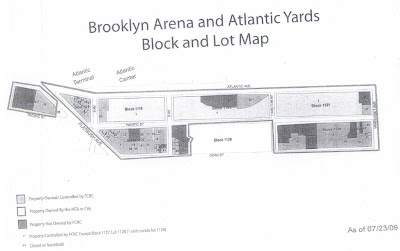
So, the deceptive ownership map of the Atlantic Yards footprint finally has been clarified, showing that a reasonable chunk of Block 1129, the southeast block, is not under the developer's ownership or control.
(Note the dark colors--indicating properly privately owned--in the northwest corner of that block, and compare it to the map at bottom, where dark colors indicate property under the developer's control. Click on graphics to enlarge.)
...The map above was distributed to ESDC board members at their September 17 meeting. I finally got a copy yesterday.

In City Hall: James's victory, Markowitz's salute, and the BP's embrace (again) of Bloomberg
City Hall (published by Manhattan Media, which, in surely a low point, produced Forest City Ratner's Brooklyn Standard "publication"), in its CHatter column, takes note of Atlantic Yards opponent Letitia James's victory over AY supporter Delia Hunley-Adossa.
...Surely Hunley-Adossa's Atlantic Yards stance didn't help her cause. There's clearly not a motivated electorate in the district ready to vote against James for her position on AY. But it's more than that: Hunley-Adossa was unwilling to appear frequently at public events or answer questions, and performed poorly in two debates.
...The next segment in the column shows James getting praised by Brooklyn Borough President Marty Markowitz for the largest margin of victory of any Council incumbent in the entire city.
And this morning City Hall reports that Markowitz is again endorsing Mayor Mike Bloomberg, despite grumbling that the mayor had shrunken the borough presidents' budgets. However, Markowitz has gotten lots of Bloomberg money for his concert series.
Markowitz likes to go with a winner, and surely he has read the polls that show Democratic candidate Bill Thompson way behind.
NoLandGrab: Brooklyn's Democratic standard-bearer has once again abandoned his party for Bloombucks. Of course, Bloomberg's orchestration of the term limits override handed Marty four more years.
Anthony Flint’s new book, Wrestling with Moses: How Jane Jacobs Took on New York's Master Builder and Transformed the American City, is well worth reading, as it fills in (and goes beyond) the missing chapter of Robert Caro’s epic biography of Moses, The Power Broker.
It contains two lively mini-biographies, coupled with accounts of major fights over a road through Washington Square Park. urban renewal in Greenwich Village, and the proposed Lower Manhattan Expressway (aka LoMex). The first fight helped shape Jacobs's thinking about urban renewal, published before her landmark 1961 book, The Death and Life of Great American Cities; the latter two she led, the second after she’d become a national figure.
My main quibble is simply with the scope of the book. Anyone wrestling with the legacies of Moses and Jacobs, especially after major retrospectives on both at museums in New York in 2007, must tackle the latter-day conflicts between their legacies: could Jacobs’s un-slumming--a version of gentrification--truly produce the low-income and affordable housing that cities like New York need, or was the wholesale clearance embraced by Moses the answer?
Or, in a different era, is there a different set of solutions? Author (and former Boston Globe reporter) Flint, to his credit, recognizes these issues, but, as I describe below, could’ve spent more time grappling with them.
Posted by eric at October 1, 2009 10:45 AM