« Hotel@MIT Name Now Le Meridien | Main | Re-think East Harlem project »
December 11, 2007
Daniel Doctoroff's Legacy
Gotham Gazette
By Tom Angotti
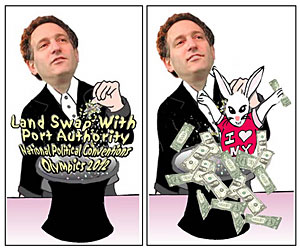 Mayor Bloomberg made the comparison between Deputy Dan Doctoroff and Robert Moses at last week's press conference announcing the Deputy Mayor's departure from city government. How do the two city planning czar's legacies compare?
Whatever Doctoroff’s accomplishments may be, the comparison to Moses is a stretch, and the talk of Doctoroff legacy premature by decades. Moses spent over half a century building public infrastructure while Doctoroff spent little more than a half-decade promoting mostly private commercial and residential development.
...
There is one major striking similarity between Moses and Doctoroff – they both claimed a monopoly on grand visions and overlooked the diverse ideas emerging from the city’s neighborhoods. Doctoroff reached out to civic leaders and neighborhood groups in a way that Moses never did. But rather than encouraging a two-way dialogue between City Hall and those who might oppose its decisions, Doctoroff's outreach usually resembled a public relations campaign to sell people on decisions that were already made. According to Greenpoint/Williamsburg community activist Phil DePaolo, when the city was pushing its waterfront zoning in that area, “Doctoroff met just with the groups that would get housing and not with others.”
NoLandGrab: Doctoroff might have gotten the strategy of meeting primarily with beneficiaries from Bruce Ratner, or maybe it's in a secret playbook somewhere.
Then there's the spectre of eminent domain and secondary displacement, which, like in the case of Robert Moses, could haunt Doctoroff's legacy for years to come:
By standing by without intervening, Doctoroff gave the city’s blessing to a number of major projects in which the Empire State Development Corporation, a state authority, promised to use its powers of eminent domain to bulldoze residential and industrial properties. Forest City Ratner’s Atlantic Yards project in Brooklyn and the Columbia expansion in West Harlem are the most notable of these projects. In Willets Point, Queens, the city itself proposes to use eminent domain to displace 225 businesses and 1,800 jobs in favor of a hotel, convention center, and giant commercial and residential complex. Any claims that Doctoroff promoted development without displacement must ignore the secondary displacement that occurs when large-scale private development forces rents and property values so high that people cannot afford to stay in their neighborhoods.
Posted by lumi at December 11, 2007 5:33 AM