« The Day (New London, CT) coverage of yesterday's oral arguments | Main | STADIUM ROW OVERSHADOWS NY BID »
February 23, 2005
High Court Takes Harder Approach With Attorney For Property Owners
Justices Grill Both Sides In NL Eminent Domain Case
By KATE MORAN
Day Staff Writer, New London
Published on 2/23/2005
Washington— U.S. Supreme Court justices gave spirited challenge to the claims of attorney Scott Bullock Tuesday that the city of New London trampled the constitutional rights of seven residents by condemning their houses to make way for development.
Bullock, a lawyer with the Institute for Justice, told the court that every house, church and corner store in the country will be at risk if governments like New London's can use eminent domain to replace modest neighborhoods with private businesses that would ostensibly help the public by producing more jobs and tax revenue.
Within moments, Justice Ruth Bader Ginsburg had interrupted him with a reminder that New London condemned the Fort Trumbull neighborhood not out of greed but to give its declining economy a shot in the arm.
“You're leaving out that New London is in a depressed economic condition,” Ginsburg admonished.
The justices aimed aggressive questions at each side in the Kelo v. New London case, but they seemed especially probing with Bullock, who was asking the court to break with precedent and restrict government's power to exercise its eminent-domain authority when the seized property would be turned over to a private developer.
In particular, they pressed him for a reason why the court should prevent the taking of land for economic development when it ruled in a 1954 case, Berman v. Parker, that governments can seize blighted property and transfer it to a developer who can build something clean and modern in its place.
“Do you want me to distinguish between blight and economic redevelopment?” Justice Anthony M. Kennedy asked. “Suppose an economist tells us an area is depressed, and if it continues for five more years, we'll have blight?”
The tough questions did not necessarily augur which way the court will lean, because they came from only six of the nine justices. Justice Clarence Thomas did not ask questions of either side. Chief Justice William H. Rehnquist, who has thyroid cancer, and Justice John Paul Stevens, whose flight back to the capital was cancelled, were absent, though both will vote in the final decision, expected by the end of June.
The Kelo case evolved more than five years ago, when city officials saw a chance to capitalize on Pfizer's decision to build its research headquarters in New London. Through its partner, the New London Development Corp., the city devised plans to replace the Fort Trumbull neighborhood with a hotel and office complex that would feed off the nearby pharmaceutical giant. When seven of the neighborhood's 90 residents refused to leave, the city took ownership of their houses by eminent domain.
Attorneys for the city have persuaded the courts in Connecticut that the taking was justified because its primary purpose was not to benefit Pfizer or another corporate entity, but to revive the local economy, improve the waterfront and help the public at large by generating jobs and tax revenue.
In questioning Wesley Horton, the attorney for the city, the justices explored whether governments might do more to compensate property owners when their land is taken for economic development. While the law requires governments to pay fair market value for seized property, several justices said such a sum does not atone for a property owner's sentimental loss or for the disruption to the household or business.
“You're paying for it, but you're also taking property from someone who doesn't want to sell,” Justice Antonin Scalia said. “That counts for nothing?”
Horton, of the Hartford firm Horton Shields & Knox, reminded the court that the issue at hand is whether the city of New London can take the Fort Trumbull property at all, not whether it paid the original owners enough money for it.
But Timothy Hollister, a Hartford land-use attorney who witnessed the oral arguments, ventured afterward that the justices pounced on the question of compensation as a way of determining whether abuses have crept into the system of taking private property.
“One way to get at that is to ask whether people are getting a fair amount of money for their homes,” Hollister said. “If so, maybe you don't need to fix the problem. But if the system is such that they can't, maybe there needs to be a tighter rein on agencies exercising eminent-domain authority.”
•••The Institute for Justice argued that such abuses do exist and will multiply if the Supreme Court allows governments to take property for economic development. Bullock said that such takings are particularly unpalatable because the promised benefits can evaporate if economic currents change.
“With economic development, the only public benefits, if they come about at all, are completely dependent on a private party making a profit,” Bullock said.
As a remedy for what Bullock called the “speculative” nature of economic-development takings, he urged the court to require proof, whether in the form of contracts or construction timetables, that a project has a reasonable certainty of success.
Several justices were skeptical that courts should be in the business of vetting economic development projects, a task that has traditionally fallen to legislative bodies. They also suggested that checks and balances already exist to prevent the epidemic use of eminent domain.
When Bullock had the floor, Justice Sandra Day O'Connor asked whether he knew of any academic research that showed takings for economic development are a frequent and growing threat to private property rights.
The question might have been a swipe at the Institute for Justice, a public interest firm with libertarian leanings that has launched a crusade in state courts and in the press against what it calls rampant abuse of eminent domain authority. Although the institute published a study that showed 10,000 pieces of land were taken by governments and transferred to private owners between 1998 and 2002 — a study cited in many news reports — Bullock did not allude to it before the court.
O'Connor also turned the question on Horton, asking him whether any controls prevent the government from uprooting one house or business to replace it with another that will generate greater tax revenue. Could a city remove a Motel 6, she asked, to make way for a Ritz Carlton?
Horton affirmed that it could, prompting a look of incredulity from several of the justices.
“You can take from A and give to B if B pays more taxes? You accept this?” Scalia wondered, as Kennedy piped in with a similar question.
Horton then made a distinction between the case at hand and a New Jersey case in which courts stopped a town from taking a house so Donald Trump could pave the land for a casino parking lot. Such a taking was primarily for the benefit of a private business, Horton said, and it did not purport to foster the healthy economic climate New London is trying to achieve with the Fort Trumbull redevelopment.
Several of the justices latched onto this line of thinking. Justice David H. Souter noted that courts already prevent government from condemning land to pander to politically connected developers.
“There isn't any question in this case that the city acted in good faith,” Souter said. “The city also didn't transfer from A to B without any object in mind. I can understand the need for some distinction between that case and what we have here.”
•••
Each side had only 30 minutes to make arguments before the court and parry the justices' questions. Horton, who spoke second, was ready to end his argument with a rhetorical crescendo when his clock ran out.
He told the justices he wanted to bundle his argument into four words they would remember, before he left them in limbo — and sent a ripple of laughter through the audience. Speaking to reporters after the hearing, Horton said the four pieces of wisdom were federalism, boundaries, discretion and precedent, all words that would encourage the court to stick with history and respect the rights of state courts and state legislatures to define proper uses of eminent domain.
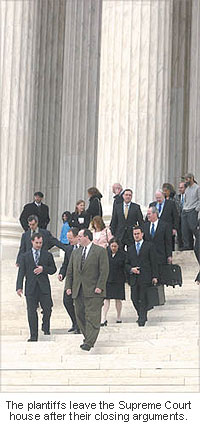
Horton, Bullock and a team of attorneys for each side filed onto the steps of the Supreme Court when arguments ended to field questions for the television cameras and to celebrate their work in the case that could define the limits of eminent-domain law for years.
As they mingled outside the court, attorneys who had watched the oral arguments were already buzzing about which side would prevail. A Web log, or online diary, that monitors the Supreme Court had predicted by 12:32 p.m., an hour after the arguments ended, that the court would come down resoundingly in favor of the city.
Hollister, the Hartford land-use attorney, also found little evidence that the justices were poised to place heavy restrictions on the way governments use eminent domain. But Benson Snaider, a New Haven land-use attorney who also attended the arguments, saw it differently.
“Justice O'Connor's remarks — can you take from a Motel 6 and give to a Ritz Carlton — I thought that was very incisive,” Snaider said. “That's the central issue here. Our entire country is based on the sanctity of private property, and I think the justices recognize that.”
© The Day Publishing Co., 2005
Posted by lumi at February 23, 2005 10:23 AM