« Similar Property Disputes Around The Nation | Main | Open Bidding May Erupt on West Side »
February 14, 2005
Final Brief Filed In Fort Trumbull Case
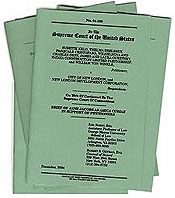 The Day:
Final Brief Filed In Fort Trumbull Case
Lawyers Take Last Step Before High Court Hears Oral Arguments On Eminent Domain
The Institute for Justice delivered its final brief in the Fort Trumbull eminent domain case to the U.S. Supreme Court on Friday, once again urging the court to limit the right of governments to take property from one private owner and hand it to another who can produce more jobs or tax revenue.
The brief is the second filed by the Institute for Justice and the final milestone in the case before oral arguments take place Feb. 22.
Final Brief Filed In Fort Trumbull Case
Lawyers Take Last Step Before High Court Hears Oral Arguments On Eminent Domain
By KATE MORAN Day Staff Writer, New London Published on 2/12/2005
New London — The Institute for Justice delivered its final brief in the Fort Trumbull eminent domain case to the U.S. Supreme Court on Friday, once again urging the court to limit the right of governments to take property from one private owner and hand it to another who can produce more jobs or tax revenue.
The brief is the second filed by the Institute for Justice and the final milestone in the case before oral arguments take place Feb. 22.
Attorneys for the firm used their last licks to convince the court that the rights of private citizens are in jeopardy so long as government has the authority to act as an all-powerful real estate broker that can force them out of their homes or businesses.
The Fifth Amendment of the U.S. Constitution gives cities and states the right to seize property for a “public use” as long as they provide “just compensation” to the displaced owner. At issue in the Fort Trumbull case is how far governments can stretch the definition of public use.
Attorneys for the New London Development Corp., the agency that condemned 15 properties in the Fort Trumbull neighborhood to usher in a hotel, rental housing and offices, argue in their brief that distressed cities like New London need the tool of eminent domain to facilitate projects that will benefit the public by generating the tax revenue needed to fund education, public safety and other government services.
As the Institute for Justice, the libertarian, public-interest law firm representing the Fort Trumbull residents, sees it, the public benefits that arise from economic development are too intangible and often too speculative to justify displacing people from their homes or businesses.
Attorneys for the institute claim the question turns on the integrity of the language of the U.S. Constitution. If public use can be construed to mean the general benefits that arise from ordinary commerce, they argue, the phrase is drained of all practical meaning.
“It must mean something other than ordinary private use,” the brief asserts. “On some fundamental, bedrock level, the examination of the meaning of the English term ‘public use' must inquire into the actual use to be made of the taken property and the extent, if any, to which such use is something that society associates with government activities, not just private profits.”
Attorneys for the NLDC had similarly used their brief to parse the public use clause of the Fifth Amendment, arguing that its primary intention was to ensure just compensation, not to create a narrow definition of public use.
In its 20-page brief, the institute urges the high court either to reject economic development as a public use or to require some proof, such as contracts with a developer, to ensure the benefits promised by a project have a reasonable certainty of coming to fruition. Because economic development is a riskier enterprise than, say, the building of a school, the institute says it wants some assurance that the sacrifice of home and business owners will not be for naught.
Ed O'Connell, an attorney for the NLDC, argued Friday that the institute is trying to use such a heightened scrutiny test to trap governments in an impossible position. If governments come ready with signed contracts, he said, they might be accused of improper collusion with developers to remove owners from their properties. If they have no contract, he added, the institute would deride their plans as too speculative.
“They want to put cities between a rock and a hard place,” O'Connell said.
The institute believes a failure to curtail the use of eminent domain will lead to open season on private property owners.
“Every home and every business, everywhere in the country, will be subject to condemnation if a local government prefers some other private party's use of property,” its attorneys wrote Friday in their brief.
The NLDC, on the other hand, argues that distressed and crowded cities like New London will lose out to suburban or rural towns, which can offer developers large chunks of vacant land for corporate campuses and other economic engines, unless they retain eminent domain as a tool to acquire land for redevelopment.
“Employing the power of eminent domain to revitalize a municipality's economy satisfies the public use requirement,” the NLDC attorneys wrote in their brief last month. “This is especially true in urban settings, in which the problem of land assembly often acts as a barrier to economic revitalization.”
Posted by lumi at February 14, 2005 8:38 AM